
The Grand Red Brick Heart of the Capital
Tokyo, Japan • Kingo Tatsuno, Architect • Opened 1914
At the precise geographic and symbolic heart of the world’s largest metropolitan area stands a building that looks, at first glance, as though it has been quietly transported from the streets of Amsterdam or London. Tokyo Station’s Marunouchi façade, red brick, white stone quoins, twin domed towers framing a central portico, belongs visually to the Meiji era’s enthusiastic embrace of European civic architecture. Step through its doors, however, and you enter a transport machine of staggering scale and complexity: the busiest Shinkansen terminal on Earth, a subterranean labyrinth of corridors and platforms serving dozens of rail lines, and a city within a city that processes nearly half a million passengers every single day.
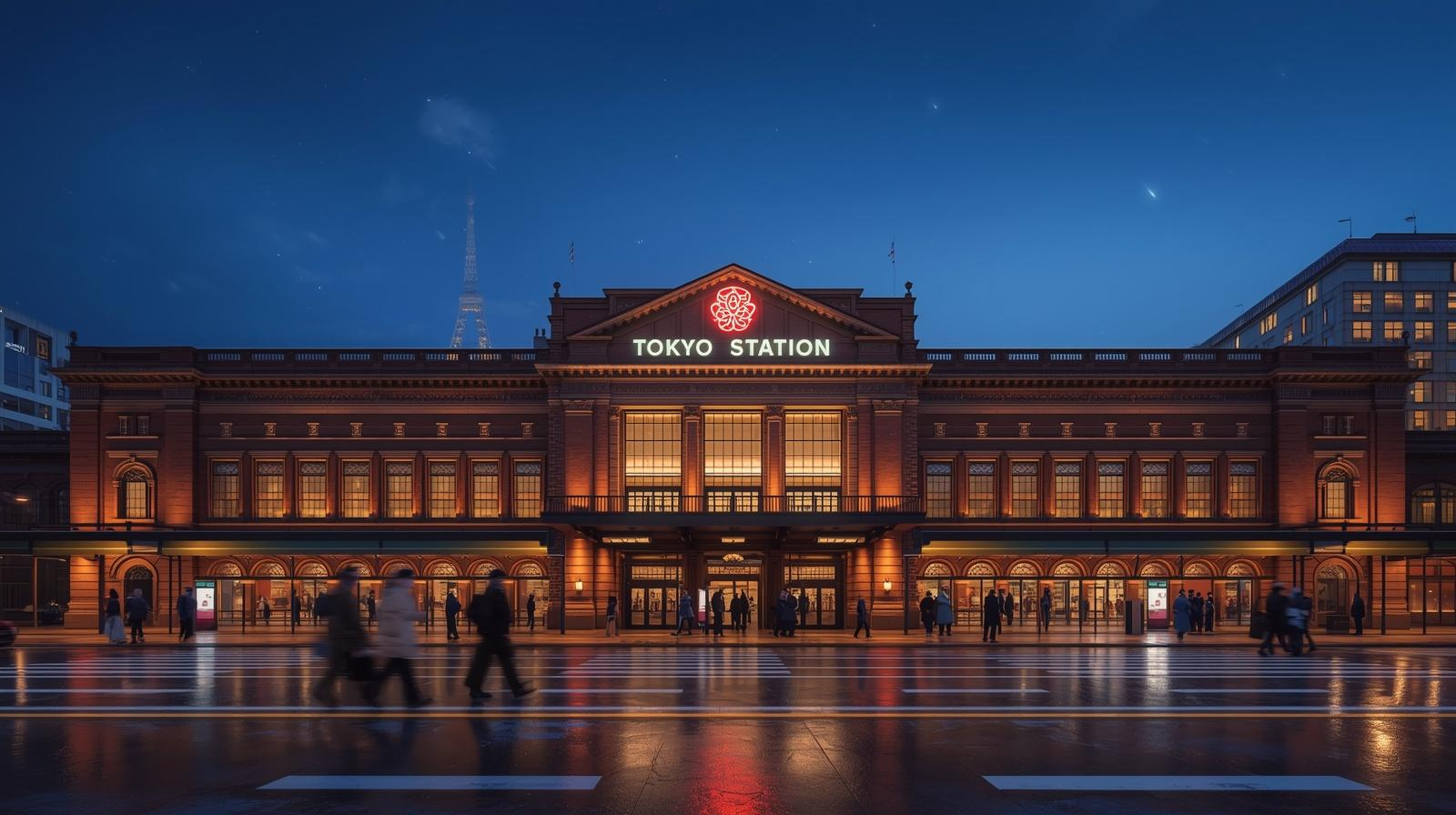
Tokyo Station is, in short, a paradox: one of the most lovingly preserved pieces of Meiji-era architecture in Japan, and simultaneously one of the most intensively used pieces of twenty-first-century infrastructure on the planet. To understand it is to understand something essential about Tokyo itself, a city that has perfected the art of holding opposites in productive tension.
At a Glance
| Location | 1 Marunouchi, Chiyoda, Tokyo, Japan |
| Opened | December 20, 1914 |
| Architect | Kingo Tatsuno (Marunouchi Building) |
| Restored | 2012 (full restoration of original Meiji façade) |
| Platforms | 30+ platforms (surface and underground) |
| Daily Passengers | Approx. 490,000–500,000 |
| Shinkansen Lines | Tokaido, Tohoku, Hokuriku, Joetsu, Yamagata, Akita, Hokkaido |
| Conventional Lines | JR Yamanote, Keihin-Tohoku, Chuo, Sobu, Yokosuka, Keiyo + more |
| Subway Access | Tokyo Metro Marunouchi Line (direct underground connection) |
| Connected Facilities | GranSta shopping, Kitte (former post office), JRTT Hotel Metropolitan, Palace Hotel proximity |
A History in Brick and Steel
The Meiji Vision
The story of Tokyo Station begins not with a building but with an idea: the idea that the capital of a newly modernising Japan required a central terminus worthy of a great nation. For much of the Meiji period (1868–1912), Tokyo’s rail network had grown organically and somewhat chaotically, with different lines terminating at different stations dotted across the city. Shimbashi, to the south, had been Japan’s first railway terminus since 1872. Ueno, to the north, served the lines heading into the Tohoku region. The two had no direct connection, and passengers wishing to travel between them had to change trains and cross the city by other means.
The proposal for a central station linking north and south was first formally articulated in the 1880s, but it was not until 1903 that the project gained full government approval, and not until 1908 that construction began in earnest. The site chosen was a tract of low-lying land in the Marunouchi district, immediately to the east of the Imperial Palace, a location that gave the new station a relationship with the seat of imperial power that was entirely deliberate and entirely political. The station and the palace would face each other across a broad boulevard, the one a symbol of modern industrial Japan, the other of ancient imperial continuity.
Kingo Tatsuno’s Design
The architect selected for the project was Kingo Tatsuno, one of the leading figures of Meiji-era Japanese architecture and a man who had studied in London under the Victorian architect William Burges before returning to Japan to help shape a new national architectural vocabulary. Tatsuno’s design for Tokyo Station drew heavily on the Dutch Renaissance Revival style, specifically the Central Station in Amsterdam, completed in 1889 by Pierre Cuypers, but synthesised it with Japanese elements and proportions to produce something that was neither straightforwardly European nor straightforwardly Japanese, but distinctly its own thing.
The original building, completed in 1914, was three storeys tall and featured the twin octagonal domed towers at each end of the Marunouchi façade that remain its most iconic elements today. The central section was marked by a grand arched entrance, and the entire structure was clad in red brick with white stone detailing materials and apalette that were, in the Tokyo of 1914, conspicuously modern and conspicuously international.
“A building that looks west across the world but bows east towards the Palace.” — Architectural historian, on Tatsuno’s design
War, Damage, and the Long Road to Restoration
Tokyo Station survived the devastating 1923 Great Kanto Earthquake largely intact, a testament to Tatsuno’s engineering, but fared less well in the Second World War. The firebombing raids of 1945 gutted the upper floors of the Marunouchi building and destroyed the original domed roofs of both towers, which were replaced in the post-war rebuilding with simplified, two-storey hip roofs that compromised the building’s original silhouette for more than six decades.
Plans to restore the station to its 1914 appearance were discussed for years but always deferred by cost and complexity. It was not until 2007 that a full restoration programme finally began, funded partly by a creative transfer-of-development-rights mechanism that allowed the unused air rights above the low-rise station building to be sold to developers of nearby high-rises. The restored station was unveiled in October 2012, its domes rebuilt in their original form, its brick facades cleaned and repaired, and its interior public spaces, particularly the spectacular barrel-vaulted ceilings of the two dome rooms, decorated with reliefs of the twelve zodiac animals and the eight compass-point imperial eagles, restored to something close to Tatsuno’s original vision.
The 2012 restoration was, by any measure, a triumph of civic ambition. It returned to Tokyo a piece of its own history that many had assumed was gone forever, and it transformed the Marunouchi façade back into one of the great urban set-pieces of the Japanese capital.
Architecture: The Old and the New
The Marunouchi Façade
The Marunouchi side of Tokyo Station, the western face, looking towards the Imperial Palace, is the historic heart of the complex and the face that appears on postcards, in films, and in the minds of most people when they picture the building. Stretching 335 metres from north to south, the red-brick façade is a masterpiece of Meiji civic architecture: symmetrical, confident, and decorated with a restrained richness that rewards close attention.
The two octagonal domed towers at the north and south ends of the façade are the building’s signature elements. Each tower rises through three full storeys and is capped by a slate-covered dome pierced by dormer windows, topped in turn by a copper lantern. The domes’ interior ceilings are painted in rich ochre and cream, adorned with plasterwork reliefs of the twelve signs of the Japanese zodiac. Standing inside and looking up, it is impossible not to be struck by the sheer ambition of the original design, and by how completely the 2012 restoration has returned it to its intended splendour.
At street level, the broad plaza in front of the Marunouchi façade, reorganised and enlarged as part of a major urban redevelopment completed in 2023, provides one of the finest urban viewpoints in Tokyo. With the station behind you and the Marunouchi business district’s glittering towers rising on either side, it offers a perspective on the city that encompasses both its Victorian foundations and its twenty-first-century ambitions in a single glance.
The Yaesu Side
The eastern façade of Tokyo Station, the Yaesu side, facing the business districts of Nihonbashi and Ginza, is a different architectural proposition entirely. Here, there is no brick, no dome, no Meiji nostalgia. The Yaesu face of the station is a product of Japan’s post-war reconstruction: a utilitarian, extensively reworked structure dominated by the glass-and-steel canopies of the Shinkansen entrance halls and the towers of the adjacent Granroof, a wave-form glass canopy by architect Kenji Naito, completed in 2013, which arches over the Yaesu central exit like a frozen breaking wave and gives the eastern approach its own kind of dramatic presence.
The contrast between the two faces is stark and, many would argue, entirely appropriate. Tokyo Station is not a building that pretends to a false unity. It is a palimpsest, a structure written over many times, each era leaving its mark, and the Yaesu side wears its modernity openly, without apology.
The Underground City
Below street level, Tokyo Station becomes something else again: a vast, interlocking network of underground concourses, shopping corridors, platform access tunnels, and transit connections that extends far beyond the footprint of the surface building and connects, through underground passages, to surrounding office towers, hotels, and the Tokyo Metro Marunouchi Line platforms.
The GranSta underground shopping complex, spread across multiple basement levels, is home to over 150 shops and restaurants, with a particular concentration of the ekiben (station bento box) vendors for which Tokyo Station is nationally famous. The range and quality of food available in the station’s underground levels, from Michelin-recommended ramen to artisan wagashi sweets, from fresh sashimi to imported wine, is a phenomenon that deserves an article of its own. Many Tokyo residents make deliberate pilgrimages to the station not to catch a train but simply to eat.
Shinkansen Hub: The Nerve Centre of Japan’s Rail Network
The Origin Point
Tokyo Station holds a unique place in the history of high-speed rail. On 1st October 1964, ten days before the opening of the Tokyo Olympics, the first Shinkansen service departed from Platform 19 at Tokyo Station, bound for Osaka’s Shin-Osaka terminus via the newly completed Tokaido Shinkansen. The journey that had previously taken six hours and forty minutes by conventional limited express was, from that day, achievable in four hours. Within a decade it would be reduced to three. The age of mass high-speed rail had begun.
That original departure point, Platform 19 at the southern end of the Shinkansen section, is marked today by a small commemorative plaque, easy to miss amid the daily flow of hundreds of thousands of passengers. It is worth pausing at if you can find it. Few places in Japan speak more quietly and more powerfully to the transformation of the country in the second half of the twentieth century.
Shinkansen Lines from Tokyo Station
Today, Tokyo Station serves as the terminus or origin point for more Shinkansen lines than any other station in Japan. The main lines are as follows:
| Tokaido Shinkansen | Tokyo → Shin-Osaka via Nagoya, Kyoto. Japan’s busiest high-speed corridor. Fastest (Nozomi): approx. 2 hrs 22 mins to Osaka. |
| Tohoku Shinkansen | Tokyo → Shin-Aomori via Sendai, Morioka. Backbone of northeast Japan’s high-speed network. |
| Hokkaido Shinkansen | Branches from Tohoku at Shin-Hakodate-Hokuto; continues to Hokkaido island. |
| Joetsu Shinkansen | Tokyo → Niigata. Connects the capital to the Sea of Japan coast in approx. 1 hr 40 mins. |
| Hokuriku Shinkansen | Tokyo → Kanazawa (extended to Tsuruga 2024). Connects the historic Hokuriku coastal region. |
| Yamagata Shinkansen | Mini-Shinkansen branch from Fukushima to Yamagata and Shinjo; runs through to Tokyo. |
| Akita Shinkansen | Mini-Shinkansen branch from Morioka to Akita; runs through to Tokyo. |
The Tokaido and Tohoku/Hokkaido/Joetsu/Hokuriku lines use separate platform areas within the station, the Tokaido platforms (14–19) in the south, the others (20–23) in the north, reflecting the fact that the two sets of lines use different track gauges and different signalling systems, and cannot interchange rolling stock.
*
The numbers associated with Tokyo Station’s Shinkansen operations are almost impossible to fully absorb. On a typical weekday, over 400 Shinkansen trains depart from or arrive at Tokyo Station. During peak holiday periods, the O-bon summer festival in August, the New Year period, the Golden Week holidays in late April and early May, that number rises sharply, and the platforms take on the organised intensity of a military operation: trains arriving, discharging passengers, being cleaned by the uniformed turnround crews (whose seven-minute platform turnaround is itself a minor legend of Japanese service culture), and departing again, all within a window of margins measured in seconds.
Seven minutes. That is all it takes for the white-uniformed osoji crew to clean a sixteen-carriage Shinkansen, rotate every seat, and prepare it for the next 1,300 passengers. Seven minutes, executed with a precision that borders on ceremony.
The JR Pass and Practical Access
For international visitors, Tokyo Station is the natural starting point for explorations of Japan by Shinkansen. The Japan Rail Pass, available to foreign tourists and covering the vast majority of JR services, including the Hikari and Kodama services on the Tokaido Shinkansen and all services on the Tohoku, Joetsu, Hokuriku, Yamagata, Akita, and Hokkaido lines, can be activated and seat reservations made at the JR East Travel Service Centre and JR Tokai Tours offices within the station.
It should be noted that the Nozomi and Mizuho services (the fastest trains on the Tokaido/San’yo corridor) are not covered by the JR Pass and require separate ticketing. For travellers holding a Pass who wish to travel to Kyoto or Osaka, the Hikari service, stopping at Nagoya, Kyoto, and Shin-Osaka, offers journey times only marginally longer than the Nozomi and represents excellent value.
Beyond the Shinkansen: Conventional Rail Connections
Tokyo Station’s Shinkansen facilities, extraordinary as they are, represent only a fraction of the station’s total rail operations. The station also serves as a major hub for conventional JR services, including the Yamanote Line (Tokyo’s iconic circular route linking the city’s main districts), the Keihin-Tohoku Line, the Chuo Line rapid and local services, the Sobu Line, the Yokosuka Line, and the Keiyo Line to Tokyo Disneyland and Chiba. The Tokyo Metro Marunouchi Line, accessible via underground connections, adds subway access to Shinjuku, Ikebukuro, and Ginza.
The combined effect is a station that connects, directly or via a single interchange, to virtually every corner of greater Tokyo and, by extension, to every major city in Honshu and beyond. It is not an exaggeration to say that Tokyo Station is the single most connected point in Japan’s rail network.
Visiting Tokyo Station: Practical Notes
Orientation
First-time visitors to Tokyo Station are routinely, and understandably, overwhelmed. The station has dozens of exits, multiple underground shopping levels, and a platform layout that seems designed to maximise confusion. A few basic orientation points help: the Marunouchi (west) side is the historic side, where the brick façade faces the Imperial Palace. The Yaesu (east) side faces the business districts of Nihonbashi and Ginza. The Shinkansen platforms (14–23) are in the southern and northern sections of the station’s main hall, clearly signed in English as well as Japanese.
The JR East Travel Service Centre, on the first basement level near the Marunouchi South exit, is the essential first stop for holders of the Japan Rail Pass: staff speak English and can activate passes, make seat reservations, and answer questions about routes.
What to See and Do at the Station
Beyond catching trains, Tokyo Station rewards leisurely exploration. The restored dome rooms, one at the north end of the Marunouchi concourse, one at the south, are among the finest interior spaces in Tokyo and are freely accessible to anyone passing through the ticket barriers. The Marunouchi Station Gallery, within the station building, hosts rotating exhibitions of art and design.
The GranSta underground shopping complex is justifiably famous for its ekiben, the elaborate, regionally specific bento boxes sold on Japanese station platforms, which reach their highest expression here. The ekiben shops at Tokyo Station stock boxes from across the country: crab rice from Hokkaido, wagyu beef from Kyushu, grilled eel from the Tokai region. Arriving an hour early for a Shinkansen specifically to browse the ekiben selection is a perfectly rational use of time.
The Kitte building, immediately adjacent to the Marunouchi South exit, in the former central post office, is worth a visit in its own right, with a rooftop garden that offers one of the best elevated views of the station’s brick façade and, on clear days, glimpses of the Imperial Palace beyond.
Getting There
From Haneda Airport: Tokyo Monorail to Hamamatsucho, then JR Yamanote or Keihin-Tohoku Line to Tokyo Station. Total journey approximately 40 minutes.
From Narita Airport: Narita Express (N’EX) direct to Tokyo Station in approximately 55–60 minutes. A single JR Pass covers this journey, making it one of the most compelling arguments for activating the Pass at the airport rather than waiting until the city.
Within Tokyo: Yamanote Line, Keihin-Tohoku Line, Chuo Line, Yokosuka Line, and Tokyo Metro Marunouchi Line all serve the station.
The Station and the City
There is a word in Japanese, ma, that refers to the pregnant pause between moments, the meaningful space between things. Tokyo Station, in its strange way, embodies ma on an urban scale. It stands between the old Japan and the new: between the brick and plaster of the Meiji era and the glass and steel of the Heisei and Reiwa periods; between the ceremonial stillness of the Imperial Palace grounds to the west and the frenetic commercial energy of the business district to the east; between the quiet of the restored dome rooms and the roar of a 16-car Shinkansen arriving on Platform 15 at 285 kilometres per hour.
To spend time in Tokyo Station, really spend time in it, rather than rushing through, is to inhabit that pause. To sit in one of the dome rooms and watch the light change on the vaulted ceiling. To stand on the Marunouchi Plaza at dusk and watch the brick façade catch the last of the day. To eat an ekiben on a Shinkansen departing northward into the Tohoku evening. These are not grand tourist moments. They are quiet ones. But they are, in their way, the moments that make a city legible.
Tokyo Station has been standing for over a century. It has survived earthquakes and firebombing and six decades with the wrong roof. It has been rebuilt, restored, expanded, and perpetually reinvented. It will, one suspects, outlast most of what surrounds it. It is, for all its complexity and its contradictions, exactly what a great city’s central station should be: a place that holds the whole city in miniature, and sends you outward into it with a sense of possibility.
— END —
Leave a Reply