
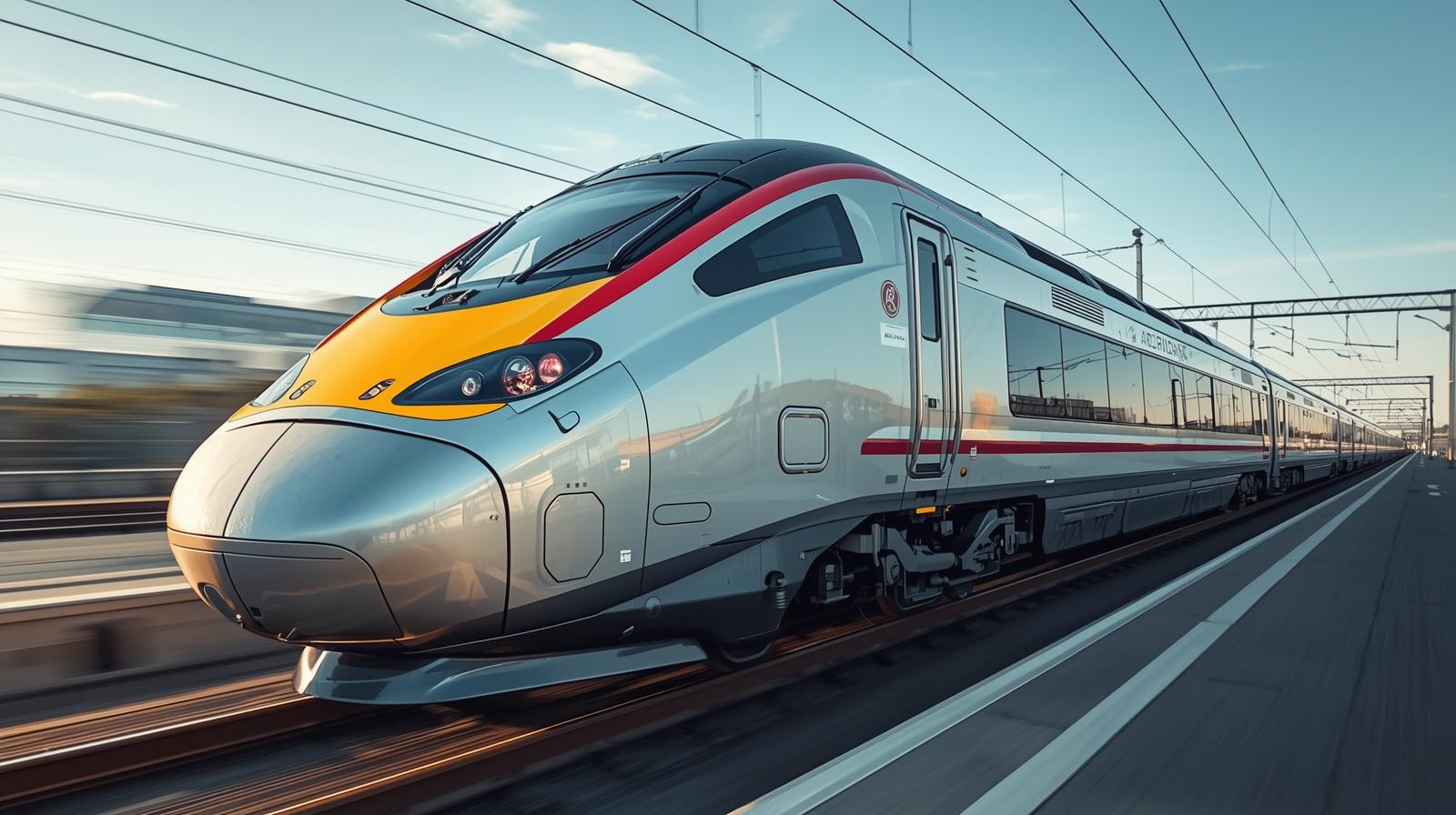
On 26th February 1981, a bright orange train streaked across the plains of Burgundy at 380 km/h, a world record for a wheeled vehicle on rails. It was a moment of pure theatre, engineered by a nation that had decided, with characteristic Gallic ambition, that it would build the fastest train on Earth. The Train à Grande Vitesse had announced itself. And France has never looked back.
A Crisis That Sparked a Revolution
The TGV’s origin story begins not with triumph, but with anxiety.
In the early 1970s, France faced an energy crisis that threatened its entire transportation strategy. The country was heavily dependent on oil, and the 1973 OPEC embargo sent shockwaves through its economy. Aircraft and cars were vulnerable to fuel price volatility. The government looked at its railways and asked a pointed question: could trains do more?
The answer came from a research programme that had been quietly running since the late 1960s. Engineers at SNCF, the French national railway, and at the manufacturer Alstom had been exploring the theoretical limits of conventional steel-wheel-on-steel-rail technology. Some in France had flirted with the idea of a gas-turbine-powered train, and a prototype called the TGV 001 was actually built with turbine engines. But the oil crisis made gas turbines suddenly unattractive. The project pivoted to electric traction, and the modern TGV concept was born.
The decision was also deeply political. President Georges Pompidou had backed a new high-speed line between Paris and Lyon, the most congested intercity corridor in France, and his successor Valéry Giscard d’Estaing pushed it forward. France was investing massively in nuclear power, which meant cheap, plentiful electricity was on the horizon. Electric high-speed rail suddenly made extraordinary economic sense.
Construction of the Ligne à Grande Vitesse (LGV) Sud-Est between Paris and Lyon began in 1976. On 27th September 1981, nine months after the record-breaking test run, the TGV entered commercial service.
Engineering the Machine
The TGV is a masterpiece of functional engineering, and several of its design choices were distinctly unorthodox.
Unlike the Japanese Shinkansen, which distributes traction motors across every carriage, the TGV concentrates its power in dedicated locomotive units at each end of the train, a configuration called an articulated set. The passenger carriages between them share bogies (the wheeled undercarriages), meaning adjacent carriages share a single bogie rather than each having its own. This reduces weight, lowers the centre of gravity, and crucially makes the train more stable at extreme speeds.
The articulated design has another quiet benefit: in the event of a derailment, the shared bogies keep carriages connected rather than allowing them to scatter independently, significantly improving safety outcomes.
The trains were designed to run on dedicated new lines, the LGV network, built to much gentler curves and gradients than conventional track, allowing sustained high-speed running. But unlike the Shinkansen, which is entirely separate from the conventional network, TGVs were engineered to run on ordinary track as well, allowing them to serve city centres directly without passengers needing to change trains.
This through-running capability was a masterstroke of practical design. A TGV from Paris could thunder down the LGV at 300 km/h, then glide onto conventional track and roll directly into the station at Marseille, Nice, or Bordeaux, no interchange required.
The Record Runs: Chasing the Impossible
Speed records are the glamorous face of railway engineering, and France has pursued them with particular relish.
The first world record came in 1955, before the TGV existed at all, French engineers pushed a specially modified electric locomotive to 331 km/h on a conventional line in the Landes region, a record that stood for over two decades. It was a demonstration of what was possible, and it planted a seed.
When the TGV programme matured, the record attempts became more systematic and more spectacular.
26th February 1981: A pre-production TGV set reaches 380 km/h on the LGV Sud-Est test track, setting a new world rail speed record and clearing the way for commercial service.
18th May 1990: The TGV Atlantique, a more powerful second-generation set, reaches 515.3 km/h on the LGV Atlantique near Vendôme. This shatters all previous records and remains a remarkable achievement even by today’s standards. The run used a specially configured five-carriage train with enlarged wheels, modified bogies, and increased power supply from the overhead lines. The track was prepared meticulously for weeks beforehand.
3rd April 2007: The TGV V150, named for its target speed of 150 metres per second, achieves 574.8 km/h on the newly built LGV Est line near Champagne. This remains the absolute world speed record for a conventional wheeled train. To achieve it, engineers fitted the three-carriage train with larger wheels (raising the carriage floor by 90mm), increased the overhead power supply to 31,000 volts, and ran on a specially prepared section of track with a favourable gradient. The bogies were modified, and the train was stripped of anything not essential to the record attempt.
The 574.8 km/h record is not merely a number on a certificate. It represents something profound about the physics of steel-on-steel traction, proof that conventional rail technology, refined and pushed to its absolute limit, can achieve speeds that were once the exclusive domain of aircraft.
Commercial Service: Changing How France Moves
Records are one thing. The everyday miracle of the TGV is another.
When commercial service began on 27th September 1981, the Paris–Lyon journey shrank from almost four hours to two hours and forty minutes. The effect on demand was immediate and dramatic. SNCF had projected modest growth in passenger numbers, but within months, it was clear they had fundamentally underestimated the appeal. The trains are full. Airlines operating the Paris–Lyon route found themselves in a fight they could not win.
As the LGV network expanded outward from Paris, south to Marseille, west to Bordeaux and Nantes, north to Lille and the Channel Tunnel, east to Strasbourg and beyond, city after city was drawn into the TGV web. Journey times that had once made day trips impractical became routine. Bordeaux, once a five-hour journey from Paris, was brought within two hours when the LGV Sud-Atlantique opened in 2017.
The effect on air travel has been decisive. On routes where the TGV can compete, typically where rail journey times fall below three hours, it captures the overwhelming majority of passengers. On the Paris–Lyon route, the TGV carries around twenty-five times more passengers than aircraft. France has deliberately leveraged this, with the government restricting short-haul domestic flights in 2023 on routes where fast train alternatives exist.
Eurostar and the International Dimension
No account of the TGV would be complete without the Channel Tunnel.
When the tunnel opened in 1994, it created something genuinely new in the world: a high-speed rail link between the British Isles and continental Europe. The Eurostar, a stretched, modified TGV designed for the tunnel’s unique technical requirements, began carrying passengers between London, Paris, and Brussels.
At its peak, the Eurostar reduced the London–Paris journey to two hours and fifteen minutes from St Pancras. For millions of travellers, it replaced the flight entirely. The train became a byword for a certain kind of effortless European mobility, boarding in the heart of London, stepping off in the heart of Paris.
The TGV’s technology also spread across Europe in different forms. The German ICE, Spanish AVE, Italian Frecciarossa, and Belgian Thalys all drew on the lessons France had learned. The Euroduplex, a double-deck TGV, extended the concept further, carrying up to 1,020 passengers per train on the busiest routes.
The Human Story Behind the Speed
Behind every speed record and every timetable innovation is a community of engineers, drivers, and technicians for whom the TGV represents something personal.
The record run on 3rd April 2007, was meticulously planned over months. Track inspectors walked every metre of the test section. Engineers ran calculations on wheel profiles, aerodynamic drag, and pantograph stability at speeds no human had experienced from the cab of a train. The driver, Eric Pieczak, practised the run dozens of times in simulation before the record attempt itself. When the TGV V150 crossed 574.8 km/h, the team in the control room erupted, decades of accumulated engineering knowledge, validated in a single extraordinary minute.
The culture at SNCF and Alstom has always combined hard-nosed pragmatism with a genuine love of the machine. French engineers speak about the TGV with a pride that goes beyond professional satisfaction. It is, in many ways, a national project, a demonstration that France can do something brilliantly, and do it first.
Environmental Credentials
In an era of mounting concern about carbon emissions, the TGV occupies an increasingly important position in the transport debate.
France generates most of its electricity from nuclear power, which means TGV journeys carry an exceptionally low carbon footprint per passenger, studies. Studies have consistently found that a Paris–Marseille TGV journey produces roughly fifty times fewer carbon emissions per passenger than the equivalent flight.
As European governments look for ways to reduce aviation’s environmental impact, the case for high-speed rail grows stronger. The EU’s push for expanded rail connectivity across the continent, with ambitious targets for doubling high-speed rail traffic by 2030, is in large part a response to what France demonstrated across four decades: that people will choose trains if trains are fast, comfortable, and competitively priced.
The Next Chapter
The TGV is now over forty years old as a commercial service, and it is evolving.
Alstom’s TGV M, branded as Avelia Horizon, entered service in 2024. It is designed to be more energy-efficient, more modular, and more accessible than its predecessors, with wider doors, improved passenger information systems, and a reduced environmental footprint during manufacture. Crucially, the number of seats has been increased without sacrificing comfort.
The broader LGV network continues to expand. New lines are planned or under construction to better connect southern France, the Alps corridor, and cross-border routes into Spain and Italy. The vision of a seamlessly connected European high-speed rail network, with Paris at its hub, is slowly being realised.
Conclusion
The TGV is, at its heart, a story about what happens when a country makes a decision and follows through with it completely.
France decided in the 1970s that it would have the world’s best high-speed railway. It built new infrastructure, developed new technology, trained new generations of engineers, and created a culture of operational excellence that has made the TGV one of the most admired railways anywhere on Earth. The speed records are the headline, but the real achievement is the hundreds of millions of journeys made every year, on time, in comfort, and with a carbon footprint that no aircraft can match.
When that bright orange prototype tore across Burgundy at 380 km/h in February 1981, it was doing something more than chasing a record. It was proving a point. And in the decades since, France has never stopped making it.
Leave a Reply