
TREADING THE BOARDS
PART 2 · opera houses
Chapter 12
Naples’ Royal Opera
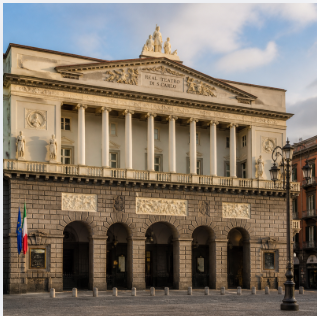
The Teatro di San Carlo in Naples is one of the most important opera houses in the history of European music. Founded in the eighteenth century under Bourbon rule, it is the oldest continuously operating opera house in the world. Long before Milan’s La Scala or Venice’s La Fenice became synonymous with Italian opera, the San Carlo established Naples as one of Europe’s foremost musical capitals. Over nearly three centuries, it has witnessed the evolution of opera from the age of the Enlightenment through the Romantic era and into the modern world. Its history is closely connected with royal patronage, architectural innovation and the careers of some of opera’s greatest composers, including Rossini, Donizetti and Verdi.
The Vision of King Charles VII
The origins of the San Carlo lie in the ambitions of King Charles VII of Naples, known later as Charles III of Spain. When Charles came to the throne of Naples in 1734, he sought to transform the city into one of the great capitals of Europe. His reign marked a period of urban development, artistic patronage and cultural renewal.
Naples was already one of the largest cities in Europe, with a thriving musical tradition and a renowned conservatory system that trained composers and performers from across the continent. Charles believed that the city deserved an opera house reflecting its political importance and royal prestige. Rather than merely refurbishing existing theatres, he commissioned the construction of an entirely new royal opera house adjacent to the Royal Palace.
The project was intended not only to entertain the court but also to demonstrate Bourbon power and sophistication. In an age when rulers used architecture and culture to proclaim their authority, the new theatre was designed as a statement of royal magnificence.
Giovanni Antonio Medrano and Angelo Carasale
The realisation of the king’s vision depended upon two remarkable figures: the architect Giovanni Antonio Medrano and the theatre entrepreneur Angelo Carasale.
Medrano, a Spanish military engineer and architect, was responsible for the theatre’s design. He conceived a grand structure that combined practicality with elegance. Unlike many earlier performance venues, the theatre was built specifically for opera, with acoustics carefully considered from the outset.
Carasale oversaw the practical execution of the project and played a crucial role in organising the venture. His experience as a theatre impresario ensured that the building would meet both artistic and commercial needs.
Construction proceeded at extraordinary speed. Work began in March 1737, and the theatre was completed in only a matter of months. On 4th November 1737, the feast day of Saint Charles Borromeo, the theatre officially opened. The new opera house was named the Teatro di San Carlo in honour of both the saint and its royal founder.
The achievement astonished contemporary Europe. The theatre was larger, more luxurious and more technologically advanced than nearly any of its rivals.
An Architectural Masterpiece
When the San Carlo opened, it was widely regarded as the finest opera house in Europe. The auditorium featured six tiers of boxes arranged in a horseshoe shape, a design that would become standard in Italian opera houses.
The royal box dominated the interior, emphasising the central role of the monarchy in the institution’s life. Rich decorations, gilded ornamentation and elegant proportions created an atmosphere of splendour that impressed visitors from across Europe.
The theatre’s acoustics quickly became legendary. Musicians and audiences praised the clarity of the sound, and this reputation continues today. Even after numerous restorations, the San Carlo remains renowned as one of the world’s finest spaces for operatic performance.
Royal Patronage and Bourbon Naples
Throughout the eighteenth century, the San Carlo flourished because of sustained royal support. The Bourbon monarchy regarded opera as an essential element of court culture and public prestige.
The theatre received generous funding and attracted some of the leading composers, singers and librettists of the age. Operas commissioned for Naples often premiered at the San Carlo before travelling elsewhere in Europe.
This patronage helped establish Naples as one of the leading centres of Italian opera. Alongside Vienna, Paris and London, the city became a destination for musicians seeking fame and opportunity.
The influence of the theatre extended far beyond southern Italy. Its productions shaped operatic trends throughout Europe, while many of its performers enjoyed international careers.
Fire and Rebirth
One of the most dramatic events in the theatre’s history occurred in 1816 when a devastating fire destroyed much of the building.
The loss was a cultural catastrophe for Naples. Yet the monarchy acted swiftly. King Ferdinand I ordered the reconstruction of the theatre, which was entrusted to the architect Antonio Niccolini.
Remarkably, the rebuilt theatre reopened within less than a year. Niccolini preserved the essential character of the original building while incorporating improvements that enhanced both safety and comfort.
The reconstructed auditorium became one of the defining masterpieces of nineteenth-century theatre architecture and remains largely intact today.
Rossini and the Golden Age of Bel Canto
The nineteenth century marked a new golden age for the San Carlo. At the centre of this flourishing stood Gioachino Rossini, one of the greatest opera composers in history.
In 1815 Rossini was appointed musical director of the royal theatres in Naples. His arrival transformed the city into one of the most vibrant centres of Italian opera.
During his Neapolitan years, Rossini composed several major works for the San Carlo, including Otello, Armida, Mosè in Egitto and La Donna del Lago. These operas demonstrated a new level of dramatic sophistication and vocal brilliance.
The exceptional singers available in Naples encouraged Rossini to push the boundaries of operatic composition. His works demanded unprecedented technical skill, helping to define the bel canto tradition that dominated Italian opera during the first half of the nineteenth century.
The relationship between Rossini and the San Carlo elevated both composer and theatre to new levels of international prestige.
Donizetti and Romantic Opera
Following Rossini’s success, the San Carlo became closely associated with another giant of Italian opera: Gaetano Donizetti.
Donizetti worked extensively in Naples and maintained a long connection with the theatre. During the 1820s and 1830s he produced a remarkable succession of operas that expanded the emotional and dramatic possibilities of the art form.
Works such as Maria Stuarda, Roberto Devereux and Lucia di Lammermoor demonstrated his gift for melody and psychological depth. His operas reflected the growing influence of Romanticism, with their emphasis upon intense emotions, tragic conflicts and historical settings.
For Donizetti, Naples offered an ideal environment in which to develop his artistic vision. The city’s audiences were knowledgeable, demanding and deeply passionate about opera. Success at the San Carlo could establish a composer’s reputation throughout Europe.
Verdi and the Maturity of Italian Opera
No account of the San Carlo would be complete without considering the influence of Giuseppe Verdi, whose career transformed nineteenth-century opera.
Although Verdi’s closest associations are often linked with Milan, Naples and the San Carlo played an important role in his artistic development. The theatre staged numerous productions of his works and contributed significantly to their dissemination among Italian audiences.
Verdi inherited the traditions established by Rossini and Donizetti but expanded opera into a more powerful dramatic form. His music combined memorable melodies with profound emotional expression and sophisticated characterisation.
Works such as Rigoletto, Il Trovatore, La Traviata, Don Carlos and Aida found enthusiastic audiences in Naples. The San Carlo became one of the leading stages through which Verdi’s masterpieces entered the international repertory.
By the late nineteenth century, Verdi had come to symbolise Italian culture itself, and the San Carlo remained one of the principal temples in which his music was celebrated.
The San Carlo in the Modern Era
The twentieth century brought challenges, including wars, political upheaval and changing artistic tastes. Yet the San Carlo continued its operations and maintained its prestige.
Careful restoration projects preserved its historic character while incorporating modern technology. Today, the theatre remains an active cultural institution, presenting a wide range of operas, ballets and concerts.
Many of the world’s leading conductors, directors and singers continue to appear on its stage. The theatre’s orchestra and chorus remain among Italy’s most respected musical ensembles.
As Naples has evolved into a modern European city, the San Carlo has remained one of its defining landmarks and an enduring symbol of its artistic heritage.
A Living Monument to Italian Opera
The history of the Teatro di San Carlo mirrors the history of Italian opera itself. Founded by a visionary monarch, designed by gifted architects and sustained by royal patronage, it became a centre of artistic innovation whose influence spread across Europe.
From the ambitions of King Charles VII and the architectural genius of Giovanni Antonio Medrano and Angelo Carassale, through the triumphs of Rossini, Donzietti and Verdi, the theatre has played a central role in shaping the operatic tradition. Nearly three centuries after its opening, the San Carlo remains not merely a historic building but a living institution where the great traditions of Italian music continue to flourish.
It stands today as one of the supreme monuments of European culture, a theatre in which the history of opera can still be heard, seen and experienced in the very place where much of that history was made.
Leave a Reply