
The Building That Changed Architecture
Part III — The Great Opera Houses of the World | 20
Introduction
Of all the opera houses in the world, only one is recognised instantly by people who have never set foot inside it. The Sydney Opera House, with its great white shells rising from the edge of the harbour, has become the symbol of a city and a nation, and one of the most photographed buildings on earth. It is also the most radical opera house ever built. Where the great theatres of Europe and the Americas looked back to the Renaissance and the Baroque, Sydney looked forward, challenging architects and engineers to build something that had never been built before.
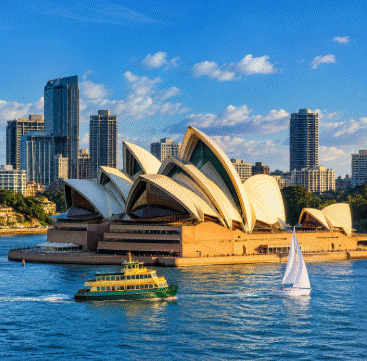
Its story is one of brilliance and bitterness: an inspired design by a young Danish architect, an extraordinary engineering challenge, a bitter dispute with the government that paid for it, and a long-delayed reconciliation. This article follows that story from the competition of the 1950s to the opening in 1973 and the building’s life as a modern performing arts centre.
A Harbour Site and a Postwar Dream
Bennelong Point, the narrow headland jutting into Sydney Harbour, has been important to its people for far longer than the opera house. It lies on the traditional lands of the Gadigal people of the Eora nation, and takes its name from Woollarawarre Bennelong, an Aboriginal man who became a notable figure in the early years of the British colony. In the twentieth century the point was occupied by a tram depot, Fort Macquarie, a Victorian-era building that was an obvious candidate for redevelopment.
*
The idea of a great performing arts centre for Sydney took shape after the Second World War. The English conductor Eugene Goossens, who led the Sydney Symphony Orchestra, argued passionately that the city needed a proper concert hall and opera house, and he found a powerful ally in the premier of New South Wales, Joseph Cahill. Cahill, a Labour politician of working-class background, saw the project as a way to bring high culture to the people and to give Sydney a landmark of international stature. In 1955 the state government announced an international competition.
The Architectural Competition
The competition was open to architects around the world, and the brief called for a building with two halls: a large one for opera and concerts, and a smaller one for drama and chamber music. A total of 233 entries arrived from 32 countries. The jury consisted of four assessors, including the celebrated Finnish-American architect Eero Saarinen, who had recently designed the TWA Terminal in New York.
According to the well-known account, Saarinen arrived after the others had begun and, going through the rejected entries, pulled out a set of drawings that had been dismissed as impractical. They were the work of Jørn Utzon, a young Danish architect then in his late thirties and little known outside Scandinavia. Saarinen recognised their quality at once and persuaded his fellow jurors. In January 1957 Utzon’s scheme was announced as the winner. The jury’s report praised it as a design of great originality, though it admitted that it was only a sketch, and its engineering had hardly been considered.
Jørn Utzon
Jørn Utzon (1918–2008) was born in Copenhagen and grew up in a family connected with ships and boat design, which perhaps explains his lifelong feeling for the sea. He trained in Copenhagen, worked for a time with the Swedish architect Gunnar Asplund and the Finnish master Alvar Aalto, and travelled widely, studying the monuments of Mexico, the traditional houses of Japan, and the architecture of the Mediterranean. He was deeply interested in the idea that a building should grow organically out of its setting and tradition.
For Sydney he proposed a stepped platform, inspired in part by the ancient Mayan temples he had seen in Mexico, on which the halls would sit like sculptural forms, with great sail-like roofs soaring above them. People have compared the shells to yachts on the harbour, to billowing sails, to the petals of a flower, or to the segments of a peeled orange. Utzon himself later explained that the shapes could be derived from a single sphere, which is a clue to how the design was eventually made buildable. Whatever its inspiration, the idea was visionary: a building that was a landscape as much as a structure.
Government Patronage and Funding
The Sydney Opera House was, above all, a state project. The New South Wales government under Cahill took responsibility for the competition and for the financing, and the project was supported by the federal government and the public. Much of the cost was raised by an ingenious device: a special state lottery, the Opera House Lottery, which sold tickets to the public and provided the bulk of the funding. In this way, ordinary Australians helped to pay for a building that was designed for the arts.
The early estimates proved wildly optimistic. The original budget was about seven million Australian dollars, with an expected completion in the early 1960s. In the end the building cost about 102 million dollars and took until 1973. Part of the reason lay in the political pressure to begin before the design was finished: Cahill, aware that the project could be lost if the political climate changed, pushed construction to start in 1959, long before the engineering problems had been resolved.
Solving the Shells: A Feat of Engineering
Utzon’s sketches were beautiful, but no one knew how to build the roofs. The shells had a complex, free-form curvature that could not be calculated with the methods of the day. The engineering firm Ove Arup and Partners, led by Ove Arup and including the young engineer Peter Rice, worked with Utzon for years on the problem, trying a series of different geometries and testing them with some of the earliest uses of computers in structural design.
The breakthrough, achieved in the early 1960s, was the so-called spherical solution. Utzon and the engineers realised that all the shells could be formed from sections of a single sphere, in the way that segments can be cut from an orange. This allowed the roof to be made from standardised prefabricated concrete ribs, which could be manufactured and assembled in sequence. The shells were then covered with more than a million glazed tiles, in glossy white and a matt cream, made in Sweden and laid in patterns so that the roofs glitter in the sun and take on different colours through the day. It was one of the great engineering achievements of the century.
Construction Controversy
The expense and the delays gave rise to growing political controversy. In 1965 the state government changed, and the new ministers, led by the Minister for Public Works, Davis Hughes, took a much harder line. They questioned the costs, challenged the architect’s methods, and began to withhold payments. Utzon, who had moved to Sydney with his family to supervise the work, found himself increasingly unable to proceed. The conflict centred on money, authority, and the design of the interiors, which had not yet been fully resolved.
In February 1966 Utzon resigned, declaring that he could no longer carry out the work. The reaction in Sydney was one of public outrage: demonstrators marched in his support, and the press carried bitter debate. But Utzon left Australia in April 1966, and he never returned to see his building completed. The task of finishing it fell to a team of Australian architects led by Peter Hall, with Lionel Todd and David Littlemore. They redesigned the interiors, including the great halls, in a manner that departed significantly from Utzon’s intentions. The glass walls and the plywood interiors that Utzon had planned gave way to different solutions, and the proposed use of the two main halls was changed, so that the larger hall became a concert hall and the smaller one the opera theatre.
Opening in 1973
The Sydney Opera House was formally opened by Queen Elizabeth II on 20th October 1973, fourteen years after construction had begun. The first public performance had taken place a few weeks earlier, in September 1973: Prokofiev’s epic opera War and Peace, staged by the Australian Opera in the new opera theatre. The opening celebrations included a concert in the new Concert Hall by the Sydney Symphony Orchestra with the great Swedish soprano Birgit Nilsson.
Utzon was not present at the opening, and his name was reportedly not mentioned in the official ceremonies, a slight that remained a source of pain for him and for many Australians. Yet, despite the controversy, the public immediately took the building to its heart.
Opera and Modern Performance
Today the complex contains several venues. The Concert Hall, the largest, seats around 2,600 people and is the home of the Sydney Symphony Orchestra. It contains one of the world’s largest mechanical-action pipe organs, built by the Australian organ-builder Ronald Sharp and completed in 1979. The opera theatre, renamed the Joan Sutherland Theatre in 2012 in honour of the great Australian soprano, seats around 1,500 and is the main stage for Opera Australia and the Australian Ballet. Smaller venues, including the Drama Theatre, the Playhouse, and the Studio, host theatre, dance, and new work.
Dame Joan Sutherland, one of the finest coloratura sopranos of the twentieth century, gave her final opera performance at the Opera House in 1990, singing in Meyerbeer’s Les Huguenots. Opera Australia presents a full season of classics and new productions, and its outdoor spectacle Handa Opera on Sydney Harbour, staged on a floating platform in front of the building, has brought opera to a still wider public. Alongside opera, the House hosts the Sydney Symphony, the Sydney Theatre Company, Sydney Dance Company, contemporary music, comedy, and festivals, including the annual Vivid Sydney festival, when the sails are lit with projected images, and Aboriginal and Torres Strait Islander arts and stories are celebrated through programmes and light projections.
The building has not been without its practical drawbacks. The orchestra pit in the opera theatre is small, and the acoustics of the Concert Hall have long been debated. In recent years extensive renewal programmes have improved the sound and the facilities of the main halls, as part of the effort to keep the House up to date.
Reconciliation and Recognition
In the decades that followed, the bitterness began to ease. In the 1990s the Opera House Trust approached Utzon, and he agreed to act as a consultant on the future of the building, producing a set of design principles to guide its care. Work began on restoring parts of the interior to his vision, and in 2004 the Utzon Room, a reception space with a large tapestry designed by the architect, was opened. Utzon was awarded the Pritzker Architecture Prize, the profession’s highest honour, in 2003, with the Opera House cited as his masterpiece. He died in 2008 without ever having seen the completed building in person.
In 2007 the Sydney Opera House was inscribed on UNESCO’s World Heritage List, one of the few buildings to be so honoured within the lifetime of its architect. The citation described it as a masterpiece of twentieth-century architecture.
Key Dates
| Year | Event |
| 1955 | New South Wales government launches an international design competition |
| 1957 | Jørn Utzon’s design is chosen from 233 entries |
| 1959 | Construction begins at Bennelong Point |
| 1961 | The “spherical solution” resolves the geometry of the shells |
| 1966 | Utzon resigns and leaves Australia |
| 1973 | Opened by Queen Elizabeth II on 20 October |
| 1979 | Grand Organ completed in the Concert Hall |
| 2003 | Utzon awarded the Pritzker Architecture Prize |
| 2007 | UNESCO World Heritage listing |
| 2008 | Utzon dies |
| 2012 | Opera theatre renamed the Joan Sutherland Theatre |
Conclusion
The Sydney Opera House changed architecture because it proved that the impossible could be built. It showed that a bold artistic vision, supported by daring engineering and public ambition, could produce a building that belonged to no tradition and yet was loved by millions. It also showed the costs of such ambition: an architect driven from his greatest work, a budget that ballooned, and years of controversy. Yet the building that emerged from the struggle is now regarded as one of the supreme achievements of the twentieth century. In its shells, rising like sails above the harbour, the city of Sydney found a symbol of itself, and the world found a new idea of what an opera house could be.
Leave a Reply