
Introduction
There are museums that contain a nation’s art, and there are museums that are themselves works of art. The Rijksmuseum in Amsterdam is, without question, the second kind. Rising above the Museumplein in a great mass of red brick, terracotta, turrets, and towers, it is one of the finest public buildings in the Netherlands, a monument whose scale, ambition, and decorative richness are matched only by the extraordinary collection it was built to house. To stand before its facade and look up at the towers and the elaborate gabled roofline is to understand, immediately, that this is a building with something to say, about Dutch history, Dutch art, Dutch national identity, and the remarkable century that produced it.
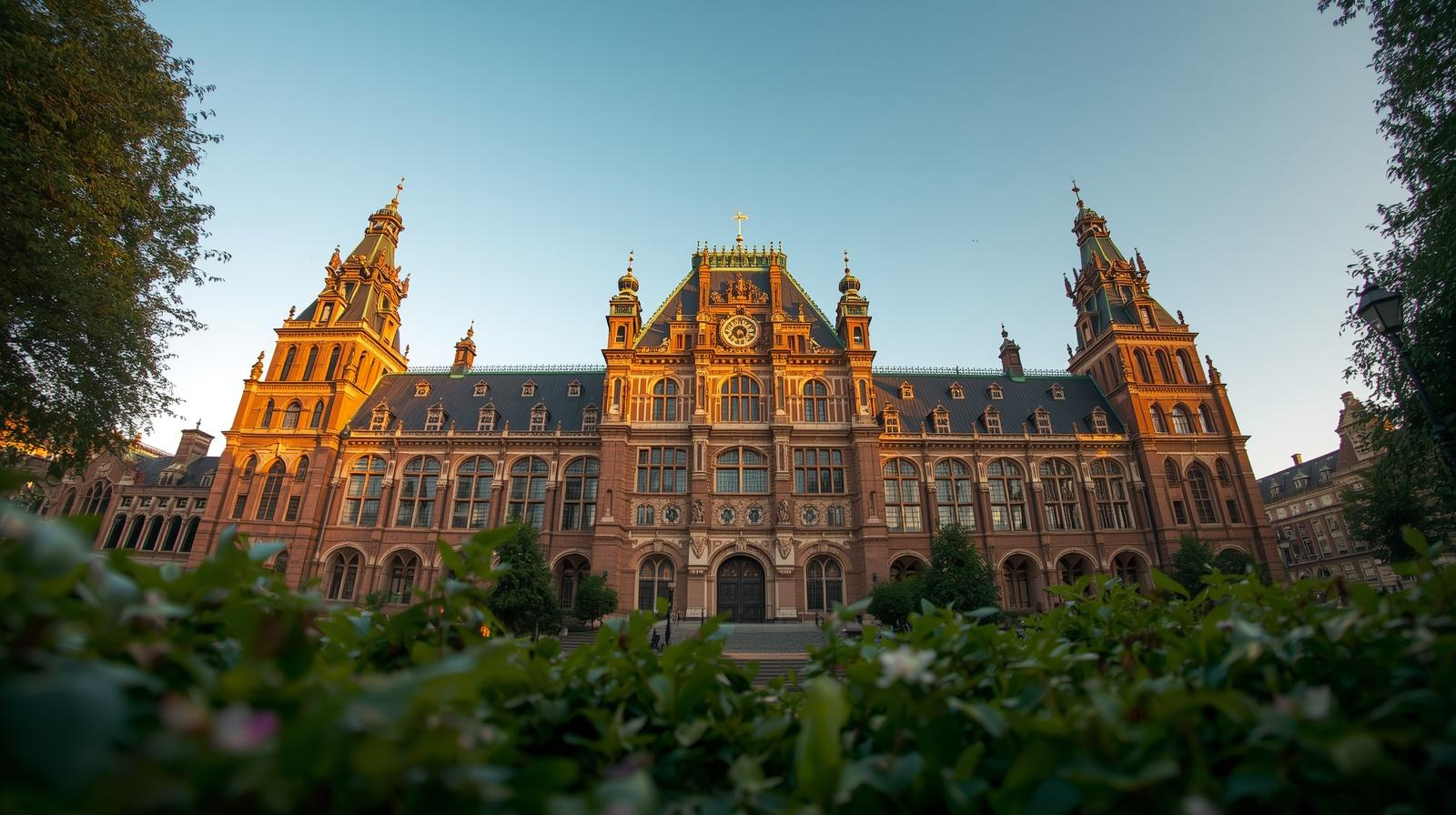
The Rijksmuseum is the national museum of the Netherlands, and its collection is among the greatest in the world. It holds more than one million objects spanning eight centuries of Dutch and Flemish art and history, including works by Rembrandt van Rijn, Johannes Vermeer, Frans Hals, Jan Steen, and Jacob van Ruisdael, the supreme masters of the Dutch Golden Age whose paintings defined a new mode of seeing the world and whose influence continues to radiate outward through the history of Western art. Rembrandt’s The Night Watch alone, hanging in its own dedicated gallery at the heart of the building, would be sufficient to make the Rijksmuseum one of the essential cultural destinations on earth.
But the Rijksmuseum is not merely a container for masterpieces. It is itself a masterpiece, an architectural achievement of the first order, designed by one of the nineteenth century’s most gifted and prolific architects, and restored in the early twenty-first century with a sensitivity and skill that have given it a second life every bit as distinguished as its first.
Origins: The Need for a National Museum
The idea of a national museum for the Netherlands was not born with the building that now houses it. The origins of the Rijksmuseum go back to 1800, when the Nationale Kunstgalerij (National Art Gallery) was established in the Huis ten Bosch palace in The Hague, under the rule of the Batavian Republic. This was part of a broader European movement, driven by the French Revolution and the Napoleonic reorganisation of European culture, in which national collections were assembled and made accessible to citizens rather than remaining the private possessions of monarchs and aristocrats.
Under the reign of King Louis Napoleon, Napoleon’s brother, who ruled the Netherlands as a client kingdom from 1806 to 1810, the collection was moved to Amsterdam and established in the Royal Palace on Dam Square, the magnificent seventeenth-century town hall that had been converted into a palace. Here it was opened as a public museum under the name Koninklijk Museum (Royal Museum), and for the first time the citizens of Amsterdam could see the great works of Dutch art assembled together.
This arrangement was always understood to be temporary. The Royal Palace was simultaneously a royal residence and a museum, an uncomfortable combination, and as the collection grew through the nineteenth century it became increasingly clear that a purpose-built home was needed. The debate over where to build it, and what it should look like, occupied Dutch cultural and political life for decades.
A site was eventually agreed upon on the southern edge of the city, on a piece of open ground that would become the Museumplein, the Museum Square around which Amsterdam’s principal cultural institutions would gradually cluster. A competition was held in 1863, and after considerable controversy and revision, the commission was awarded to Pierre Cuypers, the architect who would go on to define the visual character of modern Amsterdam.
The Architect: Pierre Cuypers
Pierre Cuypers (1827–1921) was the most important Dutch architect of the nineteenth century and, arguably, the most influential single figure in the history of Dutch architectural identity. Born in Roermond in the predominantly Catholic southern Netherlands, he studied in Antwerp before establishing his practice and becoming the pre-eminent designer of Catholic churches in the Netherlands, a country deeply divided between its Protestant north and Catholic south, and in which the church-building commissions of the southern tradition gave Cuypers decades of practice in the Gothic and neo-Gothic styles that would inform all of his work.
Cuypers was a student and admirer of the great French architectural theorist Eugène Viollet-le-Duc, whose writings argued that the Gothic style was not merely a historical curiosity but a rational, structurally honest architecture whose principles could be applied to the buildings of the modern age. Cuypers absorbed this lesson deeply, and his buildings, while rooted in historical precedent, are always structurally coherent and functionally considered. He was not a pasticheur; he was an architect who believed that the Dutch and Flemish Renaissance tradition offered a living vocabulary for contemporary building.
His appointment to design the Rijksmuseum was controversial in ways that reflected the deep religious and political tensions of nineteenth-century Dutch society. Cuypers was Catholic; the Netherlands was a predominantly Protestant country with a strong Calvinist tradition that looked with some suspicion on the ornate, image-rich architecture of Catholic Europe. When Cuypers’s design was unveiled, critics complained that the building looked too much like a Catholic church, that its pointed arches, its towers, its richly decorated surfaces were inappropriate for a secular national institution. King William III, who would open Amsterdam Centraal, Cuypers’s other great Amsterdam building, in the same year, reportedly dismissed the Rijksmuseum as a cathedral and refused to set foot inside it.
These criticisms were not entirely without foundation. Cuypers was a deeply religious man, and his architectural vision was shaped by his faith. But they also reflected a misunderstanding of what he was trying to do: not to build a church, but to create a building that expressed, through the full richness of the Dutch and Flemish architectural tradition, the depth and seriousness of the national heritage it was to house.
The Design: Architecture as National Statement
The Rijksmuseum was designed between the mid-1860s and the late 1870s, with construction beginning in 1876 and the building opening to the public on 13th July 1885, inaugurated by King William III. The design that emerged from Cuypers’s office was one of the most complex and richly conceived public buildings of the nineteenth century, a building in which every element, from the overall massing to the smallest carved detail, was part of a coherent programme of meaning.
The Approach and Setting
The building occupies a prominent site on the Museumplein, facing north towards the city centre across the long open rectangle of the square. Its principal facade is encountered from the north, and the approach, whether on foot across the square, by bicycle, or by tram, offers one of the great urban architectural experiences in the Netherlands: a long, gradually clarifying view of the building that allows the full complexity of its facade to be absorbed progressively as one draws closer.
The building is set slightly back from the street and elevated on a low podium, giving it a quiet sense of ceremony without the aggressive monumentalism of some of its European contemporaries. It is a building that invites rather than intimidates, though the scale, once one is close to it, is genuinely impressive.
The Facade and Massing
The main facade of the Rijksmuseum extends approximately 170 metres in width and is organised around a strong central axis, with two tall corner towers anchoring the ends of the composition and a prominent central section rising to a great stepped gable above the main entrance. The building is constructed in red brick with extensive dressings of natural stone and terracotta, the warm, reddish-gold palette that Cuypers used consistently in his work and that gives the building its characteristic visual warmth and richness.
The central section of the facade is the most elaborate, rising through multiple registers of arched windows and decorative panels to the great gable above. The gable is one of the building’s most celebrated features: stepped and curved in the Flemish Renaissance manner, its surface is alive with carved stone ornament, including the national coat of arms of the Netherlands, the lion of the House of Orange, displayed prominently as a declaration of the building’s civic and national character.
The two towers that rise at each end of the facade are closely related to, but subtly different from, those of Amsterdam Centraal: slightly taller, slightly more elaborate, with more complex profiles and richer terracotta decoration. Each tower carries a large clock face, a feature that connects the Rijksmuseum to the practical world of time and civic life, a reminder that this is a public building serving the people of Amsterdam rather than a private sanctuary of art.
The Passage: A Street Through the Building
One of the most distinctive and debated features of the Rijksmuseum is the passage, a public thoroughfare that runs through the centre of the building at ground level, connecting the Museumplein on the north side to the streets and canals on the south. This passage, which passes beneath the main body of the building through a vaulted tunnel of extraordinary beauty, was part of Cuypers’s original design and reflected a principle that was central to his thinking: the museum should not be a barrier between the city and its citizens, but a public space through which the life of the city could flow.
The passage is one of the great surprises of the Rijksmuseum. Approaching from the north, one enters through a pair of enormous arched gateways into a vaulted space of considerable elegance, the walls lined with Delft-blue tiles depicting scenes from Dutch history and art, the ceiling vaulted in brick and stone, the floors of polished stone. It is a space of quiet, meditative beauty, quite different in character from the grand exhibition halls above, and it has been a beloved feature of the Amsterdam cityscape since the building opened.
The passage was controversially closed during the long renovation of the early twenty-first century, and its reopening, after considerable debate and some modification, was one of the most celebrated aspects of the 2013 restoration.
The Decorative Programme
If there is a single aspect of the Rijksmuseum’s design that most clearly distinguishes it from the conventional museum buildings of its era, it is the extraordinary richness and intentionality of its decorative programme, the comprehensive scheme of paintings, sculptures, tiles, mosaics, and carved ornament that covers virtually every surface of the building and tells, collectively, the story of Dutch art and history.
Cuypers conceived the building not merely as a container for art but as a work of art in itself, a Gesamtkunstwerk, a total work of art in the Wagnerian sense, in which architecture, decoration, and collection would form a unified whole. Every room, every corridor, every facade was part of this programme, and the decorations were designed in close collaboration with art historians and cultural advisers to ensure that they accurately and comprehensively represented the Dutch cultural heritage.
The exterior terracotta panels depict scenes from Dutch history, portraits of artists, craftsmen, and scholars, allegorical figures representing the arts and sciences, and images of the trades and industries that had made the Dutch Republic prosperous. These panels were designed by Cuypers and executed by specialist craftsmen, and they give the building’s exterior a narrative density that rewards extended attention.
The interior decorations are even more elaborate. The principal galleries and corridors are lined with painted friezes depicting Dutch historical scenes, portraits of artists, and allegorical compositions. The entrance hall and the Gallery of Honour, the great central axis of the building that leads to The Night Watch Gallery, are particularly rich, with painted lunettes, decorative tilework, carved stone capitals, and painted ceilings that create an environment of immersive cultural richness. Walking through the building is not merely an experience of looking at pictures; it is an experience of being inside a comprehensive statement about Dutch civilisation and its achievements.
The Delft blue tiles of the passage, already mentioned, are perhaps the most immediately recognisable element of the decorative programme, a direct reference to one of the great traditions of Dutch decorative art, made in a medium that connects the building to the craftsmanship of the Golden Age.
The Great Hall and Gallery of Honour
The Gallery of Honour (Eregalerij) is the spine of the building, the great central corridor that runs from the entrance through the heart of the museum to The Night Watch Gallery at its far end. It is one of the most magnificent interior spaces in the Netherlands: a long, relatively narrow gallery of considerable height, its walls lined with the greatest masterpieces of Dutch painting, its ceiling carried on pointed arches that echo the Gothic vocabulary of the exterior, its floor of polished stone, and its overall atmosphere one of hushed, concentrated grandeur.
The Gallery of Honour was designed to function as a processional route, a deliberate progression from the entrance of the museum to its culminating masterpiece, The Night Watch, which hangs in its own purpose-built gallery at the end of the axis. The paintings on either side of the gallery, works by Vermeer, Hals, Steen, Ruisdael, and their contemporaries, are hung as they were in Cuypers’s original installation, at a height and spacing that reflects nineteenth-century ideas about the proper presentation of art but that has been sensitively maintained in the restoration.
The Collection: A Golden Age in Paint and Object
Any account of the Rijksmuseum must engage, however briefly, with the extraordinary collection it houses, because the building and the collection are inseparable, each giving meaning and context to the other.
The Dutch Golden Age
The core of the Rijksmuseum’s collection is the art of the Dutch Golden Age, the seventeenth century, when the Dutch Republic was the most prosperous and commercially dynamic nation in Europe, and when Dutch painting reached a peak of achievement that has never been surpassed. This was the age of Rembrandt, Vermeer, Hals, and their contemporaries, artists who transformed the possibilities of painting by looking at the world with unprecedented directness and skill, and who created an art of daily life, of light and shadow, of human presence and ordinary beauty, that remains as vivid and immediate today as it was three hundred and fifty years ago.
The Night Watch (De Nachtwacht, 1642) by Rembrandt van Rijn is the building’s, and arguably the nation’s, supreme treasure. This enormous painting, measuring approximately 3.6 by 4.4 metres, depicts a militia company led by Captain Frans Banninck Cocq preparing to march out, and it is one of the most technically accomplished and emotionally powerful paintings ever made. The deployment of light and shadow, the sense of movement and life in the figures, the psychological individuality of each face, all these qualities have ensured that The Night Watch occupies a unique place in the cultural imagination not just of the Netherlands but of the world. It has its own gallery, purpose-designed to display it at the end of the Gallery of Honour, and even in a building full of masterpieces it stops visitors in their tracks.
Vermeer’s contributions to the collection, including The Milkmaid (De Melkmeid, c.1657–1658) and The Love Letter, represent the other pole of Golden Age achievement: intimate, luminous, suffused with a quality of light and stillness that is entirely his own. Vermeer painted slowly and produced relatively few works, and the Rijksmuseum’s holdings represent a significant proportion of his known output.
Frans Hals, Jan Steen, Jacob van Ruisdael, Pieter de Hooch, the collection is, in the field of seventeenth-century Dutch painting, simply without parallel anywhere in the world.
Beyond the Golden Age
The collection extends well beyond the Golden Age. Medieval art, decorative arts, Delftware, silverware, furniture, costumes, and historical artefacts span eight centuries of Dutch material culture, and the Asian collection, assembled through the Dutch East India Company’s extensive trade networks, is one of the finest outside Asia. The museum holds approximately 8,000 objects from Asia, including extraordinary pieces of Chinese porcelain, Japanese lacquer work, and artefacts from across the Dutch colonial world.
The collection of Dutch and Flemish decorative arts is particularly important. The Rijksmuseum holds outstanding examples of Delft blue-and-white earthenware, Dutch silver, furniture from the Golden Age, and the applied arts of subsequent centuries, a comprehensive record of Dutch material culture and craftsmanship that complements the paintings and provides context for the broader story the museum tells.
Controversy, Closure, and the Long Renovation
The Rijksmuseum’s history is not one of uninterrupted triumph. The building’s second century was marked by a prolonged period of institutional difficulty and, eventually, by one of the most extensive and controversial museum restorations in European history.
Decline and the Problem of the Building
By the mid-twentieth century, the Rijksmuseum was facing the pressures that afflict all great Victorian buildings that have been intensively used for a century without fundamental reconstruction. The building’s services, heating, lighting, humidity control, fire protection, were inadequate by modern standards; the visitor circulation was confusing and cramped; the storage and conservation facilities were poor; and the decorative interiors, never well maintained, had deteriorated significantly.
Various proposals for modification and expansion were made over the decades, and some changes were implemented, not always with sensitivity to Cuypers’s original vision. By the 1990s it was clear that a comprehensive renovation was needed, and in 2003 the museum was closed to the public to allow a full-scale restoration to begin.
The Renovation: 2003–2013
The renovation that followed was one of the most ambitious and lengthy museum restorations ever undertaken. It took ten years and cost approximately 375 million euros, more than three times the original budget, and it was accompanied by constant controversy, public debate, and institutional conflict.
The principal architects chosen for the restoration were the Spanish firm Cruz y Ortiz, who won the commission in an international competition. Their brief was to restore Cuypers’s building to something close to its original character while simultaneously modernising the infrastructure, improving visitor facilities, and resolving the many circulation and spatial problems that had accumulated over a century of use.
The most contentious element of the renovation was the question of the passage, the public thoroughfare through the centre of the building. A bicycle association had established the right of cyclists to pass through the building, and the negotiation over whether and how the passage could be modified became a symbol of the broader tensions between heritage preservation, civic rights, and institutional needs. The eventual solution, which maintained the passage as a public space but reconfigured its relationship to the museum, satisfied no one entirely but managed to preserve the essential character of Cuypers’s original conception.
The restoration involved an extraordinarily detailed programme of conservation and repair: the brick and terracotta of the facades were cleaned and restored, the decorative programmes of the interiors were researched, documented, and where necessary reinstated, the tile work of the passage was conserved, and the painted friezes and lunettes of the galleries were cleaned and stabilised. Rooms that had been subdivided or modified over the decades were returned to their original proportions, and Cuypers’s spatial sequence, from entrance to Gallery of Honour to The Night Watch, was restored to something close to his original intention.
The new underground facilities, cloakrooms, ticketing, a large temporary exhibition space, and a museum shop, were inserted beneath the entrance courtyard in a manner designed to be archaeologically invisible from above, preserving the historic character of the building while providing the practical infrastructure that a modern institution requires.
The Reopening: 2013
The restored Rijksmuseum reopened on 13th April 2013, inaugurated by King Willem-Alexander in one of the most celebrated cultural events in recent Dutch history. The reaction was, by any measure, extraordinary. Visitors queued for hours; critics praised the restoration as a triumph; the building, returned to something close to Cuypers’s original vision, was almost universally recognised as one of the finest museums in the world.
The restoration had, in the end, achieved something remarkable: it had preserved and enhanced the architectural integrity of a great Victorian building while making it fully functional as a twenty-first-century institution. The Gallery of Honour, restored to its full height and luminosity, was particularly celebrated, the paintings rehung, the decorative friezes cleaned and legible, the space restored to the processional grandeur that Cuypers had intended.
Visitor numbers in the years following the reopening reflected the building’s renewed appeal. The Rijksmuseum now attracts approximately 2.5 million visitors per year, making it one of the most visited museums in Europe.
The Twin Buildings: Rijksmuseum and Amsterdam Centraal
No account of the Rijksmuseum is complete without addressing its architectural relationship with Amsterdam Centraal, the railway station that Pierre Cuypers designed in the same decade and which opened in the same year, 1889, on the opposite side of the city.
The two buildings are architectural twins: both built in red brick with terracotta and stone dressings; both featuring tall towers with pointed roofs; both organised around strongly symmetrical facades with rich decorative programmes; both drawing on the Dutch and Flemish Renaissance tradition; and both conceived as monuments to Dutch national identity at a moment when the Netherlands was asserting its cultural self-confidence after decades of relative cultural and political uncertainty.
The resemblance between the buildings is so strong that Amsterdammers have long used it as a source of gentle comedy, the station where you leave your bicycle, the museum where you leave your coat, but the relationship between them is also deeply significant. Cuypers was not repeating himself; he was elaborating a vision. The Rijksmuseum and Amsterdam Centraal together constitute a single architectural statement about what the Netherlands was and what it aspired to be: a nation with deep historical roots in the trading and maritime traditions of the north, a rich artistic heritage rooted in the Golden Age, and a confident sense of its own identity that could be expressed in stone and brick and terracotta for all to see.
Together, the two buildings define the visual character of modern Amsterdam more than any other structures. They are the bookends of the city’s self-image, the places where Amsterdam introduces itself to the world.
Legacy: A Museum for the Ages
The Rijksmuseum’s legacy is multiple and layered, operating simultaneously at the level of architecture, cultural institution, and national symbol.
As a work of architecture, it is Pierre Cuypers’s masterpiece, the building in which his gifts as a designer, his mastery of historical precedent, his commitment to craft and ornament, and his capacity for thinking at the largest scale all came together in a single, sustained achievement. The building is listed as a rijksmonument, a national listed monument, and it is one of the defining works of Dutch architectural history.
As a cultural institution, the Rijksmuseum is the guardian of the Dutch national heritage, not merely of paintings and objects, but of a particular way of seeing the world that was invented in the Netherlands in the seventeenth century and that has shaped the history of art ever since. The museum’s collection is irreplaceable; its interpretation of that collection, developed and refined over more than two centuries of scholarship and curatorial practice, is one of the great intellectual achievements of the modern museum world.
As a national symbol, the Rijksmuseum occupies a place in Dutch cultural life that is difficult to overstate. It is the place where the Dutch Golden Age is most fully and accessibly represented; where Rembrandt and Vermeer can be encountered in conditions that do justice to their work; and where the full complexity and richness of Dutch civilisation, its art, its history, its decorative traditions, its global reach, can be experienced in a single afternoon. For millions of visitors from the Netherlands and around the world, the Rijksmuseum is the place where the Netherlands makes its most powerful and eloquent case for its own significance.
The restoration of 2013 gave the building a second century that will, one hopes, be as distinguished as its first. The Rijksmuseum stands today as it has always stood: not merely as a museum, but as Holland’s house of memory, the place where the nation keeps its greatest treasures and tells its most important stories.
Key Facts at a Glance
Location: Museumstraat 1, Amsterdam, Netherlands
Founded: 1800 (as Nationale Kunstgalerij, The Hague)
Opened in current building: 13 July 1885
Architect: Pierre Cuypers (1827–1921)
Construction period: 1876–1885
Architectural style: Dutch neo-Renaissance / Gothic Revival — Cuypers style
Building dimensions: Approximately 170 metres wide
Reopened after restoration: 13 April 2013
Restoration architects: Cruz y Ortiz (Spanish firm)
Restoration cost: Approximately 375 million euros
Restoration duration: 2003–2013 (10 years)
Listed status: Rijksmonument (Dutch national listed monument)
Collection size: Over 1 million objects
Key works: The Night Watch (Rembrandt, 1642); The Milkmaid (Vermeer, c.1657–58); The Merry Drinker (Frans Hals, 1628–30)
Annual visitors: Approximately 2.5 million
Architectural twin: Amsterdam Centraal Station (same architect, same year, same style)
Leave a Reply