
Opera and European Culture
Part III — The Great Opera Houses of the World | 16
Introduction
Geneva is not the first city one thinks of when listing the great capitals of opera. It is better known for Calvin and the Reformation, for banking and watchmaking, for the Red Cross and the League of Nations. Yet on the Place de Neuve, beside the green slopes of the Parc des Bastions, stands a theatre whose history tells us a great deal about the city’s character: the Grand Théâtre de Genève. Opened in 1879, nearly destroyed by fire in 1951, and rebuilt and renewed in the decades since, it has been the principal home of opera and ballet in French-speaking Switzerland and a meeting point for the musical life of Europe.
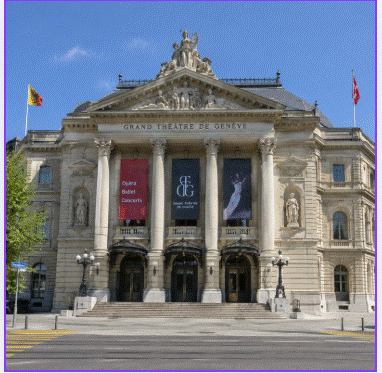
This article follows the theatre from its unlikely beginnings in a city once suspicious of the stage, through its architecture and the patrons who made it possible, to its role in Geneva’s identity as an international city of ideas.
A City Suspicious of the Stage
For much of its history, Geneva was an unpromising place for theatre. After the Reformation of the sixteenth century, when the city under John Calvin became a model of Protestant discipline, public entertainments such as plays were viewed with suspicion and often restricted. The city’s moral authorities worried that the stage encouraged idleness and vice.
The most famous statement of this attitude came from a native son. Jean-Jacques Rousseau, born in Geneva in 1712, published his Letter to d’Alembert on the Theatre in 1758, arguing against the establishment of a theatre in his home city, which he believed would corrupt its republican simplicity. The irony is rich: Rousseau was himself a composer, and his short opera Le Devin du village (1752) was one of the great successes of its age. Meanwhile Voltaire, who lived in the neighbourhood of Geneva in the 1750s and 1760s, staged plays at his estates and helped to undermine the city’s resistance. Gradually attitudes softened, and a permanent theatre, the Théâtre de Neuve, opened in 1782, though it was a modest building in comparison with what was to come.
The Patrons: A Duke’s Legacy and a City’s Ambition
By the second half of the nineteenth century, Geneva had grown into a prosperous and cosmopolitan city. The old fortifications were being dismantled, opening up space for new boulevards, hotels, and public buildings. The city’s leaders and wealthier citizens wanted cultural institutions to match its growing international stature.
A remarkable piece of good fortune helped to make this possible. Charles II, Duke of Brunswick, a deposed German ruler who had spent his later years in exile, died in Geneva in 1873 and left his considerable fortune to the city, on condition that it build him a splendid monument. The Brunswick Monument, modelled on the medieval Scaliger tombs of Verona, still stands beside the lake. The legacy, however, was far greater than the cost of the tomb, and it helped the municipality to finance major public works, including the new theatre. Public subscription, municipal funds, and the support of Geneva’s cultural societies completed the picture, making the Grand Théâtre a civic enterprise rather than a royal or aristocratic one. This was a significant difference from the court opera houses of Vienna, Dresden, or St Petersburg: it belonged to the citizens.
Architecture: A Geneva Echo of the Paris Opéra
The architect chosen for the new house was Jacques-Élysée Goss, a Geneva-born architect who had trained in the tradition of the Parisian Beaux-Arts. Goss was already known for his work on grand hotels, notably the Hôtel National, later to become the first headquarters of the League of Nations, and he brought to the theatre the confident monumentality of late nineteenth-century French design.
Its model was clearly the Paris Opéra of Charles Garnier, completed only a few years earlier. Like its Parisian cousin, the Grand Théâtre has a richly ornamented neoclassical façade with columns, sculpture, and decorative details celebrating music and drama, a generous grand foyer for the pageantry of the interval, and a horseshoe-shaped auditorium designed to display the audience as much as the stage. Scaled to a smaller city, it is considerably more compact than Garnier’s palace, but it shares the same belief that an opera house should be a civic monument as well as a theatre.
Construction took place from 1874 to 1879, and the building was inaugurated on 3rd October 1879 with a performance of Rossini’s Guillaume Tell, a choice that neatly tied the opening to the Swiss national legend. The original auditorium, with its gilded decoration and painted ceilings, held about 1,500 spectators.
Opera at the Grand Théâtre
From the start the Grand Théâtre looked to Paris for much of its repertory, and French grand opera and opéra comique, Gounod, Bizet, Massenet, and Meyerbeer, formed a staple of its programme, alongside the Italian works of Rossini, Verdi, and Puccini. Productions were often given in French, in keeping with the city’s language, and the house became a regular stop for touring companies and visiting artists from France, Italy, and Germany.
A decisive step in the theatre’s musical life came in 1918, when the conductor Ernest Ansermet founded the Orchestre de la Suisse Romande in Geneva. The orchestra, which has long served as the resident orchestra for opera performances at the Grand Théâtre, brought a new standard of musicianship to the house. Ansermet, a close associate of Stravinsky, championed contemporary music, and the Geneva stage and concert hall became a place where the twentieth-century avant-garde was presented to Swiss audiences. The city also gave its name to the Geneva International Music Competition, founded in 1939, which has launched many singers and instrumentalists.
In the later twentieth century and since, the theatre has presented a wide range of repertory, from Mozart, Wagner, and Strauss to Britten and contemporary works, and has been known for adventurous directors and designers. It has also staged works by Swiss composers, among them the Geneva-born Frank Martin, and maintains its own ballet company.
Geneva’s Cultural Identity
The Grand Théâtre cannot be understood apart from Geneva’s special position. A small republic, long a refuge for exiles and religious refugees, the city had a tradition of welcoming foreigners and ideas that made it unusually international for its size. In 1863 Henry Dunant’s humanitarian ideas led to the founding of the Red Cross there; after the First World War, the League of Nations made Geneva the capital of world diplomacy, and it has remained a centre of international organisations ever since.
This cosmopolitan context has shaped the opera house. Its audience includes Genevans, residents of French-speaking Switzerland, French neighbours from across the border, and an international community of diplomats and officials. Its programming looks both to the French tradition, the cultural language of the city, and to the wider European repertory. In that sense the Grand Théâtre is a stage on which Geneva presents itself as a place of exchange, where Protestant seriousness, French refinement, and international openness meet.
Fire and Restoration
On 1st May 1951, a fire swept through the theatre, destroying the stage and the original auditorium. The façade and parts of the structure survived, but the interior that audiences had known for seven decades was lost. For a city so proud of its theatre, it was a serious blow, and performances had to move to other venues while debate continued about how to rebuild.
The rebuilding took more than a decade. Rather than recreate the Victorian auditorium, the city chose a modern interior behind the historic exterior, with a new auditorium of about 1,500 seats and up-to-date stage machinery. The theatre reopened in 1962. Although some lamented the loss of the old gilded interior, the new house was admired for its sight lines and acoustics, and it allowed Geneva to compete with larger opera houses in the technical quality of its productions.
The twenty-first century brought another major renovation. The theatre closed in 2016 for extensive work on its stage technology, safety systems, and public spaces, and it reopened in 2019, ready for a new generation of audiences. The work was intended to preserve the character of the building while bringing it up to modern standards, a balance that Geneva has sought in much of its heritage.
Key Dates
| Year | Event |
| 1758 | Rousseau publishes his Letter to d’Alembert against theatre in Geneva |
| 1782 | Théâtre de Neuve opens |
| 1873 | Duke of Brunswick dies, leaving his fortune to Geneva |
| 1879 | Grand Théâtre inaugurated with Guillaume Tell |
| 1918 | Ansermet founds the Orchestre de la Suisse Romande |
| 1939 | Geneva International Music Competition founded |
| 1951 | Fire destroys the stage and auditorium |
| 1962 | Rebuilt theatre reopens |
| 2016–19 | Closed for major renovation, reopening in 2019 |
Conclusion
The Grand Théâtre de Genève is a different kind of opera house from the imperial palaces of Russia or the royal theatres of central Europe. It was built not by an emperor but by a republic, funded in part by an exiled duke’s bequest and by the pride of its citizens. It rose in a city that had once distrusted the theatre, survived a devastating fire, and was reborn in modern form. In its story we can see something of Geneva itself: serious, international, and quietly proud of its place in the culture of Europe. Today, on its stage, a city once wary of drama presents opera to the world.
Leave a Reply