
Introduction
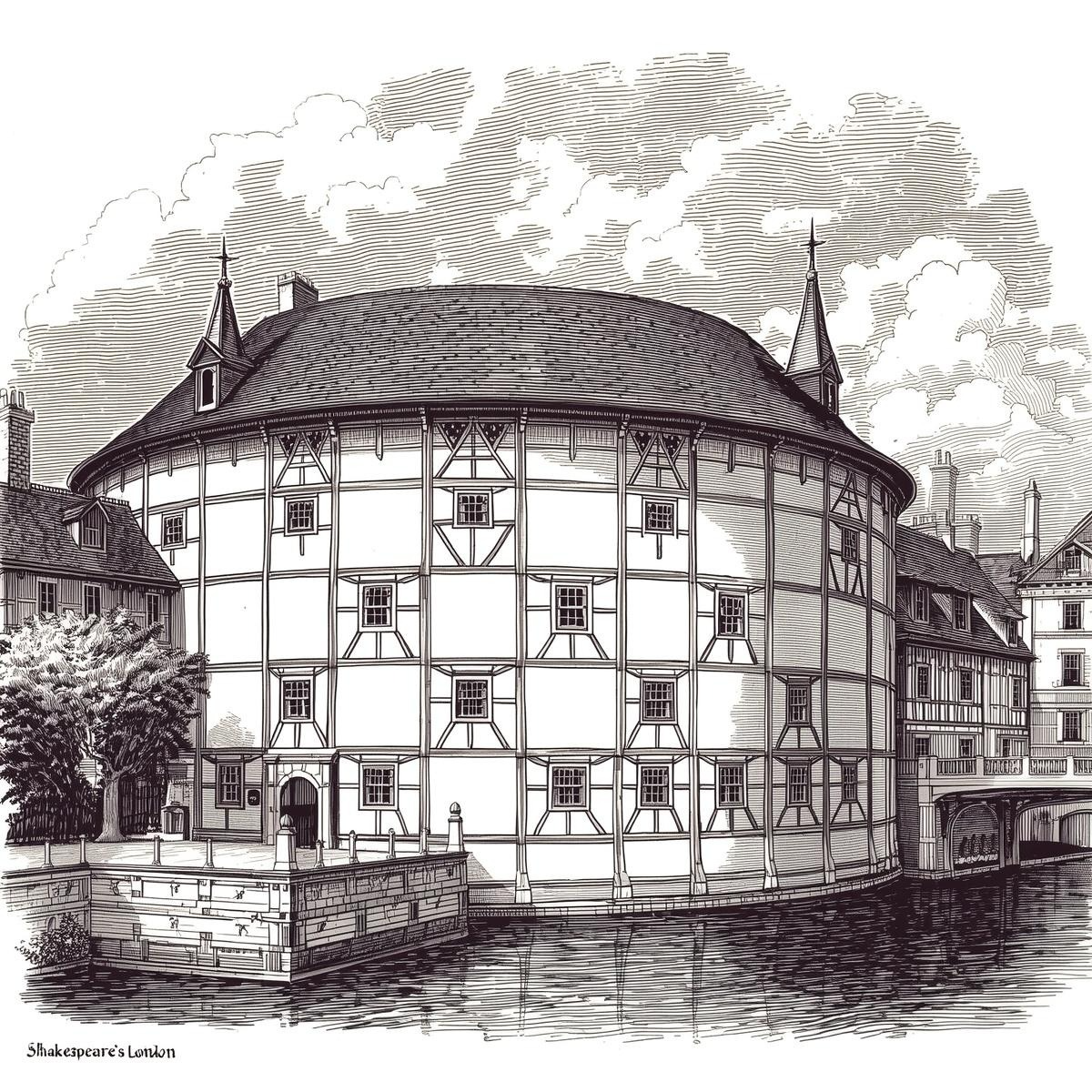
On the south bank of the River Thames, in the lively and occasionally disreputable district of Bankside in Southwark, there stands a theatre unlike any other. Shakespeare’s Globe is a living monument to one of the greatest outpourings of creative genius in the history of Western civilisation. Open to the sky, built of oak and lime plaster, its thatched roof a rare sight in modern London, it draws audiences from across the world to experience Shakespeare’s plays in something close to the conditions in which they were first performed over four centuries ago.
But the story of the Globe is not a single story. It is the story of three theatres, the first Globe, built in 1599 and destroyed by fire in 1613; the second Globe, rebuilt on the same foundations and demolished in 1644; and the modern reconstruction that opened its doors in 1997, the result of one man’s extraordinary, decades-long dream. Together they span over four hundred years of theatrical history.
The Birth of the First Globe: 1599
The origins of the Globe lie in a dispute over a lease. The story of the Globe Theatre starts with Shakespeare’s acting company, the Lord Chamberlain’s Men. Shakespeare was a part-owner, a sharer, in the company, as well as an actor and the resident playwright. From its inception in 1594, the Lord Chamberlain’s Men performed at The Theatre, a playhouse located in Shoreditch.
By the late 1590s, however, their patrons had fallen out of favour with the Queen, and the Theatre’s landlord, Giles Alleyn, had intentions to cancel the company’s lease and tear the building down. While Alleyn owned the land, he did not own the materials with which The Theatre had been built. So, on 28th December 1598, Cuthbert and Richard Burbage led the rest of the company, actors, shareholders, and volunteers, in taking the building down timber by timber, loading it onto barges, and making their way across the Thames.
It was an audacious act, conducted in the dead of winter, and it gave birth to something extraordinary. By May 1599, the new theatre was ready to be opened. Burbage named it the Globe after the figure of Hercules carrying the globe on his back, for in like manner the actors had carried the Globe’s framework across the Thames. A flag of Hercules with the globe was raised above the theatre with the Latin motto totus mundus agit histrionem, or “all the world’s a playhouse.”
The Globe was owned by actors who were also shareholders in the Lord Chamberlain’s Men. Two of the six Globe shareholders, Richard Burbage and his brother Cuthbert Burbage, owned double shares of the whole; the other four men, Shakespeare, John Heminges, Augustine Phillips, and Thomas Pope, owned a single share each. It was, in essence, the world’s first actor-owned theatre, a uniquely democratic and collaborative model that gave the company creative control and extraordinary stability.
The Design and Atmosphere
The Globe was a polygonal, open-air structure with a capacity to hold up to 3,000 spectators. It was three storeys high and featured a large, uncovered central yard where the audience, referred to as “groundlings”, could stand to watch performances. The stage extended into the yard, allowing actors to interact closely with the audience.
At the base of the stage and surrounding it on three sides was an area called the yard, where, for a penny, people would stand on the rush-strewn earthen floor to watch the performance. Wealthier patrons could pay more to sit in the covered galleries above. The result was a theatre that served every social class simultaneously, a democratic space in which noble and labourer stood side by side, watching the same play.
Large columns on either side of the stage supported a roof over the rear portion of the stage. The ceiling under this roof was called the “heavens,” and was painted as a sky with clouds. A trapdoor in the heavens enabled performers to descend using some form of rope and harness. The balcony above the stage could be used for musicians, or for dramatic scenes requiring an upper level, most famously the balcony scene in Romeo and Juliet.
The atmosphere at a Globe performance was vastly different from the hushed, darkened theatres of today. The audience was visible, the noise considerable, and the interaction between actors and spectators immediate and real.
The Plays First Performed at the Globe
The Globe quickly became the epicentre of London’s theatrical world, and it was here that some of the greatest plays ever written received their first performances. Shakespeare’s plays that were performed there early on included Henry V, Julius Caesar, As You Like It, Hamlet, Measure for Measure, Othello, King Lear, Macbeth, and Antony and Cleopatra.
As well as plays by Shakespeare, early works by Ben Jonson, Thomas Dekker, and John Fletcher were first performed here. The Globe was not merely Shakespeare’s private domain, it was a thriving commercial theatre producing a wide and ambitious repertoire. A new play opened on Bankside almost daily, and audiences from all walks of life flocked across the Thames to see the latest works.
Plays performed at the Globe often reflected contemporary issues, serving as a forum for political and social discourse. In an era before newspapers or broadcast media, the theatre was where Londoners came to see the world reflected back at them, its politics, its anxieties, its humour, and its grief.
Fire, Rebuilding, and Closure
Disaster struck on a summer afternoon in 1613. On 29th June 1613, the Globe Theatre went up in flames during a performance of Henry VIII. A theatrical cannon, set off during the performance, misfired, igniting the wooden beams and thatching. According to one of the few surviving documents of the event, no one was hurt except a man whose burning breeches were put out with a bottle of ale.
The company rebuilt swiftly. The company built a second Globe on the brick foundations of the first. It was the same size and shape, but was much more extravagantly decorated, the company could now afford it. It also had a tiled roof, not a thatched one. The second Globe operated until the Puritan backlash against public entertainment brought everything to a halt. Like all the other theatres in London, the Globe was closed down by the outbreak of the First English Civil War, when the Long Parliament closed all London theatres by an ordinance dated 2nd September 1642. It was pulled down in 1644–45 to make room for tenements.
For more than three centuries, the Globe existed only in historical record and imagination.
The Actors of the Original Globe
Richard Burbage: The First Star
No account of the original Globe is complete without the towering figure of Richard Burbage. Richard Burbage (1568–1619) was the leading actor in the Lord Chamberlain’s, King’s Men, playing the dramatic leads, including Richard III, Hamlet, Lear, and Othello.
He was the first person to play the roles of Hamlet, Lear, Othello, and Macbeth in the original Globe in London. The relationship between Burbage and Shakespeare was the defining creative partnership of the Elizabethan stage. Shakespeare wrote these roles knowing precisely the instrument through which they would be realised, Burbage’s physical presence, emotional range, and extraordinary technical skill.
Burbage’s acting style emphasised realism and emotional depth, setting a precedent for modern performance techniques. Although short and stout, Burbage was apparently an impressive figure, and there are numerous praises of him in contemporary prose, verse, and plays. He was also a painter of considerable ability and a shrewd theatrical entrepreneur, co-owner of both the Globe and the Blackfriars Theatre.
His death caused such an outpouring of grief that it threatened to overshadow the official mourning for the death of Anne of Denmark. His gravestone was said to read simply: “Exit Burbage.”
Will Kempe
Another key figure in the original company was Will Kempe, the Lord Chamberlain’s Men’s resident clown. Kempe was one of the most famous comic performers of the Elizabethan age, celebrated for his physical comedy and improvisational skill. He is believed to have originated the role of Dogberry in Much Ado About Nothing and Bottom in A Midsummer Night’s Dream. In 1600 he famously morris-danced all the way from London to Norwich, an extraordinary feat he documented in a pamphlet. He later sold his share in the Globe to his fellow shareholders.
John Heminges and Henry Condell
Two further members of the original Globe company deserve special mention not for their performances, but for their extraordinary act of cultural preservation. John Heminges and Henry Condell, both shareholders in the company, collected Shakespeare’s plays after his death and published the First Folio of 1623. Without their efforts, roughly half of Shakespeare’s surviving plays might have been lost to history forever.
The Death of a Dream and its Revival: Sam Wanamaker
For over three centuries, the Globe existed only in the historical record. Then, in the mid-twentieth century, an American actor and director named Sam Wanamaker visited London and was dismayed to find that no meaningful memorial existed on the site of the original theatre. He resolved to change that.
The driving force behind the reconstruction movement was American actor and director Sam Wanamaker, who spent decades fundraising and advocating for the theatre’s revival. Construction of the new Globe began in 1987 near the site of the original.
With the help of historical advisor John Orrell, and countless hours of research, Wanamaker pieced together a faithful design that reflected the Globe as it existed in Shakespeare’s day, as well as using some details of the second Globe theatre, built in the same spot in 1614 after a fire destroyed the first one. The new Globe is made of oak, with lime-plaster walls and a water-reed thatched roof.
Sam Wanamaker did not live to see his dream fulfilled, he died in 1993, four years before the theatre opened. But his legacy is one of the great acts of cultural stewardship of the twentieth century. A modern reconstruction of the Globe, named “Shakespeare’s Globe”, opened in 1997, with a production of Henry V.
The Modern Globe: A Living Theatre
Mark Rylance: The First Artistic Director
Between 1995 and 2005, Rylance was the first artistic director of Shakespeare’s Globe in London. His tenure was transformative. Under his directorship, the Globe re-created Shakespeare’s era through the use of all-male casts and period-appropriate music, costumes, sets, and stage techniques.
This approach, known as “Original Practices”, was a bold and, at times, controversial experiment. The biggest success of Original Practices was the discovery of a new relationship between the audience and actors. Unlike conventional theatres where the audience is in darkness, everyone can see and be seen at the Globe, and this led to a unique interaction with actors. Actors can speak directly to an audience member or respond to the reaction of the audience, creating an intimate experience where the audience becomes a vital component of the performance.
Rylance himself acted in many of the theatre’s shows, playing both male and female roles. His portrayal of Olivia in the internationally touring production of Twelfth Night in 2002 was particularly effective. He later returned to the Globe to play a chilling Iago in Othello, opposite André Holland, in a production that drew widespread acclaim.
Notable Modern Performers
The reconstructed Globe has attracted some of the finest actors of the contemporary stage. Shakespeare’s Globe has attracted numerous great actors to its unique playing space over the years, such as Charles Edwards and Eve Best in Much Ado About Nothing, Jamie Parker as Prince Hal and Henry V, Gina McKee as Boudica, Gemma Arterton in The Duchess of Malfi, and Jonathan Pryce in The Merchant of Venice.
The current artistic director is actress Michelle Terry, who also performs in many shows at the Globe. Most recently, she was an acclaimed Viola in Twelfth Night, she played the title role in Hamlet, and she starred opposite her real-life husband Paul Ready in Macbeth.
Stephen Fry brought his formidable comic gifts to the role of Malvolio in Twelfth Night, alongside Rylance’s celebrated Olivia. The production became one of the most talked-about in the Globe’s modern history.
The Sam Wanamaker Playhouse
In 2014, the Globe complex was expanded with the opening of the Sam Wanamaker Playhouse, an indoor, candlelit Jacobean-style theatre named in honour of the man who made the Globe’s reconstruction possible. Seating around 340 people, it hosts productions during the winter months when the open-air Globe falls silent, and allows the complex to explore the intimate indoor theatre tradition that ran alongside the great outdoor playhouses of Shakespeare’s era.
The Globe’s Place in London Life
Today, Shakespeare’s Globe is far more than a theatre. It is an education centre, a museum, a research institution, and one of London’s most beloved cultural landmarks. It is an incredibly atmospheric and immersive space, and you get a real thrill from seeing a Shakespeare play there, imagining his audiences sitting where you are now and watching in very similar conditions.
The choice to be a “groundling”, standing in the yard for the price of a few pounds, rain or shine, remains one of the most memorable theatrical experiences London has to offer. Performers frequently join the spectators in the yard during a show, interactivity is a huge part of Globe performances.
The 2026 summer season continues the Globe’s tradition of bold and varied programming, with productions including A Midsummer Night’s Dream, Mother Courage and Her Children, Much Ado About Nothing, Love’s Labour’s Lost, and As You Like It, alongside the UK premiere of Deep Azure, a play by the late Academy Award-nominated actor and writer Chadwick Boseman.
Legacy
The Globe Theatre, in all its incarnations, represents something rare and irreplaceable: a direct physical connection to the moment in which the English language reached its greatest heights. The original Globe gave Shakespeare and his colleagues a home for their most ambitious and enduring work. The modern Globe honours that legacy not as a museum piece but as a working theatre, alive with the same electricity that crackled through Bankside four centuries ago.
To stand in the Globe’s yard, with the sky overhead and the stage before you, is to feel history not as something remote and academic, but as something immediate and present. The wooden O endures, and in enduring, it reminds us that the great works performed within it are not relics of the past, but living, breathing expressions of what it means to be human.
Leave a Reply