
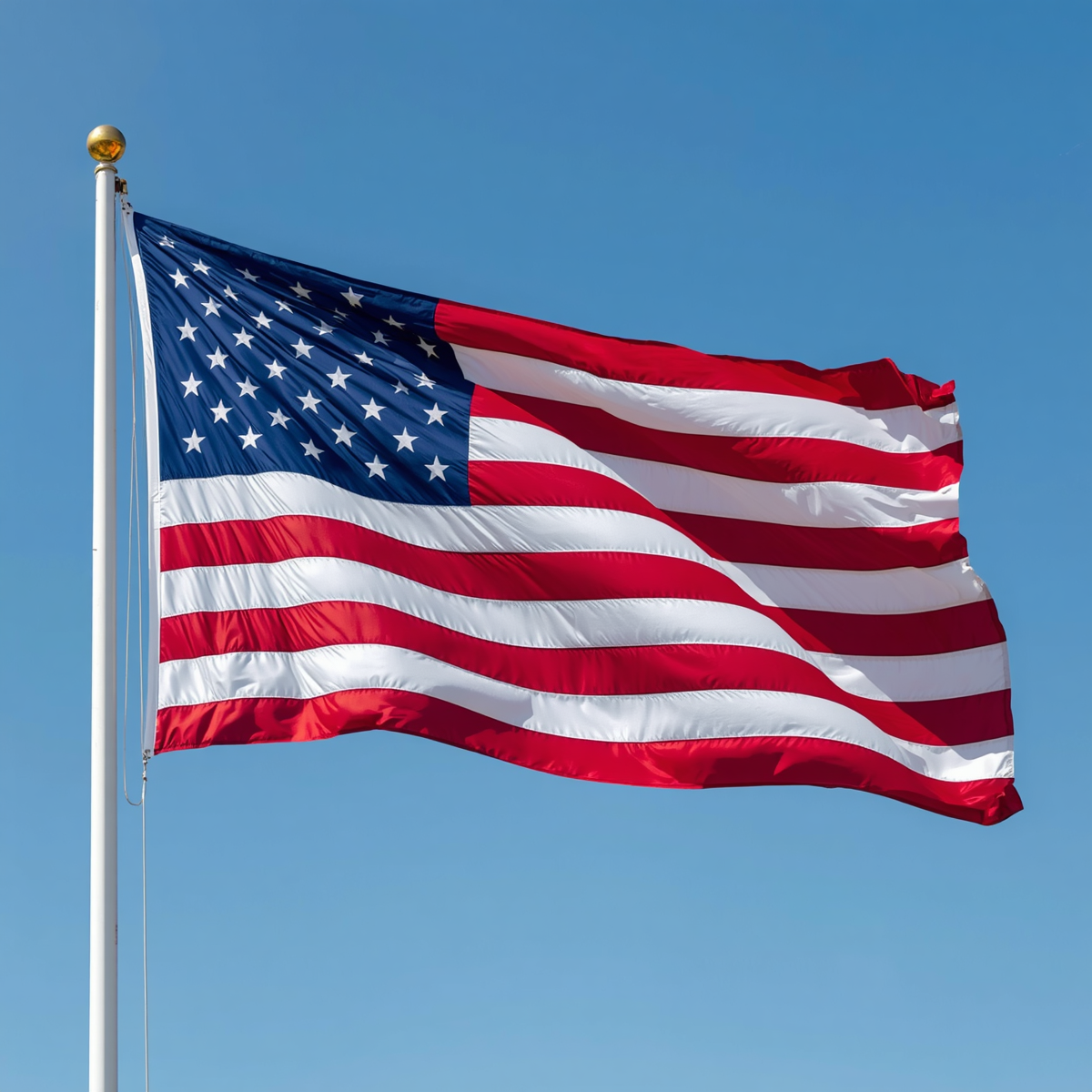
The Flag Act of 1777, passed by the Continental Congress on 14th June, 1777, marked the official birth of the Stars and Stripes, the national flag of the United States. Though brief in wording, the act carried enormous symbolic weight. It established a unifying emblem for a young nation fighting for independence and laid the foundation for one of the world’s most recognisable national symbols.
The Historical Moment
By mid‑1777, the American Revolution was well underway. The colonies had declared independence the previous year, but they lacked a single, standardised national flag. Militias, regiments, and ships used a variety of banners, many inspired by British designs.
The Continental Congress recognised the need for a unified symbol, one that would represent the new nation on battlefields, at sea, and in diplomacy.
On 14th June 1777, Congress passed a simple but historic resolution:
“Resolved, That the flag of the thirteen United States be thirteen stripes, alternate red and white; that the union be thirteen stars, white in a blue field, representing a new constellation.”
This became the first official description of the American flag.
What the Act Established
The Flag Act defined two essential elements:
- Thirteen stripes — symbolising unity among the original states
- Thirteen stars — representing a “new constellation” of free states
However, the act did not specify:
- The arrangement of the stars
- The number of points on each star
- The proportions of the flag
- The shade of red or blue
Because of this, early American flags varied widely in appearance.
Who Designed the First Flag?
The Flag Act did not name a designer. Two figures are most often associated with the early flag:
- Francis Hopkinson — a member of the Continental Congress and signer of the Declaration of Independence, widely believed by historians to have designed the first Stars and Stripes
- Betsy Ross — a Philadelphia upholsterer who, according to family tradition, sewed the first flag and suggested the five‑pointed star
While the Ross story is beloved folklore, Hopkinson’s documented claims make him the stronger historical candidate.
Why the Flag Act Mattered During the Revolution
The new flag served several crucial purposes:
- Military identity — distinguishing American forces from British troops
- Naval recognition — allowing American ships to be identified at sea
- Diplomatic legitimacy — presenting a unified national symbol to foreign allies
- Morale and unity — giving soldiers and citizens a visual emblem of independence
The Stars and Stripes quickly became a rallying point for the revolutionary cause.
Evolution After 1777
As the nation grew, the flag evolved. Later acts of Congress added stars for each new state. In 1818, Congress fixed the number of stripes at thirteen to honour the original states, while stars would continue to increase.
Today’s flag features 50 stars, reflecting a nation far larger than the one imagined in 1777.
Explore the evolution of the U.S. flag.
Legacy: Why 14th June Became Flag Day
Because the Flag Act was passed on 14th June, the date is now celebrated in the United States as Flag Day. First recognised in the 19th century and officially established in 1949, Flag Day honours:
- The creation of the national flag
- The ideals of unity and independence
- The sacrifices made during the Revolution
Communities across the country hold ceremonies, parades, and educational events.
A Symbol That Endures
The Flag Act of 1777 created more than a banner, it created a national identity. The Stars and Stripes has flown:
- On battlefields from the Revolution to the present
- On ships exploring the world’s oceans
- On the moon during Apollo 11
- At schools, government buildings, and homes across the nation
It remains a powerful emblem of American resilience, unity, and aspiration.
Leave a Reply