
THE PEOPLE, ROUTES AND ADVENTURES THAT CHANGED OUR UNDERSTANDING OF THE WORLD
Part I — The First Journeys
How early humans spread across the world
Before there were maps, roads, ships or written words, there were journeys. This article follows the longest and most consequential of them: the movement of our own species from Africa across every habitable continent. Dates are given in years ago (“kya” = thousands of years ago) and, as in all prehistory, are approximate and open to revision
.
1. Introduction and Historical Significance
Every person alive today is descended from ancestors who lived in Africa. That statement, now supported by fossils, archaeology and the genomes of living and ancient people, is the starting point of human history. The story of how a species that began in Africa came to inhabit rainforests and deserts, Arctic tundra and Pacific islands is the first great journey in the story of exploration, and in some respects the greatest.
The phrase “the journey out of Africa” is convenient but misleading. It was not a single march led by a single band toward a known destination. It was a long, uneven series of movements, some failed, some temporary, some lasting, spread across tens of thousands of years and involving populations that met, mixed and sometimes vanished. Nobody set out to “leave Africa”. Small groups of hunter-gatherers followed game, water and coastlines, and over many generations the sum of those small movements covered the globe.
The idea that Africa was our cradle is older than the evidence for it. In 1871 Charles Darwin reasoned from the distribution of living apes that humanity’s ancestors had probably lived on the African continent, a conclusion that was at the time a speculation.[1] A century and a half later it is among the best-supported conclusions in the human sciences, although the details remain vigorously debated.
2. Historical and Geographical Context
An older exodus: Homo erectus
Our species was not the first to leave Africa. Around 1.8 million years ago, populations of early Homo, most often associated with Homo erectus, were living at Dmanisi in the Caucasus (modern Georgia), and later stone tools and fossils show related hominins in Java and China. Other lineages, including the ancestors of the Neanderthals and Denisovans, also left Africa long before Homo sapiens existed. When our species finally spread, it therefore entered a world already populated by other kinds of human.
The origins of Homo sapiens
The oldest fossils attributed to early Homo sapiens come from Jebel Irhoud in Morocco, dated to roughly 300,000 years ago, with further early remains at Omo Kibish and Herto in Ethiopia.[2] Researchers increasingly favour a “pan-African” model in which our species emerged from interconnected populations across the continent rather than from a single East African homeland.[3]
The environment: climate as gatekeeper
The Pleistocene world was one of repeated climatic swings. Ice ages locked up water in glaciers, lowering sea levels by well over 100 metres at their peak and exposing land bridges and continental shelves. Warmer, wetter phases turned parts of the Sahara and Arabia into grassland with lakes and rivers, creating temporary “green corridors”. Movement out of Africa was therefore strongly shaped by when the barriers of desert and sea were at their weakest.
3. The Journey and Its Route
Because no single expedition took place, the “route” is best understood as a set of corridors and a sequence of waves. The schematic diagram below summarises the principal pathways.
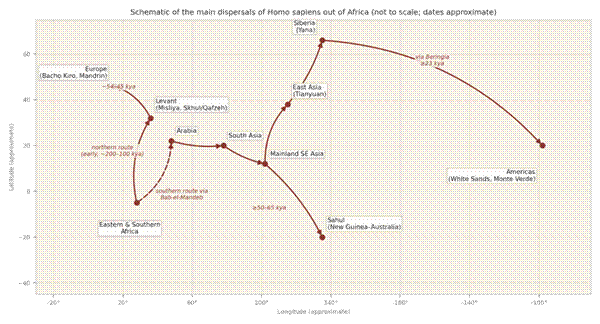
Figure 1. Schematic of the main dispersals of Homo sapiens out of Africa. Positions are approximate and routes are indicative, not reconstructed paths. Diagram prepared for this article.
Early, partial exits (c. 210–90 kya)
Fossils from Misliya Cave on Mount Carmel in Israel, dated to roughly 177,000–194,000 years ago, show that modern-looking humans were living in the Levant far earlier than once thought.[4] A skull fragment from Apidima Cave in Greece has been dated even earlier, to about 210,000 years ago, though its identification and age are contested.[5] At Skhul and Qafzeh, also in Israel, humans lived around 120,000–90,000 years ago. A finger bone from Al Wusta in Saudi Arabia’s Nefud Desert, about 85,000 years old, shows that groups also reached the Arabian interior during a wet phase.[6] Many specialists see these as early forays that left little or no lasting genetic mark on people living today.
The main dispersal (c. 70–50 kya)
Genome studies indicate that the great majority of the ancestry of living non-Africans derives from one or more dispersals around 70,000–50,000 years ago.[7] Two broad corridors are proposed:
- The northern route: across the Nile Valley and Sinai into the Levant, then onward into western Asia and Europe.
- The southern route: across the narrow Bab-el-Mandeb strait at the mouth of the Red Sea, when sea levels were low, then along the coasts of Arabia, Iran and South Asia. Coastlines offered shellfish and other reliable foods, though much of the evidence now lies underwater.
Neither route excludes the other, and both may have been used at different times.
East into Asia and Australia
Groups moving east reached South and Southeast Asia, and eventually the continent of Sahul, a single landmass at low sea level joining New Guinea, Australia and Tasmania. To reach it, people had to cross open water across the islands of Wallacea, a feat that implies deliberate watercraft or rafts. Claims for human presence at Madjedbebe in northern Australia go back about 65,000 years, though some researchers argue for a more conservative figure of around 50,000 years.[8] In either case, Australia was settled earlier than Europe, a surprising fact for anyone who assumes that history moves steadily westward.
North into Europe and Siberia
Modern humans reached Europe by around 45,000 years ago, as at Bacho Kiro Cave in Bulgaria, with some evidence for earlier incursions: a modern human presence at Grotte Mandrin in southern France has been dated to about 54,000 years ago.[9] Further east, people lived at Tianyuan Cave near Beijing by about 40,000 years ago, and by roughly 31,000 years ago, hunters were thriving at the Yana site in the Siberian Arctic.
Into the Americas
The last great continental frontier was crossed from north-east Asia into Beringia, the land bridge exposed between Siberia and Alaska during the ice age. For decades, the accepted view was that the first Americans arrived around 13,000 years ago and are marked by Clovis stone points. That picture has been dismantled. Human footprints preserved at White Sands, New Mexico, have been dated to between roughly 21,000 and 23,000 years ago, a result that was initially disputed and then supported by independent dating.[10] Sites such as Monte Verde in Chile (about 14,500 years ago) show that people had reached the far south of the continent long before Clovis. Many researchers think that groups travelled along the Pacific coast, using boats and exploiting marine resources, rather than waiting for an ice-free inland corridor.
Chronological timeline
| Years ago | Event |
| c. 1.8 million | Early Homo living at Dmanisi, Georgia: the first well-documented hominin presence outside Africa. |
| c. 300,000 | Earliest fossils attributed to Homo sapiens (Jebel Irhoud, Morocco). |
| c. 210–177,000 | Possible early sapiens remains in Greece (disputed) and Israel (Misliya). |
| c. 120–90,000 | Modern humans at Skhul and Qafzeh, Israel; Arabian occupation in wet phases. |
| c. 70–50,000 | Main dispersal of the ancestors of living non-Africans; interbreeding with Neanderthals. |
| c. 65–50,000 | First settlement of Sahul (Australia–New Guinea). |
| c. 54–45,000 | Modern humans in southern France, Bulgaria and wider Europe. |
| c. 40,000 | Humans at Tianyuan Cave, China; Mungo region, Australia, occupied. |
| c. 31,000 | People living in the Siberian Arctic (Yana). |
| c. 23,000–14,500 | First Americans: White Sands footprints; Monte Verde, Chile; Cooper’s Ferry, Idaho. |
4. The People and Cultures Encountered
The travellers did not step into an empty world. In western Eurasia they met the Neanderthals, stockier, cold-adapted humans who had lived there for hundreds of thousands of years. In Asia and the Pacific, they encountered the Denisovans, a lineage known first from a finger bone and teeth found in Denisova Cave in Siberia and identified through its DNA.
The genomic evidence shows that these meetings were not only encounters but also relationships. People outside Africa today typically carry about 1–2 per cent Neanderthal ancestry, and some populations of Oceania and Southeast Asia carry a further component from Denisovans.[11] Some inherited fragments appear to have been useful, including genes related to immunity and adaptation to altitude, but the full effects are still being investigated. The Neanderthals disappeared from the fossil record about 40,000 years ago; the reasons are debated and likely include small population size, competition and climate change, as well as absorption into larger populations.
The travellers brought with them what archaeologists call behavioural modernity: sophisticated stone and bone technology, ornaments, pigments and, eventually, spectacular art. Beads and engraved ochre from Blombos Cave in South Africa, more than 70,000 years old, show that symbolic behaviour has deep roots in Africa. The later cave paintings of Europe, such as those at Chauvet in France, are about 36,000 years old, and the art of Sulawesi in Indonesia is of comparable antiquity or older.
5. Evidence and Historical Sources
There are no written or oral sources for this journey, so its reconstruction rests on four converging kinds of evidence, each with strengths and limits.
- Fossils: direct evidence of who was where and when, but incomplete; bones survive poorly in the tropics, and many gaps remain.
- Archaeology: stone tools, hearths, shell middens, art and footprints record behaviour. Tool types do not reliably identify the species that made them.
- Genetics: since the late 1980s, DNA has transformed the field. A 1987 study of mitochondrial DNA by Rebecca Cann, Mark Stoneking and Allan Wilson, popularly dubbed “Mitochondrial Eve”, pointed to an African origin.[12] Today, whole genomes from living people and ancient bones reveal ancestry, mixing and population size. Africa holds the greatest genetic diversity, consistent with a series of founding bottlenecks as people moved away from it.
- Palaeoenvironment and dating: cores from lakes, caves and seas reconstruct climate, while radiocarbon, luminescence and uranium-series methods date sites. New dates can overturn established stories, as the Americas showThe older “multiregional” hypothesis, which proposed that modern humans evolved in parallel from ancient populations in several continents, has largely given way to an “Out of Africa” model, now refined to include interbreeding with archaic humans. Historians of science often describe this as the “Recent African Origin with admixture” view.[13]
“…it is somewhat more probable that our early progenitors lived on the African continent than elsewhere.”
— Charles Darwin, The Descent of Man (1871), ch. 6 (primary-source extract)
6. Consequences and Historical Interpretation
The consequences of this journey are, in a literal sense, the whole of later human history. Every later migration, empire and exploration took place on a planet that people had already settled. Several enduring interpretations stand out.
- Human unity: genetic variation among living people is small compared with that of many other species, and most of it exists within, not between, populations. The shared African ancestry is a scientific counterweight to claims of deep biological divisions.
- Adaptability: the settlers adapted by culture as much as by biology: new tools, clothing, fire, boats and language, together with some local genetic adaptation to climate, diet and altitude.
- Ecological impact: the arrival of humans in new lands often coincided with the decline of large animals (megafauna), as in Australia and the Americas, although climate change was also involved and the balance of causes is debated.
- Constant revision: the field has repeatedly changed its mind. Dates for Australia, the Levant and the Americas have all moved back in the past two decades, a reminder that the “first journey” is a hypothesis under continuous test, not a settled narrative.
A final caution: language of “conquest” and “settling” can unintentionally imply planning and destiny. What the evidence shows is closer to a slow, opportunistic expansion, in which most people lived and died within a small range, and the cumulative result was global.
7. The Journey for Today’s Traveller
The first journey cannot be retraced as a route, but its landscapes and finds can be visited.
| Place | What to see |
| Cradle of Humankind, South Africa (UNESCO World Heritage Site) | Cave systems with major early hominin fossil finds, and the Maropeng visitor centre. |
| Olduvai Gorge, Tanzania; Lake Turkana, Kenya | Classic sites of early human evolution, with museums and guided visits. |
| Mount Carmel caves (Nahal Me’arot), Israel (UNESCO) | Caves with evidence of Neanderthal and early modern human occupation. |
| Gorham’s Cave Complex, Gibraltar (UNESCO) | A Neanderthal refuge, with the Gibraltar National Museum. |
| Chauvet-Pont d’Arc (Ardèche, France) and Lascaux IV | Full-scale replicas of Ice Age cave art, the originals being closed to protect them. |
| Willandra Lakes Region (Mungo), Australia (UNESCO) | An ancient lakebed, with some of Australia’s oldest human remains; visits are best guided by Aboriginal custodians. |
| White Sands National Park, New Mexico, USA | The landscape in which the ancient footprints were found. |
| Natural History Museum, London; Musée de l’Homme, Paris | Exhibitions on human origins and migration. |
Visitors should check access and opening arrangements before travelling, as many sites have restricted entry or require guided tours, and some are on Indigenous land where local protocols apply.
8. Conclusion, Bibliography and Further Reading
The first journey out of Africa is less a single voyage than the opening chapter of a very long story: a story of small groups, hard climates, chance encounters and extraordinary persistence. It changed our understanding of the world by showing that all human histories are connected at the root. It also set the pattern for what follows in this series: movement driven by necessity and curiosity, shaped by geography, and recorded first in stone, bone and DNA before the arrival of words. Part I continues with the settlement of the Pacific and the peopling of the great islands and oceans.
Select bibliography
Cann, R. L., Stoneking, M. and Wilson, A. C. (1987) ‘Mitochondrial DNA and human evolution’, Nature, 325, pp. 31–36.
Clarkson, C. et al. (2017) ‘Human occupation of northern Australia by 65,000 years ago’, Nature, 547, pp. 306–310.
Darwin, C. (1871) The Descent of Man, and Selection in Relation to Sex. London: John Murray.
Dennell, R. (2020) From Arabia to the Pacific: How Our Species Colonised Asia. Abingdon: Routledge.
Green, R. E. et al. (2010) ‘A draft sequence of the Neandertal genome’, Science, 328, pp. 710–722.
Groucutt, H. S. et al. (2018) ‘Homo sapiens in Arabia by 85,000 years ago’, Nature Ecology & Evolution, 2, pp. 800–809.
Hershkovitz, I. et al. (2018) ‘The earliest modern humans outside Africa’, Science, 359, pp. 456–459.
Hublin, J.-J. et al. (2017) ‘New fossils from Jebel Irhoud, Morocco and the pan-African origin of Homo sapiens’, Nature, 546, pp. 289–292.
Reich, D. (2018) Who We Are and How We Got Here. Oxford: Oxford University Press.
Scerri, E. M. L. et al. (2018) ‘Did our species evolve in subdivided populations across Africa, and why does it matter?’, Trends in Ecology & Evolution, 33, pp. 582–594.
Stringer, C. (2012) Lone Survivors: How We Came to Be the Only Humans on Earth. New York: Times Books.
Glossary
| Term | Meaning |
| Hominin | A member of the human lineage after its split from the ancestors of chimpanzees, including Homo sapiens and extinct relatives. |
| Pleistocene | The geological epoch (c. 2.6 million to 11,700 years ago) of repeated ice ages. |
| Beringia | The land bridge, now partly submerged, linking north-east Asia and Alaska during glacial periods. |
| Sahul | The Ice Age continent joining Australia, New Guinea and Tasmania. |
| Wallacea | The island zone between the Asian and Australian continental shelves, separated by deep water. |
| Admixture / introgression | The transfer of genes between populations or species through interbreeding. |
| Ancient DNA (aDNA) | Genetic material recovered from archaeological remains. |
| kya | Thousands of years ago. |
Note: scientific dates and interpretations in this field are revised frequently. Readers should consult recent literature for the latest findings.
[1]Darwin, C. (1871) The Descent of Man, and Selection in Relation to Sex, vol. 1, ch. 6. Darwin argued that, because the gorilla and chimpanzee are humans’ nearest living relatives, it was somewhat more probable that early human ancestors lived in Africa than elsewhere.
[2]Hublin, J.-J. et al. (2017) Nature 546: 289–292 (Jebel Irhoud); Vidal, C. M. et al. (2022) Nature 601: 579–583 (Omo Kibish, dated to at least 233,000 years ago).
[3]Scerri, E. M. L. et al. (2018) ‘Did our species evolve in subdivided populations across Africa, and why does it matter?’, Trends in Ecology & Evolution 33: 582–594.
[4]Hershkovitz, I. et al. (2018) ‘The earliest modern humans outside Africa’, Science 359: 456–459.
[5]Harvati, K. et al. (2019) Nature 571: 500–504.
[6]Groucutt, H. S. et al. (2018) ‘Homo sapiens in Arabia by 85,000 years ago’, Nature Ecology & Evolution 2: 800–809.
[7]See, for example, Mallick, S. et al. (2016) ‘The Simons Genome Diversity Project’, Nature 538: 201–206; Posth, C. et al. (2016) Current Biology 26: 827–833. The exact number and timing of dispersals remain debated.
[8]Clarkson, C. et al. (2017) ‘Human occupation of northern Australia by 65,000 years ago’, Nature 547: 306–310. For the debate over its dating, see subsequent critiques in Nature and elsewhere.
[9]Hublin, J.-J. et al. (2020) Nature 581: 299–302; Slimak, L. et al. (2022) Science Advances 8: eabj9496.
[10]Bennett, M. R. et al. (2021) Science 373: 1528–1531; Pigati, J. S. et al. (2023) Science 382: 73–75.
[11]Green, R. E. et al. (2010) Science 328: 710–722; Reich, D. et al. (2010) Nature 468: 1053–1060. Percentages vary between populations and between studies.
[12]Cann, R. L., Stoneking, M. and Wilson, A. C. (1987) ‘Mitochondrial DNA and human evolution’, Nature 325: 31–36.
[13]For an accessible overview, see Stringer, C. (2012) Lone Survivors: How We Came to Be the Only Humans on Earth. New York: Times Books; and Reich, D. (2018) Who We Are and How We Got Here. Oxford: Oxford University Press.
Leave a Reply