
Sandstone, Steam, and the Soul of a City’s Railways
Sydney, New South Wales, Australia | Major Rail Hub | Interstate & Regional Services
There is a building in Sydney that most Sydneysiders pass through regularly but rarely pause to look at, properly look at, in the way that architecture deserves. Sydney Central Station, rising in warm golden sandstone above the southern end of the CBD, is one of the grandest public buildings in Australia. Its clock tower, visible from George Street and much of the surrounding city, has been marking time over Sydney’s comings and goings since 1906. Its stone facades, its soaring concourse, its subterranean platforms and its great iron-and-glass train sheds speak of a colonial era that had the ambition, the craftsmanship, and the public confidence to build things that were intended to last.
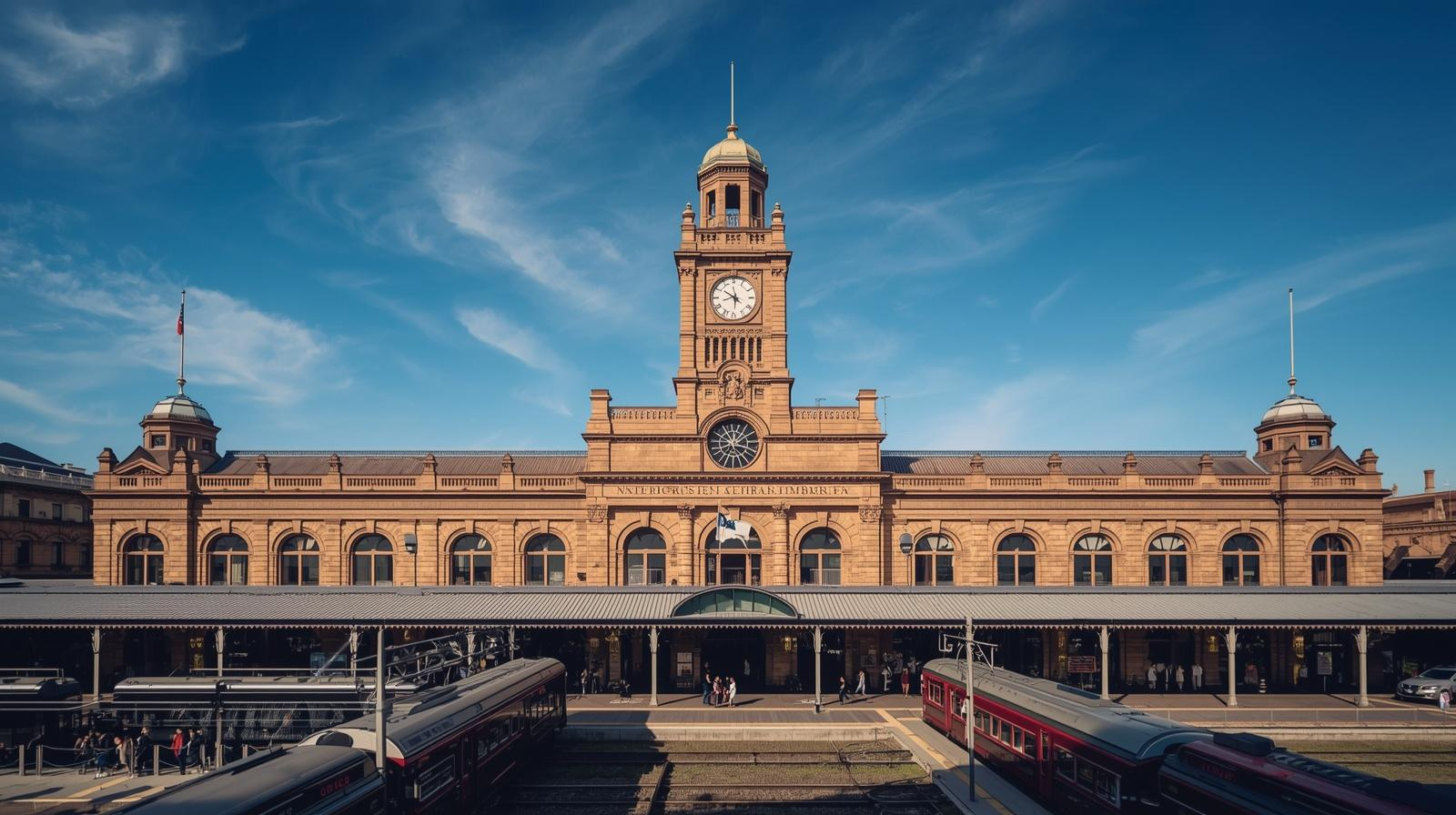
Central Station, known simply as “Central” to generations of Sydneysiders, is far more than a functional transport hub. It is the largest railway station in Australia, the principal gateway for interstate and regional rail services, the nexus of Sydney’s suburban and metro network, and one of the most significant examples of Federation-era architecture in the country. More than that, it is woven into the social fabric of Sydney in ways that go well beyond its operational role: a meeting place, a landmark, a threshold between the city and everything that lies beyond it.
This article traces the story of Central Station from its origins in the boom years of colonial New South Wales, through its architectural history and engineering achievements, to its contemporary role as the beating heart of NSW’s rail network and its ongoing transformation as Sydney continues to build for a growing population.
Historical Background: Railways Come to New South Wales
The history of Central Station begins with the birth of Australian railways. New South Wales opened its first railway line on 26th September 1855, a modest but historically significant service between Sydney and Parramatta. The original Sydney terminus was at Redfern, south of the city centre, on a site chosen for its relative flatness and its accessibility from the settled areas of early colonial Sydney. This station, known as Redfern Station, served as the city’s principal rail terminus for four decades, as the NSW railway network expanded steadily into the interior of the colony.
By the 1870s and 1880s, as Sydney’s population grew rapidly and the railway network extended to the Blue Mountains, the Hunter Valley, and beyond, Redfern Station was increasingly inadequate. Its distance from the commercial heart of Sydney, the area around Circular Quay and George Street, was a persistent inconvenience, and its capacity was straining under the volume of passengers and freight. The New South Wales Government began planning a new central terminus that would sit closer to the city’s core and serve as a fitting gateway to the colony’s expanding rail empire.
The solution was to extend the railway line northward from Redfern on an elevated viaduct, cutting through the dense working-class neighbourhoods of Chippendale and Haymarket to reach a new site on the southern fringe of the CBD. This extension required the demolition of a significant area of the old Devonshire Street Cemetery, one of Sydney’s earliest burial grounds, a decision that provoked considerable public controversy at the time and left a ghostly resonance that the station has carried ever since. The remains of approximately 29,000 people were exhumed and reinterred at Rookwood Cemetery; a memorial crypt beneath the station still marks their memory.
The First Central Station: 1906
Construction of the new Central Station began in 1900, and the building opened to passengers on 4th August 1906. The project was designed by Walter Liberty Vernon, the Government Architect of New South Wales from 1890 to 1911, whose office was responsible for an extraordinary range of public buildings across the colony and state during the Federation era. Vernon approached the station commission with the ambition appropriate to what was intended to be the grandest public building in Australia’s largest city.
The main building, the sandstone facade that faces Eddy Avenue to the south and Railway Square to the west, was completed in 1906, though the famous clock tower was not added until 1921 and subsequent wings were built in stages through the 1920s. The style is variously described as Federation Free Classical or Edwardian Baroque: a confident, exuberant blending of classical elements (columns, pilasters, rusticated stonework, arched windows) with the decorative richness that characterised public architecture in the early years of the Australian Commonwealth. The warm, buff-golden sandstone used throughout the building is quintessentially Sydney, the same local Hawkesbury sandstone used in the Queen Victoria Building, the Sydney Town Hall, and many of the city’s most cherished Victorian and Federation buildings.
Architecture: Sandstone, Clock Tower, and Train Sheds
The Main Building and Clock Tower
The principal facade of Central Station is one of the most accomplished pieces of civic architecture in Australia. Oriented roughly north–south along the line of Eddy Avenue, the building presents a symmetrical composition of considerable length, articulated by projecting bays, arched windows, and deeply cut stonework that creates a play of light and shadow across the surface. The Federation Free Classical style is evident in the restrained but assured use of classical elements: Ionic pilasters, a bold cornice line, and segmental arched windows with prominent keystones.
The clock tower, completed in 1921 to a design by the Government Architect’s office, rises to approximately 73 metres above the street and dominates the skyline of the surrounding neighbourhood. The tower is divided into a series of clearly expressed stages: a square base rising from the main building, a transitional octagonal section, a clock stage with four large clock faces visible from different directions, and a dome-capped lantern at the summit. The four clock faces, each approximately three metres in diameter, have been keeping time over Sydney’s southern CBD for over a century, and the tower has become as much a symbol of the city’s civic identity as it has a functional part of a working railway station.
The detailing of the main building rewards close inspection. The sandstone carving, executed by skilled stonemasons, many of them immigrants from Britain and Europe who brought with them the traditions of craft masonry, includes foliate capitals, decorative keystones, and moulded string courses of considerable refinement. The quality of the stonework speaks to the ambitions of the Federation era: a young nation building for the ages, determined to demonstrate that Australia was capable of producing public buildings that would stand comparison with anything in Britain or Europe.
The Grand Concourse
The interior of Central Station is organised around the Grand Concourse, a long, wide hall that runs parallel to the main facade and serves as the primary passenger circulation space for the suburban and intercity platforms. The concourse is a remarkable interior: a double-height space with a barrel-vaulted ceiling of iron and glass that admits natural light in generous quantities, illuminating the concourse with a warm, diffused glow that softens the functional severity of a busy transit space. The original timber-panelled ticket offices along one side have been significantly altered over the decades, but the spatial character of the concourse remains essentially intact, and the volume of the space retains the authority of good Victorian civic architecture.
The floors of the concourse are paved in terrazzo and stone, worn smooth by more than a century of passenger traffic. The walls are clad in cream-glazed brick, practical, reflective, and easy to maintain, with sandstone detailing at the key architectural moments. Brass fittings, heritage light fixtures, and remnants of the original signage system are preserved throughout the concourse, creating an interior that is simultaneously a working transit environment and a living museum of early twentieth-century railway design.
The Train Sheds
Behind the main building, extending north and south from the concourse, are the platform train sheds, large iron-and-glass canopy structures that cover the above-ground platform tracks. The main train shed, covering Platforms 1 through 6 (the suburban through platforms) and the adjacent terminal platforms, is a substantial structure of bolted iron columns and lattice girders supporting a curved roof of glass and corrugated iron that spans the full width of the platform tracks.
Train sheds of this type are among the most characteristically Victorian of architectural forms, combining structural engineering of considerable sophistication with an aesthetic character unique to the railway age: the combination of delicate ironwork, transparent glass, and the dramatic perspective of parallel tracks converging toward the light. Sydney’s train sheds are not the most ambitious of their kind, they do not rival the soaring spans of St Pancras or the Gare du Nord, but they are generous, well-proportioned structures that handle their functional purpose with dignity. The quality of light within them on a clear Sydney morning, when sunlight slants through the glass and strikes the old sandstone of the main building beyond, is genuinely beautiful.
The Crypt and the Cemetery
Beneath the main concourse lies one of Sydney’s most unusual heritage spaces: the Mortuary Station waiting room and, more significantly, the memorial crypt that marks the site of the old Devonshire Street Cemetery. The crypt, accessible from the concourse level, contains memorial plaques and interpretive material about the cemetery that was demolished to build the station. It is a sober, dignified space that acknowledges the human cost of the station’s construction and offers a rare moment of reflection within what is otherwise a relentlessly busy transit environment. The Mortuary Station a separate small building on the station precinct that once served as the departure point for funeral trains carrying coffins to Rookwood Cemetery, is preserved nearby and serves today as a restaurant.
*
Operational Role: The Hub of NSW Rail
Interstate Services: The Long-Distance Lines
Central Station is the principal hub for interstate and long-distance rail services in New South Wales, operated by NSW TrainLink. The station’s terminal platforms, a series of dead-end roads on the western side of the building, set below street level, serve as the departure point for some of Australia’s most storied rail journeys. Chief among these is the Indian Pacific, operated by Journey Beyond Rail, which departs Sydney for Perth on a journey of 4,352 kilometres across the continent, one of the longest rail journeys in the world, traversing the Blue Mountains, the arid outback of South Australia, and the Nullarbor Plain before descending to the Indian Ocean coast of Western Australia.
The Overland, the XPT (Express Passenger Train), and a range of regional services extend the reach of Central’s platform to Melbourne, Brisbane, and a host of regional New South Wales destinations. The XPT service to Melbourne, an overnight journey of approximately eleven hours through the Southern Tablelands and north eastern Victoria, remains a popular choice for travellers who prefer the comfort and scenery of rail to the clinical efficiency of a short-haul flight. The Canberra Xplorer service connects Sydney to the national capital in just under four hours, offering an alternative to the heavily trafficked Hume Highway.
These long-distance services carry a particular cultural significance in Australian life. In a country of continental scale, where the distances between cities are measured in hundreds or thousands of kilometres, the long-distance train journey has historically been both a practical necessity and a rite of passage. The overnight sleeper to Melbourne, the transcontinental crossing to Perth, the leisurely passage through the New South Wales tablelands on a regional service. these are experiences that have shaped generations of Australians’ understanding of the vast country they inhabit. Central Station is where these journeys begin and end.
Regional Services: Connecting NSW
Beyond the interstate routes, Central Station is the origin point for an extensive network of regional NSW TrainLink services that connect Sydney to the towns and cities of New South Wales. The Blue Mountains Line carries commuters and tourists through Penrith, Katoomba, and Lithgow to the edge of the central tablelands. The Hunter Line serves Newcastle and the Lower Hunter Valley, the heart of Australia’s coal-mining and wine-producing country. The Central Coast & Newcastle Line links Sydney to the scenic coast north of the Hawkesbury River. The South Coast Line extends to Wollongong and beyond, tracing the dramatic Illawarra escarpment south from the Royal National Park.
These regional services play a vital social and economic role that is often underappreciated in discussions of Australian transport policy. For communities in regional New South Wales, many of which have limited access to air services and are too distant from Sydney for practical daily car commuting, the train connection to Central Station is a lifeline, providing access to the city’s health services, educational institutions, employment opportunities, and cultural life. The regional train is not merely a transport option; it is, for many communities, a thread of connection to the broader Australian economy and society.
Suburban and Metro Services
Central Station is a critical node in Sydney’s suburban rail network, operated by Sydney Trains. The through-platforms at Central, Platforms 1 to 6 above ground, and the underground platforms 7 to 10 that serve the City Circle line, carry an enormous volume of suburban services connecting the CBD with the western, northern, eastern, and southern suburbs of the metropolitan area. In the morning and evening peak hours, trains through Central arrive and depart at intervals measured in minutes; the cumulative daily passenger count runs into the hundreds of thousands.
The opening of the Sydney Metro network has added a further dimension to Central’s role as a transport interchange. The new Sydney Metro City & Southwest line, which opened its underground Central Station platforms in 2024, connects the station to the North West Metro and extends south through Sydenham to Bankstown, providing a high-frequency, turn-up-and-go alternative to the conventional suburban rail network. The metro platforms at Central, a deeply excavated addition to an already complex underground rail structure, required extraordinary engineering to construct safely beneath and around the existing station infrastructure, and their opening marked the most significant expansion of Central’s capacity in the modern era.
Platform Configuration and Complexity
The platform configuration at Central Station is among the most complex of any railway station in the southern hemisphere, reflecting the layered accretion of more than a century of construction and adaptation. At the uppermost level are the above-ground terminal platforms (Platforms 11 to 23) used by interstate, regional, and some suburban services, arranged as dead-end roads accessible from the main concourse. Adjacent to these are the above-ground through-platforms (Platforms 1 to 6) used by suburban services, covered by the main train shed.
Below ground, the City Circle loop platforms (Platforms 7 to 10) occupy the first underground level, opened progressively between 1926 and 1956 as the underground City Circle was constructed to improve CBD rail accessibility. Deeper still, the T8 Airport & South line platforms occupy a second underground level, reached by escalator from the City Circle level. The new Metro platforms occupy a third and fourth underground level, excavated to depths approaching 30 metres below street level. Navigating between these layers is straightforward once one understands the system, but the spatial complexity of Central Station’s underground infrastructure is genuinely impressive: a subterranean city within a city, hewn from the sandstone that underlies much of the Sydney CBD.
Engineering Milestones: Building Below and Beyond
The City Circle Tunnels
The construction of the underground City Circle loop, an underground railway connecting Central, Town Hall, Wynyard, Circular Quay, St James, and Museum stations in a circuit around and beneath the CBD, was one of the most ambitious infrastructure projects in Australian history. Work began in the 1920s and was not completed until 1956, interrupted by the Great Depression and the Second World War. The tunnels were bored and cut through the Hawkesbury sandstone that underlies the CBD, using techniques that were at the frontier of underground construction technology for their era.
The underground platforms at Central, opened in 1926 as the first stage of the City Circle, were designed with the same architectural ambition as the surface building. The station interiors feature cream-glazed brick walls, decorative tile work, and the high platform ceilings characteristic of the early London Underground stations that provided much of the design inspiration. The heritage character of the underground platforms has been carefully maintained through successive upgrades, and they remain among the most atmospheric railway spaces in Australia.
The Airport Link and T8 Line
The opening of the Airport Link, an underground rail connection from Central Station to Sydney Airport’s domestic and international terminals, in May 2000 was a significant milestone in Central’s development as a multi-modal hub. The T8 Airport line, operated under a public-private partnership structure, provides a direct rail connection between Central and the airport terminals in approximately thirteen minutes, offering a competitive alternative to the taxi and bus services that had previously dominated airport surface transport.
The Airport Link construction required the excavation of a new underground platform level at Central, below the existing City Circle level, and the boring of tunnels beneath the densely built residential and industrial areas of Alexandria and Mascot. The project demonstrated that Sydney’s geological conditions, the reliable, relatively uniform sandstone that underlies much of the inner city, are well-suited to underground construction, a discovery that has informed the subsequent wave of Metro construction that has significantly expanded Sydney’s underground rail network.
Sydney Metro: A New Underground Era
The construction of Sydney Metro platforms at Central, completed in stages from 2019 to 2024, represents the most recent and in some ways the most technically challenging chapter in the station’s engineering history. The new Metro platforms required tunnelling and excavation to depths well below the existing City Circle and Airport line infrastructure, in a geological context made complex by the presence of existing tunnels, station structures, heritage building foundations, and the dense tangle of utilities and services that underlies any major city centre.
The engineering solution, which involved a combination of tunnel boring machine (TBM) excavation for the running tunnels and cut-and-cover construction for the station box, was managed with extraordinary care to protect the integrity of the surface building and its foundations. Vibration monitoring, ground movement instrumentation, and continuous structural assessment of the heritage sandstone building above were maintained throughout the construction period. That the 1906 building emerged from this process unharmed, its clock tower still vertical and its sandstone still intact, is a tribute to the quality of the engineering and the rigour of the monitoring regime.
Central Station and Sydney’s Social History
Migration and Arrival
Central Station has been the point of arrival in Sydney for successive waves of migration that have shaped the city’s character. In the early decades of the twentieth century, migrants arriving by ship at Circular Quay would make their way to Central by tram or on foot to connect with trains to their final destinations, to the farming districts of the Riverina, the coal fields of the Hunter, the pastoral properties of western New South Wales. For many of these migrants, mostly British and Irish in the early years, increasingly diverse after the Second World War, Central Station was their first encounter with the Australian interior: the vast, unfamiliar landscape that began at the edge of the city and extended westward without apparent limit.
After the Second World War, Australia’s immigration programme brought hundreds of thousands of European migrants, Italians, Greeks, Yugoslavs, Poles, and many others, to Sydney. Many settled in the inner suburbs around Central Station: Surry Hills, Redfern, Newtown, and Glebe became home to immigrant communities whose cultural influence is still strongly felt in the culinary and social character of these neighbourhoods today. For these new Australians, Central Station was not only a transport hub but a landmark of orientation, a fixed point in an unfamiliar city, its clock tower visible from the streets of the surrounding suburbs.
Redfern and Indigenous Sydney
Central Station sits at the boundary between the CBD and Redfern, one of the most historically significant neighbourhoods in Aboriginal Sydney. The Redfern area, particularly the block bounded by Eveleigh, Louis, Caroline, and Vine streets, known simply as “The Block”, was for decades the most concentrated urban Aboriginal community in Australia, a centre of Indigenous political activism, cultural life, and community organisation. The Aboriginal Medical Service, the Aboriginal Legal Service, and many other Indigenous organisations that became models for the rest of Australia were founded in Redfern in the early 1970s.
The proximity of Central Station to this community means that the station has been a regular gathering point for Aboriginal Sydneysiders for generations. It has also been the site of significant public events in the history of Indigenous Australia: the landmark 1992 speech by Prime Minister Paul Keating at Redfern Park, in which he became the first Australian Prime Minister to acknowledge the wrongs done to Aboriginal people in unequivocal terms, was delivered less than a kilometre from Central’s platforms. The station exists in the shadow of this history, and any full account of its social significance must acknowledge it.
The Backpackers and the Travellers
In more recent decades, Central Station has become associated with a very different kind of traveller: the backpacker. Sydney is one of the world’s great destinations for young budget travellers, and Central Station. with its direct connections to the city’s hostel district in Kings Cross and the inner suburbs, its interstate and regional services, and its role as the departure point for adventures into the Australian interior, has become a central node in the social geography of the travelling young. The area around the station, particularly along George Street south and the lanes of Surry Hills, is dense with budget accommodation, cafes, and the infrastructure of itinerant youth culture.
This association gives Central Station a cosmopolitan, democratic quality that some of the world’s great railway stations, those catering primarily to business travellers on premium services, lack. On any given day, the concourse at Central might hold a mix of Sydney commuters on their way to the office, retirees boarding the overnight train to Melbourne, backpackers consulting their phones for hostel directions, regional families arriving for medical appointments, and tourists beginning the journey to the Blue Mountains. This social breadth is one of Central’s most compelling qualities as an urban space.
Heritage, Preservation, and Renewal
Heritage Listing and Significance
Central Station is listed on the New South Wales State Heritage Register and is recognised as a place of State heritage significance. The heritage listing encompasses the main building, the clock tower, the train sheds, the underground City Circle platforms, and a range of ancillary structures including the Mortuary Station. The listing recognises Central’s significance on multiple dimensions: architectural, historical, social, and associative.
The architectural significance is evident in the quality of the Federation Free Classical design and the craftsmanship of the sandstone construction. The historical significance lies in the station’s role as the principal gateway to New South Wales since 1906 and its continuous centrality to the state’s transport, economic, and social history. The social significance encompasses the station’s role in the great migrations and movements of people that have shaped modern New South Wales. The associative significance relates to Central’s place in the collective memory of Sydneysiders across generations, its clock tower as a meeting point, its concourse as a threshold, its platforms as the beginning and end of journeys that have defined lives.
Ongoing Challenges and the Renewal Programme
Like all large heritage railway stations in use, Central faces the perpetual challenge of balancing heritage conservation with the operational demands of a twenty-first-century transport hub. The scale of passenger growth projected for Sydney, the city’s population is expected to reach six million by 2040, places enormous pressure on Central’s infrastructure, and the NSW Government has committed to a significant programme of station renewal and capacity enhancement.
The Central Station Renewal Programme, a multi-billion-dollar initiative underway at the time of writing, aims to improve passenger capacity, enhance accessibility, upgrade facilities, and integrate the new Metro infrastructure with the existing station. The programme includes the construction of new underground concourse connections, improved platform access, upgraded commercial facilities, and enhanced public spaces in the Railway Square precinct. The challenge, as with all renewal works on heritage-listed buildings in active use, is to achieve the capacity improvements that passenger growth demands without compromising the architectural integrity of a building that is, in the truest sense, irreplaceable.
Railway Square and Urban Context
The precinct around Central Station has itself undergone significant transformation in recent years. Railway Square, the open area at the western end of the station, bordered by George Street, Pitt Street, and Eddy Avenue, was for many decades a somewhat underused space, dominated by traffic and lacking the civic quality its central location warranted. A series of improvements to the square, including pedestrianisation of key areas, upgraded paving and landscaping, and the installation of public art, has progressively improved the quality of the public realm around the station.
The former Parcels Office building, a large sandstone warehouse adjacent to the main station building, has been adaptively reused as a hotel, bringing new activity to the precinct and demonstrating the potential for sympathetic adaptive reuse of heritage railway structures. The broader neighbourhood around Central is undergoing significant transformation, with major residential, commercial, and technology-focused development occurring in the surrounding blocks as the tech and creative industries gravitate toward the inner city precincts served by the station.
Central Station in Australian Culture
Central Station has a presence in Australian literature and popular culture that reflects its centrality to the national experience of travel and transition. The station appears in the work of numerous Australian writers, from the social realist fiction of the mid-twentieth century, where it figures as a threshold of class mobility and geographic dislocation, to contemporary literary fiction that uses the station as a setting for encounters between the diverse communities of the modern city.
In Australian film and television, Central Station has served as a location for productions ranging from period dramas that exploit the photogenic quality of its sandstone and ironwork to contemporary thrillers that use its underground tunnels and labyrinthine platforms to create atmosphere. The station’s clock tower has appeared in countless photographic compositions of the Sydney skyline, and the view of the tower from Railway Square, framed by the surrounding streetscape, is one of the city’s most recognisable urban images.
For generations of NSW schoolchildren, the excursion to Sydney that culminated in arriving at Central Station was a rite of passage, the overwhelming scale of the city announced first by the station’s sandstone facade and its great concourse, the smell of diesel and old stone and a thousand travellers. This accumulation of personal associations, repeated across generations, is what transforms a building from a functional structure into a place of meaning. Central Station has earned that status many times over.
Visiting Central Station: A Guide for the Attentive Traveller
Central Station is located at the southern end of Sydney’s CBD, accessible from George Street to the west, Eddy Avenue to the south, and Chalmers Street to the east. The main entrance on Eddy Avenue, beneath the clock tower, provides the most architecturally impressive approach: pausing on the footpath opposite to take in the full breadth of the sandstone facade before entering is highly recommended. The clock tower is best seen from Railway Square, where its full height is visible against the sky.
The Grand Concourse, accessed through the main entrance hall, rewards careful inspection. Look up at the iron-and-glass barrel vault; observe the quality of the sandstone detailing in the arches and cornices; note the proportions of the original ticket office bays, now housing contemporary reta-il and service functions. The train sheds to the north of the concourse are accessible by descending to platform level; standing at the end of a platform and looking back toward the station building, with the iron canopy arching overhead and the sandstone facade visible beyond, is one of the more atmospherically satisfying architectural experiences in Sydney.
The underground City Circle platforms at Central are themselves worth visiting as examples of early underground railway design. The heritage character of the cream-glazed brick walls, the decorative tilework, and the platform proportions is well-preserved, and these platforms offer a marked contrast to the sleek, contemporary design of the new Metro platforms below them, a vertical history of Australian underground railway design compressed into a few flights of stairs.
For those interested in the broader heritage of the precinct, the former Mortuary Station building on the northern side of the rail corridor is easily accessible and retains its original Victorian Gothic character. The heritage interpretation within the main station concourse, including materials relating to the Devonshire Street Cemetery, provides valuable context for understanding the human history beneath the building. The broader Railway Square precinct, with its mix of heritage sandstone and contemporary development, is worth exploring on foot before or after using the station.
Conclusion: The Station That Built a City’s Connections
Sydney Central Station has been at the heart of New South Wales’ transport network for more than a century, and in that time it has witnessed the full sweep of the state’s modern history. It has received migrants and farewelled soldiers; it has dispatched passengers into the continent’s interior and welcomed them home again; it has been adapted and extended, tunnelled beneath and built above, pressed into service for the demands of each successive generation of Sydneysiders and their changing needs.
The building itself, that magnificent sandstone pile with its copper-domed clock tower and its vast iron-roofed concourse, has endured all of this with a dignity that is the dividend of quality. Walter Liberty Vernon and his colleagues built for permanence, using materials and craftsmanship that have proved equal to the demands of a century and more. The Metro platforms excavated deep beneath the 1906 building in the 2020s are the latest chapter in a long story of adaptation and renewal; they will not be the last.
What gives Central Station its particular quality, its claim on the affection of Sydneysiders and the attention of visitors, is the combination of architectural grandeur and democratic accessibility. It is a building that was designed to be grand, and it is grand; but it is also a building that belongs to everyone, that has been used by every kind of Australian, that carries the traces of all the lives that have passed through it. No other building in Sydney can match its combination of architectural distinction and social breadth.
The clock ticks on above Railway Square. The trains arrive and depart. And Central Station, as it always has, holds the city together.
Sydney Central Station • Opened 4th August 1906 | NSW State Heritage Register | Haymarket, Sydney, New South Wales, Australia
Leave a Reply