
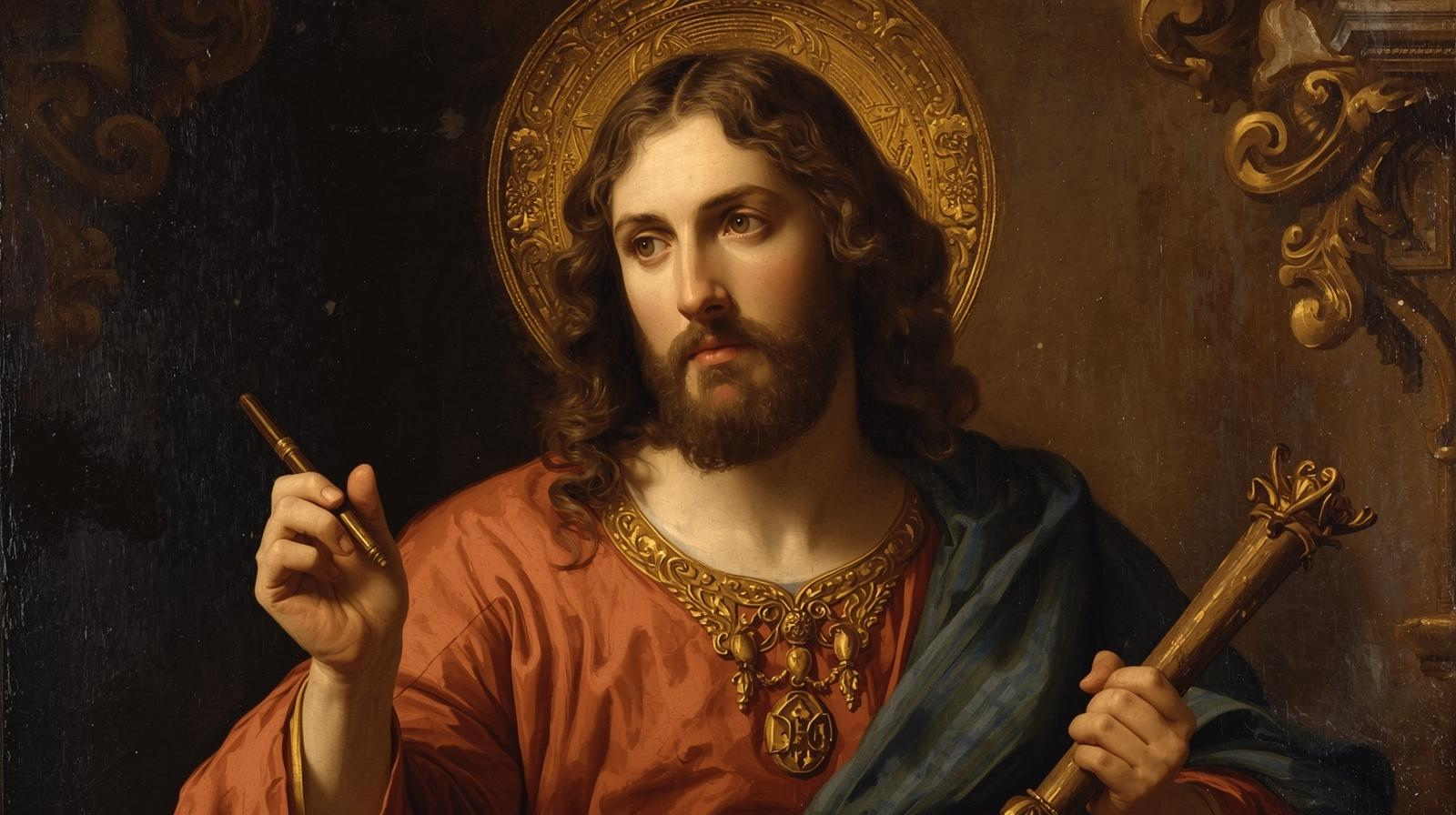
Among the twelve apostles who walked with Jesus, one stands apart in the annals of Christian tradition, not for performing the greatest miracles or leading the largest missionary journeys, but for the depth of his relationship with Christ and the sublime theology he would later write. St. John the Evangelist, born around 6 AD, was one of the Twelve Apostles of Jesus and died peacefully in the year 100 AD, making him unique among the apostles as the only one believed to have escaped martyrdom and died of natural causes.
His feast day is celebrated on 27th December in the Catholic Church, Anglican Communion, and the Lutheran Calendar, marking the third day of Christmastide. This placement in the Christmas season is no accident, John’s Gospel would become Christianity’s most profound meditation on the Incarnation, opening with the majestic words “In the beginning was the Word, and the Word was with God, and the Word was God.”
The Fisherman Called by Christ
John was the son of Zebedee, a Galilean fisherman, and Salome, and John and his brother St. James were among the first disciples called by Jesus. When two young Jewish fishermen sat by the Sea of Galilee mending their nets with their father, a man walked by and said “Follow me,” and their response reveals the startled glimmer of recognition they must have had: “Immediately they left their boat and their father and followed him”.
In the Gospel According to Mark, John is always mentioned after James and was no doubt the younger brother. Tradition holds that John was indeed the younger of the two brothers, likely making him one of the youngest apostles when Jesus called him. His mother Salome was a woman who ministered to the circle of disciples, and the family appears to have been among those with resources to support Jesus’ ministry.
The Sons of Thunder
James and John were called Boanerges, or “sons of thunder,” by Jesus, perhaps because of some character trait such as the zeal exemplified when John and James wanted to call down fire from heaven to punish the Samaritan towns that did not accept Jesus. This fiery temperament appears repeatedly in the Gospels.
The brothers also asked, oblivious as to what they were asking, to sit at the Lord’s right hand in his “glory,” a glory they likely conceived in earthly terms, and both times they were reprimanded. These incidents reveal young men of passionate devotion but limited understanding, ambitious for glory yet not comprehending the true nature of Christ’s kingdom.
Yet in all this, John, whom tradition identifies as the “beloved disciple” in John’s Gospel, was learning love, love was near enough to touch in those three years as a disciple, and above all in those three days that began with his Master washing the disciples’ feet like a slave. The transformation from “son of thunder” seeking divine retribution to the apostle who would write “God is love” represents one of the most profound character developments in Scripture.
The Inner Circle
For the three former fishermen, Peter, James, and John, that faith was to be rewarded by a special friendship with Jesus, as they alone were privileged to be present at the Transfiguration, the raising of the daughter of Jairus, and the agony in Gethsemane. John thus witnessed the three most intimate moments of Jesus’ earthly ministry: the revelation of his divine glory on the mountain, the power over death in raising a child, and the anguish of his humanity in the garden.
But John’s friendship was even more special. John is not mentioned again in his Gospel until the Last Supper when he leans on Jesus’ breast, an act that symbolises John’s profound love of Christ. This image, the beloved disciple reclining against Jesus at the final meal, has become one of the most iconic in Christian art and devotion, symbolising intimate communion with Christ.
At the Foot of the Cross
John is the only apostle the Gospels record as present when Jesus died, watching with Jesus’ mother and other women as the Son of God cried out to his Father. While the other disciples fled in fear, John stood firm. John heard another word there, to Mary about him: “Behold your son,” and to him, “Behold your mother,” entrusting her to his care.
This moment established John’s unique relationship with Mary, the Mother of God. John was given the exquisite honour of caring for Jesus’ mother as he stood beneath the cross, “Woman, behold your son… Behold, your mother”. Pious tradition holds that Mary lived with John in Ephesus until her Assumption in Jerusalem, making John the guardian of the one who had borne the Saviour.
After the Resurrection
After the Resurrection, John ran to the tomb ahead of Peter when Mary of Magdala informed the two of them that she had seen the risen Lord, but John waited for Peter and permitted him to enter the tomb first. This detail, recorded in John’s own Gospel, reveals the apostle’s characteristic humility despite his special relationship with Jesus.
John’s authoritative position in the church after the Resurrection is shown by his visit with St. Peter to Samaria to lay hands on the new converts there. John, Peter, and James the Just were the three pillars of the Jerusalem church after Jesus’ death, providing leadership during Christianity’s crucial early years.
Exile and the Book of Revelation
It had been believed that John was exiled around 95 AD to the Aegean island of Patmos, where he wrote the Book of Revelation. This exile likely occurred during the persecution under the Roman Emperor Domitian. On that rocky island in the Aegean Sea, John received the apocalyptic visions that would become Christianity’s final book, a work filled with symbolic imagery, prophetic warnings, and ultimately, hope in Christ’s final victory.
According to the 2nd-century North African theologian Tertullian, John was plunged into boiling oil from which he miraculously escaped unscathed. During the 7th century this scene was portrayed in the Lateran basilica in Rome by the Latin Gate, and the miracle is still celebrated in some traditions. While later traditions even suggested John ascended to heaven like Enoch and Elijah, the most reliable accounts indicate he died a natural death.
The Ministry in Ephesus
John was Bishop of Ephesus in Asia Minor and died around the year 100. He is strongly associated with the city of Ephesus: it is claimed that he lived his prominent life there and is buried in this city. After Mary’s Assumption, John began his missionary expeditions throughout Asia Minor, establishing and strengthening Christian communities throughout the region.
John’s grave was a goal for many pilgrimages in the early centuries, and countless legends were told about his tomb. People claimed they saw the earth on top of his grave move up and down, indicating his breathing, and believed he did not really die but only slept in the grave. Another popular tradition, known to St. Augustine, declared that the earth over John’s grave heaved as if the apostle were still breathing.
These legends arose from a misinterpretation of Jesus’ words recorded in John’s own Gospel. When Peter asked about John’s fate, Jesus replied, “If I wish him to remain until I come, what is it to thee?”, a statement the apostles misinterpreted to mean John would not die.
The Johannine Writings
Saint John the Apostle is believed to be the author of the Gospel of Saint John, three letters in the New Testament, John 1, 2, 3a, and the Book of Revelation. Though modern scholars debate the authorship of these works, Christian tradition has consistently attributed them to the beloved disciple.
Saint John, more than any other Evangelist, speaks explicitly of the Blessed Trinity and of how every human person is called to become a son or daughter of God through faith, rebirth in Baptism, and spiritual nourishment in the Eucharist. His Gospel presents the most developed theology of Christ’s divinity, opening with a profound meditation on the Word made flesh.
Because of the depth of his Gospel, John is usually thought of as the eagle of theology, soaring in high regions that other writers did not enter. While the Synoptic Gospels (Matthew, Mark, and Luke) focus on Jesus’ actions and parables, John’s Gospel delves into the meaning behind them, presenting extended discourses on subjects like the Bread of Life, the Good Shepherd, and the True Vine.
John also quotes a lengthy address of Christ at the Last Supper about the meaning of his New Commandment of Love, illustrating its theme of service with his account of the washing of the disciples’ feet. This emphasis on love became John’s defining characteristic, he is often called the “Apostle of Charity” or the “Apostle of Love.”
“The way we came to know love was that he laid down his life for us; so we ought to lay down our lives for our brothers”, these words from John’s first epistle encapsulate the transformation of the young “son of thunder” into Christianity’s theologian of divine love.
Patronage and Symbols
John is the patron saint of love, loyalty, friendships, and authors. He is also the patron saint of arms manufacturers, art dealers, Basket makers, bookbinders, booksellers, publishers, butchers, candlemakers, compositors, editors, engravers, glaziers, government officials, harvesters, lithographers, notaries, painters, papermakers, printers, saddle makers, scholars, sculptors, theologians, and winemakers. This extensive patronage reflects both his role as an author and the various legends associated with him.
He is invoked against burns, epilepsy, foot problems, hailstorms, and poisoning, protections connected to the legends of his miraculous survival when plunged into boiling oil and when challenged to drink poisoned wine.
One of John’s familiar attributes is the chalice, often with a snake emerging from it according to legend from the Acts of John, John was challenged to drink a cup of poison to demonstrate the power of his faith, and thanks to God’s aid the poison was rendered harmless. The chalice can also reference the Last Supper or Christ’s words to John and James: “My chalice indeed you shall drink.”
John the Evangelist is symbolically represented by an eagle, one of the creatures envisioned by Ezekiel and in the Book of Revelation. The eagle, which flies higher than any other bird and can look directly at the sun, symbolises John’s soaring theological insights and his penetrating vision of divine mysteries.
In art, John is often depicted with an eagle, symbolising the height he rose to in his Gospel. He may also be shown as either an elderly man with a white beard or as a youthful, sometimes even androgynous figure, the latter reflecting medieval traditions that emphasised his purity and his role as the beloved disciple.
Celebration of the Feast Day
The feast day of Saint John in the Catholic Church, Anglican Communion, and the Lutheran Calendar is on 27th December, the third day of Christmastide. The traditional liturgical colour is white, and Freemasons celebrate this feast day, dating back to the 18th century, when the Feast Day was used for the installation of Grand Masters.
St. John’s Day was a general holiday in medieval times, not only as the third day of Christmas but also in its own right as the feast of an Apostle. The placement immediately after St. Stephen’s Day (26th December) and the Feast of the Holy Innocents (28th December) creates a sequence reflecting the different forms of witness to Christ, Stephen the martyr who died for Christ, John the confessor who lived for Christ, and the innocents who died because of Christ.
The Blessing of Wine
The significant part of the traditional celebration was the blessing and drinking of wine, called the “Love of St. John” because, according to legend, the saint once drank a cup of poisoned wine without suffering harm. This custom, deeply rooted in European tradition, continues in various forms today.
The prayer of this blessing can be found in the Roman Ritual titled “Blessing of Wine on the Feast of Saint John the Evangelist,” and in central Europe, people still practice the custom of bringing wine and cider into the church to be blessed. After the blessing, some of the consecrated wine is poured into every barrel in the wine cellars, sanctifying the entire year’s supply.
People take Saint John’s wine with their meals on 27th December, expressing the mutual wish: “Drink the love of Saint John,” and it is also kept in the house throughout the rest of the year. At weddings, bride and bridegroom take some of it when they return from the church, and it is also considered a great aid to travellers and drunk before a long journey as a token of protection and safe return.
This tradition beautifully combines the legend of John’s miraculous survival of poison with the broader symbolism of wine in Christianity, representing both Christ’s blood and the joy of celebration. The phrase “Love of St. John” captures the apostle’s essential message: that God is love, and we are called to love one another.
Patron Saint Status
While St. John is not the primary patron saint of any country, he holds special significance in various places. He is particularly venerated in Ephesus, Turkey, where both his tomb and the house where he lived with Mary have been sites of pilgrimage for centuries. Numerous churches, cathedrals, cities, and institutions around the world bear his name, testifying to his enduring influence.
In the Eastern Orthodox Church, John is celebrated on additional feast days beyond December 27, reflecting the high honour in which he is held across all Christian traditions. His influence extends beyond religious contexts, the Gospel of John has profoundly shaped Western literature, philosophy, and art, with its opening prologue about the Logos (Word) providing a bridge between Greek philosophy and Christian theology.
The Legacy of the Beloved Disciple
Tradition holds that John outlived the other Apostles, dying around 101 AD, the only Apostle who died of natural causes. This longevity allowed him to guide the early Church through its formative decades, to write his profound theological works, and to train a new generation of Christian leaders.
The transformation of John from an ambitious, hot-tempered fisherman to the theologian of divine love represents the transformative power of intimacy with Christ. The young man who once sought to call down fire from heaven became the elder who wrote, “Beloved, let us love one another, for love is from God, and everyone who loves is born of God and knows God.”
John’s feast day on 27th December invites Christians to reflect on what it means to be a “beloved disciple”, to rest against Christ’s heart, to stand firm at the foot of the cross, to care for others as Christ cared for us, and to proclaim through word and deed that “God is love.” In the darkest days of winter, three days after Christmas, the Church celebrates the apostle who proclaimed the light that “shines in the darkness, and the darkness has not overcome it.”
Whether through the blessing of wine, the reading of his sublime Gospel, or simply the renewal of love in our own hearts, the feast of St. John the Evangelist calls us to embrace the love that transforms “sons of thunder” into apostles of charity, and ordinary believers into beloved children of God.
Leave a Reply