
A Century of Arrivals, Departures, and National Memory
Seoul, South Korea | Historical Station | KTX High-Speed Rail Hub
There is a particular quality of stillness that gathers in old railway stations, a residue of all the partings and homecomings, the migrations and evacuations, the ordinary Tuesdays and the days that changed everything. Seoul Station has this quality in abundance. It is a building that has witnessed more of Korean history than perhaps any other single structure: the humiliation of colonial rule, the catastrophe of war, the astonishing arc of economic transformation, and the daily rhythms of a capital that is now one of the great cities of the world.
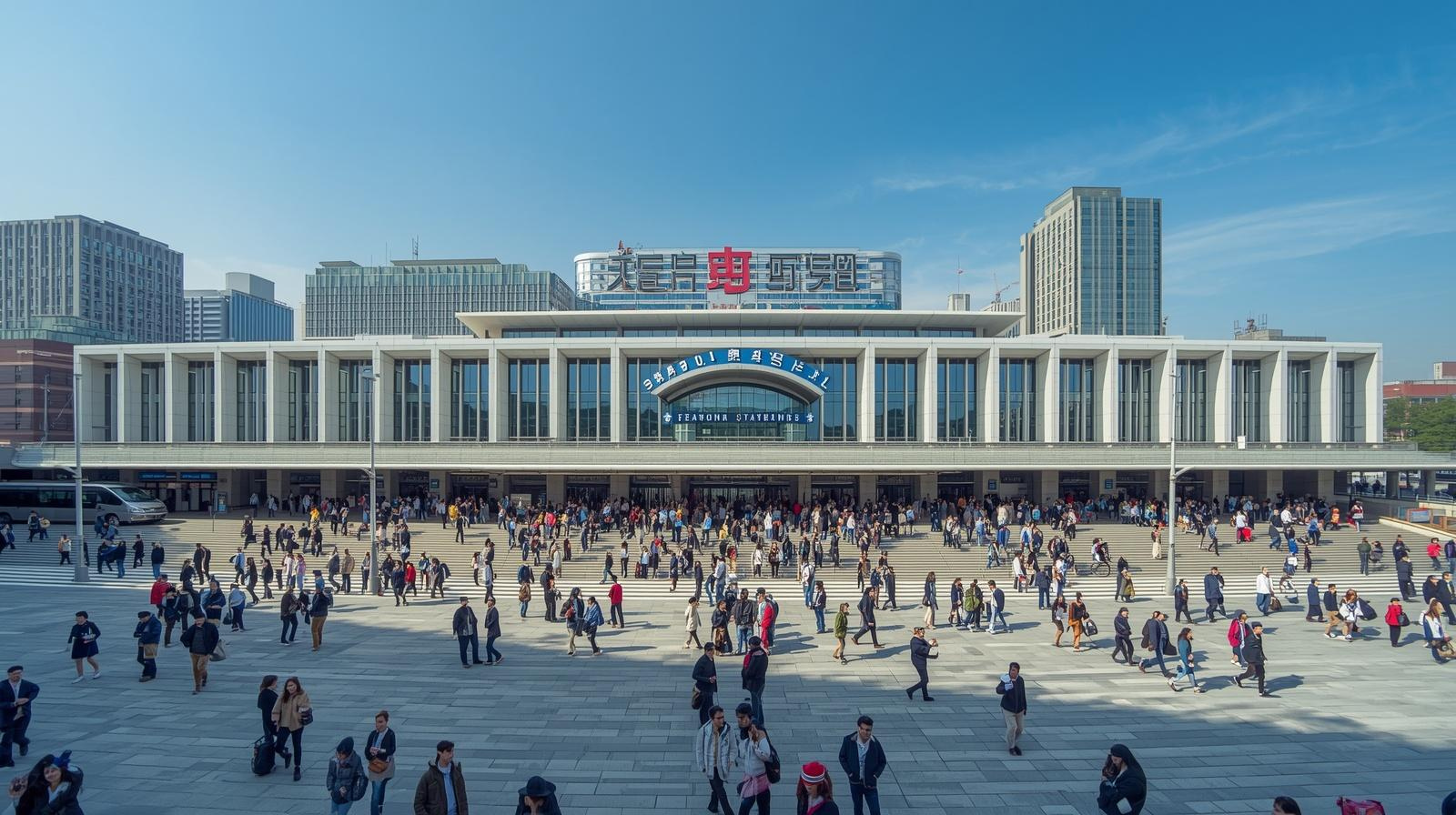
The station that stands today is, in fact, two stations occupying the same precinct: the original 1925 building, a domed Renaissance Revival structure modelled on Tokyo Station and now preserved as a cultural heritage site; and the vast modern complex opened in 2004 alongside it, which serves as the northern terminus of Korea’s KTX high-speed rail network and handles in excess of 100,000 passengers on a typical weekday. Together, they embody the central tension of contemporary Seoul, a city simultaneously obsessed with its future and haunted by its past.
To pass through Seoul Station is to move through layers of Korean time. The commuter pressing through the automatic barriers at dawn; the elderly man who remembers arriving from the provinces in the 1960s to find work in factories that did not yet exist; the tourist bound for Busan on the KTX; the teenager with headphones who has never known a Korea without high-speed internet and global cultural influence, they share this space, and its walls hold all of their stories simultaneously.
Historical Background: A Station Born Under Colonial Rule
The history of Seoul Station begins not with Korean ambition but with Japanese imperial strategy. Following Japan’s annexation of Korea in 1910, the colonial Government-General undertook a systematic modernisation of Korean infrastructure, railways chief among them. Railways were the sinews of colonial control: they moved troops, extracted resources, and connected the peninsula to the wider Japanese empire. The station at Namdaemun, named for the Great South Gate of the old Joseon capital, was a key node in this network.
The first station on the site, a modest wooden structure, opened in 1900 as Noryangjin Station before the line was extended into the city proper. A more permanent station building was constructed in 1915, but it was the magnificent structure completed in 1925 that gave Seoul its defining rail landmark. Designed by a Japanese architect, Tsukamoto Yasushi, in a Western Renaissance Revival style that deliberately echoed Tokyo Station, itself designed in a Dutch Renaissance manner by Kingo Tatsuno in 1914, the 1925 building was a statement of imperial prestige: modern, imposing, and unmistakably not Korean.
The irony of the colonial railway system is one that Korean historians have written about extensively. The infrastructure was built by Korean labour, for Japanese purposes, and yet it also created physical connections across the peninsula that would prove foundational for the independent Korean state that emerged in 1945. The railway lines that the Japanese built to extract coal from the northern mountains and rice from the southern plains became, after liberation, the arteries of Korean economic integration and national cohesion.
The 1925 Building: Architecture of Ambiguity
Design and Style
The original Seoul station building is a work of considerable architectural quality, even as its history complicates any simple admiration. The two-storey structure is dominated by a large central copper dome, now aged to a distinctive verdigris green, which rises above a symmetrical facade of red brick and granite. The entrance is framed by a grand arched portal, and the facade is articulated with pilasters, rusticated stonework, and classical cornice details that draw on the vocabulary of late Renaissance and Baroque European civic architecture.
The interior, now restored and open as a cultural venue, retains much of its original character. The main waiting hall, a double-height space beneath the dome, has the gravitas of a public building designed to impress. Stained glass windows admit coloured light, marble floors and wainscoting speak of institutional permanence, and the proportions of the space create a sense of occasion quite different from the utilitarian transit sheds of lesser stations. It is a building that insists on the importance of travel, and of those who travel.
The Tokyo Station Parallel
The resemblance between the 1925 Seoul Station and Tokyo Station is not coincidental. Both buildings deploy a similar vocabulary of red brick, white stone trim, copper domes, and symmetrical massing. The parallel was deliberate: by making Seoul’s principal station architecturally legible as a sibling of Tokyo’s, the colonial administration was asserting the incorporation of Korea into a Japanese-centred modernity. Architecture, here as elsewhere, was put in the service of ideology.
The comparison is worth pursuing for another reason, however: it illuminates how architectural styles travel and transform. Kingo Tatsuno’s Tokyo Station was itself derived from Dutch Renaissance models, specifically Amsterdam Central Station, designed by P.J.H. Cuypers in 1889. By the time this style reached Seoul, it had passed through Japanese interpretation and emerged as something that belongs to none of its source traditions entirely, but speaks instead of the complex cultural flows of early twentieth-century Asia.
Designation and Restoration
After decades of use as an active station, the 1925 building was decommissioned as a rail facility when the new Seoul Station complex opened in 2004. Rather than demolish it, a fate that has befallen many significant colonial-era buildings in Korea, where the politics of historical memory are complex, the city designated it Historic Site No. 284 and undertook a careful restoration. It reopened in 2011 as “Culture Station Seoul 284”, a multi-purpose cultural venue hosting exhibitions, performances, and public events.
The restoration raised difficult questions that Korean society continues to grapple with: how to preserve buildings associated with colonial oppression without appearing to commemorate or valorise that oppression; how to acknowledge historical complexity without either sanitising the past or succumbing to a paralysing guilt that prevents engagement with it. The solution adopted, adaptive reuse as a cultural space, with the building’s colonial origins explicitly acknowledged in its interpretation, represents a thoughtful, if inevitably imperfect, negotiation of these tensions.
War, Division, and the Station in Korean Memory
No account of Seoul Station can avoid the Korean War. When North Korean forces crossed the 38th parallel on 25th June 1950, Seoul fell within three days. The station, as the city’s principal transport hub, was a primary military objective and a focal point of the chaos that engulfed the capital. Hundreds of thousands of civilians attempted to flee southward through the station in those first terrible days; many did not make it. The Han River bridges were blown by the ROK Army on 28th June, with civilians still crossing them, in a desperate attempt to slow the North Korean advance, but Seoul fell regardless.
The city changed hands four times during the war. Each time, the station was a site of military transit, civilian displacement, and the particular horror that attends the occupation and reoccupation of a great city. By the time the armistice was signed in July 1953 and Seoul was definitively in South Korean hands, the station building had suffered significant damage, much of the city lay in ruins, and the peninsula was divided along a line that has not moved since.
The division of Korea gave Seoul Station a particular emotional resonance that it retains to this day. For decades after the war, the station was the point of departure for Koreans travelling south, but the lines that had once run north, to Pyongyang and beyond, were severed. Families divided by the war, longing for relatives in the north whom they would never see again, passed through this building. The northbound platforms became a kind of wound in the city’s geography, serving no trains, pointing toward an unreachable destination. The Gyeongui Line, which had connected Seoul to Sinuiju on the Chinese border, was among the most evocative of these severed arteries.
The Miracle on the Han River: Reconstruction and Growth
Korea’s economic recovery from the devastation of the war was one of the most remarkable development stories of the twentieth century. From a per capita income lower than many African countries in 1953, South Korea grew to become the world’s tenth-largest economy by the 1990s. Seoul was the engine and showcase of this transformation, expanding from a ruined city of under a million people at the war’s end to a metropolitan area of over 25 million by the turn of the millennium.
Seoul Station was at the centre of this transformation. The great internal migration of the 1960s and 1970s, when hundreds of thousands of Koreans left the countryside to seek work in Seoul’s expanding industrial districts, passed through the station. For many migrants, arriving at Seoul Station for the first time was the defining experience of their new life: the overwhelming scale of the city, the noise and pace of modernity, the mixture of hope and disorientation that attends all great migrations. Korean literature and cinema of this period returns again and again to the figure of the provincial arriving at Seoul Station, suitcase in hand, country accent intact, facing a city that had not finished becoming itself.
The KTX Revolution: High-Speed Rail Comes to Korea
Development and Opening
Korea’s decision to build a high-speed rail network was taken in the late 1980s, as the country prepared for the 1988 Seoul Olympics and began to think seriously about its infrastructure needs for the coming century. The conventional rail network, the Gyeongbu Line connecting Seoul to Busan, Korea’s second city, was approaching capacity saturation, and journey times of four to five hours between the two cities were a significant constraint on the economic integration of the peninsula.
After extensive study of French, German, and Japanese high-speed rail systems, Korea chose to base its KTX (Korea Train eXpress) technology on the French TGV, developed by Alstom. The decision reflected a pragmatic assessment of technology maturity and the strength of France’s offer, which included significant technology transfer provisions that would allow Korea to develop its own high-speed rolling stock over time. Unlike China, which would later adopt a similar strategy on a vastly larger scale, Korea was building a single initial corridor rather than a national network, and the terms of the technology partnership reflected this more modest scope.
Construction of the Seoul–Busan KTX line proved extraordinarily complex and expensive. The route traverses some of the most geologically challenging terrain in East Asia, the mountainous interior of the Korean peninsula, requiring dozens of tunnels, hundreds of viaducts, and an enormous quantity of precision earthwork. The project, begun in 1992, took twelve years to complete and cost significantly more than originally projected. The line opened on 1st April 2004, with Seoul Station as its northern anchor.
The New Seoul Station Building
The opening of KTX services required a new station facility capable of handling the increased passenger volumes and the specific operational requirements of high-speed rail. The new Seoul Station building, designed by the architectural firm Gansam Architects and Partners, opened alongside the KTX line in 2004. It is a large, modern structure, executed in glass, steel, and polished stone, that connects directly to the 1925 building through an enclosed elevated walkway, allowing the two stations to function as a single integrated complex while maintaining their architectural distinctness.
The design of the new building is confidently contemporary, with none of the historicist references that characterise the colonial-era structure. A large glass curtain wall facade floods the main concourse with natural light, and the circulation system, escalators, lifts, and wide pedestrian corridors, is designed for the rapid movement of large numbers of passengers. The building is integrated with the Seoul Metropolitan Subway at basement level, connecting to Lines 1 and 4, and with the Airport Railroad Express (AREX), which provides a direct link to Incheon International Airport.
KTX Operations: Shrinking the Peninsula
The impact of KTX services on Korean life has been profound and is still unfolding. The journey from Seoul to Busan, 421 kilometres, takes 2 hours 15 minutes on the fastest KTX services, compared with around 4 hours 30 minutes on the fastest conventional express trains it replaced. This compression of distance has fundamentally altered the relationship between Korea’s two largest cities. Day trips from Seoul to Busan, once impractical, are now routine. Business meetings, cultural events, and personal journeys that would previously have required an overnight stay can be accomplished in a single day.
The KTX network has expanded considerably since 2004. The Honam KTX line extended high-speed services to Gwangju and Mokpo in the southwest; the Gyeonggang line connected to Gangneung on the east coast (dramatically in time for the 2018 PyeongChang Winter Olympics, which the new line effectively made accessible from Seoul in around two hours); and further extensions have progressively extended the network’s reach. From Seoul Station, KTX services now fan out to most major Korean cities, making the station the de facto centre of the national high-speed rail web.
Korea subsequently developed its own domestically designed high-speed trains, designated KTX-Sancheon and later KTX-Eum, reducing dependence on the French TGV technology and building Korean expertise in high-speed rail engineering. These trains, manufactured by Hyundai Rotem, operate alongside the original TGV-derived sets on services from Seoul Station, and are scheduled to become the dominant rolling stock on the Korean network in the coming years.
Architecture of the New Complex: Design in Detail
The Main Concourse
The main concourse of the new Seoul Station is a generous, well-organised space that handles its enormous daily passenger flows with relative ease. The ground-level hall, accessed from the station’s street frontage on the western side, is dominated by a high glass atrium that admits daylight and creates a sense of spaciousness unusual in Asian urban rail stations, where the pressure of land values typically produces compact, utilitarian interiors. The ticketing machines and staffed windows are arrayed along one wall; the departure boards, in the clean typography of Korean Rail (Korail), display the next hour’s services in Korean, English, and Chinese.
The waiting areas are comfortably furnished and maintained to a high standard of cleanliness that reflects the particular Korean emphasis on public orderliness. Commercial facilities, coffee chains, convenience stores, restaurants, and a food court, are concentrated on the concourse level and the level above, with a wider range of dining options available in the underground mall that connects the station to the surrounding retail district.
Multi-Modal Integration
One of the most significant features of Seoul Station is its integration with multiple transport systems. The station serves as a hub for KTX high-speed services, Saemaeul and Mugunghwa conventional express trains, the Seoul Metropolitan Subway (Lines 1 and 4), the Airport Railroad Express (AREX), and numerous bus routes including several intercity coach services. This multi-modal integration means that Seoul Station functions not merely as a railway terminus but as the most important single transport interchange in South Korea.
The AREX connection deserves particular mention. Opened in 2010, the Airport Railroad Express runs from Seoul Station to Incheon International Airport in approximately 43 minutes on the all-stop service, or 51 minutes on the airport express service with a premium fare. More significantly, Seoul Station hosts an off-airport check-in facility where passengers can check in for flights operated by Korean Air and Asiana Airlines and deposit their luggage before travelling to the airport, collecting boarding passes and proceeding directly to the departure gates on arrival. This facility, the only one of its kind in South Korea, transforms the passenger experience for departing international travellers and represents an unusual degree of integration between rail and aviation transport systems.
Social Dimensions: The Station as Urban Space
Homelessness and Social Welfare
Seoul Station has a social dimension that its gleaming concourses do not always advertise but cannot conceal. The station and its immediate surroundings have long been a gathering place for Seoul’s homeless population, a visible manifestation of the social costs of rapid urbanisation and economic inequality that Korea’s remarkable growth story has produced alongside its prosperity. In winter, the underpasses and heated public areas of the station provide crucial warmth for those without shelter; in summer, the shaded arcades offer refuge from the heat.
The presence of the homeless at Seoul Station has been a source of persistent civic tension, periodically prompting calls for removal and dispersal from business interests and commuters, and equally persistent counter-arguments from social welfare advocates who point out that the station is one of the few places in the city where marginalised people can access the basic amenities of shelter, warmth, and proximity to social services. The debate is a microcosm of broader Korean arguments about the social contract, the obligations of a prosperous society to its most vulnerable members, and the uses of public space.
The Station in Popular Culture
Seoul Station has been a recurrent presence in6 Korean film, literature, and music. The 2016 animated film “Seoul Station”, a prequel to the enormously successful zombie thriller “Train to Busan”, opens with the station’s homeless community and uses the location to explore themes of social exclusion, state indifference, and the fragility of the structures that separate the comfortable from the desperate. The choice of Seoul Station as a setting was entirely natural: it is a space where the full social spectrum of Korean life is visibly present, where the successful and the struggling share the same platforms.
In Korean literature, Seoul Station appears as a threshold space, a place of transformation where characters leave behind one version of themselves and begin another. The migrant arriving from the provinces, the student departing for a new life, the soldier returning from military service (mandatory for Korean men and a rite of passage that has shaped generations of Korean identity), Seoul Station is where these transformations begin and end. Its emotional geography in Korean culture is as rich as any landmark in the capital.
Reunification Dreams: The Northern Platforms
Perhaps the most poignant aspect of Seoul Station is what it lacks: active rail connections to the north. The Gyeongui Line, which once ran from Seoul through Kaesong to Sinuiju on the Chinese border, was severed at the demilitarised zone in 1953 and has remained disconnected, apart from a brief experimental reconnection between 2007 and 2008 during a period of improved inter-Korean relations, when a limited number of freight trains operated between Seoul and the Kaesong Industrial Complex just north of the border.
The northbound platforms at Seoul Station carry an immense symbolic weight in Korean consciousness. The dream of reconnecting the Korean railway network, and, by extension, of Korean reunification more broadly, has motivated numerous proposals for extending KTX services northward to Pyongyang, and eventually across the Trans-Siberian Railway connection to Europe. Proponents of this vision argue that a rail connection between the Korean peninsula and the European rail network, via Russia and China, would transform the economic geography of Eurasia and create powerful incentives for political reconciliation.
This vision, grandiose, romantic, and as yet entirely hypothetical, haunts Seoul Station. Every traveller heading south on the KTX passes platforms that point north toward an unreachable destination. The station is, in this sense, a monument not only to where Korea has been and where it is now, but to where it might yet go, if history can be persuaded to yield.
Visiting Seoul Station: A Practical Guide
Seoul Station is located in Jung-gu, the central district of Seoul, approximately 2 kilometres southwest of the historic Namdaemun Market and 3 kilometres west of the City Hall area. It is among the most accessible points in the city, served by two metro lines, multiple bus routes, and the AREX airport connection. Most major tourist areas of central Seoul are within thirty minutes by public transport.
For visitors interested in the architectural heritage of the old building, Culture Station Seoul 284 opens its doors regularly for exhibitions and events, and even when no event is scheduled, the exterior of the 1925 building, with its copper dome and red-brick façade, is well worth examining from the plaza that separates it from the new station complex. The contrast between the two buildings, old Seoul and new Seoul, imperial past and technologically confident present, is visible at a glance and tells more about Korean history than many hours of museum-going.
Taking the KTX from Seoul Station is itself a highly recommended experience, even for travellers without a specific destination in mind. The Busan route, passing through Daejeon, Daegu, and Gyeongju, offers a rapid cross-section of the Korean peninsula, from the dense urban fabric of the capital through industrial cities, agricultural plains, and mountain tunnels to the port and beach city of Busan. The train itself is comfortable, quiet, and punctual to a degree that will impress passengers accustomed to European rail services. Tickets can be purchased at the station, on the Korail website, or through the KorailTalk app.
The area immediately surrounding Seoul Station has undergone significant redevelopment in recent years, most notably the transformation of the elevated Seoullo 7017 (formerly the Seoul Station Overpass, an urban freeway ramp built in 1970 and decommissioned in 2015) into an elevated urban park and pedestrian walkway. Designed by the Dutch firm MVRDV and opened in 2017, Seoullo 7017 offers a distinctive elevated promenade connecting Seoul Station to the surrounding neighbourhoods, planted with over 24,000 plants representing 228 native Korean species. It is an ambitious piece of urban placemaking that reflects Seoul’s growing confidence in treating public space as a civic asset.
Seoul Station in Regional Context
Seoul Station invites comparison with the great railway stations of its East Asian neighbours. Tokyo Station, the most obvious parallel given the colonial-era architectural connection, shares Seoul Station’s duality of historic building and modern extension, though the Tokyo building has been more extensively restored to its original appearance following wartime damage. Osaka Station and Shanghai Hongqiao are more purely modern facilities, lacking the historical accretion that gives Seoul Station its complexity.
What distinguishes Seoul Station from these comparisons is the intensity of the historical experience it has absorbed. Tokyo Station survived the Second World War with its structure intact, though damaged; it did not witness an occupation, a division, a refugee crisis. Shanghai Hongqiao is entirely a creation of the high-speed rail era and carries no pre-modern memory. Seoul Station alone, among the great East Asian railway stations, holds within its precincts both the architecture of colonial modernity and the infrastructure of the technological present, separated by a century of extraordinary history and connected by the continuous thread of Korean life flowing through both buildings, day after day, decade after decade.
Conclusion: Where Korea Meets Itself
Seoul Station is a place where Korea is continuously rehearsing its own identity. Every day, in its concourses and on its platforms, the country’s past and its present are simultaneously present. The 1925 dome, green with age, presides over the plaza with a dignity that its origins in colonial ambition have not diminished, because buildings accumulate meanings beyond the intentions of those who commission them. The KTX trains departing every few minutes for Busan, Gwangju, and Gangneung carry the confidence of a nation that has built, in half a century, one of the most sophisticated rail systems in the world.
Between these two poles, the inherited building and the constructed future, passes the daily life of a city and a nation: the commuters and the travellers, the businesspeople and the tourists, the elderly who remember when the northern platforms were not merely symbolic and the young who cannot imagine the peninsula as anything other than it is. Seoul Station holds all of them, as it has held all their predecessors, as it will hold whoever comes after them.
The trains run south. The northern platforms wait. And the station, as it has always done, endures.
Seoul Station • Established 1900 | Historic Site No. 284 | KTX Hub since 2004 | Jung-gu, Seoul, South Korea
Leave a Reply