
Three Centuries of the Green Banner of Faith
11th March 2026 · يوم العلم السعودي · Saudi Flag Day
| Date | 11th March, annually |
| First celebrated | 11th March 2023 (86th anniversary of the flag’s adoption) |
| Established by | Royal Order of King Salman bin Abdulaziz Al Saud, 1st March 2023 |
| Commemorates | King Abdulaziz’s adoption of the national flag on 11th March 1937 |
| Flag colour | Green (Pantone 330C) with white Shahada and sword |
| Unique distinction | The only national flag in the world that is never flown at half-mast |
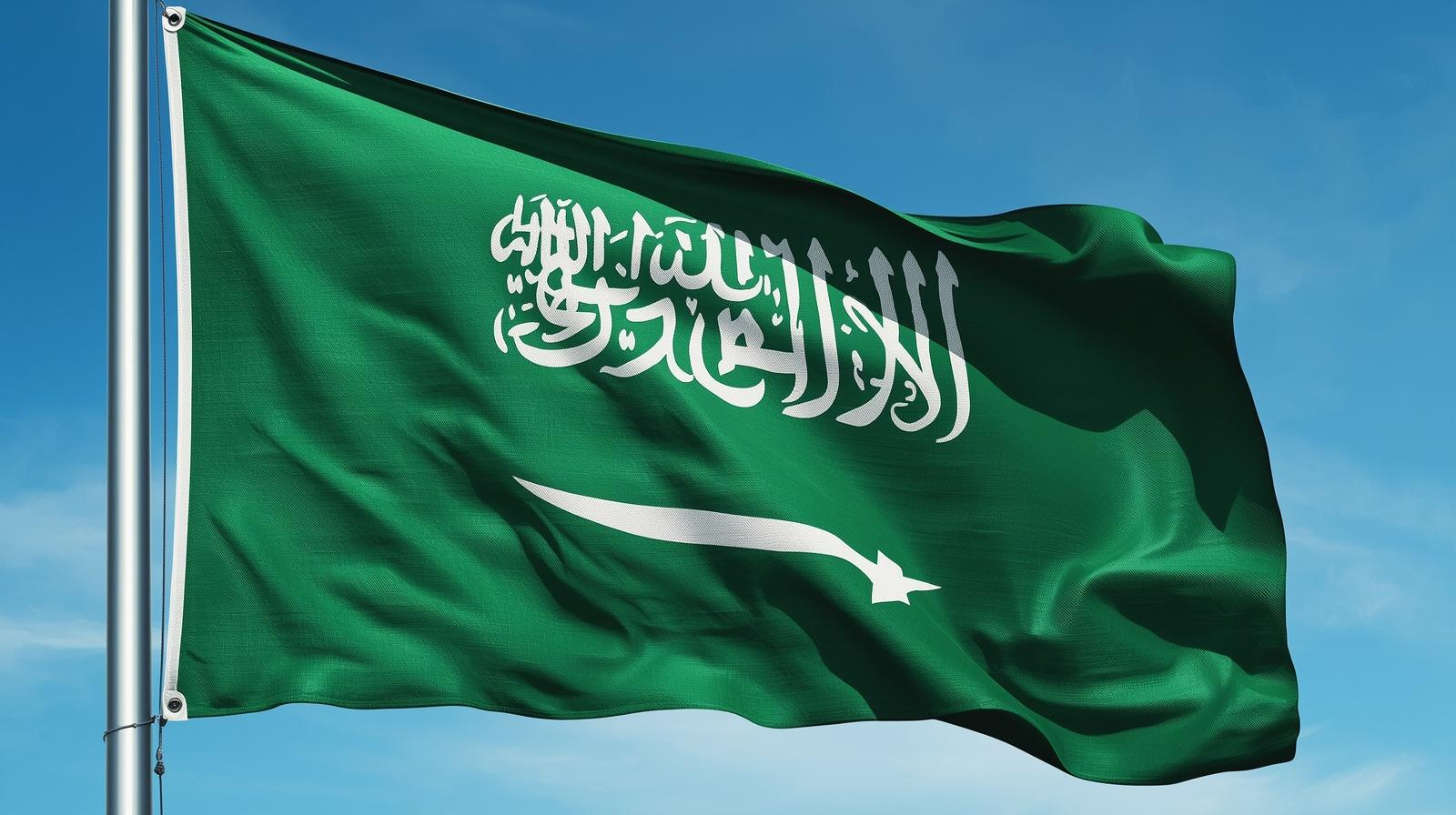
What Is Saudi Flag Day?
Every year on 11th March, the Kingdom of Saudi Arabia celebrates Flag Day, known in Arabic as Yawm al-Alam (يوم العلم). Streets, neighbourhoods, government buildings, and private homes across the Kingdom are draped in the iconic green flag. Drone shows light up the sky over major cities. Schools hold assemblies. Citizens share images of the flag on social media in a wave of national pride. At Saudi Arabia’s embassies and consulates around the world, the green banner of the Kingdom is raised with ceremony and reflection.
The day is relatively new: Flag Day was established by Royal Order of King Salman bin Abdulaziz Al Saud on 1st March 2023, with the first celebration held just ten days later on 11th March 2023. Yet the occasion it commemorates reaches back nearly three centuries. Saudi Flag Day marks the moment on 11 March 1937 when King Abdulaziz ibn Saud formally adopted the national flag in its modern form, and, through that flag, celebrates the entire history of the Saudi state stretching back to its founding in 1727.
It is the Kingdom’s third non-religious national holiday calculated by the Gregorian calendar, joining Saudi National Day (23rd September) and Saudi Founding Day (22nd February). Its creation reflects a broader effort under Saudi Vision 2030 to strengthen national identity, celebrate the Kingdom’s heritage, and give Saudi citizens a richer calendar of civic occasions that connect them to their history.
The value of the national flag extends throughout the history of the Saudi state since its founding in 1727, bearing the Islamic declaration of faith in the middle, symbolising the message of peace and the religion of Islam upon which this blessed state was established.
A Flag Older Than the Kingdom: The History of the Saudi Banner
The First Saudi State and the Green Banner of Faith (1727)
The history of the Saudi flag does not begin in 1937, nor in 1932 when the modern Kingdom was proclaimed. It begins in 1727, in the oasis town of ad-Dir’iyyah in the Najd region of the central Arabian Peninsula, when Imam Mohammed bin Saud founded the First Saudi State. From that founding moment, a green flag bearing the Shahada, the Islamic declaration of faith, ‘There is no God but Allah and Muhammad is the Messenger of Allah’, was raised as the banner of the new state.
That first flag, described in historical sources as green silk and wool with the Shahada woven upon it, was carried personally by Imam Mohammed bin Saud and, in his place, by his sons as they led their armies. According to the historian Ibn Bishr, before any military campaign, the flag would be raised near the palace gate as a call to arms, with tribal leaders and regional princes gathering around it before departure. The flag was not merely decorative: it was the physical embodiment of the state, of its faith, and of the authority of its ruler. For nearly three centuries, it has fulfilled that role without interruption.
The Alliance of 1744 and the Wahhabi Reform Movement
The green banner of the Saudi state was inseparable from its religious identity. In 1744, Imam Mohammed bin Saud formalised a historic alliance with the Islamic scholar and reformist Muhammad ibn Abd al-Wahhab, whose movement sought to purify Islamic practice and return to its foundational principles. This alliance, combining political authority with religious legitimacy, became the ideological engine of the Saudi state. The colour green on the flag carried deep Islamic resonance, associated with the Prophet Muhammad’s lineage through his daughter Fatimah, and chosen by the Wahhabi movement as it began its campaign to unify the Arabian Peninsula in the late eighteenth century.
A remarkable eyewitness account survives from 1807, recorded by Domingo Badia, a Spanish spy travelling under the Muslim alias Ali Bey el Abbassi. Posing as a pilgrim, he entered Makkah and witnessed the army of Imam Saud, son of the second Saudi ruler Abdulaziz bin Muhammad, entering the holy city. He recorded seeing 45,000 of Saud’s followers in pilgrimage dress, all carrying green flags bearing the Shahada written in large white Arabic letters. This account is one of the earliest detailed external descriptions of the Saudi banner, and it confirms the flag’s already deep-rooted role as the symbol of both the state and its faith.
The Second Saudi State and Continuity of the Banner (1824)
The First Saudi State collapsed between 1818 and 1824 under military pressure from the Ottoman Empire and its Egyptian ally, who viewed the expanding Wahhabi-Saudi power as a threat to Ottoman authority over the holy cities of Makkah and Madinah. But the Saudi state was revived. Imam Turki bin Abdullah, founder of the Second Saudi State, re-established Saudi authority in Riyadh and the surrounding regions, and the green banner bearing the Shahada was raised once again. The Second State carried the same flag as the First, maintaining an unbroken visual and symbolic continuity across the decades of struggle and revival.
Historical records of the Second Saudi State describe the same ritual of the flag: before raids and campaigns, tribal and regional leaders were summoned to gather at a specified location marked by the flag, which Imam Turki or his son Faisal would oversee in procession. The flag was the call, the rallying point, and the promise of the state’s authority and protection. This tradition of the flag as living symbol, not just a piece of cloth but an animate expression of sovereignty, runs continuously from 1727 to the present day.
Ibn Saud, Unification, and the Sword (1902–1932)
The modern history of Saudi Arabia begins on 15 January 1902, when the young King Abdulaziz ibn Saud, then just 22 years old, led a small party of followers in a daring night raid on Riyadh, recapturing the city from the rival Al Rashid family and restoring Al Saud rule over the Saudi heartland. It was the opening move of a thirty-year campaign of unification. As he consolidated power across the Arabian Peninsula, bringing Najd, Hejaz, Asir, and Al-Ahsa under his authority, King Abdulaziz refined the Saudi flag.
In 1902, as he established himself as the Sultan of Nejd, the sword was added to the flag for the first time, placed above the Shahada. Variants appeared over the following years, including versions with two crossed swords and a white vertical stripe at the hoist. These variations reflected the different territories and functions of the expanding state. In 1926, as King of Nejd and Hejaz, King Abdulaziz ordered the founding body to study and standardise the flag’s design. The process of formalisation had begun.
On 23rd September 1932, a Royal Decree united all the territories under the name the Kingdom of Saudi Arabia, with Abdulaziz as its king. The Nejdi flag, bearing the Shahada and sword on a green field, became the national flag of the new kingdom, though it remained unstandardised in its precise dimensions and design details.
For nearly three centuries, the Saudi flag has been a beacon, a banner, and a witness to the campaigns that built and unified the Saudi state. Citizens have taken it as a proud symbol of honour that will never be lowered.
The Formal Adoption: 11th March 1937
The date commemorated by Flag Day, 11th March 1937, marks the moment when King Abdulaziz formalised the Saudi flag by adopting Shura Council Resolution No. 354, setting the flag’s dimensions at 150 centimetres in length and 100 centimetres in width. The resolution also designated separate flags for the King himself, the Crown Prince, the Armed Forces and aviation, the Royal Saudi Navy, and commercial maritime purposes. A special flag for the king was created, matching the national flag but with the national emblem, two crossed swords above a palm tree, embroidered in gold in the lower corner of the hoist side.
By this point the flag had assumed essentially its current form: a green field bearing the Shahada in white, with a white sword beneath it, the handle directed toward the lower right. The sword in the 1937 version was more curved than the straight sword of the modern flag, and the inscription took up more of the flag’s field, but the essential design was in place. This is the moment Flag Day commemorates: the point at which the centuries-old green banner of the Saudi state became an officially defined, legally codified national symbol.
The Standardisation of 1973
The Saudi flag as seen today was formally standardised under the National Flag Law issued by royal decree of King Faisal on 15 March 1973. This decree resolved a longstanding issue with the flag’s design: because the Shahada is written in Arabic script, which reads from right to left, a flag that simply mirrored the inscription would produce reversed and unreadable text on the reverse side. The 1973 design solved this by ensuring that the white inscription and sword are double-sided, visible and correct from both faces of the flag, a technical achievement that required careful construction.
The 1973 standardisation also changed the sword from a curved blade to a straight one, and reduced the scale of the inscription relative to the green field, giving the flag the proportions now recognised worldwide. The implementing regulations of the Flag Law were issued in 1978, and in 1986 the Saudi Arabian Organisation for Standardisation and Metrology issued precise geometric specifications for every element of the flag. The 1992 Basic Law of Governance gave the flag its final constitutional expression: green, with width equal to two-thirds of its length, bearing the Shahada in the Thuluth script with a straight sword beneath, and never to be lowered at half-mast.
The Symbolism of the Saudi Flag
Green: The Colour of Islam and Life
The green of the Saudi flag is one of the most significant greens in the world of vexillology. It is not a colour chosen for aesthetic reasons alone: it carries centuries of meaning. Green is the colour most closely associated with Islam, traditionally linked to the Prophet Muhammad and to the description of paradise in the Quran. It was the chosen colour of the Wahhabi movement as it unified the tribes of the Arabian Peninsula, and it has adorned the Saudi banner without interruption since 1727. The specific shade used today is precisely defined as Pantone 330C. Symbolically, green also represents growth, fertile land, vitality, and prosperity, fitting for a nation built from the desert.
The Shahada: The Declaration of Faith
At the heart of the Saudi flag is the Shahada, written in elegant white Thuluth calligraphy: ‘La ilaha illallah, Muhammadun rasulullah’ — ‘There is no God but Allah, and Muhammad is the Messenger of Allah.’ This is the most fundamental statement of Islamic faith, the declaration required to become a Muslim and the foundation of Islamic theology. Its presence on the flag makes the Saudi national banner unique among the flags of the world: it is both a national symbol and a sacred religious text.
This dual character has important practical and legal consequences. Because the Shahada is considered holy, the Saudi flag is subject to strict rules of respect that differ from those governing most other nations’ flags. It is prohibited from being printed on clothing or used as a commercial trademark without official permission. Saudi Arabia famously protested against its inclusion on a FIFA football ahead of the 2002 World Cup, and objections have been raised on several occasions when the flag has appeared in contexts deemed disrespectful to its sacred text. The flag is never to be flown vertically in its standard form, though special vertical versions exist with the inscription and sword rotated accordingly.
The Sword: Strength, Justice, and Dignity
Beneath the Shahada, a single white sword points to the lower right, its blade straight and its handle at the lower left. The sword was added to the flag by King Abdulaziz in 1902 as he began his campaign to unify the Arabian Peninsula, and it represents strength, dignity, deep wisdom, and the pursuit of justice. It is the sword of King Abdulaziz himself, the founder’s personal weapon, and its straightness in the current version symbolises precision and righteousness. The sword does not represent aggression or conquest for its own sake, but the capacity and the will to defend the faith, the people, and the state.
A Flag That Never Flies at Half-Mast
One of the most extraordinary facts about the Saudi flag is that it is never lowered to half-mast. Saudi Arabia is the only country in the world whose national flag carries this absolute prohibition. The reason is theological: because the flag bears the Shahada, the sacred declaration of Islamic faith, lowering it would be considered an act of disrespect toward the words of God. Even at moments of national mourning, the death of a king, a national catastrophe, or a period of grief, the green flag of Saudi Arabia continues to fly at full height. When it is lowered at the end of an official occasion, it must be carefully folded so that the Shahada faces upward, and it must be stored in a flag case. The flag must never touch the ground or water.
Establishing Flag Day: The Royal Order of 2023
Saudi Flag Day was created by Royal Order on 1st March 2023, the very first day of Ramadan in that year, issued by King Salman bin Abdulaziz Al Saud. The order designated 11 March as an annual national occasion to celebrate the Saudi flag, reflecting the belief of King Salman and Crown Prince and Prime Minister Mohammed bin Salman that the flag carries immense significance as a manifestation of the Saudi state, its strength and sovereignty, its cohesion and national unity.
The date of 11th March was chosen to commemorate King Abdulaziz’s formal adoption of the flag on 27 Dhul-Hijjah 1355 AH, corresponding to 11th March 1937. The first Flag Day was therefore the 86th anniversary of that adoption. Flag Day joined Saudi National Day, celebrated on 23rd September to mark the proclamation of the Kingdom in 1932, and Saudi Founding Day, celebrated on 22nd February to mark the founding of the First Saudi State in 1727, as the Kingdom’s three main non-religious national occasions on the Gregorian calendar.
How Flag Day Is Celebrated
The celebrations of Saudi Flag Day blend official ceremony with popular participation. Across the Kingdom, the national flag is raised on all government buildings and public institutions. Saudi embassies and consulates worldwide fly the flag on the day and may hold receptions or events for the Saudi community abroad. In Riyadh and other major cities, the day is typically marked by fireworks displays and spectacular drone shows that trace the outlines of the flag across the night sky in green and white light. Landmarks are illuminated in the flag’s colours.
Schools and universities hold assemblies, lectures, and cultural events exploring the history and meaning of the flag. The Ministry of Culture and the National Centre for Archives and Records produce educational materials for schools and the public. On social media, the hashtag for Flag Day trends widely as Saudi citizens share images of the flag and messages of pride and patriotism. Commercial spaces display the flag prominently, and citizens adorn their homes, vehicles, and public spaces with green and white decorations.
The Bairaq al-Ardah, the ceremonial flag used in the traditional Saudi Ardah sword dance and deeply beloved by the country’s kings, also features prominently in Flag Day celebrations. This special flag, with the Shahada and sword embroidered in golden thread on green silk, is carried during Ardah performances, its golden finial glittering atop a four-metre pole. The Ardah is one of Saudi Arabia’s most treasured cultural traditions, and the flag’s role within it speaks to the deep emotional bond between the Saudi people and their national banner.
Why the Flag Matters: Identity, Vision 2030, and the Future
Saudi Flag Day did not emerge in isolation. It is part of a broader programme of national identity-building under Saudi Vision 2030, Crown Prince Mohammed bin Salman’s ambitious plan to transform the Kingdom’s economy and society. Vision 2030 places great emphasis on pride in Saudi heritage, history, and culture as foundations for the national confidence required to navigate a period of profound change. The creation of new national occasions. Founding Day was only established in 2022, Flag Day in 2023. reflects a deliberate effort to deepen Saudi citizens’ connection to their state’s three-century history.
For Saudi Arabia’s young and rapidly growing population, of whom a large majority are under thirty-five, these occasions provide a meaningful connection to a history that stretches back long before the oil era that shaped the modern Kingdom. The flag, in particular, carries that history in its very fabric: the same green, the same Shahada, the same sword that accompanied the founding of the First Saudi State in 1727, carried forward across three Saudi states, countless battles, a century of modernisation, and into a twenty-first century of extraordinary transformation.
The flag’s prohibition on half-masting also carries a message for the future: it is a banner of strength and continuity, not of grief. It does not bow, it does not lower, it does not express defeat. In a region of turbulent history, that constancy has its own kind of power. As Saudi Arabia looks toward 2030 and beyond, the green flag remains what it has always been: a statement of faith, a declaration of identity, and an emblem of a nation that has endured.
The Saudi flag is an eternal value and a symbol of pride and loftiness, carrying the meanings of belonging and citizenship, and the connotations of unification, strength, justice, growth, and prosperity. It embodies the concept of the state and expresses national unity and historical depth.
Timeline: The Saudi Flag and Flag Day
| Timeline: The Evolution of the Saudi Flag & Flag Day | |
| 1727 | Imam Mohammed bin Saud founds the First Saudi State at ad-Dir’iyyah. The first Saudi flag is raised: a green silk and wool banner bearing the Shahada — ‘There is no God but Allah and Muhammad is the Messenger of Allah’. |
| 1744 | The alliance between Imam Mohammed bin Saud and the Islamic scholar Muhammad ibn Abd al-Wahhab is formalised, cementing the green banner of faith as the symbol of the emerging Saudi state. |
| 1807 | A Spanish spy travelling under the alias Ali Bey el Abbassi witnesses Imam Saud’s army entering Makkah — he records 45,000 followers in pilgrimage dress, all carrying a green flag bearing the Shahada in large white Arabic letters. |
| 1824 | The Second Saudi State is established. The same green banner bearing the Shahada continues in use, maintaining continuity with the First State. |
| 1902 | King Abdulaziz ibn Saud recaptures Riyadh and begins the unification of the Arabian Peninsula. A sword is added to the flag for the first time, and variants with two crossed swords and a white hoist stripe come into use. |
| 1926 | King Abdulaziz orders the founding body to study the flag and design a standardised form for the new Kingdom of Hejaz and Sultanate of Nejd. |
| 1932 | The Kingdom of Saudi Arabia is officially proclaimed on 23 September. The Nejdi flag, bearing the Shahada and sword on green, becomes the national flag of the unified kingdom. |
| 1937 | On 11 March (27 Dhul-Hijjah 1355 AH), King Abdulaziz formally adopts the flag by approving Shura Council Resolution No. 354, setting official dimensions of 150cm by 100cm and designating specific flags for the King, Crown Prince, Armed Forces, Navy, and commercial shipping. |
| 1952 | The Shura Council issues revised regulations on flag sizes and specifications following input from the Ministry of Foreign Affairs. |
| 1973 | On 15 March, a royal decree issued by King Faisal formally standardises the flag under the National Flag Law. The inscription is changed to appear identical from both sides. The curved sword is replaced with a straight sword. This remains the current design. |
| 1978 | The Implementing Regulations of the Law of the Flag are issued, setting detailed legal rules for the flag’s use, display, and protection. |
| 1986 | The Saudi Arabian Organisation for Standardisation and Metrology issues precise specifications for the national flag, including exact geometric measurements for the sword and Shahada. |
| 1992 | The Basic Law of Governance formally codifies the flag’s description in law: green, width two-thirds of length, bearing the Shahada and an unsheathed sword, never to be lowered at half-mast. |
| 2023 | On 1 March, King Salman issues a Royal Order designating 11 March as Saudi Flag Day — the first new non-religious public holiday based on the Gregorian calendar after Saudi National Day and Saudi Founding Day. The inaugural celebration is held on 11 March 2023. |
| 2026 | Saudi Flag Day is celebrated on 11 March for the fourth time, with events across the Kingdom and at Saudi diplomatic missions worldwide. |
The Law of the Flag: Rules and Protocol
The Saudi flag is governed by a detailed legal framework accumulated over decades. The National Flag Law of 1973, the Implementing Regulations of 1978, and the standardisation specifications of 1986 together define every aspect of the flag’s physical properties, its permitted uses, and its prohibited uses. The 1992 Basic Law of Governance elevated these provisions to constitutional status.
The flag must always be in good condition: flying a torn or faded flag is prohibited. It must never touch the ground or water. It must never be used as a trademark or for advertising without official permission, and it may not be printed on clothing or other consumer items, out of respect for the sacred Shahada it bears. Special rules apply to the folding of the flag when it is lowered: it must be folded so that the Shahada faces upward and the sword is on the underside, and it must be stored in a flag case.
The flag is raised on all government buildings and public institutions on national and official occasions, including Flag Day, National Day, and Founding Day, as well as on official reception days and throughout the year at permanent installations. Saudi diplomatic missions worldwide fly the flag continuously. The King has a special version of the flag with the national emblem, crossed swords and a palm tree, embroidered in gold in the lower hoist corner. Similar special flags exist for the Crown Prince, the Armed Forces, the Royal Saudi Navy, and the commercial maritime fleet.
Leave a Reply