
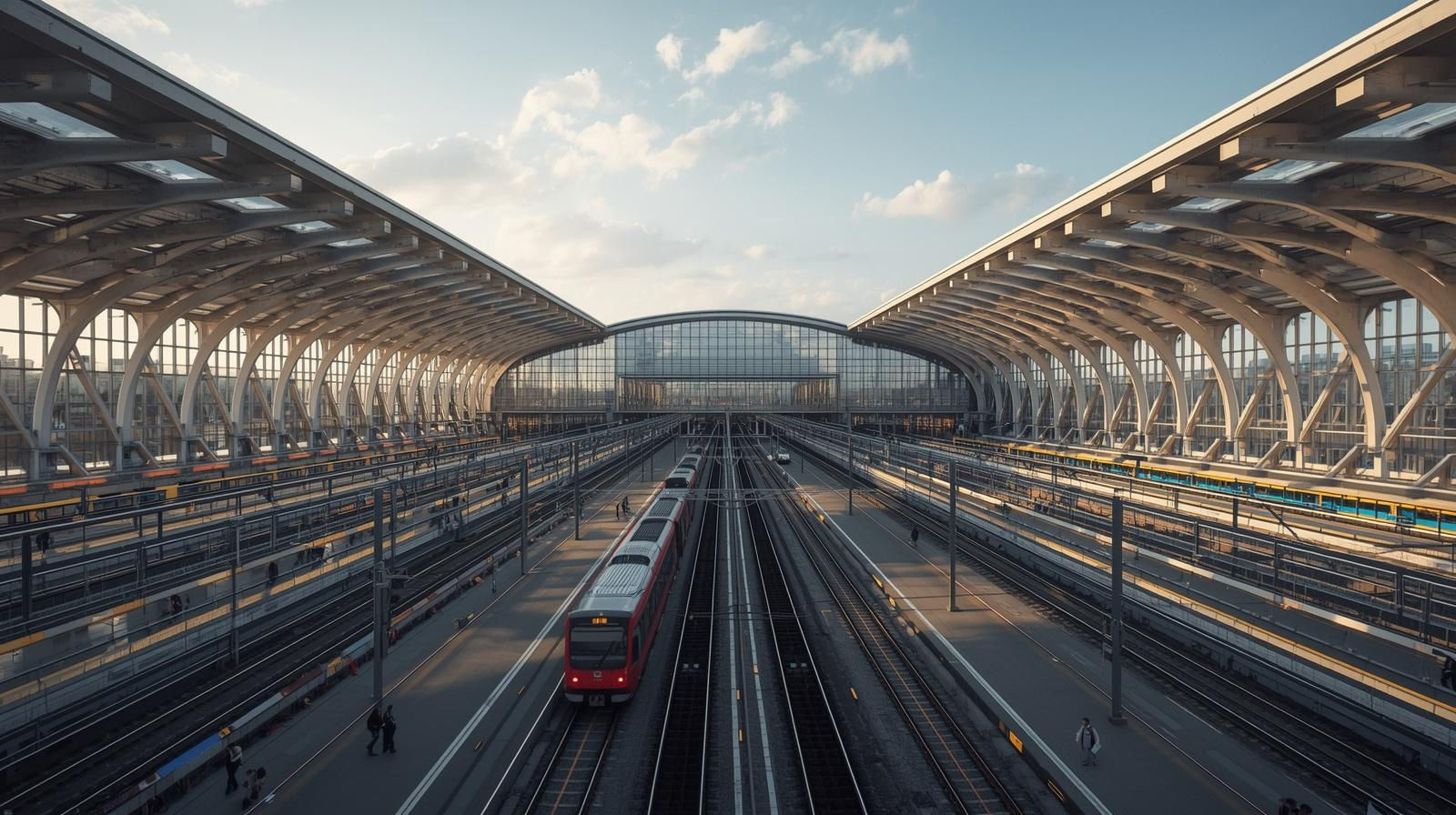
It is one of the most striking buildings in the Netherlands, a gleaming, angular wedge of stainless steel and glass that announces, without apology, that this is a city unafraid of bold ideas. Rotterdam Centraal is not just a train station. It is a statement.
A City Reborn From the Ashes
To understand the station, you first have to understand Rotterdam itself. On the 14th of May 1940, the Luftwaffe reduced the city’s medieval centre to rubble in a matter of hours. Where most European cities rebuilt conservatively, Rotterdam chose to rebuild radically, embracing modernism, glass towers, and experimental architecture as an act of civic defiance. The result is a city unlike any other in the Netherlands: a skyline of skyscrapers, cube houses, and daring public buildings that feels closer to Manhattan or Chicago than to Amsterdam.
The station sits at the heart of this story. The original Rotterdam Centraal was officially opened on 21st May 1957, designed by architect Sybold van Ravesteyn to replace the Delftse Poort station, which had been damaged in the wartime bombing. Van Ravesteyn’s building served the city for half a century, a dignified but ultimately modest post-war structure of separate parts, a standalone entrance building, a tunnel, and individual canopied platforms. It was workmanlike. It was adequate. And by the early 2000s, it was finished.
The Case for a New Station
The story of the new station begins in the mid-1990s, when the Dutch government initiated the ambitious “High-Speed Line South” project, aiming to connect Rotterdam with Antwerp and Brussels. Suddenly, Rotterdam Centraal wasn’t just a national commuter hub, it was going to be a gateway to Europe. The old building simply couldn’t carry that ambition.
*
With 110,000 passengers a day, the station handles as many travellers as Amsterdam Airport Schiphol. The pressure on the existing infrastructure was enormous, and the city and national rail authority ProRail agreed: a complete replacement was necessary, not just a renovation, but something that would genuinely rival the great stations of the continent. The new Central Station of Rotterdam would need to match the efficiency, capacity, comfort, and style of major stations such as Madrid, Paris, London, and Brussels.
Enter Team CS
In 2003, Team CS was founded, a partnership between three architectural firms: Benthem Crouwel Architects, MVSA (Meyer en Van Schooten Architecten), and West 8. It was an unusual arrangement: three independent studios, each with their own identity, working as a single creative unit. Remarkably, they based themselves in the Groot Handelsgebouw, the large commercial building directly opposite the station site, so they could focus entirely on a design taking shape on the very square in front of them.
Design began in 2003, construction started in 2007, and the station was completed in 2014. During the interim years, a temporary structure kept the city moving while Van Ravesteyn’s beloved building was demolished.
The Design: One Roof to Rule Them All
The guiding philosophy of Team CS was elegantly simple. Trains and all station facilities had to be under one roof. Where the old station was a collection of separate elements awkwardly stitched together, the new building would be a single, unified entity.
The station hall now runs all the way through from Proveniersplein on the north side to Stationsplein on the south side, with a 250-metre-wide platform roof forming a single entity with the main entrance hall and passenger thoroughfare.
But the roof is not one thing, it is two, cleverly joined. The roof that spans the entire station is made up of two halves: a high, light section vaulting the tracks and trains, and a more imposing section over the main entrance hall clad in shiny stainless steel. The effect from the street is of a building that shifts and transforms as you move around it, part industrial shed, part futuristic arrowhead.
The roof structure is largely transparent on the northern Provenier side, forming a continuous cover across the rail tracks and ensuring the platforms are flooded with natural light. A print in the glass and different patterns of solar cells tempers the glare, creating an ever-changing play of shadows on the platforms.
*
The Iconic Façade: Steel and the River Maas
The southern entrance is where the drama truly lives. The main entrance features a shiny, stainless steel look that deliberately references the glittering surface of the River Maas. It is a bold, angular canopy, like the prow of a ship, or the nose of a high-speed train, that thrusts toward the city square with unmistakable confidence.
This sweeping canopy of stainless steel and glass creates an inviting and spacious environment for travellers while allowing natural light to flood the station concourse. Inside, the mood shifts entirely. Visitors are greeted by high ceilings, many windows, and a warm wooden interior, a contrast that feels both human and grand. Seven large skylights are installed in the south hall, and depending on the position of the sun, beams of natural light are cast inside via mirrors in the roof, a deliberate “Rembrandt effect,” inspired by the famous image of Grand Central Station in New York.
The station restrains itself to two big moves, a shed over the platforms and a scissor of concrete vaulting over the waiting and transfer area, making it clear that any station is fundamentally about two things: waiting for a train, and arriving at a city.
*
Connecting a Divided City
One of the less obvious but most thoughtful aspects of the design is how it handles the two very different neighbourhoods on either side of the tracks. The districts to the north and south differ greatly in character and density. At Spoorsingel, the front façade is modest, in keeping with the character of the nineteenth-century residential neighbourhood and the smaller passenger flow, in stark contrast with the urbane concourse that performs as a gateway to the metropolitan city centre.
To the south, the architects purposely wanted to create something more outspoken with a certain majesty and allure, in keeping with the scale of its surroundings including the Groot Handelsgebouw building and the high-rise towers along Weena. The station, in other words, speaks a different architectural language depending on which side you approach from, and it does so deliberately.
The square in front of the station, Stationsplein, is now a public space free of traffic, achieved by building a car park beneath the square for 750 vehicles and storage facilities for 5,200 bicycles, with trams relocated to the east side.
Sustainability and Scale
The station is also an example of sustainable architecture. More than 130,000 solar panels have been installed on the roof, accounting for approximately 10,000 m² of the total 28,000 m² roof surface, reducing CO₂ emissions from energy consumption at the station by eight percent.
The finished building covers 46,000 m² and plays an important role in the European network of high-speed rail connections, serving as a gateway to Europe for countless international passengers entering and leaving the Netherlands.
Honouring the Past
For all its forward-looking confidence, the design contains quiet moments of respect for what came before. The original clock and font used at the station’s main entrance were preserved and retained in the new building. One of the original sculptures commissioned for Van Ravesteyn’s 1957 station, affectionately nicknamed the Speculaasjes (Speculoos Cookies), was kept and placed on the platform above the station’s primary bicycle tunnel. Even the Y-shaped pattern of the structural columns is echoed, repeated in the design of the handrails throughout the station.
Why It Stands Out
Rotterdam Centraal works because it understands what a great station actually is. It is not a shopping mall with trains attached. It is not a glass box dressed up in branding. It is user-friendly, accessible, and transparent, a meeting place and hub that opens to the city with a grand gesture.
In a country famous for its pragmatism, this is a building that dares to be magnificent. It fits Rotterdam perfectly, a city that looked at its own ruins and decided to build something worth looking at. The station is proof that infrastructure, when taken seriously, can become civic art.
Rotterdam Centraal: The Station That Dares to Look Like the Future
It is one of the most striking buildings in the Netherlands, a gleaming, angular wedge of stainless steel and glass that announces, without apology, that this is a city unafraid of bold ideas. Rotterdam Centraal is not just a train station. It is a statement.
–
A City Reborn From the Ashes
To understand the station, you first have to understand Rotterdam itself. On the 14th of May 1940, the Luftwaffe reduced the city’s medieval centre to rubble in a matter of hours. Where most European cities rebuilt conservatively, Rotterdam chose to rebuild radically, embracing modernism, glass towers, and experimental architecture as an act of civic defiance. The result is a city unlike any other in the Netherlands: a skyline of skyscrapers, cube houses, and daring public buildings that feels closer to Manhattan or Chicago than to Amsterdam.
The station sits at the heart of this story. The original Rotterdam Centraal was officially opened on 21st May 1957, designed by architect Sybold van Ravesteyn to replace the Delftse Poort station, which had been damaged in the wartime bombing. Van Ravesteyn’s building served the city for half a century, a dignified but ultimately modest post-war structure of separate parts, a standalone entrance building, a tunnel, and individual canopied platforms. It was workmanlike. It was adequate. And by the early 2000s, it was finished.
The Case for a New Station
The story of the new station begins in the mid-1990s, when the Dutch government initiated the ambitious “High-Speed Line South” project, aiming to connect Rotterdam with Antwerp and Brussels. Suddenly, Rotterdam Centraal wasn’t just a national commuter hub, it was going to be a gateway to Europe. The old building simply couldn’t carry that ambition.
With 110,000 passengers a day, the station handles as many travellers as Amsterdam Airport Schiphol. The pressure on the existing infrastructure was enormous, and the city and national rail authority ProRail agreed: a complete replacement was necessary, not just a renovation, but something that would genuinely rival the great stations of the continent. The new Central Station of Rotterdam would need to match the efficiency, capacity, comfort, and style of major stations such as Madrid, Paris, London, and Brussels.
Enter Team CS
In 2003, Team CS was founded, a partnership between three architectural firms: Benthem Crouwel Architects, MVSA (Meyer en Van Schooten Architecten), and West 8. It was an unusual arrangement: three independent studios, each with their own identity, working as a single creative unit. Remarkably, they based themselves in the Groot Handelsgebouw, the large commercial building directly opposite the station site, so they could focus entirely on a design taking shape on the very square in front of them.
Design began in 2003, construction started in 2007, and the station was completed in 2014. During the interim years, a temporary structure kept the city moving while Van Ravesteyn’s beloved building was demolished.
The Design: One Roof to Rule Them All
The guiding philosophy of Team CS was elegantly simple. Trains and all station facilities had to be under one roof. Where the old station was a collection of separate elements awkwardly stitched together, the new building would be a single, unified entity.
The station hall now runs all the way through from Proveniersplein on the north side to Stationsplein on the south side, with a 250-metre-wide platform roof forming a single entity with the main entrance hall and passenger thoroughfare.
But the roof is not one thing, – it is two, cleverly joined. The roof that spans the entire station is made up of two halves: a high, light section vaulting the tracks and trains, and a more imposing section over the main entrance hall clad in shiny stainless steel. The effect from the street is of a building that shifts and transforms as you move around it, part industrial shed, part futuristic arrowhead.
The roof structure is largely transparent on the northern Provenier side, forming a continuous cover across the rail tracks and ensuring the platforms are flooded with natural light. A print in the glass and different patterns of solar cells tempers the glare, creating an ever-changing play of shadows on the platforms.
*
The Iconic Façade: Steel and the River Maas
The southern entrance is where the drama truly lives. The main entrance features a shiny, stainless steel look that deliberately references the glittering surface of the River Maas. It is a bold, angular canopy, like the prow of a ship, or the nose of a high-speed train, that thrusts toward the city square with unmistakable confidence.
This sweeping canopy of stainless steel and glass creates an inviting and spacious environment for travellers while allowing natural light to flood the station concourse. Inside, the mood shifts entirely. Visitors are greeted by high ceilings, many windows, and a warm wooden interior, a contrast that feels both human and grand. Seven large skylights are installed in the south hall, and depending on the position of the sun, beams of natural light are cast inside via mirrors in the roof, a deliberate “Rembrandt effect,” inspired by the famous image of Grand Central Station in New York.
The station restrains itself to two big moves, a shed over the platforms and a scissor of concrete vaulting over the waiting and transfer area, making it clear that any station is fundamentally about two things: waiting for a train, and arriving in a city.
Connecting a Divided City
One of the less obvious but most thoughtful aspects of the design is how it handles the two very different neighbourhoods on either side of the tracks. The districts to the north and south differ greatly in character and density. At Spoorsingel, the front façade is modest, in keeping with the character of the nineteenth-century residential neighbourhood and the smaller passenger flow, in stark contrast with the urbane concourse that performs as a gateway to the metropolitan city centre.
To the south, the architects purposely wanted to create something more outspoken with a certain majesty and allure, in keeping with the scale of its surroundings including the Groot Handelsgebouw building and the high-rise towers along Weena. The station, in other words, speaks a different architectural language depending on which side you approach from, and it does so deliberately.
The square in front of the station, Stationsplein, is now a public space free of traffic, achieved by building a car park beneath the square for 750 vehicles and storage facilities for 5,200 bicycles, with trams relocated to the east side.*
Sustainability and Scale
The station is also an example of sustainable architecture. More than 130,000 solar panels have been installed on the roof, accounting for approximately 10,000 m² of the total 28,000 m² roof surface, reducing CO₂ emissions from energy consumption at the station by eight per cent.
The finished building covers 46,000 m² and plays an important role in the European network of high-speed rail connections, serving as a gateway to Europe for countless international passengers entering and leaving the Netherlands.
Honouring the Past
For all its forward-looking confidence, the design contains quiet moments of respect for what came before. The original clock and font used at the station’s main entrance were preserved and retained in the new building. One of the original sculptures commissioned for Van Ravesteyn’s 1957 station, affectionately nicknamed the Speculaasjes (Speculoos Cookies), was kept and placed on the platform above the station’s primary bicycle tunnel. Even the Y-shaped pattern of the structural columns is echoed, repeated in the design of the handrails throughout the station.
Rotterdam Centraal works because it understands what a great station actually is. It is not a shopping mall with trains attached. It is not a glass box dressed up in branding. It is user-friendly, accessible, and transparent, a meeting place and hub that opens to the city with a grand gesture.
In a country famous for its pragmatism, this is a building that dares to be magnificent. It fits Rotterdam perfectly, a city that looked at its own ruins and decided to build something worth looking at. The station is proof that infrastructure, when taken seriously, can become civic art.
In the architecture of Rotterdam Centraal, modernity, efficiency, and pride converge. It is more than a traveller’s stop, it is a cultural and architectural icon that encapsulates Rotterdam’s essence.
Rotterdam Centraal was designed by Team CS, Benthem Crouwel Architects, MVSA (Meyer en Van Schooten Architecten), and West 8. It opened in 2014 and has since become one of the most celebrated transport buildings in Europe.
Leave a Reply