
“Every murderer is probably somebody’s old friend.”
It is one of the most celebrated opening lines in crime fiction: “It was five o’clock on a winter’s morning in Syria.” With those eleven words, Agatha Christie, the undisputed Queen of Crime, set in motion one of the most ingeniously plotted murder mysteries ever written. Published in 1934, Murder on the Orient Express has never been out of print. It has sold tens of millions of copies worldwide, been translated into scores of languages, and adapted for stage, screen, radio, television, and even video games. It introduced the world to one of literature’s most beloved detectives, and it immortalised a train that had already captured the imagination of an age.
But the story of how this extraordinary novel came to be, and how the grand, romantic Orient Express inspired every page of it, is as compelling as the mystery itself.
Agatha Christie: The Queen of Crime
Before the novel, there was the woman. Agatha Christie is the most widely read novelist in history, with sales in excess of two billion copies worldwide. Born in 1890 in Torquay, Devon, she began writing detective fiction during the First World War, drawing on her knowledge of poisons gained while working as a dispenser for the Red Cross. Her first novel, The Mysterious Affair at Styles, introduced Hercule Poirot to the world in 1920. Christie drew on her time treating Belgian soldiers during World War I to create the character of the fastidious, eccentric Hercule Poirot, whom she describes as a celebrated veteran of the war.
Poirot, with his magnificent waxed moustache, obsessive orderliness, and legendary reliance on the “little grey cells”, became one of the most enduring fictional detectives in the history of literature. And it was aboard the most legendary train in the world that he would solve his most celebrated case.
The Train That Sparked a Dream
Long before Christie ever set foot on the Orient Express, the train had loomed large in her imagination. In her autobiography, Christie recalled: “All my life I had wanted to go on the Orient Express. When I had travelled to France or Spain or Italy, the Orient Express had often been standing at Calais, and I had longed to climb up into it.”
In the late 1920s, the Simplon Orient Express route carried travellers from Paris’ Gare de l’Est through Lausanne, Milan, Venice, Belgrade, Sofia, and finally to Istanbul’s Haydarpaşa Station, taking nearly three days. Border crossings brought changes of locomotive, language, and landscape, but not of comfort. The train was a world unto itself, a moving society of diplomats, aristocrats, spies, adventurers, and lovers, sealed together in elegant carriages as Europe scrolled past the frosted windows. For a crime writer of Christie’s particular genius, it was irresistible.
In 1928, Agatha Christie took her first solo trip abroad, a year after her divorce from Archie Christie. Originally, she had planned a trip to the West Indies. But at a supper party two days before her departure, her friends Katherine and Leonard Woolley convinced her to join them on their dig in Ur, Iraq. Agatha promptly exchanged her ticket and instead boarded the Orient Express to Baghdad.
Described by Christie as “the train of my dreams,” she settled into her wagon lit compartment and recalled the journey as everything she had dreamed of, describing her fascination at looking out onto “an entirely different world”, past the mountain gorges of Yugoslavia and the Balkans, alongside the Sea of Marmara in Turkey. On that same journey, she eventually made her way to Ur, where she would meet the archaeologist Max Mallowan, who would become her second husband. Christie took many more trips on the Orient Express after that, referring to it as “undoubtedly my favourite train,” and even taking her typewriter with her when she accompanied Max to digs in Iraq and Syria.
Three Incidents That Built a Novel
The plot of Murder on the Orient Express was not born from one moment of inspiration, it was assembled from three remarkable real-life experiences, each one feeding something essential into the story
.
The Blizzard of 1929
Just a few months after Christie’s first journey on the Orient Express in 1928, in February 1929, the same locomotive was trapped by a blizzard near Çerkezköy, Turkey, remaining marooned for six days. Christie, following the story from home, was transfixed. The image of a great luxury train, its passengers sealed inside by a wall of snow, with nowhere to run and no police for hundreds of miles, it was a crime novelist’s paradise. The closed world of the snowbound train, in which the murderer must be one of a finite number of suspects, became the structural spine of her novel.
The Flooding of 1931
In 1931, Christie was travelling alone on the Orient Express when the train came to a halt in the middle of the night as the line had flooded due to a violent thunderstorm. The journey was documented in a letter she sent to Max which started: “My darling, what a journey! Started out from Istanbul in a violent thunder storm. We went very slowly during the night and about 3 AM stopped altogether.”
The letter includes descriptions of some passengers on the train who influenced the plot and characters of the book: in particular an American lady, Mrs. Hilton, who was the inspiration for the memorable Mrs. Hubbard. Christie was not merely stranded, she was watching, listening, and filing away every detail with the cool, observant eye of the born storyteller.
In Max Mallowan’s memoirs, he recalls another incident involving Christie and the Orient Express: “It was luck that she lived to write the book.” He described Christie standing on the platform at Calais when she slipped on the ice and fell underneath the train. Fortunately, a porter was nearby to pull her up from the track before the Orient Express started moving again.
The Lindbergh Kidnapping
The third strand of inspiration came not from the train at all, but from the most sensational crime story of the early 1930s. In the book, when Poirot searches the murdered man’s compartment for clues, he finds a scrap of burnt paper that reads “–member little Daisy Armstrong.” He deduces that the victim is really a mobster who kidnapped the three-year-old heiress Daisy Armstrong, collected $200,000 in ransom, and was responsible for her death.
The book was hugely popular when it was released, and the parallels between Daisy Armstrong and the real kidnapping of Charles Lindbergh’s baby son were unmistakable to contemporary readers. The case had thrown the country into a frenzy, newspapers stopped the presses to break the news, and the FBI mobilised agents to help in the search.
Christie reportedly had her own sharp instincts about the Lindbergh case. She suspected the kidnapping had been committed by a foreigner, a hunch proved correct when the culprit was found to be German immigrant Richard Hauptmann. As one Lindbergh expert noted: “I think she had a better sense of getting to the heart of this than a lot of the investigators.”
Writing the Novel: Istanbul and the Pera Palace
Christie wrote the novel almost entirely in a room at the Pera Palace Hotel in Istanbul. The hotel had been constructed in 1892 by the Eastern and Orient Express Railway to meet a niche demand: a luxury hotel for passengers disembarking from the Venice Simplon-Orient Express. Its illustrious guest list over the years included Mata Hari, Greta Garbo, Edward VIII, Sarah Bernhardt, Ernest Hemingway, and Alfred Hitchcock.
Christie was a regular guest, and Room 411 became intimately associated with her. Room 411 is now the Agatha Christie Suite, where much of the original and opulent Victorian furniture still remains, a place where visitors can almost feel the presence of the writer seated at her typewriter, breathing life into Hercule Poirot.
Christie’s notable attention to detail is evident throughout the novel. While writing it, she checked cabin layouts, door handles and light switches, noting down their positions. These crucial details would lead Poirot to solve the case.
The novel’s moral heart, its famously controversial ending, in which Poirot chooses justice over the letter of the law in a way that shocked and divided readers, is perhaps its most remarkable achievement. Christie’s resolution of the crime pushes the boundaries of traditional detective stories and explores the moral complexities of retribution. It was a bold, audacious twist that, nearly a century later, has lost none of its power.
Critical Reception of the Novel
When Murder on the Orient Express was published by Collins Crime Club on 1st January 1934, the reaction from critics and readers alike was one of delight and admiration.
The Times Literary Supplement concluded that “the little grey cells solve once more the seemingly insoluble. Mrs Christie makes an improbable tale very real, and keeps her readers enthralled and guessing to the end.” The Guardian praised the mystery, while Dorothy L. Sayers, Christie’s great rival and fellow member of the Detection Club, declared it in the Daily Herald “a brilliantly ingenious story.” The New York Herald Tribune raved that it was “nothing short of swell,” proclaiming Christie “probably the best suspicion-scatterer and diverter in the business.” It became an instant bestseller on both sides of the Atlantic.
Bestselling mystery novelists such as Louise Penny, Tana French, Sue Grafton, Donna Leon, and Jacqueline Winspear all credit the influence of Christie’s work. In 2015, Murder on the Orient Express was ranked as the world’s second favourite Christie novel, pipped only by And Then There Were None.
The Film Adaptations
The 1974 Masterpiece: Sidney Lumet’s All-Star Classic
For forty years after its publication, Murder on the Orient Express was adapted for radio and television but not for cinema. That changed in spectacular fashion in 1974, when the British director Sidney Lumet assembled one of the most extraordinary casts in Hollywood history.
The film features the Belgian detective Hercule Poirot played by Albert Finney, with suspects portrayed by Lauren Bacall, Ingrid Bergman, Sean Connery, John Gielgud, Jean-Pierre Cassel, Vanessa Redgrave, Michael York, Rachel Roberts, Jacqueline Bisset, Anthony Perkins, Denis Quilley, Colin Blakely, and Wendy Hiller. The assembled star power was staggering, a roll call of the greatest actors of the era gathered in a single luxurious train set.
The film was a commercial and critical success. Ingrid Bergman won the Academy Award for Best Supporting Actress, and the film received five other nominations at the 47th Academy Awards: Best Actor for Finney, Best Adapted Screenplay, Best Original Score, Best Cinematography, and Best Costume Design.
Agatha Christie herself loved the film. At the age of 84, she made her last public appearance at the Royal Premiere in London. Her only complaint, delivered with characteristic dry precision, was about the moustache. Christie’s biographer quoted her as saying: “It was well made except for one mistake. It was Albert Finney, as my detective Hercule Poirot. I wrote that he had the finest moustache in England, but he didn’t in the film. I thought that a pity, why shouldn’t he?”
Critical response has only grown warmer over the decades. The film is now regarded as one of the finest British mystery films ever made, a classic in every sense and the pick of the bunch when it comes to Agatha Christie movies, and the place many amateur detectives got a first taste of the genre they came to love. Lumet’s direction is considered masterful, his ability to put a collection of sensational actors in a confined space and make it riveting, as he had already demonstrated in 12 Angry Men, reached its most elegant expression here. The dramatic score by Richard Rodney Bennett, who also played piano on the soundtrack, perfectly captured the melancholy glamour of the golden age of rail.
The 2001 Television Film
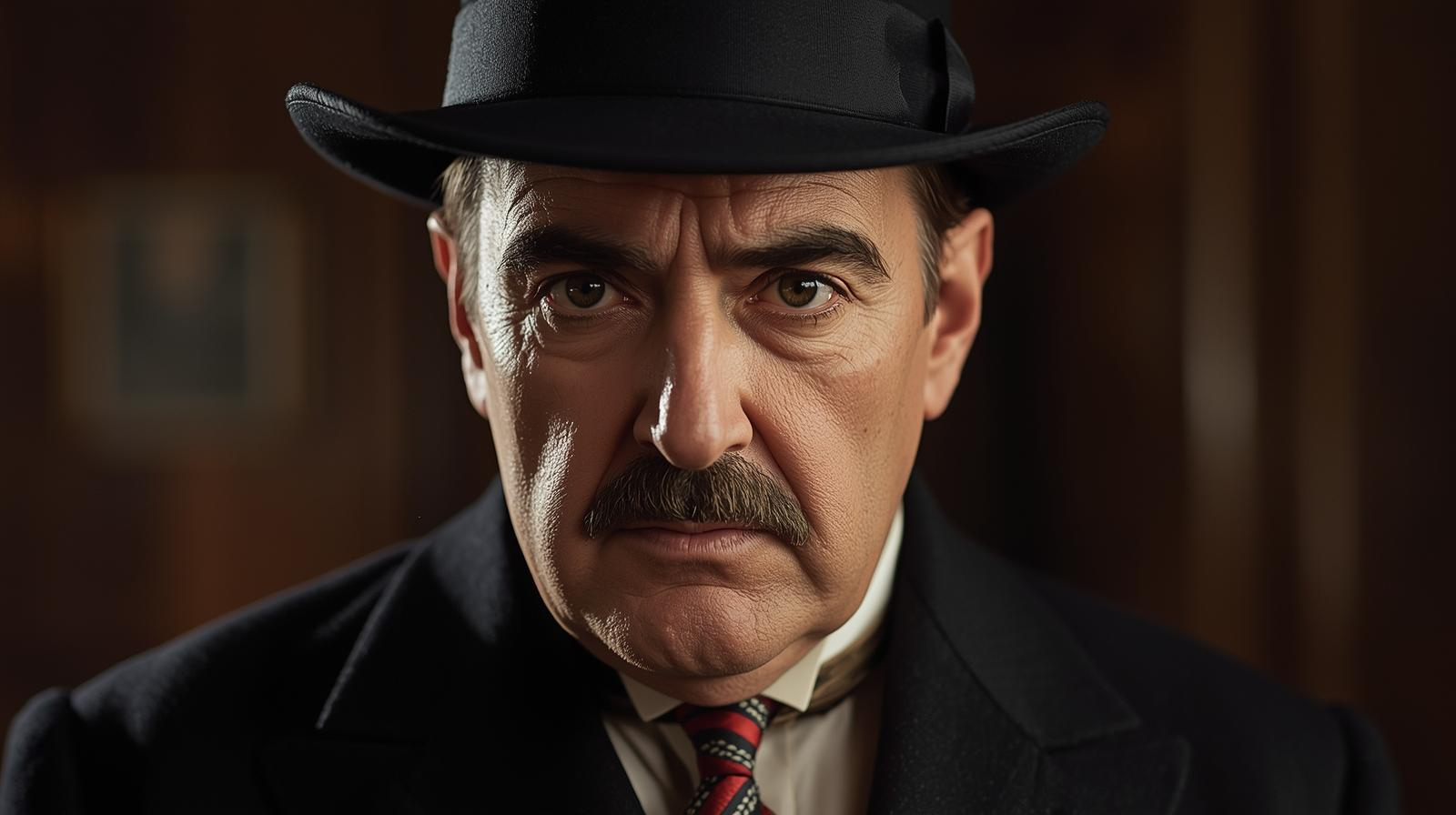
A television adaptation was produced in 2001, with Alfred Molina in the role of Poirot. The story was updated to a contemporary setting, and several characters were either combined or removed. It was widely considered a misstep, a cautionary tale about the dangers of tampering too freely with Christie’s meticulously constructed architecture.
David Suchet’s 2010 Version
David Suchet reprised his celebrated role as Hercule Poirot in a 90-minute television film in 2010, co-produced by ITV Studios and WGBH. Many regard Suchet as the definitive Poirot, having played the role across 25 years in the ITV series. His version of Murder on the Orient Express is considered darker, more introspective, and more spiritually conflicted than the 1974 version, depicting Poirot as a figure haunted by his perfectionism and pained by what the case’s resolution does to his faith.
Kenneth Branagh’s 2017 Spectacle
The 2017 film was co-produced and directed by Kenneth Branagh, who also starred as Hercule Poirot, from a screenplay by Michael Green. The film features an ensemble cast including Tom Bateman, Penélope Cruz, Willem Dafoe, Judi Dench, Johnny Depp, Josh Gad, Derek Jacobi, Leslie Odom Jr., Michelle Pfeiffer, and Daisy Ridley.
Visually, the film is extraordinary. It was one of the few productions in recent decades to have used 65mm film cameras, among the very few released in that format since Branagh’s own Hamlet in 1996. The result is a picture of sumptuous, widescreen grandeur, every carriage gleaming, every costume impeccable.
The reception was mixed. On the positive side, Leah Greenblatt of Entertainment Weekly gave the film a B+, calling it “a lushly old-fashioned adaptation wrapped in a veritable turducken of pearls, monocles, and international movie stars.” Blake Goble of Consequence of Sound called it “handsomely staged, exceptionally well-cast, and reasonably faithful.” More critically, the Roger Ebert website noted that despite camera trickery and a technically impressive production, there is too little levity and cleverness afoot, with a cast whose talent is barely tapped. The key isn’t whodunit but how you do it.
The moustache, meanwhile, took on a life of its own. Branagh’s enormous, silvery-grey handlebar moustache was specifically designed to distinguish his Poirot from all others, and it very much succeeded, earning a place in the pantheon of great follicular performances in cinema history.
The film grossed over $350 million worldwide, proving that appetite for Christie’s story remains insatiable, and it set up a sequel, Death on the Nile, released in 2022.
The Real Train: From Glory to Resurrection
The story of the Orient Express itself is as dramatic as any Christie novel, a tale of glory, decline, and phoenix-like rebirth.
The Orient Express launched its first service in 1883, running from Paris through Strasbourg, Munich, Vienna, Budapest and Bucharest to Istanbul. For decades it was the most glamorous way to cross Europe, carrying royalty, diplomats, spies, and socialites in polished wooden compartments, with fine dining, white-gloved service, and the entire continent rolling past the windows.
The primary historic services were interrupted during both the First and Second World Wars. The direct Paris–Istanbul route ended in 1962, and by 1977, all service to Istanbul was suspended. The golden age was over. The great train that had inspired Christie was broken up, its carriages scattered to national railway systems or left to rust on forgotten sidings.
James Sherwood and the Resurrection
The train was subsequently bought and rescued by the American entrepreneur James B. Sherwood, who restored the dangerously dilapidated old carriages. Sherwood spent years tracking down original Wagons-Lits carriages from across Europe, many of them in a sorry state of decay, and restored each one to its 1920s and 1930s splendour with a devotion bordering on obsession.
Services featuring the fully refurbished original carriages restarted, and today the train, under its moniker the Venice Simplon-Orient-Express (VSOE), is owned by hospitality brand Belmond and plies various routes across Europe, visiting Vienna, Verona, Amsterdam, and Budapest.
Christie’s Enduring Effect on the Train Today
The shadow of Agatha Christie falls over every aspect of the modern Orient Express experience, and the train’s operators know it. First among the VSOE’s contemporary services is an annual retracing of the original journey from Paris to Istanbul, the Grand Tour, which concludes with the chance to stay in the strikingly refurbished Pera Palace, and specifically to spend the night in Agatha Christie’s faithfully preserved room.
A ticket for this once-in-a-lifetime adventure doesn’t come cheap. The five-night trip from Paris to Istanbul on the 18-carriage Venice-Simplon Orient Express train costs just under €22,000 for a twin cabin, including private accommodation, overnight stays in Bucharest and Budapest, Continental breakfast served daily in the cabin, three-course lunches, four-course dinners with cheese boards, excursions led by local guides, and a dedicated steward service.
The luxury train service launched in 1982 and now expands on the original’s opulent legacy with cocktail lounges, live pianists, and fine dining. The carriages used are the real ones, the Venice Simplon Orient Express features 17 carriages built between 1926 and 1949. To step aboard is to step directly into the world Christie described. And her name is everywhere, not as a marketing afterthought, but as the very soul of what makes the experience meaningful.
The Pera Palace Hotel in Istanbul, meanwhile, has leaned fully into its Christie connection. When it was restored and reopened in 2010, an Agatha restaurant was created, with dishes influenced by three of the most famous stops on the Orient Express route, Paris, Venice, and Istanbul, fusing French, Italian, and Turkish cuisines.
For Christie fans, the pilgrimage is irresistible: step onto the platform at Sirkeci Station where the train once arrived, stay where Christie wrote, and walk the streets that inspired her, connecting the story, the journey, and the legend.
And for the truly adventurous, there is even an annual retracing of the original Paris-to-Istanbul journey on the VSOE, often referred to as the Grand Tour, which has a more involved itinerary and a greater historical resonance than the regular services.
A Legacy Without End
Nearly a century after it was written, Murder on the Orient Express continues to exert its extraordinary spell. It is not merely a crime novel, it is a meditation on justice, on human nature, on the strange moral universe where the letter of the law and the demands of the heart can pull in opposite directions. Christie never flinched from that tension, and it is what has kept the story alive across generations.
More than 80 years after its initial publication, the story continues to exert an incredible hold over people, on the train itself, an impressive locomotive and Art Deco carriages have been recreated or restored, because audiences understand instantly the appeal and allure of that world. The Orient Express is every bit as much a character as the rest of the cast.
The train that Agatha Christie fell in love with on an autumn afternoon in 1928, and which she immortalised in one of the greatest crime novels ever written, rumbles on. Its polished mahogany panelling reflects the faces of new travellers, its dining cars still ring with the clink of champagne flutes, and somewhere in the Balkan darkness, the snow still falls.
“Trains are wonderful…. To travel by train is to see nature and human beings, towns and churches and rivers, in fact, to see life.” — Agatha Christie
Murder on the Orient Express was first published on 1st January 1934 by Collins Crime Club. It has never been out of print.
Leave a Reply