
History, Innovation & Legacy
The Story of the Single-Rail Railway and its Place in the Future of Transport
Introduction
There is something undeniably futuristic about a monorail. Gliding silently above the streets on a single slender beam, free of the congestion below, the monorail has long captured the imagination of engineers, city planners, and the public alike. For well over a century, it has been the transport of tomorrow, a promise of clean, efficient, elevated transit that seems perpetually on the cusp of transforming the world’s cities. That it has not yet done so at the scale many predicted is part of what makes its history so fascinating.
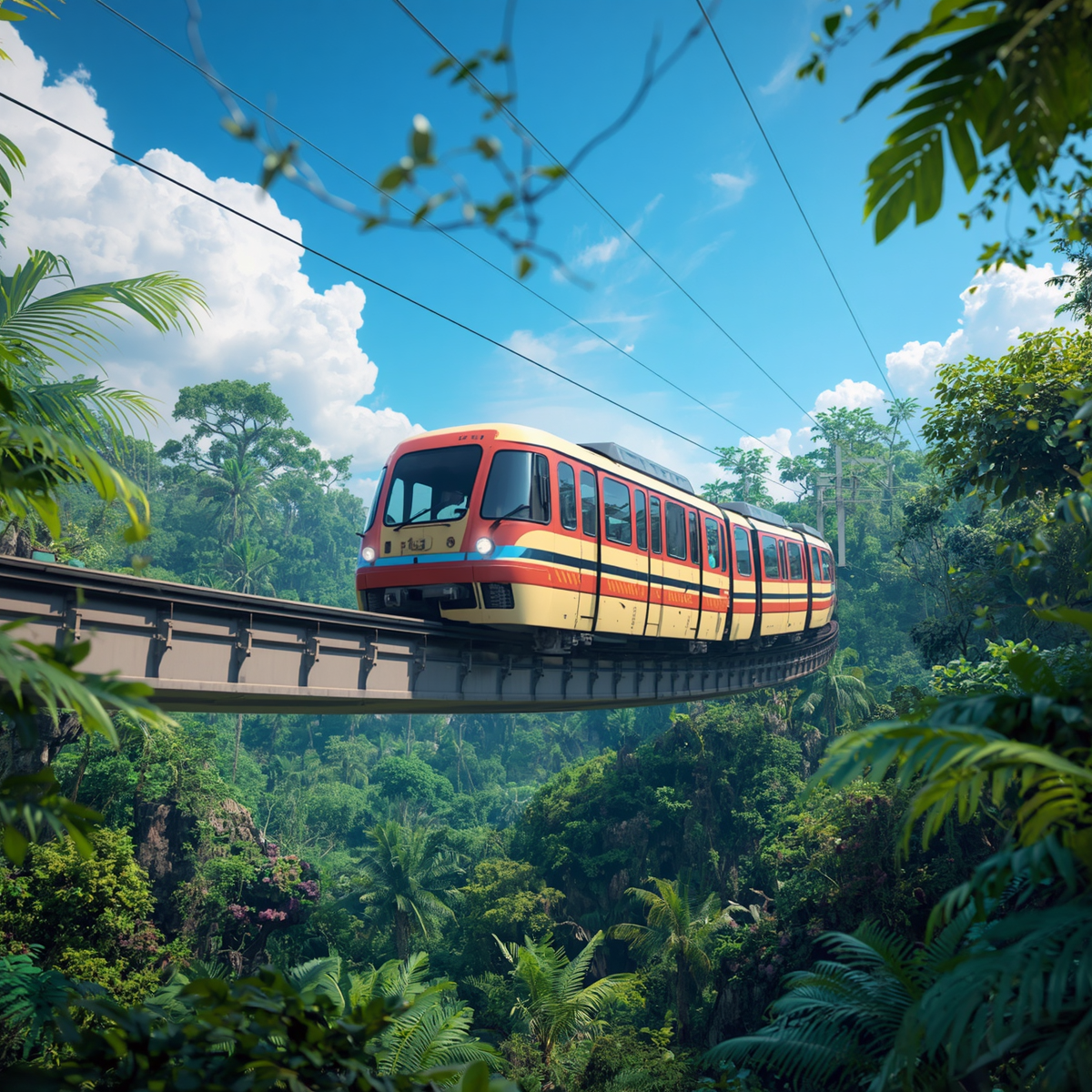
The word monorail simply means a railway running on a single rail, as opposed to the standard two-rail track of conventional railways. Within this broad definition, however, lies a remarkable diversity of engineering approaches: trains that straddle a central beam, trains that hang suspended below it, systems driven by linear induction motors, by conventional wheels, by magnetic levitation. The monorail is not a single invention but a family of related ideas, united by the vision of rail travel liberated from the conventional track bed.
This article charts the full history of the monorail, from its eccentric nineteenth-century origins, through the optimistic mid-twentieth-century boom, to the systems operating today and the role that monorail technology may yet play in the cities of the future.
Origins: The Nineteenth Century
The First Proposals and Patents
The concept of a single-rail railway is older than the steam locomotive itself. In 1821, the British engineer Henry Robinson Palmer obtained what is widely regarded as the first patent for a monorail system. Palmer’s design was straightforward: a wooden beam mounted on posts, along which a vehicle would be slung on either side like panniers on a horse, balanced by gravity. He built a working example at the Royal Victoria Dockyard in Woolwich, London, in 1825, used to transport materials around the yard. Though primitive by later standards, Palmer’s system demonstrated the core monorail principle: a single elevated rail supporting a vehicle balanced across it.
Throughout the middle decades of the nineteenth century, inventors in Britain, France, Germany, and the United States filed numerous patents for single-rail systems, each proposing slightly different solutions to the central engineering challenge: how do you keep a vehicle balanced on a single point of contact? A conventional two-rail railway is self-stabilising, the two rails provide lateral support automatically. A monorail must solve this problem through its own design, either by hanging below the rail (where gravity provides natural pendulum stability), straddling it (where the vehicle’s weight is spread either side), or through active gyroscopic or mechanical balancing.
The Listowel and Ballybunion Railway (1888)
The most remarkable of all Victorian monorail ventures was the Listowel and Ballybunion Railway in County Kerry, Ireland, which opened in February 1888 and operated until 1924. Designed by the French engineer Charles Lartigue, the Lartigue Monorail used a distinctive A-frame trestle structure, with the track running along the top of the frame and the carriages hanging in pairs on either side like saddlebags. A central driving rail at the apex of the A-frame carried the locomotive’s driving wheels, while two lower guide rails prevented the train from tipping.
The Listowel and Ballybunion Railway was, by any measure, an eccentric piece of engineering. Because loads had to be balanced on either side of the track, a consignment of goods on one side required an equivalent weight on the other, a farmer wishing to transport a calf was required to place another calf, or an equivalent weight of stones, in the opposing pannier. Passengers could not move freely between carriages, as this would upset the balance. Switching from one track to another required the use of turntable junctions of extraordinary complexity. Yet despite these inconveniences, the railway operated reliably for 36 years across 14 miles of the Kerry countryside, carrying passengers, livestock, and goods with reasonable efficiency. It was closed in 1924 after being damaged during the Irish Civil War, and the track was lifted for scrap. A modern replica of a short section has since been built at Listowel, where visitors can experience Lartigue’s singular creation.
The Listowel and Ballybunion Railway remains one of the most idiosyncratic transport systems ever built, an engineering curiosity that nonetheless served its community faithfully for nearly four decades.
The Gyroscope Monorail: Brennan and Scherl
The most audacious attempt to solve the monorail balancing problem was made by the Irish-Australian inventor Louis Brennan, who developed a gyroscopically stabilised monorail car in the early twentieth century. Brennan’s vehicle balanced on a single rail using two large gyroscopes spinning at high speed inside the car body. As long as the gyroscopes were spinning, their angular momentum kept the car perfectly upright, it could even lean into curves like a bicycle. Brennan demonstrated his invention at the Japan-British Exhibition at White City, London, in 1910, where it was a sensation, carrying passengers at speeds up to 32 km/h on a demonstration track.
The German inventor August Scherl independently developed a similar gyroscopic monorail, which he demonstrated in Berlin in 1909. Both Brennan’s and Scherl’s systems attracted serious attention from military and commercial interests, the British War Office funded further development of Brennan’s design, envisioning it for use in difficult terrain. Ultimately, however, the mechanical complexity and vulnerability of the gyroscope systems proved prohibitive. Neither was developed into a commercial railway, and the gyroscopic monorail remains one of the great might-have-beens of transport history.
The Wuppertal Schwebebahn: A Monorail That Endured (1901)
While most early monorail ventures remained curiosities or short-lived experiments, one system from the early twentieth century not only survived but thrives to this day. The Wuppertal Schwebebahn, literally “suspension railway”, in the Wupper valley of Germany opened in 1901 and has been in almost continuous operation ever since, making it the oldest electric elevated railway and the oldest monorail in the world still running as a public transit system.
The Schwebebahn was designed by the engineer Eugen Langen and built through the narrow, industrialised Wupper valley where conventional railways would have required the demolition of large numbers of buildings or consumed scarce flat land. Langen’s solution was to hang the railway from a steel lattice structure above the River Wupper itself for much of its route, and above the city streets for the rest. Cars suspended below the beam sway gently like pendulums as they travel, providing natural stability without complex mechanical systems.
The Schwebebahn covers 13.3 kilometres through the cities of Barmen, Elberfeld, and Vohwinkel (now all part of the city of Wuppertal), with 20 stations. It carries approximately 25 million passengers per year and forms an indispensable part of the city’s public transport network. Its remarkable longevity, over 120 years of operation, owes much to regular modernisation: the current fleet of blue and silver cars, introduced between 2016 and 2023, is the sixth generation of rolling stock.
The Schwebebahn is also famous for one of the most remarkable incidents in railway history: in 1950, a circus elephant named Tuffi was brought aboard as a publicity stunt. Frightened by the noise and movement, Tuffi broke free and leapt through a window into the River Wupper below, where she was rescued, unharmed. The incident has become a beloved part of Wuppertal folklore.
The Mid-Twentieth Century: The Age of Monorail Optimism
The 1950s and 1960s represented the golden age of monorail optimism. As the post-war world imagined a future of atomic power, space exploration, and gleaming modern cities, the monorail seemed a natural fit, clean, elevated, technologically sophisticated, and free from the noise and congestion of street-level traffic. World’s fairs, theme parks, and forward-looking city planners embraced the monorail as the transport technology of tomorrow.
Alweg and the Straddle-Beam Revolution
The technological breakthrough that defined mid-century monorail optimism came from the Swedish industrialist Dr. Axel Lennart Wenner-Gren, who founded the Alweg company in 1952 (the name is an acronym of his name). Alweg developed a straddle-beam monorail system in which the train cars sit atop a concrete or steel beam, gripping it with rubber-tyred wheels on the sides and underneath for guidance and support. The rubber tyres provided quieter and smoother running than steel-on-steel systems, and the reinforced concrete beam was relatively cheap and straightforward to construct.
Alweg built a demonstration track at Cologne in 1952 and exhibited widely. Its system attracted enormous interest from city planners around the world who were grappling with post-war urban expansion and traffic congestion. Alweg proposed monorail systems for Los Angeles, New York, San Francisco, Chicago, and many other cities, commissioning detailed feasibility studies and design proposals. Most of these came to nothing defeated by cost, competing interests, and the formidable political power of the highway lobby, but a handful were realised, most famously in Seattle.
The Seattle World’s Fair Monorail (1962)
The Seattle Centre Monorail, built by Alweg for the 1962 World’s Fair (officially the Century 21 Exposition), is perhaps the most famous monorail in North America. Running just 1.6 kilometres from downtown Seattle to the fairgrounds, it was built in thirteen months and opened in April 1962, a remarkable construction achievement. The monorail ferried millions of fair visitors and became one of the defining images of 1960s futurism, sleek, modern, and thrillingly fast.
The Seattle Monorail was intended as a demonstration of a technology that would soon transform American cities. In the event, it remained what it was built as: a short demonstration line. After the fair closed, the city retained it as a transit link between downtown and the Seattle Centre, where it still operates today. Despite numerous proposals over the decades to extend the system into a city-wide network, none has come to fruition. The original 1962 trains remained in service, remarkably, until 2018, when they were retired after 56 years, replaced by modern replicas faithful to the original design.
Disneyland and the Theme Park Monorail
No institution did more to embed the monorail in the popular imagination than the Walt Disney Company. Walt Disney himself was a passionate advocate for innovative urban transport, he had studied various transit technologies, including the Alweg system, and incorporated a monorail into the original Disneyland in Anaheim, California, when it opened its Tomorrowland expansion in 1959. The Disneyland Monorail was the first daily operating monorail in the Western Hemisphere.
For Disney, the monorail was not merely a ride but an ideological statement, proof that modern, clean, elevated transit could work and could delight the people who used it. When Walt Disney World opened in Florida in 1971, it featured an ambitious monorail network connecting the Magic Kingdom with its resort hotels and the Transportation and Ticket Centre. The Walt Disney World Monorail System spans approximately 22 kilometres of track across three interconnected lines and carries tens of millions of passengers annually. It remains the most extensive purpose-built resort monorail system in the world.
The Disney monorails exerted an incalculable cultural influence. Generations of visitors to Disneyland and Walt Disney World formed their mental image of what futuristic transport should look like aboard these sleek vehicles, and the monorail became a shorthand for modernity and optimism. When The Simpsons satirised small-town susceptibility to transport boondoggles in the 1993 episode Marge vs. the Monorail, the joke worked precisely because the monorail’s association with grandiose futurism was so deeply embedded in popular culture.
“Monorail! Monorail! Monorail!” The chant from the iconic 1993 Simpsons episode captured both the genuine excitement monorails generated and the tendency for their promise to outrun their delivery.
Major Monorail Systems of the World
Despite the gap between the grand visions of the 1950s and 1960s and the reality of what was actually built, a number of significant monorail systems have been constructed around the world, particularly in Japan, where the technology found its most enthusiastic commercial application.
Japan: The World’s Foremost Monorail Nation
Japan embraced the monorail with an enthusiasm matched nowhere else on earth, and today operates more monorail lines than any other country. The first Japanese monorail, the Ueno Zoo Monorail in Tokyo, opened in 1957, making it the first monorail in Asia. Though small, a zoo attraction rather than public transit, it demonstrated Japanese interest in the technology and sparked further investment.
The Tokyo Monorail, which opened in 1964 in time for the Tokyo Olympic Games, is one of the busiest and most commercially successful monorails in the world. Running 17.8 kilometres from Hamamatsucho station on the JR Yamanote Line to Haneda Airport, it carries approximately 130,000 passengers daily and has transported billions of passengers since its opening. The Tokyo Monorail was a technological and commercial triumph that helped establish Japan as the world leader in monorail development.
Osaka’s Osaka Monorail, opened in stages between 1990 and 1997, is now the longest monorail in the world, spanning 28.0 kilometres with 14 stations. It serves as an orbital route connecting major railway lines around the northern suburbs of Osaka, and carries over 100,000 passengers per day. Further extensions have been planned and are under construction. The Chiba Urban Monorail, opened in 1988, is notable for being a suspended monorail, the largest suspended monorail system in the world, with a total length of 15.2 kilometres. Its cars hang below the beam on a straddle structure, combining the stability of the straddle system with the pendulum smoothness of a hanging car.
Japan’s Shonan Monorail (1970), the Kitakyushu Monorail (1985), the Tama Monorail (1998), and the Okinawa Urban Monorail (2003), known affectionately as the Yui Rail, further demonstrate the breadth of Japanese monorail development. The Yui Rail is particularly significant as the only monorail in Japan built primarily as a conventional urban transit line on Okinawa Island, where the terrain and urban density made it an attractive alternative to conventional metro.
The Kuala Lumpur Monorail — Malaysia (2003)
The KL Monorail in Kuala Lumpur, Malaysia, opened in 2003 and represents one of the most ambitious monorail projects undertaken outside Japan. Running 8.6 kilometres through the heart of the Malaysian capital with 11 stations, it was built to relieve congestion in one of Southeast Asia’s busiest city centres. Operated by Prasarana Malaysia and integrated into the wider Klang Valley rail network, it carries over 50,000 passengers daily and is a vital urban transit artery. The original Scomi-built trains have been supplemented by new rolling stock, and extension plans have been discussed for many years.
The Las Vegas Monorail — USA (2004–2021)
The Las Vegas Monorail opened in 2004, connecting the major resort hotels along the Las Vegas Strip over a 6.4-kilometre route with seven stations. It was intended to reduce car traffic on the notoriously congested Strip corridor. The system faced chronic financial difficulties from the outset, struggling with low ridership, partly because most of its stations were inconveniently located at the rear of casino properties, making access cumbersome for visitors. The Las Vegas Monorail Company filed for bankruptcy twice and the system ultimately closed permanently in May 2021, a casualty of both the Covid-19 pandemic and its underlying structural problems. It stands as a cautionary tale about monorail systems that are not well integrated into the pedestrian and transit environment they serve.
The Mumbai Monorail, India (2014)
India entered the monorail era with the opening of Phase 1 of the Mumbai Monorail in February 2014, the first monorail to operate in India. Running through the densely populated Chembur and Wadala districts of Mumbai, it was intended as part of a broader strategy to extend mass transit to areas not yet served by the city’s suburban railway and metro networks. The Mumbai Monorail uses the Scomi SUTRA straddle-beam system and covers 19.54 kilometres with 17 stations across its two phases, the second of which opened in 2019. Despite an important role in its corridors, it has faced persistent operational challenges, including rolling stock shortages and maintenance issues, and ridership has been lower than projected.
The Palm Jumeirah Monorail, Dubai (2009)
Dubai’s Palm Jumeirah Monorail, opened in 2009, is the world’s first fully automated monorail, operating without any onboard driver. Running 5.4 kilometres across the trunk and frond of the iconic Palm Jumeirah artificial island, it connects the Atlantis resort at the tip of the island with the mainland metro connection at Gateway Station. Though short, it provides an essential link across a peninsula where no road alternative is practical, and offers spectacular views of the Arabian Gulf and Dubai skyline. Its fully automated operation represents the frontier of modern monorail technology.
Technology: How Monorails Work
Modern monorail systems fall into two broad categories, distinguished by their relationship to the beam on which they travel.
Straddle-Beam Monorails
In a straddle-beam system, the train sits astride a single concrete or steel beam, with load-bearing wheels running along the top and flanged or rubber-tyred guide wheels gripping the sides. The Alweg system and its descendants, including the Bombardier INNOVIA Monorail, the Hitachi monorail used in Tokyo and Osaka, and the Scomi SUTRA, all follow this principle. Straddle-beam monorails are the most common type worldwide, particularly suited to urban transit applications where high capacity and high frequency are required. The concrete beam guideway is a relatively economical form of elevated infrastructure, and the rubber-tyred running surface provides quieter operation and better acceleration and braking than steel-on-steel systems.
Suspended Monorails
Suspended monorails, in which the cars hang below the beam, offer natural pendulum stability and a distinctive, airy riding experience. The Wuppertal Schwebebahn is the oldest and most famous example; the Chiba Urban Monorail in Japan is the largest modern example. Suspended systems have the advantage that the vehicle’s centre of gravity is naturally below the beam, making them inherently stable without complex guidance systems. Their disadvantage is that the overhead structure must carry the full weight of the vehicle from above, requiring robust and often visually intrusive support structures.
Magnetic Levitation Monorails
The most technically advanced monorail variant eliminates physical contact between vehicle and beam entirely, using magnetic levitation, maglev, to float the vehicle above the guideway. Germany’s Transrapid system, which achieved commercial operation in Shanghai in 2004, and Japan’s SCMaglev (Superconducting Maglev) represent the pinnacle of this technology. While not monorails in the traditional sense, the guideway is more of a trough than a rail, they share the single-guideway, elevated-transit philosophy that defines the broader monorail concept. Japan’s SCMaglev has achieved test speeds exceeding 600 km/h, making it the fastest rail vehicle ever built.
Cultural Legacy: The Monorail in Popular Imagination
Few transport technologies have exercised such a powerful hold on the popular imagination as the monorail. Its association with the future is deeply ingrained, not merely because it is a modern technology, but because it was adopted so enthusiastically by the imagery of twentieth-century futurism. World’s fair illustrations, science fiction comics, mid-century advertising, and futurist city plans invariably featured monorails gliding between gleaming towers. The 1939 New York World’s Fair, the 1964-65 New York World’s Fair, and countless others featured monorail attractions that became highlights of the exhibitions.
In cinema and television, the monorail became a reliable visual shorthand for the future. The 1968 film 2001: A Space Odyssey features a lunar monorail; the Jetsons animated series of the 1960s depicted a monorail-served sky city; the Star Wars franchise has featured monorail systems in its world-building. Closer to the present, the monorail systems of Disney parks have appeared in countless films and television productions set within those parks, reinforcing the association between monorails and a benign, optimistic vision of technological progress.
The Simpsons episode Marge vs. the Monorail (1993), written by Conan O’Brien, has become perhaps the most culturally resonant treatment of the monorail in popular culture. In it, the town of Springfield is sold a fraudulent monorail system by a con man, resulting in disaster. The episode perfectly captures the ambivalent relationship between the monorail’s genuine technological appeal and the tendency for its promise to be exploited by boosterism and wishful thinking. Transport planners and urban economists regularly cite it when discussing monorail proposals.
Why the Monorail Revolution Did Not Happen
Given the extraordinary enthusiasm of the 1950s and 1960s, why did the monorail not transform the world’s cities as its advocates predicted? The answer lies in a combination of practical, economic, and political factors that together constituted a powerful argument for conventional rail.
Capacity was a fundamental constraint. Monorail vehicles, limited by the dimensions of their beam and the physics of their operation, are generally smaller and lighter than conventional metro trains. A standard metro car can carry 200-300 passengers; a typical monorail car carries 50-100. To match the passenger throughput of a busy metro line, a monorail must run very frequent short trains, which demands sophisticated signalling and creates operational complexity. This capacity gap made monorails difficult to justify for the busiest urban corridors.
Interoperability was another issue. Conventional railways share standardised track gauges, signalling systems, and rolling stock specifications, allowing trains from different operators to run on shared infrastructure. Monorail systems, by contrast, are highly proprietary: an Alweg-pattern monorail cannot share track with a Hitachi or Bombardier system. This lock-in effect makes network extensions expensive and limits the economies of scale available to conventional rail.
Emergency evacuation presents particular challenges on elevated monorail systems. If a vehicle breaks down or catches fire on an elevated beam, passengers cannot simply step off onto a conventional platform, they may be stranded above ground level, sometimes between stations, requiring special evacuation procedures. Modern systems have addressed this with walkways alongside the beam and improved emergency protocols, but the perception of vulnerability persisted.
Finally, the political economy of transport investment favoured conventional rail. Established railway engineering firms, trades unions, and civil engineering contractors had little commercial interest in promoting a technology that used different construction methods, different rolling stock, and different operational systems. The highway lobby, meanwhile, was actively hostile to any rail investment. Monorail advocates, often outsiders to the established transport industry, struggled to overcome these entrenched interests.
The Future of Monorails
Despite the failure of the mid-century monorail revolution to materialise at scale, the technology is far from obsolete. In several specific contexts, monorails continue to offer genuine advantages over conventional rail alternatives, and a number of new systems have been proposed or are under construction around the world.
Urban areas in developing countries, where rapid population growth is creating urgent demand for mass transit but where the cost of underground metro construction is prohibitive, represent a natural market for elevated monorail systems. India, in particular, has seen sustained interest in monorail technology as a complement to its expanding metro network. Beyond Mumbai, proposals for monorail systems have been developed for several other Indian cities, and the Indian government has invested in domestic monorail manufacturing capabili.
Airport connections, resorts, and other dedicated corridors where capacity requirements are moderate but speed and reliability are paramount continue to represent a strong niche for monorail technology. The fully automated systems now available, exemplified by the Palm Jumeirah Monorail and various airport elevated, electrically powered, guided by a beam or rail, but carrying small groups of passengers in on-demand pods rather than scheduled trains. Whether these systems will achieve commercial scale remains to be seen, but they represent a continuation of the monorail tradition of seeking elegant, elevated solutions to the problem of urban mobility.
Japan’s continued investment in monorail expansion, including planned extensions to the Osaka Monorail and new lines in Okinawa, and the opening of new systems in the Middle East and Southeast Asia suggest that the monorail, in its appropriate niches, has a secure future. It will not be the universal urban transit solution that 1960s optimists imagined, but it is a proven, reliable technology with specific applications where it is genuinely the best available option.
Notable Monorail Systems at a Glance
The following table summarises some of the world’s most significant monorail systems, past and present.
| System | Opened | Location | Type | Status |
|---|---|---|---|---|
| Wuppertal Schwebebahn | 1901 | Germany | Suspended | Still operating |
| Listowel & Ballybunion | 1888 | Ireland | Lartigue A-frame | Closed 1924 |
| Disneyland Monorail | 1959 | USA (CA) | Straddle (Alweg) | Still operating |
| Seattle Center Monorail | 1962 | USA (WA) | Straddle (Alweg) | Still operating |
| Tokyo Monorail | 1964 | Japan | Straddle (Hitachi) | Still operating |
| Walt Disney World | 1971 | USA (FL) | Straddle (Alweg) | Still operating |
| Chiba Urban Monorail | 1988 | Japan | Suspended (SAFEGE) | Still operating |
| Osaka Monorail | 1990 | Japan | Straddle (Hitachi) | Still operating |
| KL Monorail | 2003 | Malaysia | Straddle (Scomi) | Still operating |
| Palm Jumeirah Monorail | 2009 | UAE | Straddle (automated) | Still operating |
| Mumbai Monorail | 2014 | India | Straddle (Scomi) | Still operating |
| Las Vegas Monorail | 2004 | USA (NV) | Straddle (Bombardier) | Closed 2021 |
Conclusion
The history of the monorail is a story of persistent ambition meeting persistent reality. From Henry Robinson Palmer’s timber beam at Woolwich Dockyard in 1825, through the eccentric ingenuity of the Lartigue system in rural Ireland, the gyroscopic dreams of Brennan and Scherl, the mid-century optimism of Alweg and Disney, to the bustling urban arteries of Tokyo and Osaka today, the monorail has always promised something that conventional railways cannot quite offer: a lighter, cleaner, more elegant form of elevated transit.
That promise has been only partially kept. The universal monorail city of 1960s futurism never arrived. However, the technology that was supposed to replace the conventional metro has instead found its own secure place in the transportation ecosystem, in specific corridors, cities, and applications where its particular combination of qualities makes it genuinely the best solution available. The Wuppertal Schwebebahn, still gliding over its river after 120 years, is proof that a well-conceived monorail, given the right conditions, can last as long as any railway on earth.
The monorail has always been the transport of tomorrow. But then, as now, it is also very much a transport of today, carrying millions of passengers every day through Tokyo, Osaka, Kuala Lumpur, Dubai, and the parks of Florida, a living reminder that the future, when it finally arrives, tends to look rather different from the way we imagined it, but no less remarkable for that.
Leave a Reply