A Guide to Every Kind of Library in the World
When most of us picture a library, we imagine the same thing: a hushed building lined floor to ceiling with shelves, long reading tables, and a librarian behind a desk. It is a powerful image, and it is a real one. But it is only one image among hundreds. The library, at its heart, is simply the meeting of a reader and a book, and human ingenuity has found an extraordinary range of ways to bring those two things together, regardless of geography, wealth, or infrastructure.
Around the world, libraries travel by donkey and camel, by boat and bicycle, by horseback and on foot. They live inside old telephone boxes and repurposed refrigerators, in garden sheds and converted buses, on park benches and inside trees. They are staffed by volunteers and professionals, by community activists and retired teachers. They serve mountain villages in Zimbabwe and tower blocks in Tokyo, fishing communities in the Amazon and nomadic families in the Mongolian steppe.
This article is a tour through the astonishing variety of libraries our world has produced, a celebration of the many creative, stubborn, and often beautiful ways that people have refused to let books remain out of reach.
Part One: The Conventional Library and Its Many Forms
The National Library
Every country with a strong literary or bureaucratic tradition eventually creates a national library, an institution charged with collecting and preserving the entirety of a nation’s published output. These are the great repositories of a country’s written memory. The British Library in London holds over 170 million items and receives a copy of virtually every publication produced in the UK under legal deposit laws dating back to 1662. The Bibliotheque nationale de France in Paris, the Library of Congress in Washington DC, the National Library of China in Beijing, and the Russian State Library in Moscow are similarly vast, functioning as much as archives for scholars and researchers as places for ordinary readers to browse.
National libraries are often architecturally grand, deliberate statements of national pride and intellectual ambition. The Library of Congress, with its ornate Beaux-Arts Jefferson Building opened in 1897, is considered one of the most beautiful buildings in the United States. The new National Library of Qatar, designed by Rem Koolhaas and opened in 2018, is a spectacular folded steel structure in Doha that houses the country’s national archive alongside public reading rooms.
The Academic and University Library
University libraries are among the oldest continuously operating libraries in the world. The Bodleian Library at Oxford, founded in 1602, holds over thirteen million items and is a legal deposit library in its own right. The university library serves a different purpose from the public library: its collections are specialised, its users primarily researchers, academics, and students, and its holdings often include rare manuscripts, incunabula, and archival materials unavailable elsewhere.
In recent decades, university libraries have undergone a quiet revolution as physical collections have been supplemented, and in some cases partially displaced, by digital subscriptions to academic journals and databases. The tension between open access to scholarship and the commercial interests of academic publishers has made the university library a battleground for the future of knowledge itself.
The Public Library
The municipal public library, free, open to all, funded by local taxation, remains the most familiar and most democratically important form. As explored in the companion article on library history, the public library emerged in the mid-19th century as a deliberate act of civic provision: the recognition that an informed citizenry required access to books that most individuals could not afford to buy. Today, public libraries offer far more than books: computers and internet access, language classes, children’s story times, maker spaces, mental health support signposting, and warm, safe spaces for anyone who needs them.
The School Library
The school library is, for many children, the first library they ever enter, and its impact on reading habits and educational outcomes can be profound. Research consistently shows that schools with well-stocked, well-staffed libraries produce more confident readers and higher academic achievers. Yet school libraries are among the most chronically underfunded of all library types, in many countries, including the United Kingdom, large numbers of schools have no dedicated library at all, or maintain a room of donated books supervised by a teaching assistant with no professional training in librarianship.
Where school libraries do thrive, they can be transformative. School libraries in Finland, whose education system is widely regarded as world-leading, are integral to the curriculum and staffed by qualified librarians who work alongside teachers. In the United States, the American Association of School Librarians advocates for school library programmes, and the evidence they cite is compelling: schools with trained librarians consistently outperform those without across a range of literacy and attainment measures.
The Special and Professional Library
Not all libraries are open to the public. Law libraries, medical libraries, corporate information centres, parliamentary libraries, and military libraries all serve specific professional communities with highly specialised collections. The House of Commons Library in Westminster, for instance, employs a team of research librarians whose sole purpose is providing Members of Parliament with accurate, non-partisan research and briefings. Hospital libraries serve both clinical staff and, in the best cases, patients, offering reading materials and bibliotherapy programmes to people in long-term care.
Prison libraries occupy a particular and poignant place in this category. Research shows that access to books in prison is strongly associated with reduced reoffending, and reading programmes in prisons have won passionate advocates among prison governors, rehabilitation workers, and the writers who donate their time to lead reading groups. In the United Kingdom, the Shannon Trust’s Turning Pages programme uses peer mentoring to help prisoners who cannot read to learn to do so, a reminder that the library’s fundamental mission of connecting people to the written word is never more urgent than when those people have been most excluded from it.
“Outside of a dog, a book is man’s best friend. Inside of a dog, it’s too dark to read.” — Groucho Marx
Part Two: Libraries on the Move — Taking Books to the Reader
Some of the most remarkable libraries in the world never stay in one place. Where geography, poverty, or infrastructure makes it impossible to bring readers to a building, the mobile library brings the building, or at least a selection of its shelves, to the reader. The creativity and determination that humans have applied to this challenge is breath taking.
The Bookmobile
The bookmobile, a van or bus fitted with shelves and driven on a regular circuit of communities, is the most familiar form of mobile library. The first horse-drawn travelling library in the United States is credited to Mary Lemist Titcomb of Washington County, Maryland, who in 1905 began dispatching a wagon loaded with books to rural communities. The idea quickly spread, and by the mid-20th century bookmobiles were a fixture of rural and suburban life in America, Britain, Canada, and Australia.
Today’s bookmobiles are often large, purpose-built vehicles with climate control, accessible ramps, and digital catalogues. In the United Kingdom, many counties still operate mobile library services, though funding cuts since 2010 have decimated their numbers. In the United States, an estimated 750 bookmobiles still operate, many serving elderly and housebound residents, low-income communities, and rural areas far from the nearest branch library. Some American bookmobiles have been converted into mobile STEM labs, offering not just books but science equipment, coding resources, and 3D printers.

The Donkey Library
In the mountains and valleys of remote Colombia, a man named Luis Soriano has spent decades travelling a circuit of villages with his two donkeys, Alfa and Beto, each loaded with saddlebags containing up to 120 books. His Biblioburro, ‘donkey library’, began in 1990 when Soriano, a teacher, became frustrated that his students had nothing to read at home. He bought two donkeys, loaded them with books, and set off into the countryside.
The Biblioburro now serves hundreds of children in remote communities that no road reaches, no van can navigate, and no conventional library would ever find viable to serve. Soriano travels at weekends, reading aloud to children, swapping books, and encouraging families to read together. His story attracted international attention and inspired a children’s book. He has since established a small rural library building as a base for the service, but the donkeys remain central to its reach.
Donkey libraries are not unique to Colombia. In Zimbabwe, the Donkey Mobile Library has operated in rural Matabeleland, serving communities spread across vast distances of semi-arid land where roads are impassable in rainy season. In Ethiopia and parts of East Africa, similar initiatives have used donkeys to carry books to pastoralist and farming communities.
| Spotlight: The Biblioburro
Luis Soriano’s donkey library in Colombia has become one of the most celebrated library stories in the world, a reminder that the will to share books can transcend any obstacle of terrain or infrastructure. When asked why he persists, Soriano has said simply that he cannot imagine watching children grow up without books. |
The Camel Library
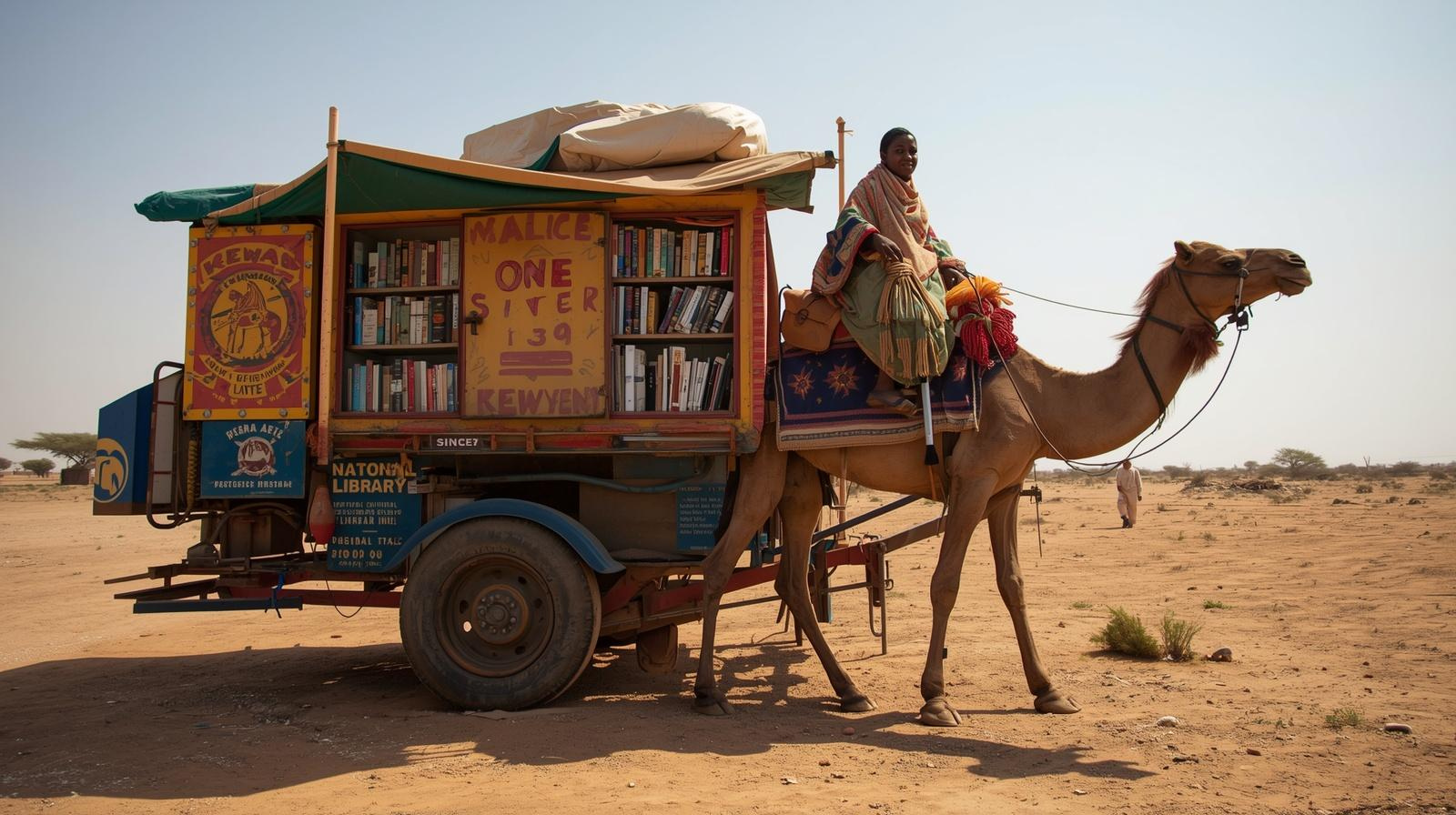
In the vast arid expanses of northern Kenya, the Kenya National Library Service has operated a Camel Mobile Library since 1996. The service uses a string of camels, each carrying metal boxes of books, to serve nomadic and semi-nomadic communities in Garissa and Wajir counties, communities that are Muslim, largely Somali in ethnicity, and live in one of the most remote and harsh environments on the continent.
Each camel carries approximately 200 books, and the library travels a circuit of settlements, stopping at schools, mosques, and community meeting points. The library stocks books in Somali, Swahili, Arabic, and English, and includes materials aimed at children and adults alike. The camel library has become internationally famous and has inspired similar initiatives: in Ethiopia, Somalia, and Sudan, camel libraries have been piloted in response to the extraordinary reach of the Kenyan model.

The Elephant Library
In Thailand and parts of Southeast Asia, the elephant has been enlisted in the cause of reading. The Thai Elephant Conservation Centre in Lampang has operated a small elephant-borne book service as an educational outreach project, and in several remote communities in northern Thailand, elephant caravans have carried books to hill tribe villages inaccessible by vehicle. While these projects are smaller in scale than the camel and donkey libraries of Africa and South America, they reflect the same essential insight: that the right animal for the terrain can make the difference between a community having books and not having them.

The Horse Library
During the Great Depression of the 1930s, the United States Works Progress Administration funded a remarkable initiative known as the Pack Horse Library Project in the mountains of eastern Kentucky. The Appalachian region was among the poorest in the country, its communities scattered across hollows and ridges connected only by narrow dirt tracks. Librarians, almost all of them women, rode horses and mules into these communities, delivering books, magazines, and hand-sewn scrapbooks of recipes, farming advice, and stories.
The Pack Horse librarians became legendary figures in their communities, often riding up to 120 miles a week in all weathers, fording streams and navigating mud tracks that no vehicle could traverse. They brought with them not just books but a sense that these isolated communities mattered, that their children deserved access to knowledge. The project ran from 1935 to 1943 and served an estimated 100,000 people. It has since been celebrated in novels, documentaries, and a children’s book, and is remembered as one of the most inspiring library initiatives in American history.
The Bicycle Library
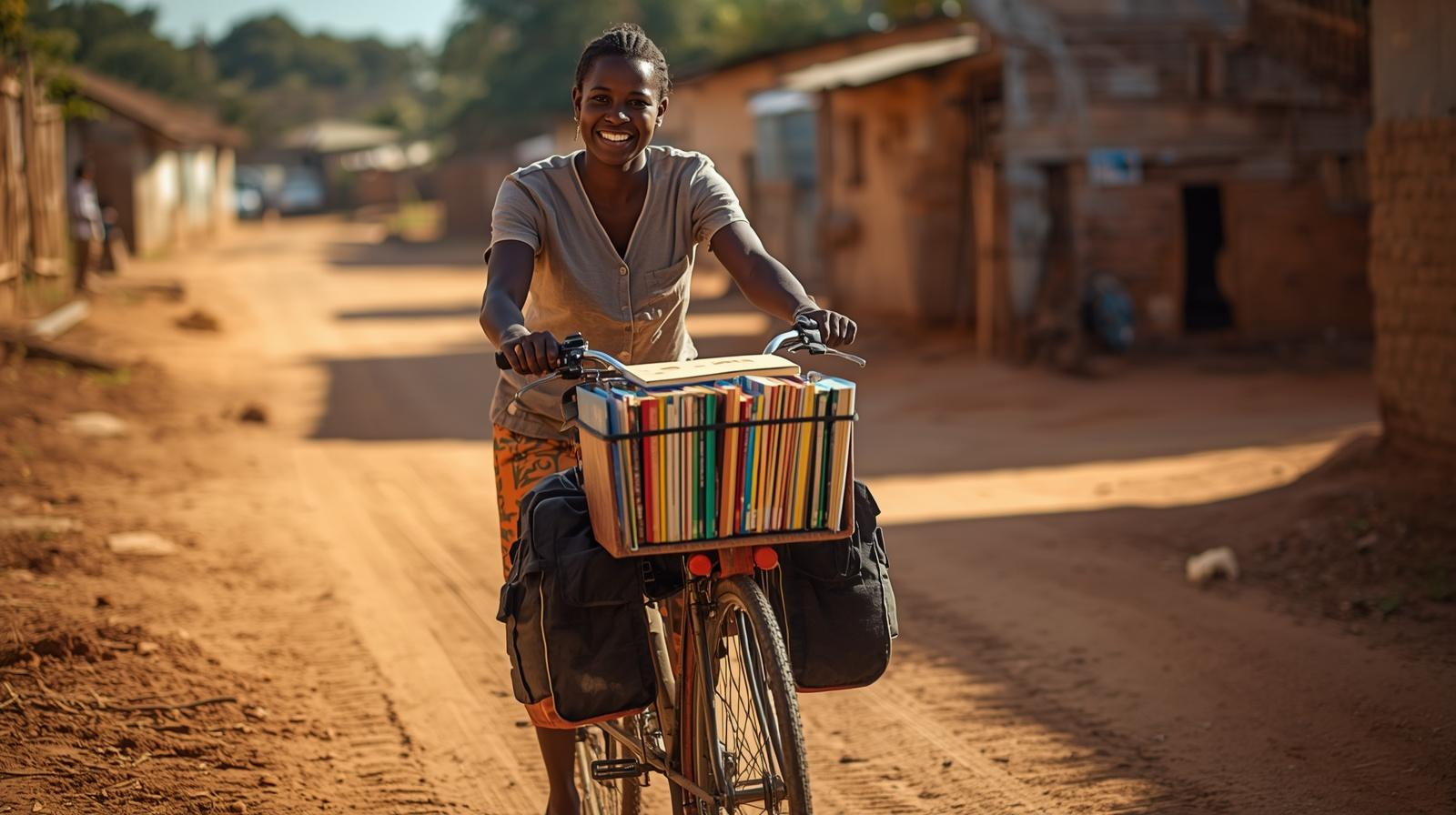
The bicycle is the workhorse of community outreach in many parts of the developing world, and libraries have not been slow to harness its versatility. In Uganda, Rwanda, and Tanzania, bicycle-borne libraries have been established by NGOs and community organisations to serve rural schools and villages. A single bicycle can carry a pannier of thirty to fifty books, and a volunteer rider can cover a circuit of several villages in a day.
In urban contexts, the cargo bicycle has found a new role as a pop-up library vehicle. In several European cities, Amsterdam, Berlin, Copenhagen, bicycle-mounted libraries have operated as community outreach projects, setting up in parks, markets, and housing estates and offering books for borrowing. In the United States, organisations like Books on Bikes in Seattle have combined literacy outreach with free book giveaways, using cargo bikes to bring books directly into communities with low library access.
The Boat Library
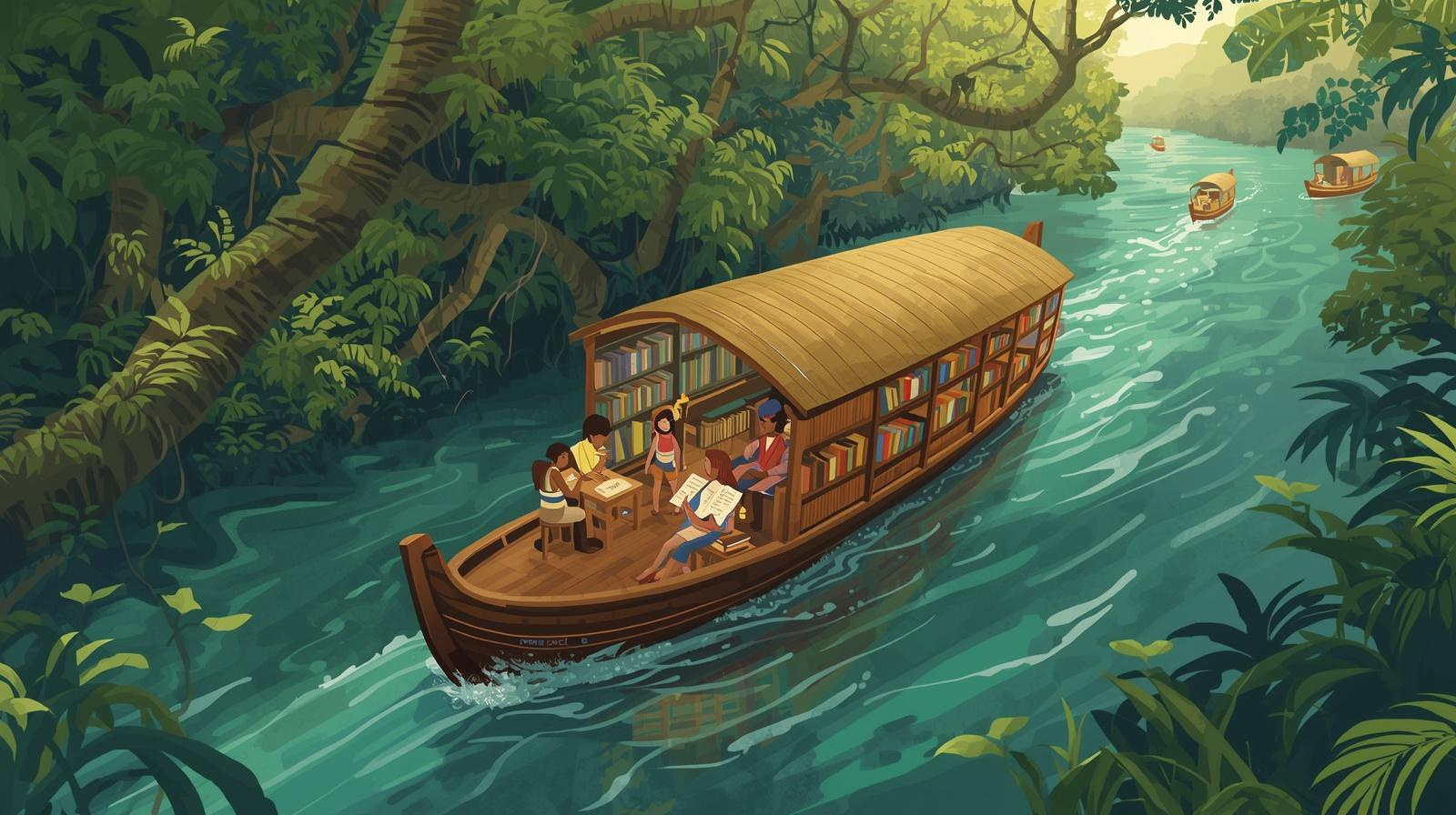
Where water is the road, boats become the library vehicles. In the dense river network of the Amazon basin, Brazil operates a fleet of boat libraries, Bibliotecas Flutuantes, or Floating Libraries, serving riverside communities (ribeirinhos) that can only be reached by water. These wooden vessels carry collections of several hundred books and visit communities on a regular schedule, often mooring for a day or two to allow borrowing, reading aloud, and story sessions for children.
Bangladesh, with its extraordinary density of waterways and frequent flooding, has operated boat schools and boat libraries for decades, reaching communities that spend significant parts of the year surrounded by water. The Shidhulai Swanirvar Sangstha NGO has run a fleet of solar-powered boat schools that also function as mobile libraries, serving communities in the northern flood plains.
In Norway, the nation’s extraordinary coastline and island geography gave rise to the Bokbaaten, the Book Boat, which has operated since 1959 as a floating library serving communities along the western coast and its offshore islands. The service uses a small vessel that visits ports and jetties on a regular schedule, bringing books to communities that are hours from the nearest library building. Similar floating library services operate in parts of Finland’s lake district and among the islands of the Philippines.
| Spotlight: The Bokbaaten
Norway’s Book Boat has been visiting coastal communities since 1959. Part library, part community event, its arrival in a small harbour is still treated as a local occasion, a reminder that even in one of the world’s wealthiest and most connected countries, geography creates its own need for creative library solutions. |
The Seaplane Library
In some of the world’s most remote communities, even a boat cannot reliably reach the destination. In parts of rural Alaska, Canada’s northwest territories, and remote Pacific islands, seaplanes have been used to deliver library books alongside mail, medicine, and groceries. While not constituting dedicated library services in their own right, these deliveries form part of a wider network of outreach that ensures even the most isolated communities have access to reading materials. Some remote Canadian communities receive book boxes by float plane as part of a provincial library outreach programme, exchanging their returned books for a fresh selection every few months.
The Backpack Library
In mountainous and roadless regions where no vehicle of any kind can go, human carriers, librarians and volunteers on foot, have carried books in backpacks to the most remote communities on earth. In Nepal, community reading rooms have been established in mountain villages, with volunteers making regular treks to resupply them. In parts of rural Papua New Guinea and the Solomon Islands, literacy workers carry small collections of books on foot through dense jungle and across mountain passes.
The Asha Deep Foundation in India has operated backpack libraries in remote Himalayan villages in Himachal Pradesh, with volunteers trekking to villages that can only be reached on foot and spending time reading with children before leaving a fresh supply of books. These are among the most labour-intensive library services imaginable, and among the most moving.
Part Three: Community Libraries, Book Swaps, and Guerrilla Reading Spaces
Not all library innovation comes from institutions. Some of the most creative and charming library spaces in the world have emerged from the grassroots, from individuals who looked at a disused telephone box, a garden fence, or a gap in a hedge and thought: this could hold books.
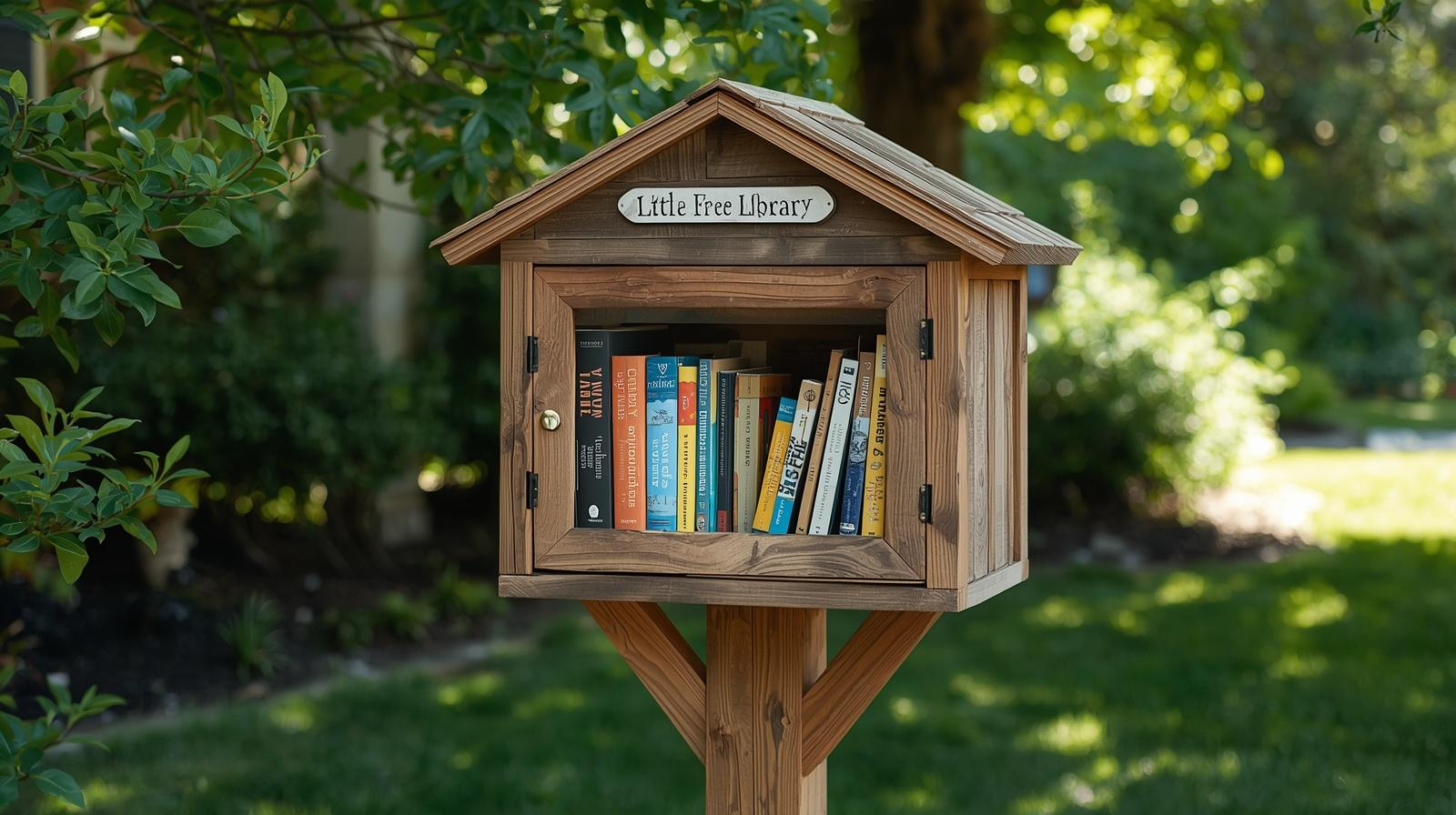
The Little Free Library
In 2009, a man named Todd Bol in Hudson, Wisconsin, built a small wooden box in the shape of a house, mounted it on a post in his front garden, filled it with books, and invited his neighbours to take one and leave one. He called it a Little Free Library, in tribute to his late mother who had been a schoolteacher. His neighbour Rick Brooks saw the idea’s potential and they began spreading the concept: a miniature library, free to all, maintained by whoever built it, governed by the simple principle of ‘take a book, return a book.’
The idea spread with astonishing speed. By the early 2020s, the Little Free Library organisation had registered over 150,000 Little Free Libraries in over 120 countries, making it, by number of locations, one of the largest library networks in the world. They appear in front gardens and on street corners, outside schools and community centres, in the grounds of churches and beside allotments. They are built from old telephone boxes, reclaimed wood, repurposed furniture, and elaborate hand-crafted structures in every conceivable style. Some are simple wooden boxes; others are miniature replicas of famous buildings, whimsical sculptures, or intricately painted works of folk art.
The Little Free Library phenomenon has not been without critics. Some librarians have pointed out that these unmediated book swaps tend to fill up with discarded rather than sought-after titles, and that they are most common in already well-served, middle-class neighbourhoods. The organisation itself has responded to these critiques by prioritising the establishment of Little Free Libraries in food deserts and under-served communities, and by partnering with schools and social service organisations to stock boxes with high-quality, age-appropriate children’s books.
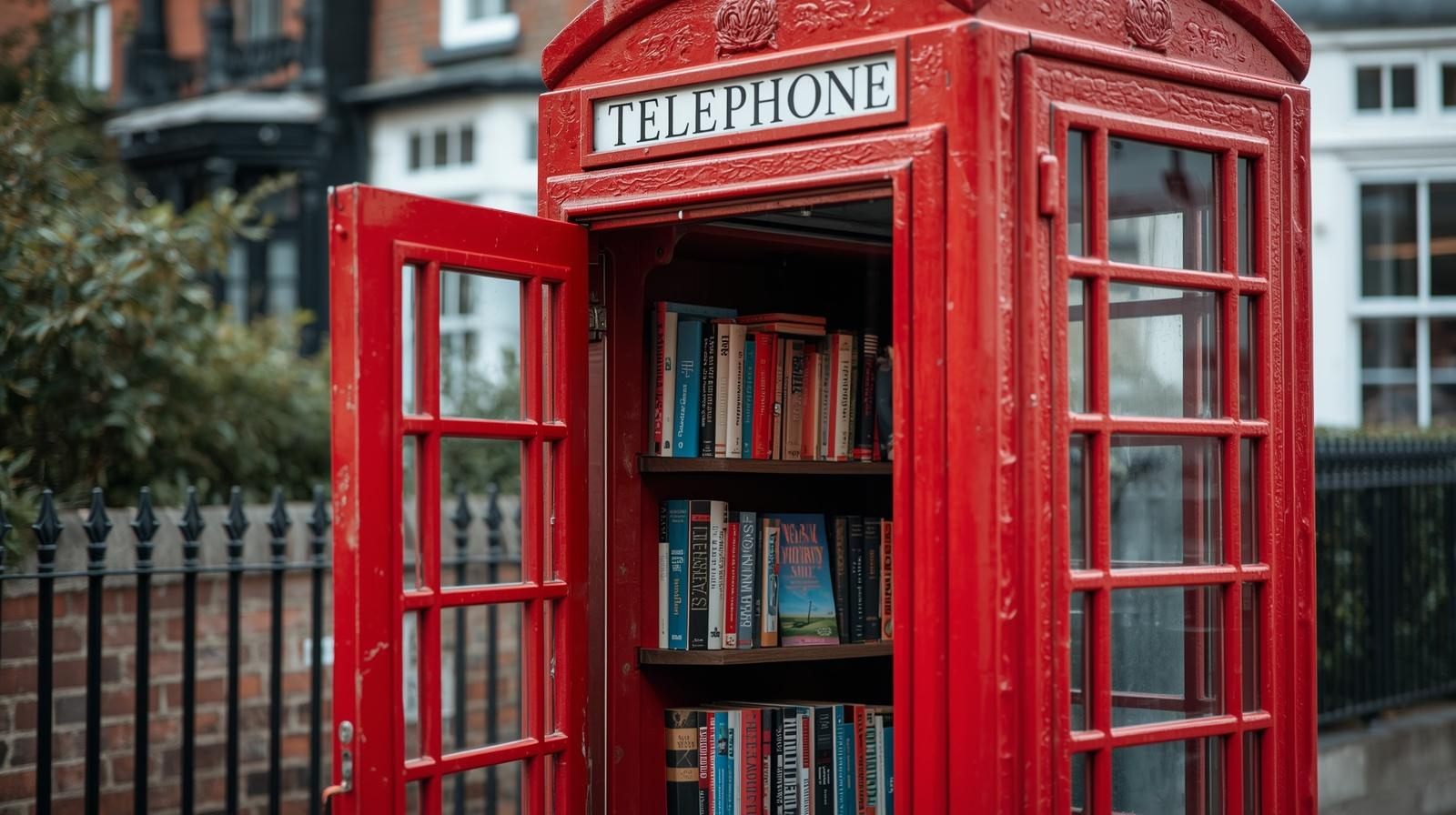
The Telephone Box Library
In 2009, the year Todd Bol built his first Little Free Library, BT in the United Kingdom began a programme called Adopt a Kiosk, offering redundant red telephone boxes to local communities for a nominal fee of one pound. Many communities chose to convert them into micro-libraries: the iconic K6 boxes, designed by Giles Gilbert Scott in 1935, were already beloved pieces of street furniture, and their sturdy cast-iron shelves and glazed doors made them near-perfect book cabinets.
Today, hundreds of former telephone boxes across the UK have been converted into community book swaps. They appear in village greens and high streets, outside pubs and post offices, in seaside towns and market squares. Some are run with extraordinary care and organisation, their shelves regularly weeded and restocked by volunteers; others are more chaotic, offering a jumble of donated paperbacks that changes week by week. All of them are free, all of them are open at any hour, and all of them carry the faint, pleasing atmosphere of a treasure hunt.
The telephone box library has spread well beyond the United Kingdom. In Canada, Australia, New Zealand, and parts of continental Europe, repurposed phone booths and kiosks have been transformed into book swap points. In Germany, the phenomenon is known as the Offener Bucherchrank, the open bookcase, and takes the form not just of former phone booths but of standalone wooden shelving units installed in public spaces, stocked entirely by community donations and free to all.
| Spotlight: Westbury-sub-Mendip
The Somerset village of Westbury-sub-Mendip converted its red telephone box into a library in 2010, making it one of the earliest in the UK. Stocked and maintained entirely by volunteers, it has been visited by readers from as far away as the United States and Japan, attracted by its fame as one of the prettiest book swap boxes in the country. |
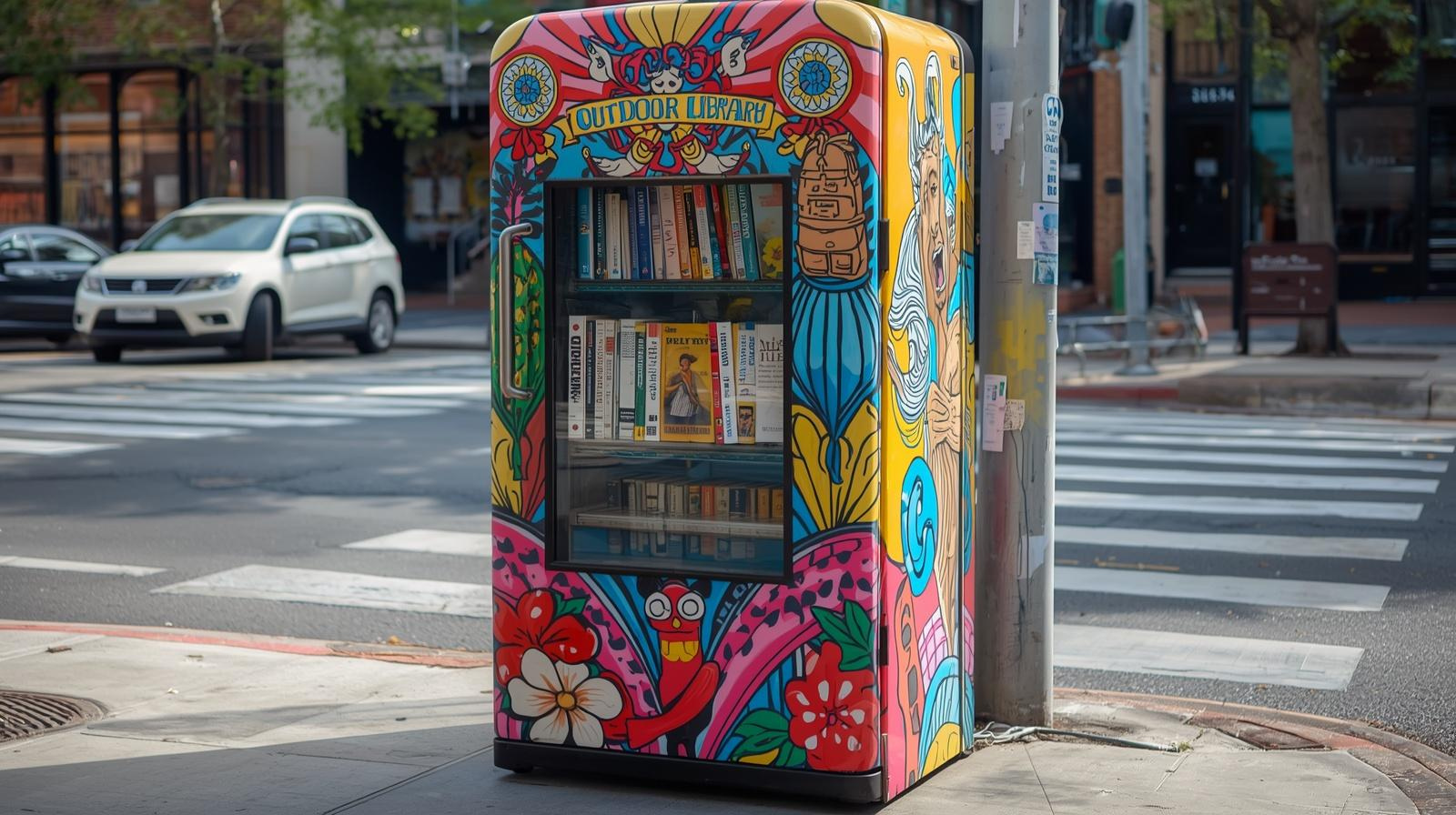
The Fridge Library
In several African and Latin American cities, community activists have repurposed old refrigerators as neighbourhood book exchange points. An old fridge, with its weatherproof seal, its compact size, and its distinctive appearance, makes a surprisingly effective outdoor library cabinet. The concept has appeared in communities in Nigeria, South Africa, Brazil, and Colombia, often as part of broader neighbourhood beautification and literacy projects. Painted in bright colours and decorated with murals, these fridge libraries become community landmarks as well as book exchange points.
The Seed Library
A charming and increasingly popular variant of the community library applies the lending principle not to books but to seeds. Seed libraries, usually housed in a small cabinet or wooden box, often inside a public library or community centre, allow gardeners to borrow packets of vegetable, herb, and flower seeds at the start of the growing season, on the understanding that they will save seeds from their harvest and return them (or equivalent seeds) at the end of the season. While not a library in the literary sense, the seed library embodies the same core principle: communal ownership of a shared resource, freely available to all.
The seed library movement has grown significantly in the United Kingdom, United States, Canada, and Australia, often housed within or affiliated to public libraries as part of sustainability and community food growing initiatives. The Broughton Community Growing Project in Edinburgh, the Seedy Sunday events held in towns across the UK, and the Boulder Public Library’s seed lending programme in Colorado are among the best-known examples.
The Tool Library
Similar in spirit, the tool library applies the lending model to hand tools, power tools, and garden equipment. Tool libraries have grown rapidly in the UK, Canada, and the United States, typically run as community enterprises or cooperatives. The Library of Things charity, founded in London in 2014, operates several tool and goods libraries across the capital. Toronto’s Tool Library has thousands of members borrowing everything from drills to paint sprayers. These initiatives reduce consumption, save money, build community, and, perhaps most importantly for this article, extend the library idea beyond its conventional literary boundaries.
The Human Library
Founded in Copenhagen in 2000, the Human Library takes the metaphor of lending to its most radical and humanising conclusion. Instead of books, readers borrow people, individuals who volunteer to be ‘read’ in a conversation lasting around thirty minutes. The ‘books’ in a Human Library are people whose identities, experiences, or life stories might challenge stereotypes or provoke difficult questions: a refugee, a person with a disability, a former criminal, someone living with a mental illness, a member of an often-misunderstood religious community. The reader gets to ask anything they like; the human book gets to answer or decline.
The Human Library organisation has run events in over eighty countries, working with schools, universities, public libraries, festivals, and businesses. Its founder, Ronni Abergel, conceived the idea after a friend was stabbed in what appeared to be a hate crime, and wanted to create a space in which prejudice could be challenged not by argument but by conversation. The Human Library remains one of the most creative and thought-provoking extensions of the library concept, a reminder that knowledge does not only live in books.
The Prison Library and Street Library
Several organisations around the world have established unofficial, grassroots libraries in public spaces specifically to reach people sleeping rough or living in extreme poverty. Street libraries operated by charities in cities from Melbourne to Manchester offer books in places frequented by homeless communities, alongside food parcels, clothing, and other support services. The act of offering a book rather than merely food or shelter carries its own message: that the person receiving it is seen as someone with curiosity and inner life, not merely material need.
In some cities, ‘blessing boxes’, similar in concept to Little Free Libraries but specifically stocked with food, toiletries, and practical items, have evolved to include books alongside their more immediately practical offerings. These crossover spaces, part food bank and part library, reflect the growing understanding that material and intellectual poverty often travel together, and that addressing one without acknowledging the other is an incomplete response.
“A library in the middle of a community is a cross between an emergency exit, a life-raft and a festival.” — Zadie Smith
Part Four: Digital Libraries, Specialist Collections, and the Library of the Future
The Digital Library
The internet has made possible a new kind of library that the founders of the British Museum Reading Room could not have imagined: a collection of millions of texts, freely accessible to anyone with a connection, without walls, opening hours, or library cards. Project Gutenberg, founded by Michael Hart in 1971, in an act widely considered the beginning of the digital library movement, has digitised over 70,000 books whose copyright has expired, making them freely available worldwide. Internet Archive, founded in 1996 by Brewster Kahle, has digitised millions more, including a massive collection of out-of-print and hard-to-find 20th-century books made available through a controlled digital lending programme.
Open Library, a project of Internet Archive, aims at nothing less than a catalogue of every book ever published, with as many as possible available for free lending. Wikipedia, while not a library in the traditional sense, functions as one of the largest free reference collections in history. The HathiTrust Digital Library, a partnership of major academic libraries, holds over 17 million digitised volumes.
These digital libraries have enormously expanded access to knowledge, particularly for readers in countries where physical library infrastructure is limited. A student in rural Malawi with a smartphone can access more text through Project Gutenberg and Wikipedia than was available in the entire city of London two centuries ago. Yet digital libraries also face serious challenges: not all books can be freely digitised due to copyright restrictions, not all communities have reliable internet access, and the long-term preservation of digital files presents its own archival challenges.
The Library of Tibetan Works and Archives
In Dharamsala, India, the Library of Tibetan Works and Archives was established in 1970 by the Tibetan government-in-exile as a response to the destruction of Tibetan cultural heritage following the Chinese occupation of Tibet. The library holds over 80,000 manuscripts, books, and archival materials, many of them unique texts rescued from Tibet at great personal risk. It is both a research library of global importance and an act of cultural resistance, a determination that a people’s written heritage would not be erased.
The library serves not just Tibetan scholars and monks but researchers from around the world, and runs educational programmes for Tibetan refugees settled in India. Its existence is a reminder that libraries can be acts of political defiance as much as intellectual provision.
The Talking Library
For visually impaired readers, the talking library, an audio collection of books read aloud and made available for borrowing, has been a vital institution since the 1930s. The Royal National Institute of Blind People in the UK operates one of the largest, with a collection of over 70,000 titles available on CD, USB, and as downloadable audio files. Organisations such as Learning Ally in the United States provide recorded textbooks for students with dyslexia and other print disabilities. As audiobooks have entered the mainstream, these services have grown in scope and accessibility, though the specific needs of people with print disabilities, who may require slow, clearly enunciated narration rather than the performative style of commercial audiobooks, mean that dedicated talking libraries continue to serve a distinct and important purpose.
The Pop-Up Library
In festivals, markets, community events, and empty urban spaces, the pop-up library has become an increasingly popular way of bringing books to unexpected places. Temporary reading spaces erected in parks, on beaches, in shopping centres, and at street festivals demonstrate the simple power of making books available in places where people already are, rather than expecting them to make a dedicated journey.
The Edinburgh International Book Festival, the Hay Festival, and literary events around the world create temporary library spaces that are heavily used during their brief existence. In the United States, organisations like Read Indeed have distributed pop-up book collections at community events in under-served neighbourhoods. In New York, The Street Library has installed book collections in Laundromats and hair salons in low-income areas, places where people wait and where a book is a natural companion.
The Laundromat Library
The Laundromat Library concept, pioneered in several American cities, is based on a simple insight: people waiting for their laundry to finish are a captive audience with time on their hands. By placing book collections in Laundromats in low-income neighbourhoods, where residents often cannot afford home washing machines and where library buildings may be far away, these initiatives bring books precisely to the communities that need them most, at a moment when they have nothing else to do. Some schemes have focused on children’s books, placing small reading corners in Laundromats to give parents and children something to do together during the wash cycle.
The Library at the End of the World
One of the most remote libraries in the world is the library at the Concordia research station in Antarctica, where a small collection of books circulates among the scientists and support staff who overwinter in conditions of extreme isolation. Similarly, the International Space Station maintains a small digital library accessible to its crew, and nuclear submarines carry libraries for their crews during months-long submersions. These are, in the most literal sense, libraries at the edge of human experience, and their existence speaks to something fundamental about human beings: even in the most extreme conditions, in the most isolated places on earth, we want to read.
Conclusion: The Library Is Everywhere
What this survey reveals, above all, is that the library is not a building. It is an idea, the idea that knowledge should be shared, that books should circulate freely among those who want to read them, that no community is too remote, too poor, or too small to deserve access to the world of the written word. This idea has taken root in every culture on earth, and has found expression in forms as varied as human geography and human ingenuity permit.
The grandeur of the British Library and the homespun charm of a red telephone box stuffed with paperbacks are expressions of the same impulse. The Kenyan camel librarian making his circuit of nomadic settlements and the volunteer who refills the Little Free Library on the corner of her street are doing the same work. The digital archive that makes 70,000 free texts available to anyone on earth and the Colombian teacher whose donkeys carry books into the mountains are all, in their different ways, in the same business: getting books to people who want them.
In an age of information overload, when we are surrounded by screens and overwhelmed by data, the library, in all its forms, offers something rare and increasingly precious: curated, considered, trustworthy access to the best that human thought and imagination have produced. Whether that library travels by camel, by cable, by bicycle, or by sea; whether it lives in a palace of marble or a box of painted wood on a garden post; whether its stock is seeds or tools or human stories, the library endures, because the hunger for knowledge endures.
Take a book. Leave a book. Pass it on.
Leave a Reply