
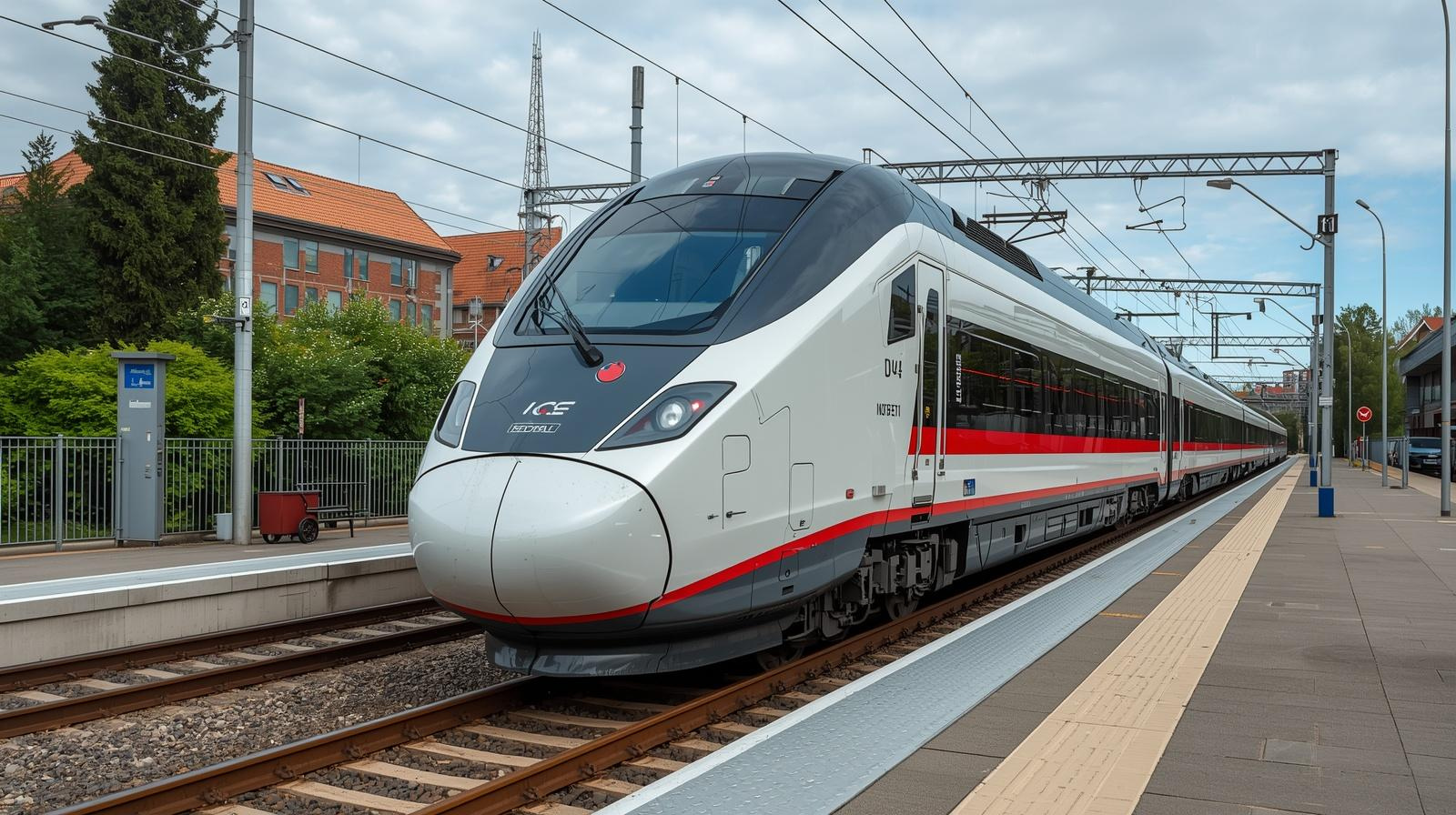
On 2nd June, 1991, a sleek white train with a distinctive red stripe glided out of Hamburg’s central station and headed south toward Munich. The InterCity Express, ICE, had entered regular service, and Germany was making a statement that was characteristically its own: not the most flamboyant entry into the high-speed rail era, not the fastest, not the most theatrical, but perhaps the most thoughtful. The ICE was engineered not just for speed, but for integration, a train designed to work within Germany’s existing rail culture rather than replace it.
The German Philosophy: Integration Over Isolation
To understand what makes the ICE distinctive among the world’s great high-speed trains, it helps to start with what it is not.
The Japanese Shinkansen runs on completely separate, dedicated infrastructure, entirely isolated from the conventional rail network. The French TGV, while capable of running on ordinary track, was conceived primarily as a point-to-point express between major cities on new lines. Both are brilliant systems. But Germany chose a different philosophy.
The ICE was designed from the outset to serve not just the handful of largest German cities, but the entire fabric of a country with an unusually polycentric urban structure. Germany has no single dominant megacity in the way that France has Paris or Japan has Tokyo. Berlin, Hamburg, Munich, Frankfurt, Cologne, Stuttgart, Düsseldorf, power and population are distributed across multiple major centres, and dozens of medium-sized cities play significant roles in economic and cultural life.
A system that only served the biggest nodes would leave most of Germany behind. The ICE was therefore engineered to run at high speed on new dedicated lines where they existed, and to transition seamlessly onto upgraded conventional track to reach the cities that new lines did not serve. The result is a network of extraordinary geographic reach, and considerable operational complexity.
Origins: From InterCity to InterCity Express
The ICE did not emerge from nowhere. It grew out of Germany’s existing InterCity network a system of fast, reliable locomotive-hauled trains that had been the backbone of long-distance rail travel since the 1970s.
As France was preparing to launch the TGV and Japan was expanding its Shinkansen, German Federal Railways, Deutsche Bundesbahn, was conducting its own research into the possibilities of high-speed rail. A prototype train, the Intercity-Experimental, was built in the mid-1980s and used for testing and record attempts. On 1st May 1988, it set a world speed record of 406.9 km/h on a section of new line near Fulda, a record that lasted only until the TGV Atlantique surpassed it two years later, but which demonstrated that German engineering could compete at the highest level.
The production ICE 1 trains that entered service in 1991 were the direct descendants of this experimental programme. They were large, comfortable trains, significantly wider than their French counterparts, designed with the long-distance traveller firmly in mind. Restaurant cars, airline-style seating in first class, and a smooth, quiet ride reflected a conviction that high-speed rail should offer a genuinely superior travel experience, not merely a faster one.
The ICE Generations: An Evolving Family
One of the defining characteristics of the ICE programme has been its willingness to evolve. Unlike some rail systems that settled on a single successful design, Germany has produced multiple generations of ICE trains, each addressing the limitations of its predecessor and each reflecting advances in technology and operational experience.
ICE 1 (1991): The original. A classic locomotive-hauled configuration with a power car at each end and up to fourteen passenger carriages between them. Long, stately, and deliberately comfortable. The ICE 1 still operates today, having undergone extensive refurbishment, a testament to the durability of its fundamental design.
ICE 2 (1996): A shorter, half-length version of the ICE 1, designed to be coupled in pairs for flexible capacity management. Two ICE 2 sets could run as one train and be split at an intermediate station, serving two different destinations from a single departure, an elegant solution to the challenge of serving multiple endpoints from one service.
ICE 3 (2000): A fundamental rethinking of the ICE concept. The ICE 3 abandoned the dedicated power car in favour of distributed traction, motors spread across multiple axles throughout the train, in the manner of the Shinkansen. This reduced axle loads, allowing the train to operate on a wider range of routes, and freed up space at the ends of the train for panoramic cab-view seating, a feature that became an instant favourite with passengers fortunate enough to secure those front-row tickets. The ICE 3 also became the first ICE variant approved for international operation, running under the different electrification systems of France, Belgium, and the Netherlands.
ICE T (1999) and ICE TD (2001): Tilting variants, designed to run faster through curves on conventional, winding track. The tilting mechanism, similar in principle to that used by Britain’s Pendolino and Italy’s ETR 460, allows the train to lean into curves, permitting higher speeds without the discomfort that lateral forces would otherwise impose on passengers. The ICE T brought high-speed travel to routes through hilly terrain that would otherwise have required new infrastructure to serve properly.
ICE 4 (2017): The newest and largest member of the family, designed for the twenty-first century’s demands of capacity, energy efficiency, and passenger comfort. The ICE 4 is longer than any previous ICE, capable of carrying over 900 passengers in its longest configuration. It is also significantly more energy-efficient than its predecessors, consuming around 22% less energy per seat than the ICE 3, and was designed with maintenance simplicity in mind, reducing the cost and complexity of keeping trains in service. The ICE 4 forms the backbone of Deutsche Bahn’s long-term fleet strategy.
ICE 3neo (2022): A modernised successor to the ICE 3, built on an updated platform by Siemens under the Velaro brand. The 3neo introduced improved passenger amenities, better accessibility, enhanced digital connectivity, and further efficiency gains. Its entry into service marked a significant step in Deutsche Bahn’s ongoing fleet renewal programme.
The Network: New Lines and Old Tracks
Germany’s high-speed rail network reflects the country’s federated political structure and its complex geography in ways that are both its greatest strength and its most persistent challenge.
The Neubaustrecken, new high-speed lines built specifically for ICE operation, connect the country’s major corridors. The Cologne–Frankfurt line, opened in 2002, is one of the most impressive pieces of railway engineering in Europe: a 177-kilometre route that cuts through the Westerwald hills using a combination of tunnels, viaducts, and cuttings to maintain gradients manageable at 300 km/h. The journey time between the two cities fell from around two hours to just under an hour.
The Berlin–Munich line, fully opened in 2017 after a construction programme spanning decades, was a transformative moment for German rail. The journey between Germany’s two largest cities, previously a grinding four-hour slog, fell to just under four hours initially, with acceleration to under three hours and forty-five minutes subsequently. It was not the fastest high-speed journey in the world, but it connected two cities that had existed, politically and culturally, in separate orbits for much of the previous century.
Yet large parts of the ICE network still run on upgraded conventional lines, often shared with regional and freight trains. This is where Germany’s integrated philosophy comes at a cost. Speed is constrained, punctuality is vulnerable to knock-on delays from slower traffic, and the complexity of managing trains across both high-speed and conventional infrastructure creates operational headaches that purely dedicated systems do not face.
The Punctuality Problem
No honest account of the ICE can avoid the subject of punctuality.
Germany has a reputation, cultivated over generations, for precision and reliability. Deutsche Bahn, the operator of the ICE network, inherited this expectation and has often fallen short of it. Delays on the ICE network have been a persistent source of frustration for German passengers, and in some recent years the system’s on-time performance has compared unfavourably not just with Japan’s Shinkansen (an almost unfair comparison, given the Shinkansen’s unique operating conditions) but also with other European competitors.
The reasons are structural as much as operational. The German network is heavily used by freight trains, which share tracks with ICE services outside the dedicated new lines. Maintenance backlogs have accumulated after years of underinvestment in infrastructure renewal. The integrated approach that gives the ICE its geographic reach also means that a delay anywhere in the system can propagate rapidly across the network.
Deutsche Bahn has acknowledged the problem and committed to a major infrastructure renewal programme, the Generalsanierung, that involves closing key routes entirely for extended periods to allow comprehensive track and signalling upgrades. The ambition is to restore a level of reliability befitting Europe’s largest economy and one of the world’s great engineering cultures. Whether the programme delivers on its promises is one of the defining infrastructure questions in Germany today.
Going International: The ICE Beyond Germany’s Borders
The ICE 3’s multi-system capability opened a new chapter: high-speed trains running across borders without passengers needing to change.
Services from Frankfurt and Cologne to Paris via the Belgian high-speed network began in the mid-2000s, offering an alternative to flying on one of Europe’s busiest business travel routes. The ICE runs through to Amsterdam, connecting Germany’s western cities to the Dutch capital in under three hours. Services to Vienna link Germany to Austria, and connections into Switzerland extend the network’s reach further.
These international operations are operationally demanding. Each country has its own signalling systems, electrification standards, and safety certification requirements. The multi-system ICE 3 trains carry equipment to operate under four different overhead voltages and are certified to the safety standards of multiple national regulators. That they do so routinely, and largely without incident, is a considerable engineering and regulatory achievement.
The expansion of international high-speed services across Europe, driven partly by environmental pressure on aviation and partly by the improving competitiveness of rail, is likely to bring further growth in cross-border ICE services in the years ahead.
The Eschede Disaster and Its Legacy
Any account of the ICE must confront the darkest moment in its history.
On 3rd June, 1998, exactly seven years after the ICE entered commercial service, an ICE 1 train travelling from Munich to Hamburg derailed catastrophically near the town of Eschede in Lower Saxony. A fatigued wheel tyre failed, causing a carriage to strike a bridge support at high speed. The bridge collapsed onto the train. One hundred and one people were killed, making it the deadliest rail accident in post-war German history.
The investigation revealed that a new type of rubber-cushioned wheel, introduced to reduce noise, had developed a crack that went undetected by the inspection regime in place at the time. The failure was systemic as much as mechanical, a combination of design, inspection, and quality assurance shortcomings.
The response was comprehensive. The rubber-cushioned wheels were replaced across the fleet with solid steel wheels. Inspection procedures were overhauled. Safety monitoring systems were upgraded. The railway industry internationally adopted the lessons of Eschede into its own wheel inspection protocols.
The Eschede disaster did not stop the ICE programme, but it fundamentally changed it, and it serves as a permanent reminder that even the most sophisticated engineering systems require continuous vigilance, rigorous inspection cultures, and the humility to question assumptions.
Passenger Experience: The ICE as a Place to Be
Deutsche Bahn has long understood that a high-speed train competes not just on journey time but on the quality of the experience it provides.
ICE trains are spacious by European standards. Seats are wide, legroom is generous, and the ride, at its best, on the purpose-built new lines is, remarkably smooth and quiet. The restaurant car, a fixture of the ICE 1 and maintained in various forms across subsequent generations, reflects a German conviction that a long train journey should include the opportunity for a proper meal, not merely a packet of crisps from a trolley.
Wi-Fi connectivity, patchy in the early years of its introduction, has gradually improving has become an expectation rather than a luxury. The ICE app allows passengers to monitor their journey in real time, reserve seats, and access digital tickets. The effort to make the train a productive working environment, as much as a transit vehicle, reflects the importance of business travel to the ICE’s revenue base.
The cab-view seats at the front of ICE 3 and 3neo trains remain one of the most distinctive features of the ICE experience. Sitting in the leading carriage, with an unobstructed view through the driver’s cab window to the track ahead, is a genuinely thrilling way to experience high-speed rail, watching signals blur past, tunnels rush up and swallow the train, and the landscape open up as the train emerges onto a viaduct above a valley. These seats are always among the first to sell out.
The Future: Hydrogen, Digital Rail, and the Deutschland-Takt
Germany’s ambitions for its rail network extend well beyond incremental improvements to the existing ICE service.
The Deutschland-Takt, a long-planned national integrated timetable, aims to create a system in which trains across the entire country are coordinated to meet at key interchange hubs, minimising connection times and making multi-leg journeys genuinely seamless. The concept, already implemented with considerable success in Switzerland, treats the national rail network as a single integrated system rather than a collection of separate services. For the ICE, this means scheduling arrival and departure times to mesh with regional and local services, making high-speed rail the backbone of a coherent national travel ecosystem rather than a premium overlay on top of it.
Hydrogen-powered trains are under active development for routes where electrification is not economical, though the ICE network itself is fully electrified. Digital signalling, replacing the physical lineside signals that currently govern much of Germany’s rail operation, promises to increase capacity on existing infrastructure by allowing trains to run closer together more safely. This technology, known as ETCS (European Train Control System), is being rolled out progressively and is central to Deutsche Bahn’s infrastructure renewal strategy.
Siemens, the manufacturer of the ICE 3neo and supplier of much of the ICE fleet, continues to develop the next generation of high-speed technology. The Velaro platform on which the 3neo is based is also the foundation of trains operating in Spain, Russia, China, and the United Kingdom, a reminder that German high-speed rail engineering has influenced the entire world, even where the trains do not carry the ICE name.
Conclusion
The ICE is not the world’s fastest high-speed train, nor its most punctual, nor the one with the longest network. It is something more interesting than any of those superlatives: a train that reflects the full complexity of the country it serves.
Germany is not France, with one overwhelming capital city and a natural hub-and-spoke geography. It is not Japan, with the political will and the fiscal capacity to build an entirely separate infrastructure system from scratch. It is a large, densely populated, federally structured country with a polycentric urban geography, a powerful engineering tradition, a fierce commitment to quality, and an equally fierce public expectation that things should work.
The ICE navigates all of that, imperfectly, at times frustratingly, but with a fundamental seriousness of purpose that is hard not to admire. It has connected Germany’s cities in ways that would have seemed improbable a generation ago. It has carried billions of passengers. It has spread German high-speed technology across four continents. And through the Generalsanierung and the Deutschland-Takt, it is working, slowly, methodically, in the German way, to become the system it has always aspired to be.
The white train with the red stripe is still running. And Germany, characteristically, is still working to make it better.
Leave a Reply