
Introduction
There is a particular kind of anticipation that belongs only to certain railway stations, a feeling compounded of departure and desire, of journeys about to begin and destinations already half-imagined. The Gare de Lyon in Paris produces this feeling more powerfully than almost any other station in the world. To stand on its concourse with a ticket in your hand is to feel the pull of the south: the lavender fields of Provence, the Mediterranean glittering under a hard blue sky, the vineyards of Burgundy rolling past a dining car window, the Italian lakes, the Swiss Alps, the cities of the Riviera. For more than a century, the Gare de Lyon has been the station from which Parisians and travellers from across the world have set off in pursuit of warmth, beauty, and the particular pleasures that lie at the end of a southbound train.
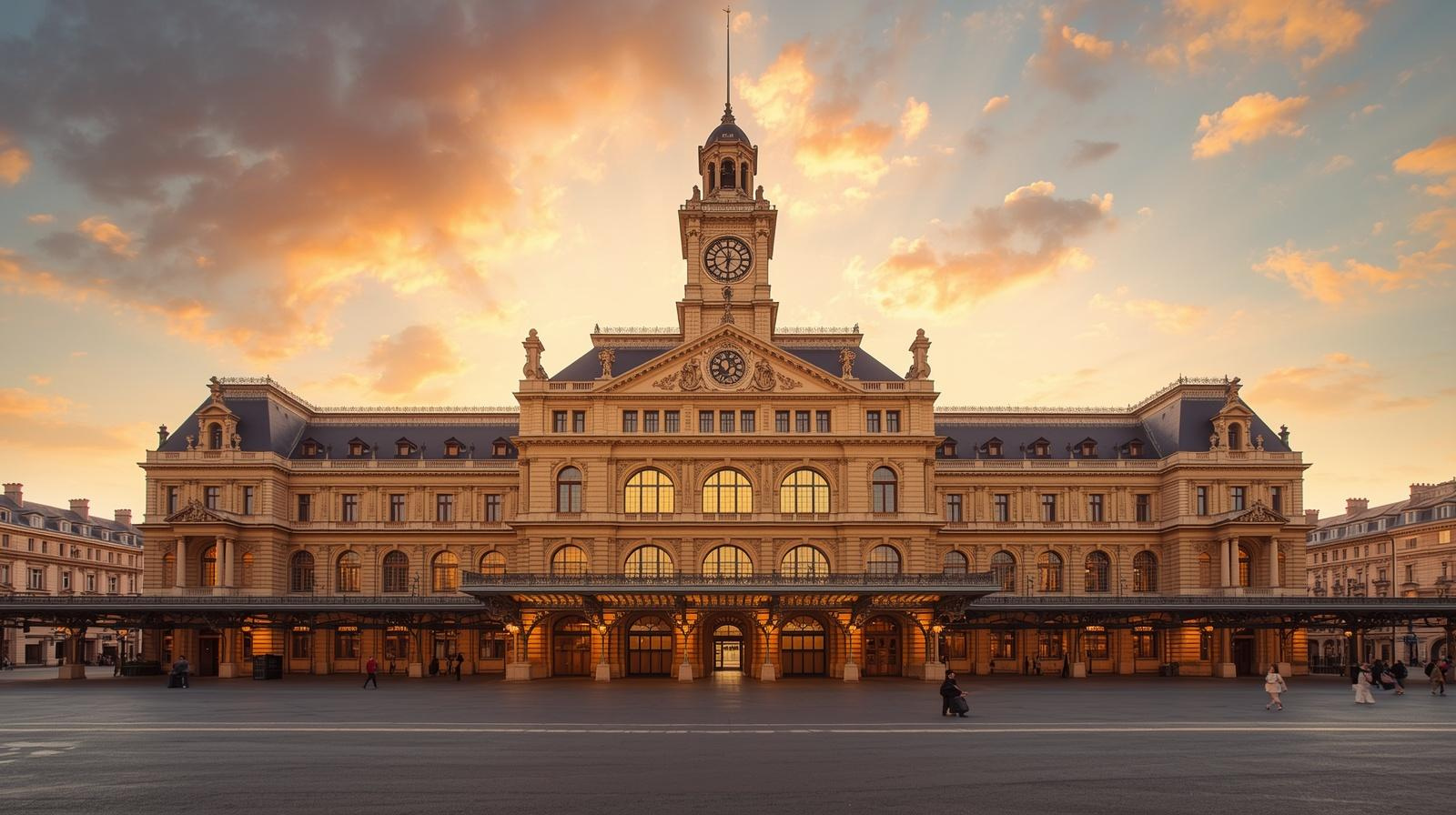
It is also, by any measure, one of the most beautiful railway stations ever built. Its famous clock tower rises above the 12th arrondissement like a beacon, its ornate Belle Époque facade commands one of Paris’s great transport axes, and within its walls is one of the most celebrated restaurant interiors in France, the legendary Le Train Bleu, a monument to the decorative arts of the early twentieth century that has been feeding travellers and seducing non-travellers since 1901.
The Gare de Lyon is not the largest station in Paris, nor the busiest. But it is, without question, the most glamorous, the station most saturated with history, romance, and the particular mythology of luxury travel that reached its apogee in the age of the great express trains.
Origins and Early History
The Gare de Lyon takes its name from the city of Lyon, towards which its tracks head south from Paris. The station sits on the Place Louis-Armand in the 12th arrondissement, on the right bank of the Seine, roughly two kilometres south-east of the city centre.
The first station on the site was built in 1847 to serve the Paris-Lyon-Méditerranée Railway (PLM), the great company that connected Paris to Lyon, Marseille, and the Mediterranean coast. This original building was a relatively modest structure, entirely inadequate for the ambitions of the PLM, which was rapidly becoming one of the most important and profitable railway companies in France.
As the volume of traffic grew through the latter half of the nineteenth century, the French Riviera was becoming a fashionable destination for wealthy Europeans, and the PLM was their primary means of getting there, it became clear that a new, grander station was needed. The occasion that crystallised this decision was the Paris Exposition Universelle of 1900, the great world’s fair that transformed the French capital and for which an entire generation of Parisian public buildings was renewed or rebuilt. The Gare de Lyon was among them.
Architecture and Construction: Marius Toudoire
The new Gare de Lyon was designed by the architect Marius Toudoire (1852–1927), who was the PLM company’s in-house architect. Toudoire was a product of the prestigious École des Beaux-Arts in Paris, trained in the academic tradition that dominated French architecture in the second half of the nineteenth century, and his design for the Gare de Lyon is a confident and accomplished work in the Belle Époque style, the exuberant, ornate, richly decorative aesthetic that characterised French public architecture at the turn of the twentieth century.
The station was built between 1895 and 1900, opening in time for the Exposition Universelle, and it represented a very considerable investment by the PLM. The company was not merely building a transport facility; it was building an advertisement for itself and for the destinations it served, and it intended the building to say, unambiguously, that travelling with the PLM was a luxurious and civilised experience.
The Facade
The facade of the Gare de Lyon, facing onto the Boulevard Diderot and the Place Louis-Armand, is a long, horizontal composition of considerable elegance. It is built in cream-coloured stone, giving it a brightness and warmth that contrasts with the darker stonework of many Parisian public buildings, and its surface is animated with the full vocabulary of Belle Époque ornament: arched windows framed by carved stone surrounds, pilasters and cornices enriched with classical mouldings, sculptural decoration in the form of allegorical figures, garlands, and cartouches, and an overall sense of controlled richness that stops well short of excess.
The facade is structured around a central section that projects slightly forward and is given additional emphasis by the pavilion above it, creating a clear hierarchy that draws the eye to the main entrance. The flanking wings are treated more quietly, their long rhythms of arched windows giving the composition a measured, stately quality.
The Clock Tower
The dominant feature of the Gare de Lyon’s exterior, and the element that has made it one of the most recognisable buildings in Paris, is the magnificent clock tower that rises from the eastern end of the building to a height of approximately 67 metres (220 feet). Built between 1899 and 1900, the tower is Toudoire’s masterpiece: a composition of extraordinary elegance and precision that draws on Italian Renaissance campanile traditions while remaining entirely French in its refinement and detail.
The tower rises in stages, each diminishing slightly in mass as it ascends, through a series of arched openings and decorative registers enriched with carved stone, to the large clock faces, one on each of the tower’s four sides, and then upward still further through a lantern stage to the gilded finial at its summit. The clock faces themselves are large and handsome, framed in decorated stone surrounds, and they are illuminated at night, making the tower a landmark visible from considerable distances across the city.
The tower has been compared, inevitably, to the Big Ben clock tower in London (completed 1859) and to various Italian campanili, but it is in truth a distinctly French creation, more delicate and refined than its English counterpart, more richly decorated than most Italian precedents, and entirely at home in the Parisian streetscape.
The Train Shed
Behind Toudoire’s ornate facade lies the great train shed, a more utilitarian structure but one of considerable scale, with a wide-span iron and glass roof covering the main platforms. The shed was rebuilt and extended at various points in the twentieth century as the volume of traffic grew, and it now handles some of the busiest platform operations in France. The functional spaces of the station, the concourses, the ticket halls, the waiting areas, are generous and well-lit, though they lack the decorative ambition of the exterior. The building’s designers clearly understood that the facade and the restaurant above were where the PLM’s prestige was to be expressed; the platforms were where the trains needed to run efficiently.
Le Train Bleu: A Restaurant Like No Other
If the Gare de Lyon has one feature that elevates it above virtually every other railway station in the world, it is the restaurant on the first floor of the facade building, the legendary Le Train Bleu.
Opened in 1901, a year after the station itself, Le Train Bleu, originally called the Buffet de la Gare de Lyon, was commissioned by the PLM as the crowning jewel of their new station. The company spared no expense: they hired the finest craftsmen and decorators in France, and the result was an interior of almost overwhelming magnificence that has survived essentially intact for more than 120 years.
The Interior
The restaurant occupies a suite of rooms on the first floor, reached by a grand staircase from the main concourse. The principal dining room and its ancillary salons are decorated in a style that can only be described as Belle Époque maximalism: every surface is covered in ornament, every ceiling is painted, every arch is gilded, and the overall effect is one of opulent, joyful excess that is somehow never oppressive.
The ceilings are the glory of the room. They are divided into coffered panels, each filled with a large oil painting depicting the landscapes, cities, and pleasures of the destinations served by the PLM railway. There are 41 paintings in total, executed by some of the leading academic painters of the day, including Gaston Casimir Saint-Pierre, Henri Gervex, and François Flameng. They show the Bay of Angels at Nice, the harbour at Marseille, the vineyards of Burgundy, the châteaux of the Loire, the ski slopes of the Alps, the cathedrals of Lyon, a panoramic advertisement for the south and east of France, displayed in paint and gold above the heads of the travellers about to depart for those very places.
The walls are panelled in dark wood, carved and moulded in the Belle Époque manner, with mirrors set into elaborate frames to multiply the light and space. The gilded plasterwork of the cornices and friezes is of exceptional quality, intricate, inventive, and executed with a precision that speaks of craftsmen working at the very top of their abilities. The chandeliers are enormous and magnificent. The floor is covered in encaustic tiles of complex geometric patterns. Even the hat racks and luggage shelves are works of decorative art.
The restaurant was renamed Le Train Bleu in 1963, taking its name from the famous luxury express train that had for decades been one of the PLM’s most celebrated services (of which more below). It was classified as a historic monument in 1972, recognising the exceptional quality of its decoration and ensuring its preservation.
Famous Visitors
Over its 120-plus years of operation, Le Train Bleu has attracted a remarkable roster of famous guests. Coco Chanel was a regular visitor, as was the writer Colette, who lived nearby and used the restaurant as an extension of her social life. Marcel Proust is said to have dined there. Salvador Dalí was a devotee. Brigitte Bardot, Jean Gabin, Louis Jouvet, the list of celebrated names associated with Le Train Bleu reads like a roll-call of twentieth-century French cultural life. More recently, the restaurant has featured in films, fashion shoots, and the social media feeds of a new generation of visitors for whom its gilded ceilings provide an incomparable backdrop.
To eat at Le Train Bleu before boarding a TGV to the south is to participate in one of the great rituals of Parisian life, a tradition of departure that connects the present to an age of travel quite different from our own.
The Great Trains: A History of Luxury Departures
The Gare de Lyon’s identity as the station of luxury and romance was built not just by its architecture but by the trains that departed from its platforms. Over the course of the twentieth century, it was the origin point for some of the most celebrated express services in the history of European rail.
Le Train Bleu: The Blue Train
The most famous train ever to depart from the Gare de Lyon was undoubtedly Le Train Bleu, the Calais–Méditerranée Express, which ran from the Channel port of Calais through Paris to the French Riviera, connecting the boat trains from Britain with the sunlit coast of the south.
First operated in 1886 and given its famous nickname in 1949 (after the distinctive blue livery of the Pullman sleeping cars), Le Train Bleu became the definitive expression of luxury rail travel in the first half of the twentieth century. Its passengers were the rich and famous of Europe: British aristocrats heading to their winter villas on the Riviera, American millionaires bound for the casinos of Monte Carlo, film stars, diplomats, writers, and the entire floating world of the international wealthy class that made the Côte d’Azur its playground between the wars.
The train’s Pullman cars were fitted out to a standard of comfort and elegance that rivalled the finest hotels. Passengers dressed for dinner; the dining car offered cuisine of restaurant quality; the sleeping compartments were panelled in wood and hung with curtains. To travel on Le Train Bleu was to inhabit, for one night, a world of effortless privilege.
The train’s cultural resonance extended far beyond its passenger list. Agatha Christie set her 1928 novel The Mystery of the Blue Train aboard a fictionalised version of the service, one of her Hercule Poirot mysteries that introduced millions of readers to the mythology of Riviera luxury. Coco Chanel and Sergei Diaghilev collaborated on a ballet called Le Train Bleu (1924), with sets by Henri Laurens and a curtain painted by Pablo Picasso. The train had become a cultural object as much as a transport service, an emblem of a particular mode of European high life.
Le Train Bleu continued to operate in various forms through the postwar decades, though the rise of air travel and the decline of the grand Pullman tradition diminished its lustre. The last through-service in the original tradition ran in 1981, though the name was subsequently applied to a TGV-era overnight service that maintained a nominal connection to the legend.
The Orient Express
While the Orient Express is most associated with the Gare de l’Est, its traditional Paris terminus for the eastward journey to Istanbul, the Gare de Lyon had its own significant connections to this most legendary of all train services. Various Orient Express routings over the years passed through or originated from the Gare de Lyon, particularly services that connected with the Simplon Orient Express, which ran via Switzerland, the Simplon Tunnel, and northern Italy to the Balkans and beyond.
The Venice Simplon-Orient-Express (VSOE), the luxury private service revived by James Sherwood in 1982 and still operating today, departs from Paris as part of its London–Venice itinerary, and over the years has used various Paris stations including connections through the Gare de Lyon. The association of the Gare de Lyon with Oriental and exotic destinations, via Switzerland, the Alps, and Italy, was part of its identity from the earliest years of the PLM.
The Mistral and Other Named Expresses
Between the wars and in the postwar decades, the Gare de Lyon was the departure point for a series of named express trains that maintained, in their different ways, the tradition of glamorous southbound travel. The Mistral, introduced in 1950, was for a time the fastest and most prestigious express in France, running non-stop from Paris to the Riviera in a little under seven hours. Named after the fierce wind that sweeps down the Rhône valley, it was operated with Pullman cars and a level of service that recalled the pre-war golden age. The Côte d’Azur Rapide, the Phocéen, and other named services similarly traded on the mythology of the southern journey.
The TGV Era
The modern era of the Gare de Lyon began on 27th September 1981, when the first TGV (Train à Grande Vitesse, High Speed Train) service departed from its platforms. The TGV Sud-Est line, running between Paris and Lyon on purpose-built high-speed track, reduced the journey time between the two cities from approximately four hours to just two, a transformation in the geography of French travel that was as significant, in its way, as the arrival of the railway itself a century and a half earlier.
The TGV transformed the Gare de Lyon from a monument of the past into a working hub of the future. Where the Belle Époque had made it glamorous, the TGV made it busy, very busy. The high-speed network expanded steadily southward through the 1980s and 1990s, reaching Marseille and the Mediterranean coast, Montpellier, Nîmes, and eventually a web of destinations across the south and south-east of France, as well as connections into Switzerland, Italy, and Spain.
Today, the Gare de Lyon is one of France’s principal TGV hubs, handling hundreds of high-speed departures every day. The journey to Lyon takes approximately two hours; to Marseille, three hours; to Nice, approximately five and a half hours. The station is also the departure point for Thello services to Italy and for Lyria services to Switzerland, maintaining the Gare de Lyon’s historic role as the gateway to the Alps and the Mediterranean world.
The Station Today
The Gare de Lyon of the twenty-first century is a building operating under considerable pressure. It handles approximately 90 million passengers per year, making it one of the busiest stations in France, and the Victorian-era infrastructure, however magnificently it has been maintained, was not designed for this volume of traffic. The platforms, concourses, and approaches are frequently congested, and the station has been the subject of ongoing investment and modification to increase its capacity and improve the passenger experience.
The RER A and D lines pass through the station at underground level, providing connections to central Paris, Charles de Gaulle Airport, and points across the Île-de-France. Métro Line 14 also serves the station, as does the surface Métro Line 1 at the nearby Bastille stop. The integration of these underground services has required considerable engineering work over the decades.
The facade, the clock tower, and Le Train Bleu restaurant are all listed as historic monuments, protected from unsympathetic alteration. The station was extensively refurbished in the 1990s and early 2000s, and the facade was cleaned and restored, returning the cream stonework to something close to its original brightness.
Le Train Bleu continues to operate as a restaurant open to all, not just rail travellers, and it remains one of the most extraordinary dining rooms in France. To book a table under those painted ceilings, surrounded by the gilded evidence of a century of luxurious departures, is to participate in a piece of living history.
The Architecture of Departure
There is a phrase sometimes used by architectural historians, architecture of departure, to describe buildings whose design is inflected by their function as thresholds: places where people pass from one world into another, where the everyday is left behind, and the journey begins. The great railway stations are the supreme examples of this type: places where the act of leaving is given architectural form.
The Gare de Lyon is perhaps the finest example of departure architecture in the world. Everything about it, the warm cream stone facade, the soaring clock tower counting down the minutes to departure, the painted ceilings of Le Train Bleu showing the landscapes of elsewhere, the platforms where TGVs wait to carry their passengers into the south, speaks of the experience of setting out.
Marius Toudoire built a station that understood what railway travel, at its best, could feel like. He built not just a machine for moving passengers but a frame for the experience of departure, a space in which the imagination could take flight before the train had left the platform.
More than a century later, that frame still holds. The trains are faster, the passengers more numerous, the world incomparably changed. But the feeling that the Gare de Lyon produces, that particular compound of anticipation and desire, of journeys beginning and destinations beckoning, remains entirely its own.
Key Facts at a Glance
Location: Place Louis-Armand, 12th arrondissement, Paris
Original station opened: 1847
Current building opened: 1900 (for the Paris Exposition Universelle)
Architect: Marius Toudoire (1852–1927)
Architectural style: Belle Époque / Beaux-Arts
Clock tower height: Approximately 67 metres (220 feet)
Le Train Bleu restaurant opened: 1901; classified historic monument 1972
First TGV departure: 27 September 1981
Annual passengers: Approximately 90 million
Principal services: TGV to Lyon, Marseille, Nice, Montpellier and southern France; Lyria to Switzerland; connections to Italy; RER A and D; Paris Métro Line 14
Famous trains: Le Train Bleu (Calais–Méditerranée Express); the Mistral; the Côte d’Azur Rapide; Venice Simplon-Orient-Express connections
Leave a Reply