
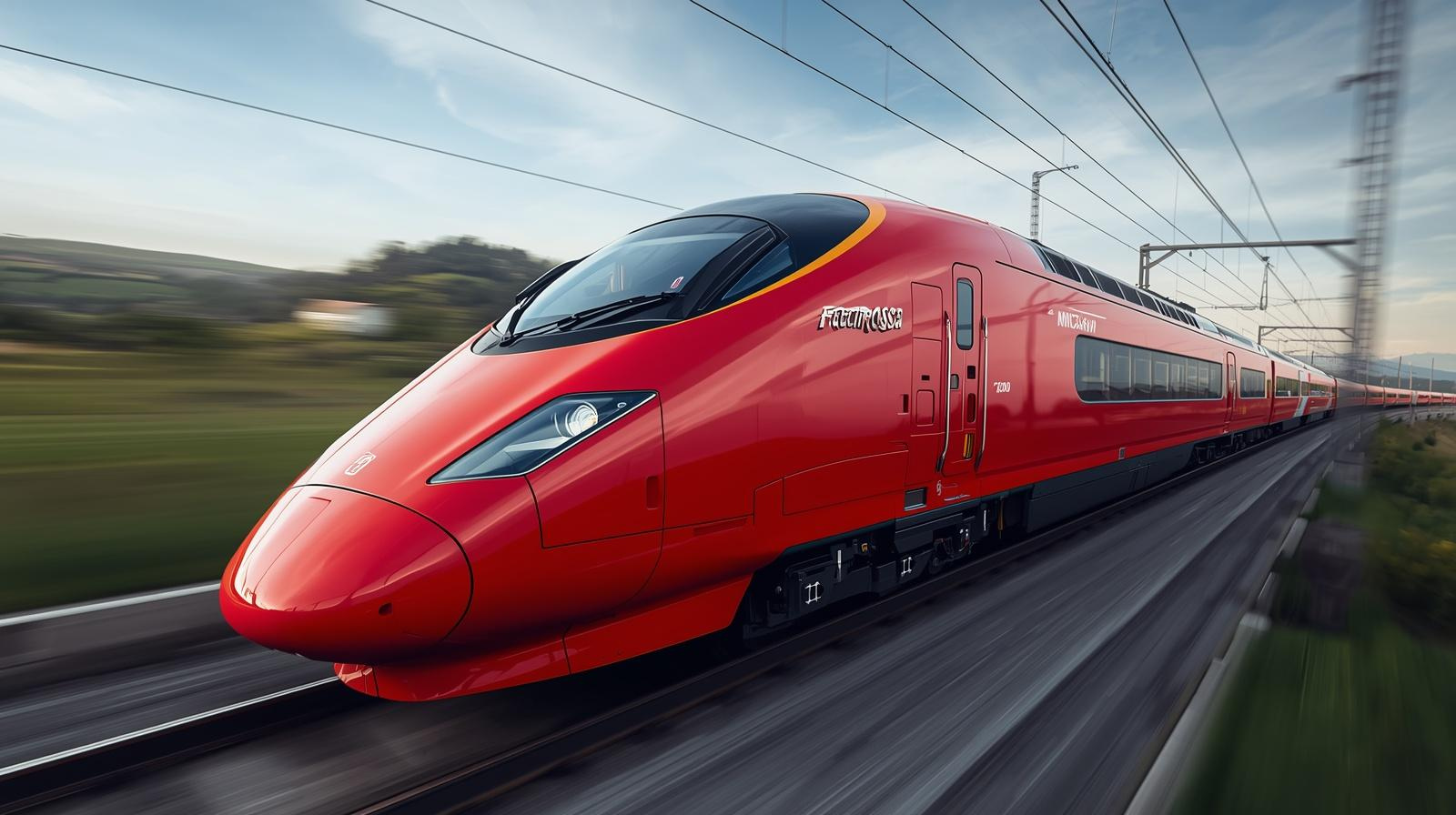
On the morning of 25th April 2015, Italy’s Liberation Day, a date chosen with deliberate patriotic flair, the Frecciarossa 1000 entered commercial service between Milan and Rome. It was, by any technical measure, the fastest train in Europe at the time. But in Italy, a train is never merely a machine. The Frecciarossa 1000 was a piece of design, a cultural statement, and a declaration that the country which gave the world Ferrari, Pininfarina, and Armani could also give it the most beautiful high-speed train ever built. The Red Arrow had been fired.
A Country Transformed by High-Speed Rail
To appreciate the Frecciarossa 1000, it helps to understand what high-speed rail has done to Italy, because the transformation has been more dramatic, and more contested, than in almost any other country.
Italy’s geography presents a classic challenge: a long, narrow peninsula running roughly 1,300 kilometres from the Alps in the north to the tip of Calabria in the south, with a spine of mountains, the Apennines, running almost its entire length. The distance between Milan and Rome is around 580 kilometres. Before high-speed rail, the conventional train journey took around four and a half to five hours on a good day. Flying was the default choice for anyone with business to conduct.
The construction of Italy’s Alta Velocità network, high-speed lines along the backbone of the country, changed that calculus entirely. The Milan–Rome journey by high-speed train now takes as little as two hours and fifty-five minutes on the fastest services. The flight, when you factor in airport transfers, check-in, security, and baggage reclaim, rarely wins on total journey time. Rail has recaptured the corridor decisively.
What makes Italy’s high-speed story unusual is that it was driven, in significant part, by private competition. When NTV, Nuovo Trasporto Viaggiatori. launched its Italo services in 2012, it became the first private operator to challenge a national incumbent on a high-speed line in Europe. The competition between Italo and Trenitalia (the state operator, which runs the Frecciarossa) drove fares down, service quality up, and passenger numbers sharply higher. Italy became an accidental pioneer of open-access high-speed rail, an experiment that Spain would later follow.
The Frecce Family: Red, Silver, and White Arrows
The Frecciarossa 1000 belongs to a family of branded services that Trenitalia has developed with considerable marketing intelligence.
The Frecce, Arrows, are divided by speed and service tier. The Frecciabianca (White Arrow) operates on conventional upgraded lines at lower speeds. The Frecciargento (Silver Arrow) uses tilting technology to run faster through curves on mixed-use lines. The Frecciarossa (Red Arrow) is the flagship, the fastest, the most prestigious, the one that runs on the dedicated Alta Velocità infrastructure at speeds the other services cannot match.
Within the Frecciarossa brand, several generations of train have operated. The ETR 500, a powerful, elegant machine that entered service in the 1990s, carried the Frecciarossa name for years and still operates on the network. But the ETR 1000, marketed as the Frecciarossa 1000, is a different proposition altogether. It was designed from scratch to be not merely an incremental improvement but a generational leap, faster, quieter, more efficient, and more beautiful than anything that had come before it.
Building the ETR 1000: A European Collaboration
The Frecciarossa 1000, technically designated ETR 1000, for Elettro Treno Rapido 1000, was developed by a joint venture between Bombardier Transportation and AnsaldoBreda (subsequently acquired by Hitachi Rail). The partnership combined Canadian-European manufacturing expertise with Italian engineering heritage, and the result was a train that set new benchmarks across multiple technical categories.
The design brief was uncompromising. The train had to be capable of operating at 400 km/h in test conditions and 360 km/h in commercial service, faster than any other train then operating in Europe. It had to be lighter than its predecessors, more energy-efficient, and quieter. It had to meet the stringent Technical Specifications for Interoperability that govern cross-border operation in the European Union, enabling it to run in multiple countries without modification. And it had to look extraordinary.
The exterior design was entrusted to Giugiaro Italdesign, the firm responsible for, among other things, the original Volkswagen Golf, the Lotus Esprit, and the BMW M1. The result is a train that genuinely rewards attention: a long, low nose that sweeps back in a continuous curve, flanks that are smooth and uncluttered, and a livery of deep red and white that manages to be both dramatic and purposeful. It does not look like any other train on Earth.
At 202 metres in length, the standard eight-carriage Frecciarossa 1000 carries up to 457 passengers across four service classes, Executive, Business, Premium, and Standard, a class hierarchy that reflects Italy’s comfort with unapologetic luxury at the top end of the market.
The Technology Inside: What Makes It Extraordinary
The Frecciarossa 1000’s technical specifications are remarkable even by the elevated standards of modern high-speed rail.
The train uses distributed traction, sixteen traction motors spread across four motorised carriages, producing a total output of 9,800 kilowatts. This extraordinary power-to-weight ratio, combined with the train’s aerodynamic efficiency, enables it to accelerate rapidly and sustain very high speeds with minimal energy waste.
The aerodynamics were developed using computational fluid dynamics modelling and refined in wind tunnel testing. The nose profile was optimised to minimise the pressure wave that builds up when a train enters a tunnel at high speed, a critical concern in Italy, where the Apennine tunnels are long and the pressure effects at 300 km/h can be significant. The train’s coefficient of aerodynamic drag is among the lowest of any high-speed train in the world.
Active noise and vibration control systems maintain a cabin environment that is exceptionally quiet even at full operating speed. Passengers seated in Executive class, the top tier, equipped with wider leather seats and a personal service that competes with business class aviation, experience a ride of a smoothness that, to those not forewarned, can make it difficult to believe the train outside the window is covering ground at five kilometres per minute.
The braking system combines regenerative electrical braking, which returns energy to the overhead lines when the train decelerates, with conventional disc brakes, achieving a deceleration rate that allows safe stopping from 300 km/h within the distances required by the Italian and European safety frameworks.
Energy consumption was a central design priority. The ETR 1000 uses approximately 30% less energy per seat than the ETR 500 it supplements, a reduction achieved through lighter construction materials, improved aerodynamics, and the efficiency of the regenerative braking system. In a single year of operation, the energy savings compared to older rolling stock are substantial enough to power thousands of Italian homes.
The Speed Record: February 2023
Speed records and Italian engineering have a long and proud relationship, from Ettore Bugatti’s racing cars to the water speed records of the Macchi seaplanes. The Frecciarossa 1000 added a new chapter on 14th February 2023.
On that day, a specially configured ETR 1000 set a new Italian rail speed record of 363 km/h on the Roma–Napoli high-speed line, surpassing the previous Italian record and demonstrating that the train’s design margin extended well beyond its commercial operating speed. The run was conducted under controlled conditions, with the line closed to other traffic and the train’s systems configured for maximum performance rather than passenger comfort.
The record was not merely symbolic. It validated the engineering assumptions on which the train had been designed, confirmed the integrity of the track and overhead supply infrastructure at extreme speeds, and provided operational data that will inform future developments. It also gave Trenitalia a marketing narrative that is, in the intensely competitive world of European high-speed rail, genuinely useful.
The Passenger Experience: Where Italy Does What Italy Does Best
If German high-speed rail reflects Germany’s engineering rigour, and Japanese high-speed rail reflects Japan’s operational discipline, then Italian high-speed rail reflects Italy’s conviction that life should, wherever possible, be beautiful.
Boarding a Frecciarossa 1000 at Milano Centrale, itself a monument of Fascist-era grandeur that manages, somehow, to be genuinely magnificent, is an experience that begins before the train moves. The station’s vast stone concourse, the boarding gates staffed by Trenitalia personnel in elegantly designed uniforms, the digital departure boards ticking down to departure: all of it is done with a theatrical flair that is hard to imagine in a British or German equivalent.
The train itself continues the theme. Executive class carriages are finished in leather and dark wood tones, with mood lighting that adjusts through the journey. The catering trolley offers espresso prepared to a standard that most Italian bars would consider respectable, a detail that, in Italy, is not trivial. The seat-back screens provide real-time journey information, entertainment, and connectivity.
But the Frecciarossa 1000 is not merely a luxury product. Standard class is spacious, well-designed, and at the competitive fare levels that open access has created, genuinely affordable. The train has democratised a travel experience that, a decade earlier, would have been available only to those with the budget for an air ticket or the patience for a conventional train.
Going International: The Frecciarossa Crosses the Alps
Trenitalia’s ambitions for the Frecciarossa 1000 have extended beyond Italy’s borders.
In December 2021, a Frecciarossa service began operating between Milan and Paris, the first Italian high-speed train to run internationally in revenue service. The journey of around seven hours covers a route that crosses the Alps via the Fréjus tunnel and connects Italy’s economic capital directly to France’s. It operates in competition with TGV services on the same corridor, offering an Italian alternative on one of Europe’s most trafficked international rail routes.
The multi-system capability of the ETR 1000, designed from the outset to operate under the different electrification systems and signalling standards of Italy, France, Germany, Austria, and Switzerland, makes this international expansion possible without modification. Trenitalia has signalled ambitions to extend Frecciarossa services to further European destinations, with Spain and Germany cited as potential future corridors.
In Spain, a remarkable development has already occurred: Trenitalia’s Spanish subsidiary won one of the open-access licences offered by the Spanish government and launched Iryo services in 2022 using ETR 1000 trains operating under the Iryo brand. The Italian train, rebranded and repainted, now competes directly with Renfe and Ouigo on the Madrid–Barcelona corridor, a pan-European deployment of Italian technology that would have seemed improbable a decade ago.
Alta Velocità: The Infrastructure Behind the Arrow
The Frecciarossa 1000 is only as fast as the infrastructure it runs on, and Italy’s Alta Velocità network is a considerable engineering achievement in its own right.
The lines connecting Turin, Milan, Bologna, Florence, Rome, and Naples were built over a period of roughly two decades, beginning in the 1990s and completing the core north–south spine by the early 2010s. Constructing high-speed lines through central Italy required some of the most complex tunnelling work in European rail history, the Apennine mountains do not yield easily, and the 18.6-kilometre Base Tunnel beneath the Apennines on the Bologna–Florence line was, for a time, one of the longest high-speed rail tunnels in Europe.
The quality of the infrastructure, its geometry, its smoothness, the precision of its maintenance, is what enables the Frecciarossa 1000 to operate at 300 km/h commercially and to have reached 363 km/h in testing. Track geometry is monitored continuously by dedicated inspection trains, and deviations from specification trigger maintenance interventions before they can affect ride quality or safety.
The extension of the Alta Velocità network southward, toward Salerno, Bari, and eventually Reggio Calabria, has been a long-standing ambition and a persistent source of political debate. Southern Italy has historically been underserved by high-quality infrastructure of all kinds, and the prospect of a high-speed rail connection linking Naples to Palermo via a bridge or tunnel across the Strait of Messina, the long-discussed, repeatedly delayed Ponte sullo Stretto, remains one of the great unresolved questions of Italian infrastructure policy.
The Competition: Italo and the Open Access Model
No account of the Frecciarossa would be complete without acknowledging the rival that sharpened it.
Italo, NTV’s service, operated using Alstom AGV trains, entered service in 2012 and immediately challenged Trenitalia’s complacent dominance of the high-speed corridor. The AGV, designed by Alstom with input from Formula One aerodynamicist Rory Byrne, was itself a technically advanced machine, and NTV competed aggressively on price and service quality.
The response from Trenitalia was the Frecciarossa 1000, a train developed, at least in part, to ensure that the state operator had a technical and commercial argument that could defeat a well-funded private challenger. Competition, in this case, demonstrably served the passenger. Fares fell. Service frequency increased. On-board quality improved across both operators. The Milan–Rome corridor became one of the best-value high-speed rail journeys in Europe.
The Italian experiment confirmed what France’s TGV and Spain’s AVE had begun to suggest, and what open-access advocates had long argued: that the high-speed rail market, on dense corridors, is large enough to support competing operators, and that competition produces better outcomes for passengers than monopoly.
Sustainability and the Green Argument
Italy’s high-speed trains run on electricity, and Italy’s electricity grid, while historically dependent on fossil fuels in ways that France’s nuclear-heavy grid is not, is undergoing rapid decarbonisation, driven by ambitious renewable energy targets and significant investment in solar and wind generation.
The carbon comparison between a Frecciarossa journey and an equivalent flight on the Milan–Rome corridor is already strongly favourable to the train, and it improves further as the grid decarbonises. Studies have consistently found that the modal shift from air to rail on the corridor, substantial and ongoing, represents one of the most significant emissions reductions achievable in Italian transport without regulatory intervention.
The Frecciarossa 1000’s energy efficiency, combined with the regenerative braking system that returns power to the grid on deceleration, makes it one of the greenest ways to travel long distances anywhere in the world. Trenitalia has made sustainability a central element of its commercial positioning, a strategy that reflects both genuine environmental commitment and an acute awareness of where European consumer preferences are heading.
Conclusion
The Frecciarossa 1000 is many things at once: a technical achievement that set European speed records, a design object that reflects the finest traditions of Italian industrial aesthetics, a commercial weapon deployed in a genuinely competitive market, and an ambassador for Italian engineering on the international stage.
It is also, at its most fundamental, a train that does its job with extraordinary flair. It connects Milan and Rome in under three hours. It carries passengers in comfort that airlines struggle to match. It does so cleanly, quietly, and with a reliability that, on the Alta Velocità infrastructure, is considerably better than the Italian rail system’s historical reputation might suggest.
Italy gave the world the Renaissance, the espresso, and the sports car. It has also, in the Frecciarossa 1000, given the world one of the finest high-speed trains ever built. The Red Arrow flies, and it does so in a way that only Italy could have conceived.
Leave a Reply