
The Resurrection of Jesus Christ
Faith, Tradition and Celebration Across the Christian World
What Is Easter?
Easter is the most important feast in the Christian calendar. It celebrates the resurrection of Jesus Christ from the dead on the third day after his crucifixion, the event that Christians of every tradition regard as the cornerstone of their faith, the moment that vindicates everything Jesus taught and did, and the pledge of eternal life for all who believe.
Unlike Christmas, which celebrates the beginning of Christ’s earthly life, Easter marks its culmination and its transformation. The cross and the empty tomb are the two poles around which the whole of Christian theology revolves, and Easter Sunday is the feast on which the empty tomb is proclaimed with every resource of song, light, colour and joy that the Church can muster.
St Paul, writing to the early Christians in Corinth around AD 55, expressed the absolute centrality of the resurrection with characteristic bluntness: if Christ has not been raised, he wrote, then Christian preaching is useless and faith is futile. Easter is therefore not a peripheral observance or a seasonal decoration; it is the very reason Christianity exists.
The word Easter itself is of disputed origin. In most languages, French Paques, Spanish Pascua, Italian Pasqua, Russian Paskha, the feast takes its name directly from the Hebrew Pesach (Passover), reflecting the deep connection between the death and resurrection of Christ and the Jewish festival commemorating the Exodus from Egypt. In English and German (Ostern), however, a different name prevails. The Venerable Bede, writing in the 8th century, suggested it derived from Eostre, a Germanic goddess of spring, though modern scholars debate this derivation. Whatever its etymology, the English name has come to carry the full weight of Christian resurrection faith.
The Resurrection Narrative
All four Gospels record the resurrection of Jesus, though with differences of emphasis and detail that have generated centuries of theological and historical discussion. The broad narrative, however, is consistent across all accounts.
On the morning of the first day of the week, what we now call Sunday, a group of women, led by Mary Magdalene, came to the tomb where Jesus had been buried on Friday evening. They came expecting to complete the burial anointing that had been left unfinished before the Sabbath. What they found instead was a tomb that was open and empty.
In Matthew’s account, a great earthquake had occurred, an angel had rolled back the stone sealing the entrance, and the guards posted by the authorities had fallen to the ground in terror. In Luke’s account, two men in dazzling clothes announced to the bewildered women that the one they sought was not there: he had risen. In John’s Gospel, the account is extraordinarily intimate: Mary Magdalene, weeping outside the tomb, encounters a figure she takes for the gardener, until he speaks her name, “Mary”, and she recognises him.
In the days that followed, according to all four Gospels and the letters of Paul, the risen Christ appeared to his disciples on multiple occasions: in a locked room in Jerusalem, on a road to the village of Emmaus, beside the Sea of Galilee, and finally on a hillside where, before ascending to the Father, he commissioned his followers to go into all the world and make disciples of all nations.
These resurrection appearances are the foundation on which the entire edifice of Christian faith was built. The disciples who had scattered in fear after the crucifixion became, within weeks, the bold proclaimers of resurrection who turned the ancient world upside down. Easter is the feast on which Christians celebrate that transformation and claim it for themselves.
When Is Easter? The Question of Dating
One of the most practically confusing aspects of Easter is that its date changes from year to year. Unlike Christmas, which is fixed on 25th December, Easter is what is called a movable feast; it falls on a different Sunday each year, anywhere between 22nd March and 25th April.
The standard Western rule, established by the Council of Nicaea in AD 325, is that Easter falls on the first Sunday after the first full moon following the spring equinox. This lunar basis reflects the feast’s connection to Passover, which is itself calculated according to the Hebrew lunar calendar.
The matter is complicated further by the fact that Eastern Orthodox churches, and some other Eastern Christian bodies, calculate Easter using a different method, following the older Julian calendar rather than the Gregorian calendar adopted in the West in 1582. As a result, Orthodox Easter (called Pascha) often falls one, four, or five weeks after Western Easter, though in some years the dates coincide. For millions of Christians in Greece, Russia, Serbia, Romania, Ethiopia, Egypt and elsewhere, the Orthodox calculation determines when Easter is celebrated.
The divergence between Eastern and Western Easter dates has been a source of both practical inconvenience and theological reflection for centuries, and proposals for a common date have been periodically discussed without yet achieving consensus. In 2025, Western and Orthodox Easter happened to fall on the same date, 20th April, a coincidence that occurs only occasionally.
Holy Week: The Journey to Easter
Easter does not arrive without preparation. The week before Easter Sunday, known as Holy Week, is the most intense and spiritually concentrated period in the entire Christian year, walking believers step by step through the final days of Jesus’s earthly life.
Holy Week begins with Palm Sunday, when Christians commemorate Jesus’s triumphal entry into Jerusalem riding on a donkey, welcomed by crowds waving palm branches and crying Hosanna. In many churches, palm branches or crosses woven from palm are blessed and distributed to the congregation.
Monday, Tuesday and Wednesday of Holy Week vary in observance, though many churches offer daily services or reflections. Holy Wednesday is sometimes observed as Spy Wednesday, marking the day on which Judas agreed to betray Jesus.
Holy Thursday, also called Maundy Thursday, commemorates the Last Supper at which Jesus instituted the Eucharist, washed his disciples’ feet, and prayed in the Garden of Gethsemane before his arrest. Many churches hold an evening Mass or service of the Lord’s Supper, often followed by a period of prayer watch through the night.
Good Friday, as explored in a companion article, is the day of the crucifixion, the day of fasting, silence, and sorrow. Holy Saturday is the in-between day, the day Christ lay in the tomb, a day of waiting and emptiness observed with particular solemnity in many traditions.
Then, in the darkness before dawn on Easter Sunday, the night is broken by fire.
The Easter Vigil: Mother of All Vigils
For Catholics, Orthodox Christians, many Anglicans, and Lutherans, the liturgical heart of Easter is not Sunday morning but the Easter Vigil, a nocturnal service celebrated in the darkness of Holy Saturday night, extending into the earliest hours of Sunday morning. The ancient Church called it the mother of all vigils, and there is nothing quite like it in any other religious tradition in the world.
In the Roman Catholic Rite, the Vigil begins outside the church in complete darkness. A large fire is kindled, and from it the Paschal Candle a great candle of wax representing the risen Christ, is lit. The deacon or priest carries it into the darkened church, pausing three times to sing the ancient proclamation: “The Light of Christ.” Candles held by the congregation are lit from the Paschal Candle until the whole church glows with flame.
The Exsultet, an ancient hymn of breath taking beauty dating to at least the 4th century, is then sung, announcing the resurrection in language of soaring joy: it calls upon the heavens and the earth, the angels and the Church, to rejoice at the defeat of death and the return of light. The readings that follow span the entire history of salvation from the creation of the world through to the resurrection, up to nine readings drawn from the Old and New Testaments.
The Vigil climaxes in the Gloria, sung for the first time since it was silenced on Holy Thursday, in the renewal of baptismal promises by the entire congregation, and, in many parishes, in the baptism and reception of new members into the Church. Easter is the traditional night for baptism in the early Church, and this practice has been widely restored in the modern era.
The Orthodox Easter Vigil is similarly dramatic. At midnight, as the church waits in darkness, the priest emerges from the sanctuary with the light and proclaims, “Christ is risen!” (Christos Anesti!), and the congregation responds with rapturous joy: “Truly He is risen!” (Alithos Anesti!). Bells ring, fireworks may explode outside, and the church erupts in light and song. The Divine Liturgy that follows, often not ending until 2 or 3 in the morning, is one of the most exhilarating acts of Christian worship anywhere on earth.
Easter Across Christian Traditions
Roman Catholic
For Roman Catholics, Easter Sunday is the apex of the liturgical year, the culmination of the Sacred Triduum, the three days of Holy Thursday, Good Friday and Holy Saturday, and the Sunday of Sundays. Following the Vigil, Easter Sunday Mass is celebrated with maximum solemnity: the church adorned with white and gold, flowers filling every surface, the Gloria and Alleluia sung with voices that have been silent throughout Lent.
The forty days of Lent that precede Easter, beginning on Ash Wednesday, are a period of prayer, fasting and almsgiving in preparation. The traditional Lenten fast, which historically involved abstaining from meat, dairy and eggs throughout the season, gives Easter its association with the breaking of the fast: the egg, the lamb and the rich foods of Easter breakfast carry the joy of relief and abundance after weeks of restraint.
Easter Sunday is followed by the Easter Octave, eight days celebrated as a single great feast, and then the fifty days of Eastertide, which extends to Pentecost Sunday. Throughout this season, the Alleluia that was buried at the start of Lent rings out at every Mass, and the mood of the liturgy is one of unbroken resurrection joy.
Eastern Orthodox
In the Orthodox world, Pascha (Easter) is not merely the most important feast; it is the Feast of feasts, the celebration that gives all other celebrations their meaning. The entire liturgical year is oriented towards it, and no other observance comes close to it in theological centrality or liturgical splendour.
The Orthodox Holy Week is an immersion of extraordinary depth. Great and Holy Monday through Wednesday feature long services meditating on the approach of the Passion. Holy Thursday brings the Liturgy of St Basil and the washing of feet. Great and Holy Friday is the day of mourning, with the veneration of the Epitaphios. Great and Holy Saturday is a day of strange, solemn beauty, Christ in the tomb, yet the tomb already beginning to radiate light.
At midnight on Pascha, the church bursts into the Paschal troparion, the ancient hymn “Christ is risen from the dead, trampling down death by death, and upon those in the tombs bestowing life”, sung and re-sung with increasing exultation as the Divine Liturgy unfolds. The paschal greeting Christos Anesti is exchanged between all believers throughout the forty days of the Paschal season, which continues until Ascension Thursday.
After the long Lenten and Holy Week fast, the Paschal feast table is laden with traditional foods: kulichi (tall sweet bread), pashka (a rich cheesecake), and red-dyed eggs in Russia and Eastern Europe; tsoureki (braided sweet bread) and red eggs in Greece; lamb soup and spit-roast lamb in many Orthodox countries. These are often brought to church on Holy Saturday to be blessed before the feast.
Anglican
The Anglican Communion, encompassing the Church of England, the Episcopal Church in the United States, and churches across the Anglican world, celebrates Easter with a rich blend of liturgical tradition and theological breadth. Easter Sunday is marked with great joy in parishes of every theological stripe, from the incense-wreathed solemnity of Anglo-Catholic High Churches to the contemporary warmth of charismatic evangelical congregations.
The Church of England’s liturgy for Easter draws on centuries of tradition, combining elements of the ancient Western Rite with the distinctively English language of the Book of Common Prayer and its successors. The Easter Vigil has been significantly restored in Anglican practice since the mid-20th century, and many English cathedrals and parish churches now hold late-night or very early morning services of extraordinary beauty.
Easter morning in England has its own particular cultural character: the smell of spring in cold stone churches, the massed lilies and daffodils around the altar, the sudden lifting of the Lenten plainness, the organ unleashed at full swell. The ancient Easter greeting, “The Lord is risen! He is risen indeed, Alleluia!”, is exchanged between clergy and congregation, and the Easter Eucharist is celebrated with every festive resource the tradition offers.
Lutheran
Lutheran Easter observance combines profound theological seriousness about the resurrection with a rich tradition of music and communal celebration. The Lutheran Reformation did not abandon the Easter feast but deepened its theological content, insisting on the resurrection as the vindication of the doctrine of justification by faith alone.
The Easter Vigil has been significantly recovered in Lutheran practice, particularly in Scandinavian and German churches, and the Easter morning service, often beginning before dawn, is celebrated with great festivity. The great Easter chorales of Bach and the Lutheran hymn tradition are a particular gift to Christian worship: hymns such as “Christ the Lord is Risen Today”, “Now All the Vault of Heaven Resounds”, and the ancient Christ ist erstanden fill Lutheran churches with music of resurrection joy.
In Scandinavia, Easter Sunday is followed by an Easter Monday holiday, and the entire Easter period from Palm Sunday onwards is a time of family gathering, feasting and celebration in which Christian faith and Scandinavian cultural tradition are richly intertwined.
Methodist and Free Church
Methodist, Baptist, United Reformed and other Free Church traditions in Britain and beyond celebrate Easter with energetic joy, typically centred on a lively Easter morning service combining rousing hymns, preaching on the resurrection, and often a Communion service. The mood is one of triumphant celebration rather than liturgical solemnity, though many Free Churches have developed a growing appreciation for the richness of Holy Week observance.
Sunrise services, held outdoors or in large venues as dawn breaks on Easter morning, have become popular across many evangelical and charismatic traditions, drawing hundreds or thousands of worshippers to hillsides, beaches and parks to greet the resurrection with the rising of the sun. These services, often followed by a shared breakfast, have a particular freshness and joy that captures something of the experience of those first witnesses at the empty tomb.
Easter is also one of the key evangelistic moments in the Free Church calendar, with special services designed to welcome those who may not regularly attend church but who come at Easter as a cultural and spiritual touchstone.
Coptic and Oriental Orthodox
The Coptic Church of Egypt, the Ethiopian and Eritrean Orthodox Tewahedo Churches, the Armenian Apostolic Church and other Oriental Orthodox communions celebrate Easter according to their own ancient liturgical calendars and in forms that reflect the extraordinary antiquity of their traditions.
Coptic Easter (Feast of the Resurrection or Eid el-Qiyama) follows a period of fasting known as the Great Lent (Kiahk), which in the Coptic tradition lasts fifty-five days, one of the longest Lenten fasts in any Christian tradition. During this period, Coptic Christians abstain from all animal products. Easter Sunday breaks the fast with a richly laden table: fanid (sugar candy), coloured eggs, the traditional feteer pastry, and a feast of meat dishes prepared with joyful abandon.
Ethiopian Easter (Fasika) is similarly preceded by a long and strictly observed fast. The celebration includes elaborate church services with the distinctive Ethiopian liturgical chant, dancing priests in ornate vestments carrying the great processional Tabot (a replica of the Ark of the Covenant), and a nationwide atmosphere of celebration that spills out into the streets with feasting, singing and the exchange of gifts.
Armenian Easter (Zatik) is a national as well as religious occasion in Armenia, preceded by a fast and celebrated with red eggs, special lamb dishes and the singing of Sharakans (hymns) that preserve musical traditions stretching back over fifteen centuries.
Easter Around the World: Country by Country
United Kingdom
Easter in the United Kingdom blends Christian observance with customs that have accumulated over many centuries. The four-day bank holiday weekend, from Good Friday through Easter Monday, is one of the most cherished in the English calendar, associated with the first real warmth of spring, family gatherings, and the chocolate Easter egg.
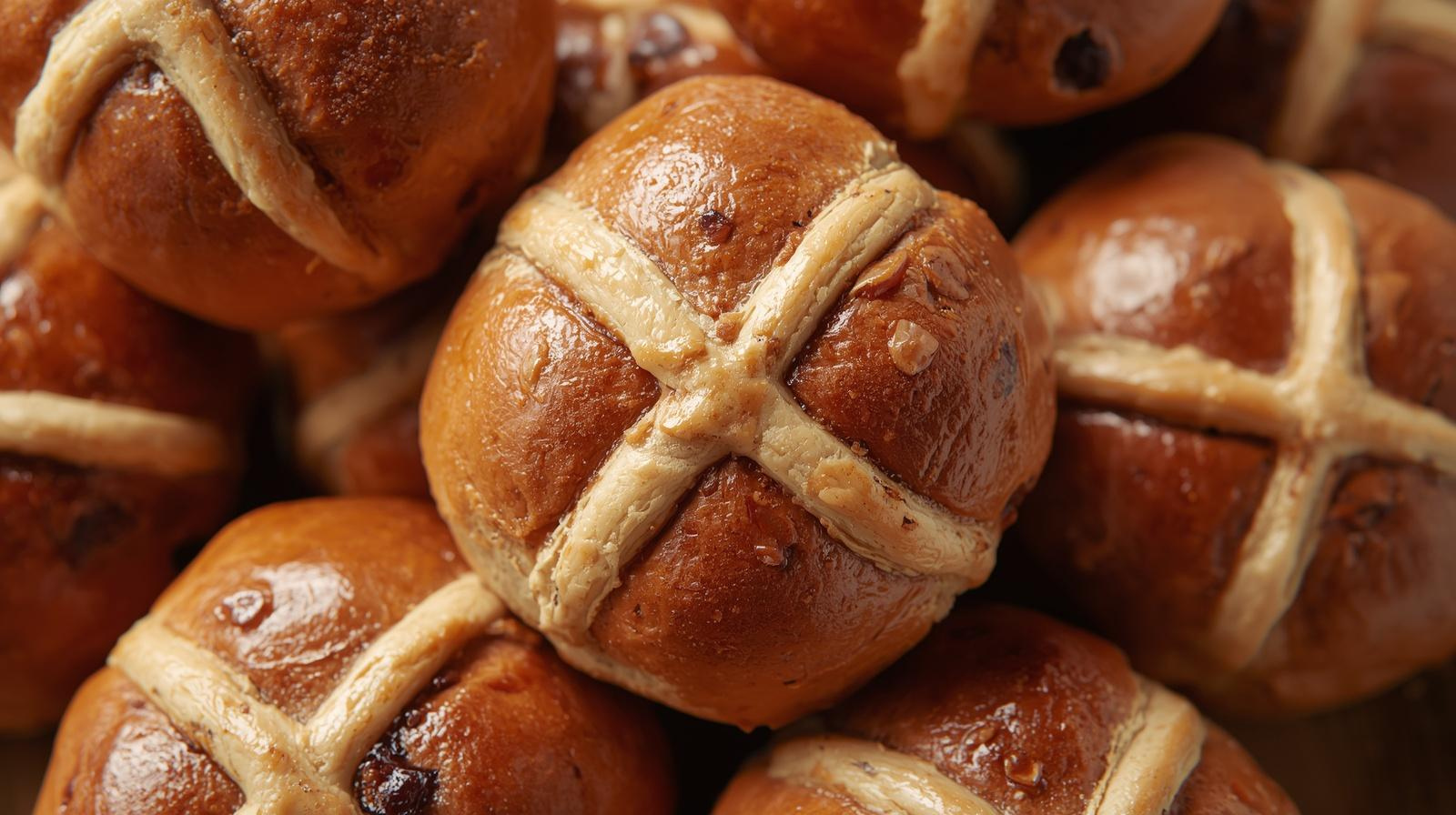
Hot cross buns, spiced and marked with a cross, are traditionally eaten on Good Friday and have become one of the most recognisable symbols of the British Easter. Their origins may lie in pre-Christian spring breads, but by the Tudor period, they had been Christianised and were associated specifically with Good Friday. Today they appear in British shops as early as January, to widespread annual complaint.
The chocolate Easter egg is a 19th-century development; the first commercial chocolate egg was produced in Britain in 1873, and has become central to the secular dimension of British Easter. Egg hunts in back gardens, the Cadbury Creme Egg, the great Easter egg mountain in every supermarket: these are as much a part of the British Easter as church attendance, and the two dimensions, sacred and confectionery, coexist with characteristic British pragmatism.
Morris dancing, egg rolling (rolling hard-boiled eggs down hillsides, as at Avenham Park in Preston), and the Hare Pie Scramble at Hallaton in Leicestershire are among the more unusual traditional Easter customs that survive in various parts of England.
Greece
Easter in Greece is, by common consent of both Greeks and visitors, one of the most spectacular and moving Easter celebrations in the world. It is emphatically the most important holiday in the Greek calendar, surpassing Christmas both in religious intensity and in the scale of national celebration.
The midnight Anastasi (Resurrection) service on Holy Saturday is the pivotal moment. As midnight approaches, the lights in packed churches are extinguished. The priest emerges from the altar with the Holy Light, symbolically brought from Jerusalem, where a flame is said to miraculously appear each year in the Church of the Holy Sepulchre, and the flame spreads from candle to candle until the church blazes with flame. The bells ring, fireworks explode in the night sky, and the cry of Christos Anesti! echoes across the hillsides of every Greek town and village.
The breaking of the Lenten fast at midnight involves the traditional magiritsa, a rich lamb offal soup that provides the first taste of meat after weeks of fasting. Easter Sunday brings the great feast: whole lambs roasted on spits from early morning, red eggs (kokkina avga) cracked against each other in a game of egg-tapping, tsoureki bread braided and flavoured with orange and spice, and tables spread under the open sky for hours of eating, drinking, singing and dancing.
On Easter Sunday evening, the traditional game of tsougrisma sees each person tap their red egg against another’s, saying Christos Anesti. The person whose egg survives uncracked is said to have good luck for the year ahead. Families who live away from their home villages make the journey back for Easter in a migration that rivals the August exodus to the islands.
Russia and Eastern Europe
In Russia, Ukraine, Serbia, Bulgaria, Romania, and across the Slavic Orthodox world, Pascha is a feast of ancient depth and extraordinary cultural richness, reclaimed in the post-Soviet era with particular fervour after decades of enforced secularisation.
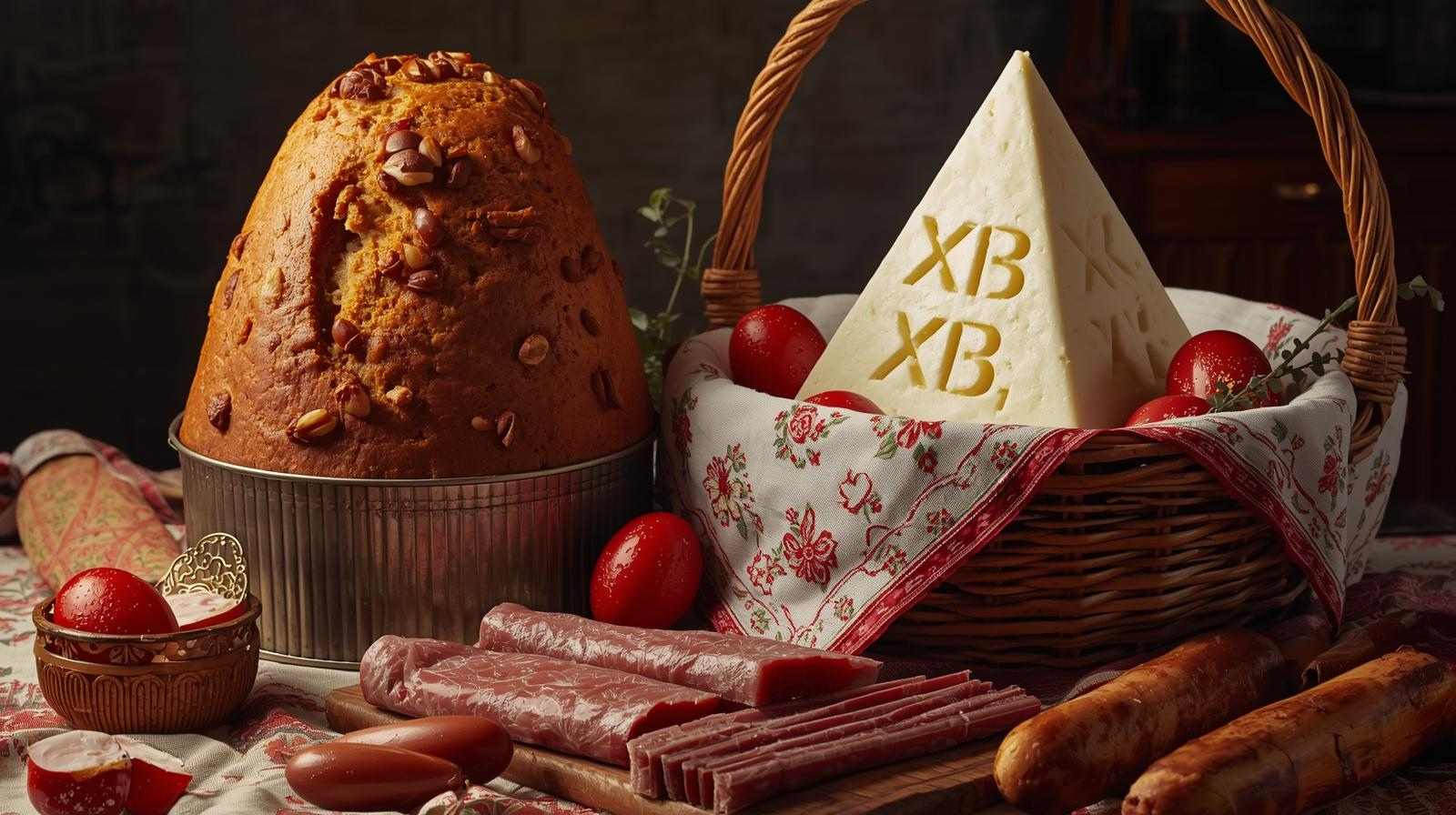
The Russian Easter tradition of the kulich, a tall, dome-shaped sweet bread enriched with eggs, butter, dried fruits and spices, and traditionally baked in a coffee tin, and the paskha, a pyramid-shaped cold cheesecake moulded with the letters XB (Khristos Voskrese, (Christ is Risen), are icons of the Russian Easter table. Both are brought to church in baskets lined with embroidered cloths on Holy Saturday, along with red eggs, cold meats and sausages, to be blessed by the priest before the Vigil.
The exchange of the paschal greeting Khristos Voskrese / Voistinu Voskrese (Christ is Risen / Truly He is Risen) is observed throughout the forty days of the Paschal season, replacing ordinary greetings of hello and goodbye. The triple kiss on the cheek that accompanies the greeting is one of the most tangible expressions of Easter joy in Slavic Christian culture.
Ukrainian Easter traditions include the famous pysanky, intricately decorated eggs created using a wax-resist method and covered with elaborate geometric and symbolic patterns, which are among the most beautiful folk art objects in European Christian culture. The craft of pysanka decoration is passed from generation to generation, and the eggs are traditionally given as gifts at Easter.
Italy
Italian Easter (Pasqua) is both deeply religious and exuberantly festive. Holy Week in Rome draws pilgrims from around the world, with the Pope presiding over the Palm Sunday Mass in St Peter’s Square, the Way of the Cross at the Colosseum on Good Friday, the Easter Vigil in St Peter’s Basilica, and the great Easter Sunday Urbi et Orbi blessing from the central loggia of the Basilica, broadcast live to hundreds of millions around the world.
Throughout Italy, elaborate processions mark Holy Week, with the most famous including the Processione dei Misteri in Trapani, Sicily, in which enormous floats depicting scenes of the Passion are carried through the streets for twenty-four hours by members of ancient confraternities, and the dramatic Good Friday procession at Chieti in Abruzzo, one of the oldest in Italy.
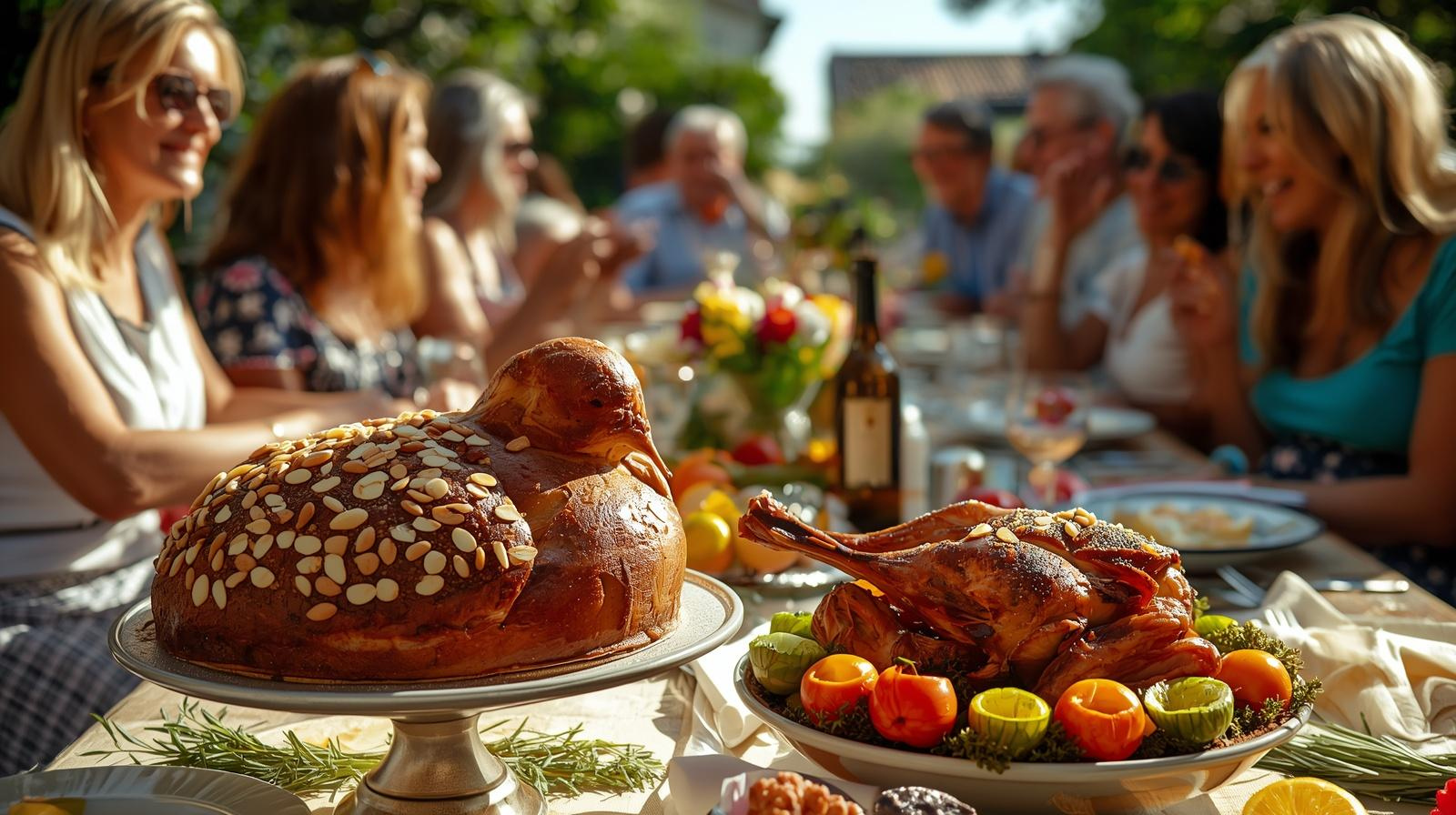
The Easter table in Italy centres on the Colomba di Pasqua, a dove-shaped sweet bread similar to the Christmas Panettone, made with candied peel and topped with almonds and sugar, and the traditional Easter lamb dish, agnello al forno, roasted with herbs and served at the extended family lunch that is the social heart of Italian Easter. The expression Natale con i tuoi, Pasqua con chi vuoi (Christmas with your family, Easter with whoever you want) reflects the somewhat more relaxed social character of the Italian Easter compared to Christmas.
Easter Monday in Italy is called Pasquetta (Little Easter) and is traditionally spent outdoors in the first warmth of spring, with family and friends gathering in parks and countryside for picnics and celebrations.
Spain
Spanish Easter (Semana Santa, Holy Week) is one of the most visually dramatic religious observances in the world. In cities and towns across Spain, but especially in Seville, Malaga, Valladolid, Toledo and Zamora, elaborate processions of religious brotherhoods (cofradias or hermandades) move through the streets carrying enormous pasos, floats bearing sculptural groups depicting scenes of the Passion, accompanied by thousands of nazarenos (penitents) wearing distinctive pointed hoods and carrying candles or wooden crosses.
The Seville processions are internationally famous: they last throughout Holy Week, each cofradia following its own ancient route through the narrow streets of the city, the paso swaying on the shoulders of costaleros (bearers who carry the float from within, invisible to spectators), preceded by bands playing the haunting Saeta music of Andalucia. The atmosphere combines intense religious devotion, civic pride and theatrical spectacle in a way found nowhere else on earth.
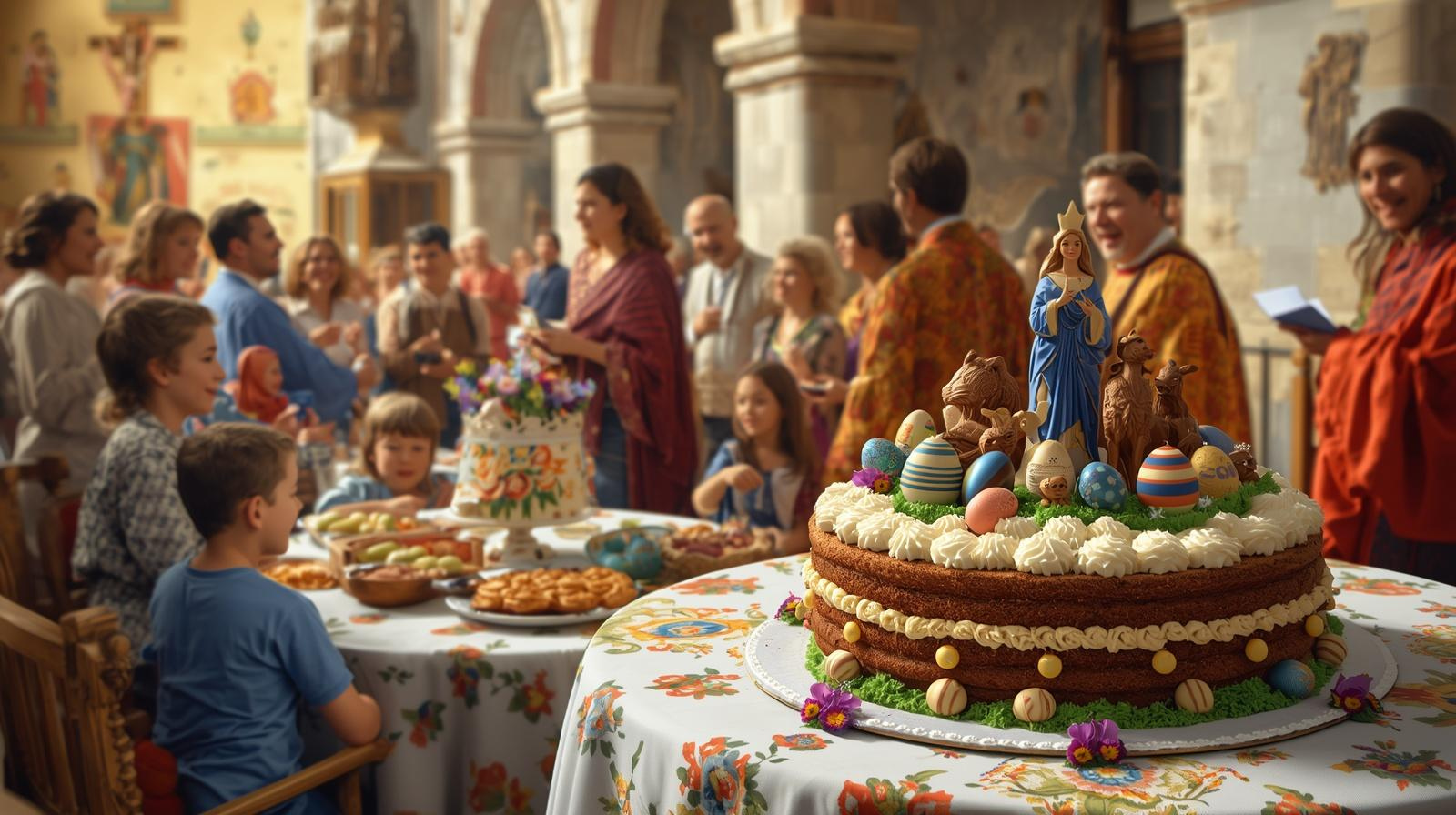
Easter Sunday in Spain brings the celebration of the resurrection with joyful Masses and family feasts, the Mona de Pascua (a traditional Easter cake given by godparents to their godchildren, decorated with chocolate eggs and figurines), and the beginning of the spring social season.
Germany and Austria
German Easter customs are among the most influential in the Western world, as many practices now considered universal, including the Easter egg hunt and the Easter Bunny (Osterhase), originated in the German-speaking lands and were brought to North America by German immigrants in the 18th and 19th centuries.
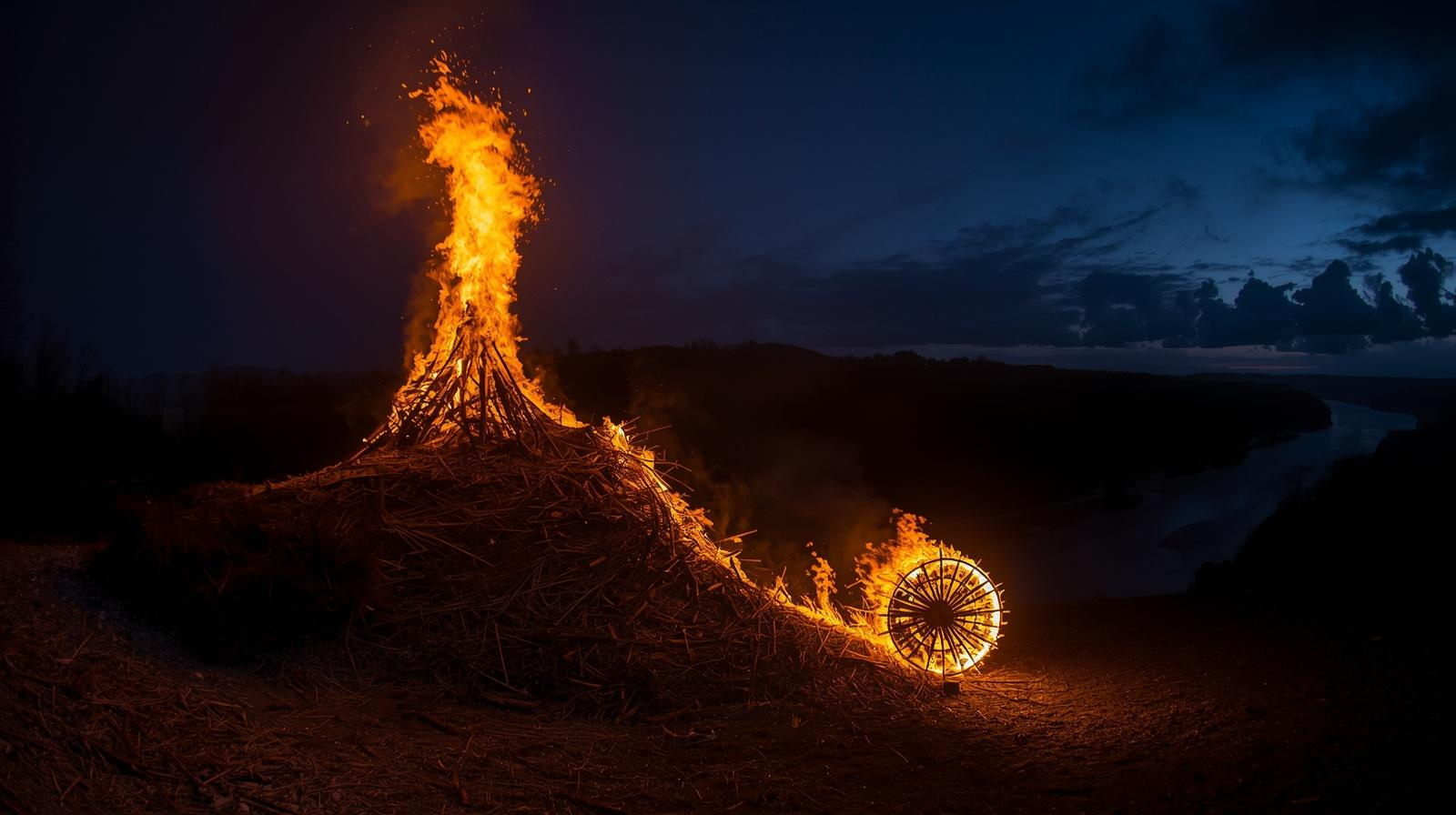
The Easter fire (Osterfeuer) is a widespread German custom: on Holy Saturday evening or Easter Sunday morning, great bonfires are lit on hillsides throughout Germany, symbolising the end of winter and the coming of the light of the resurrection. In some regions, a wheel of straw is set ablaze and rolled down a hill into a river, one of the more dramatic expressions of the universal fire symbolism of Easter.
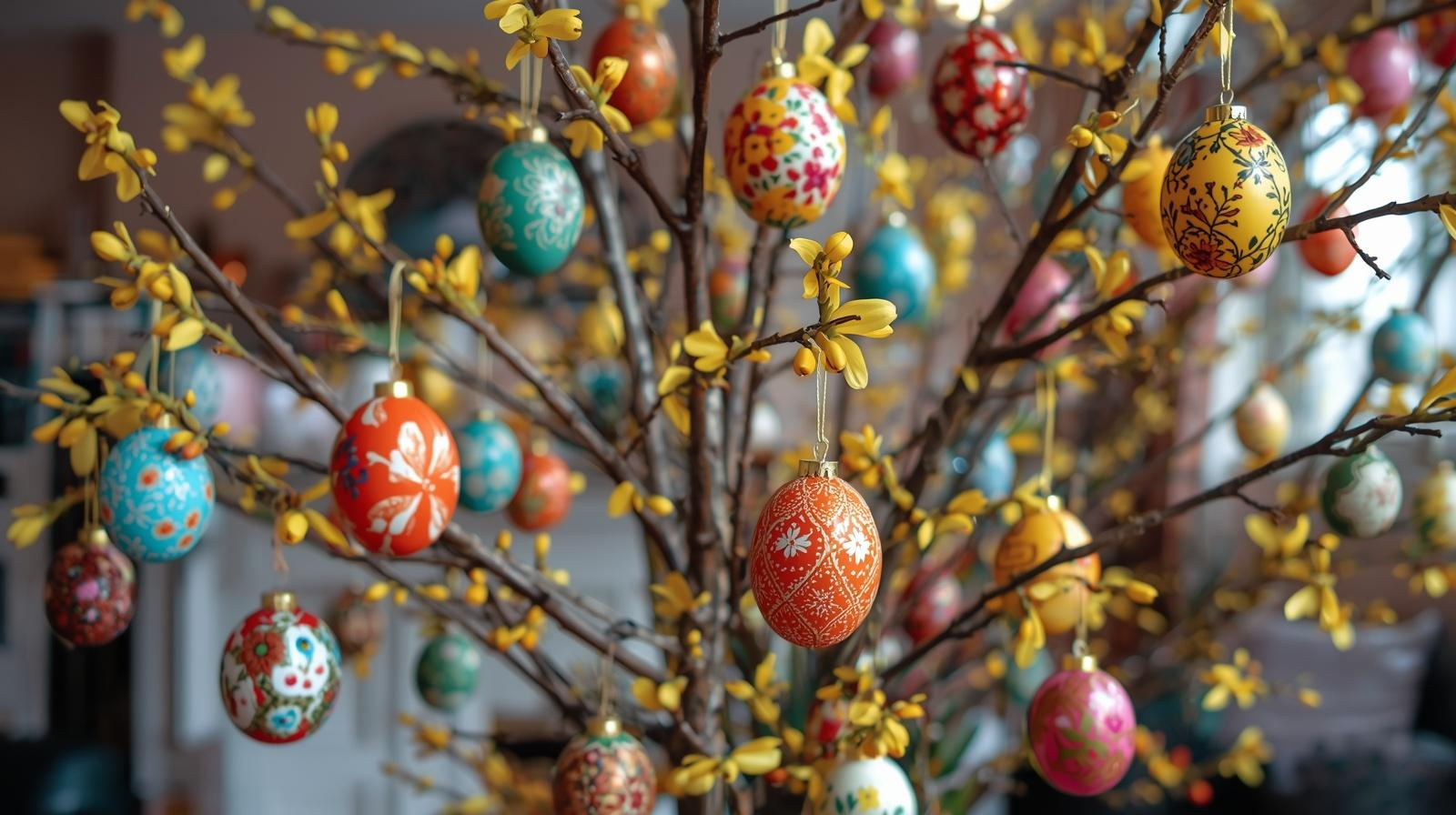
The Osterbaum (Easter tree) is a characteristically German tradition: branches, often of birch or forsythia, are decorated with painted and blown eggs and displayed indoors or in the garden. The custom has spread widely across Northern Europe and has found enthusiastic admirers internationally.
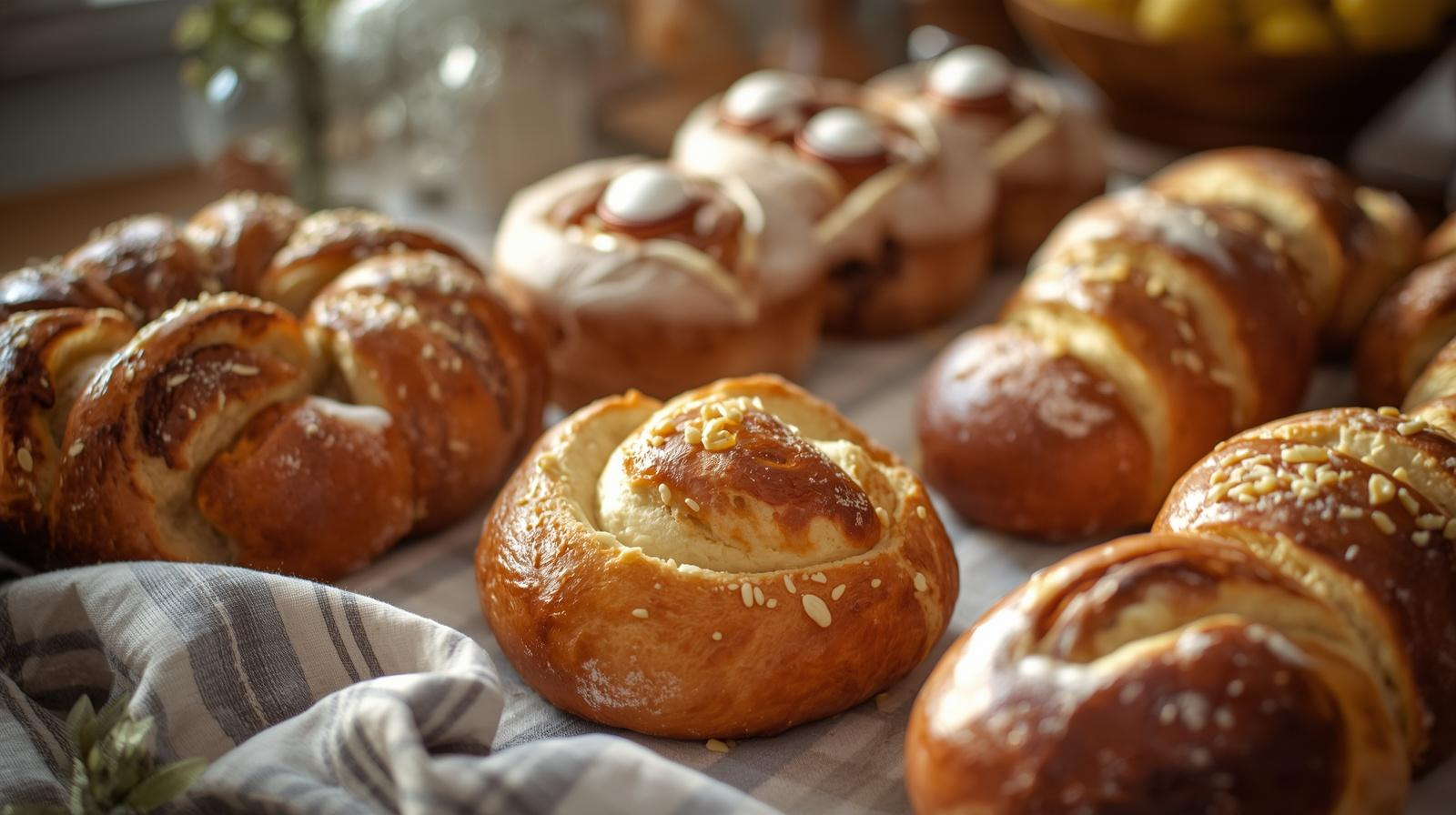
Austrian Easter is particularly associated with elaborate bread-making: the Osterpinze, a soft, sweet roll flavoured with aniseed and lemon, is traditional in the Alpine regions, and elaborate Easter breads of various forms are baked and blessed in churches throughout the country.
France
French Easter (Paques) has a distinctive cultural character shaped by the deep roots of both Catholicism and a strong secular tradition. The religious observance in France centres on the Easter Sunday Mass, celebrated in the great cathedrals and parish churches with particular solemnity, and on the Easter Vigil for those committed to liturgical practice.
A charming French tradition explains the church bells falling silent from Good Friday until Easter Sunday not by the theological reason (mourning the death of Christ) but by a folk legend: the bells have flown to Rome to be blessed by the Pope, and on Easter Sunday morning, they fly back, dropping chocolate eggs and bells into gardens for children to find. The Easter bells (cloches de Paques) are therefore a dual symbol of both religious and confectionery joy.
French Easter chocolatiers produce some of the finest Easter confections in the world, magnificent chocolate eggs, fish, hens, bells and rabbits in the windows of every patisserie and confiserie, reaching a level of artistry that is taken with great seriousness in a country where the quality of chocolate is a matter of national pride.
Poland
Polish Easter (Wielkanoc, Great Night) is one of the most richly detailed in all of Europe, combining intense Catholic religious observance with folk traditions of great beauty and antiquity.
Holy Saturday in Poland centres on the Swieconka, the blessing of the Easter basket, in which families bring baskets of Easter foods to church to be blessed by the priest. The basket traditionally contains: a lamb-shaped cake or butter lamb (baranek), hard-boiled eggs (pisanki), kielbasa sausage, ham, bread, horseradish, salt, and a small candle. The blessed foods form the centrepiece of the Easter Sunday breakfast, the most important meal of the Polish year.
Easter Monday in Poland is known as Smigus-Dyngus (Wet Monday), an ancient custom in which people drench each other with water, originally associated with spring purification rituals but now a day of boisterous fun in which no one, however formally dressed, is safe from a bucket of water or a well-aimed water pistol. The custom is observed with particular enthusiasm by children and young people, and in Warsaw, Krakow and other cities, the streets on Easter Monday can resemble a good-natured battle.
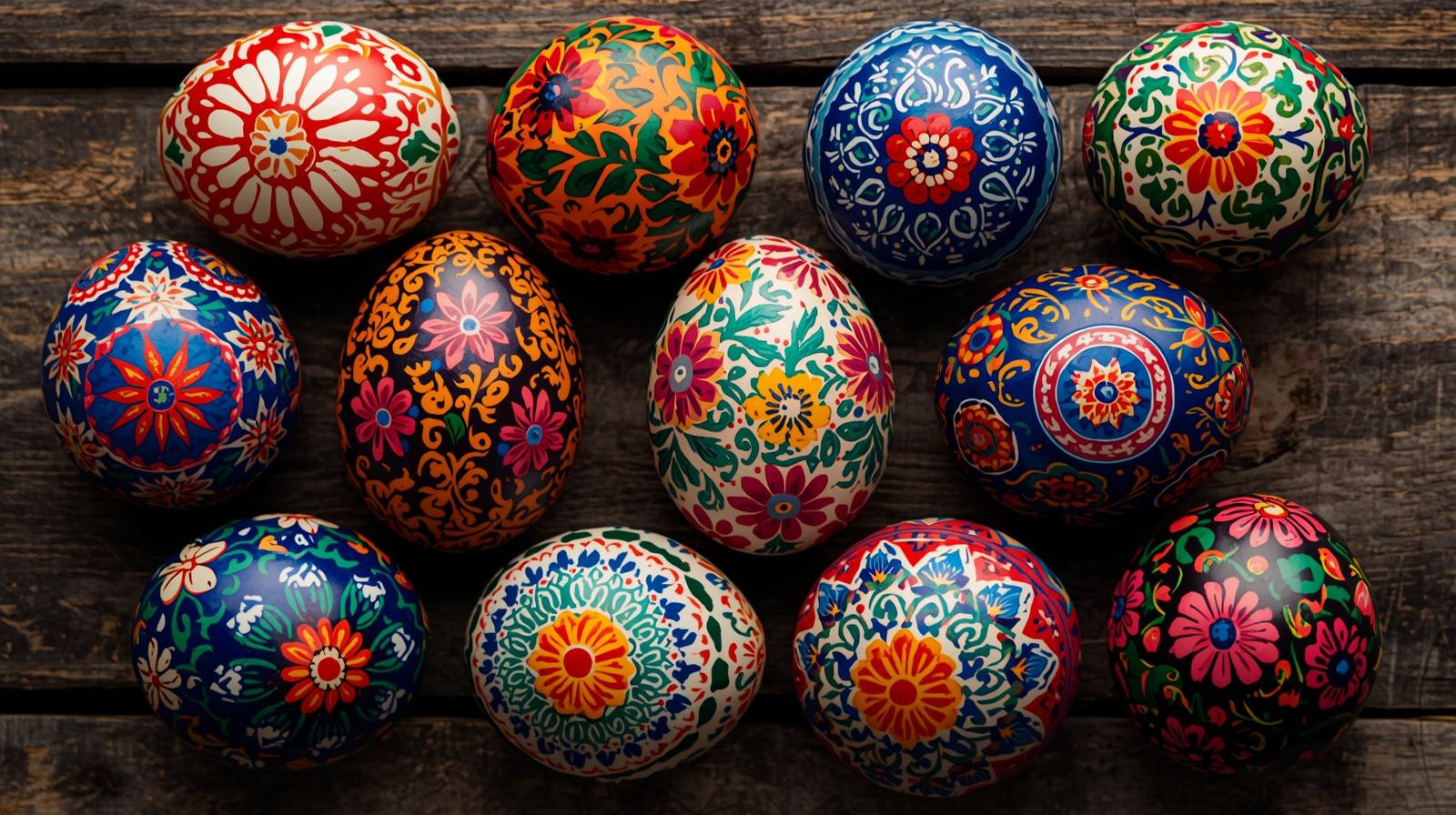
Polish pisanki (decorated Easter eggs) rival the Ukrainian pysanky in their beauty and intricacy, using a variety of techniques including wax-resist, etching, and paper applique, and they are treasured both as religious objects and as works of folk art.
The Philippines
Easter in the Philippines is observed with a fervour that reflects the country’s position as the most Catholic nation in Asia. The entire Holy Week (Mahal na Araw, Beloved Days) is a national holiday, and the religious observances draw virtually the entire population into participation.
The Salubong, celebrated in the early hours of Easter Sunday, is one of the most distinctive Filipino Easter customs. Two processions, one carrying a statue of the risen Christ, the other a statue of the Virgin Mary in black mourning, move through the streets from opposite directions and meet at the church entrance. An angel figure (often a young girl on a platform or carried aloft) descends to remove the black veil from the Virgin’s face in a dramatic gesture of joy at the resurrection, and the reunited figures are carried into the church for the Easter Mass. The Salubong is simultaneously a profound theological statement about the resurrection and a piece of theatrical community liturgy of great emotional power.
The Visita Iglesia custom, visiting seven churches during Holy Week to pray the Stations of the Cross,draws millions of Filipinos into extended acts of pilgrimage. In rural areas, Passion plays (Sinakulo) recreating the events of Holy Week are performed over multiple days, with local community members taking the roles of Jesus, Mary, the disciples and the soldiers.
Latin America
Across Latin America, Easter is observed with a blend of Catholic religious practice and rich local cultural traditions that varies considerably from country to country and even from region to region.
In Mexico, the Semana Santa processions rival those of Spain in their elaborateness and drama, particularly in cities such as Taxco, where thousands of flagellant penitents, wearing hoods and crowns of thorns, carrying heavy wooden crosses, process through the streets on Good Friday in acts of public penance that have been observed for centuries. The Easter Sunday celebration brings the contrasting joy of the resurrection with fireworks, mariachi bands, and extended family feasts.
In Brazil, Semana Santa is the occasion for the largest Passion play in the world: the Paixao de Cristo in Nova Jerusalem, a specially built “New Jerusalem” in the state of Pernambuco, performed to audiences of over 50,000 people per night. Ecuador, Peru and Colombia have similarly elaborate Holy Week traditions, including the famous carpet of flowers (alfombras) laid in the streets of Antigua in Guatemala, though technically in Central America, through which the Good Friday processions pass.
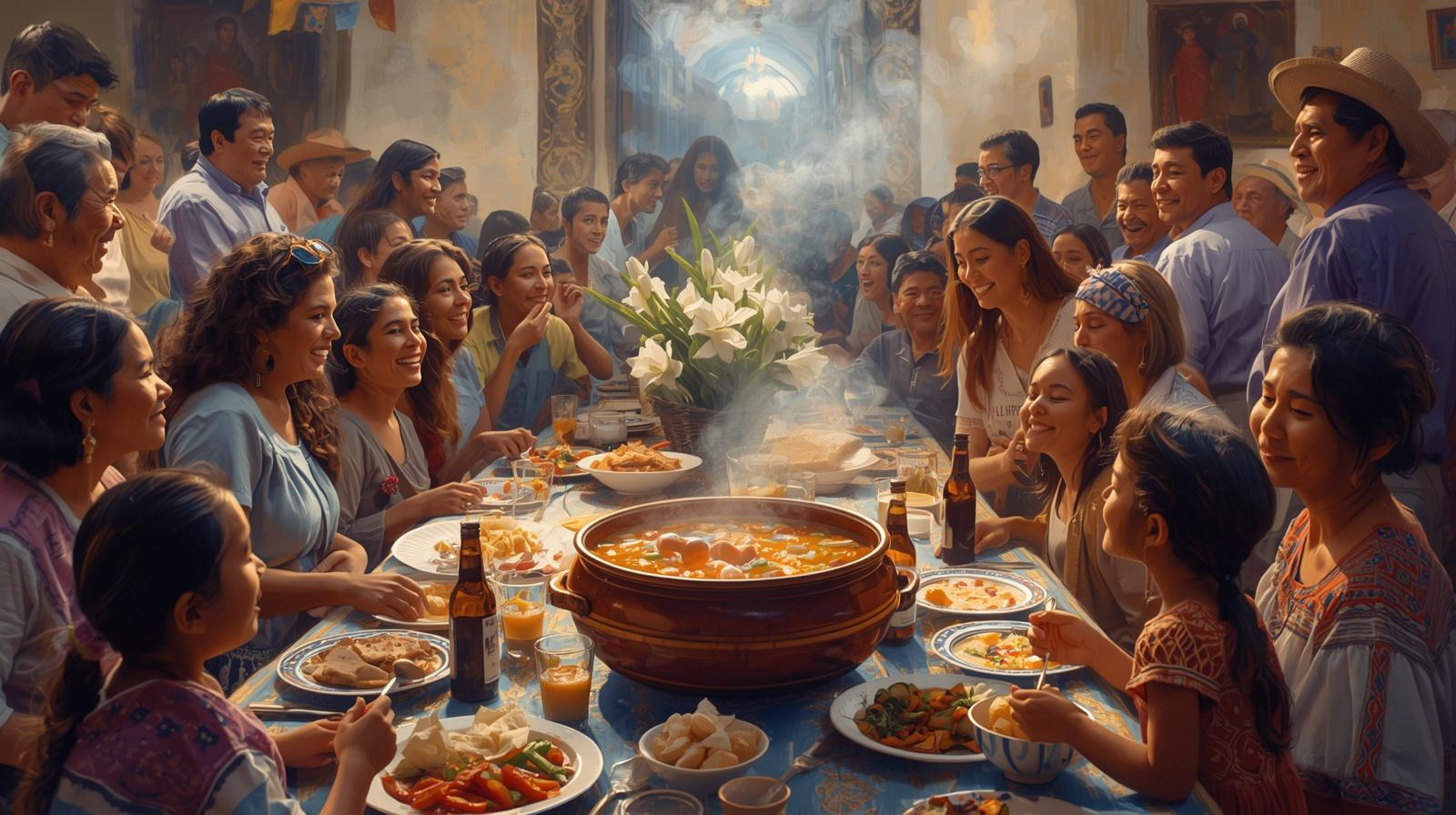
Easter Sunday across Latin America typically brings the breaking of the Lenten fast with a great family feast, often centred on the traditional Sopa de Semana Santa (Holy Week soup) specific to each country, and the joy of the resurrection is celebrated with music, dancing and the gathering of extended families.
Ethiopia and the Coptic World
Ethiopian Fasika is preceded by Tsome Filseta, the fifty-five-day fast observed by Ethiopian Orthodox Christians, one of the most demanding fasting disciplines in any Christian tradition. During this period, the faithful abstain from all animal products, eating only once a day after midday prayer.
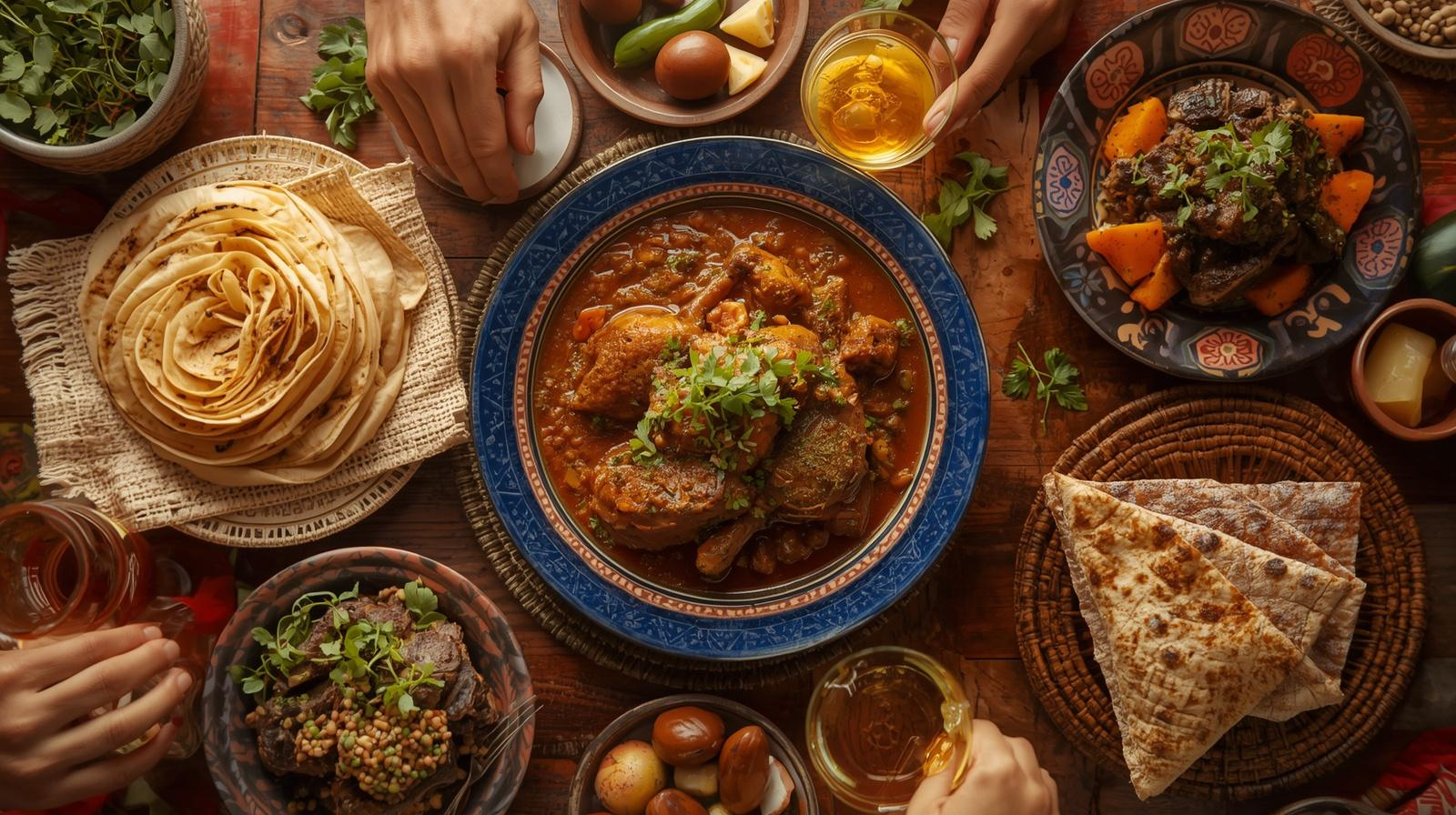
Easter Sunday breaks the fast with an explosion of colour, sound and flavour. Doro Wat, the rich, deeply spiced chicken stew that is Ethiopia’s national dish, and Injera (the spongy flatbread) form the centrepiece of the Easter feast, along with lamb dishes and tej (honey wine). Churches are packed from the early hours, the liturgy accompanied by the rhythmic beating of the kebero drum and the chanting of Ge’ez hymns in a continuous act of worship that can last many hours.
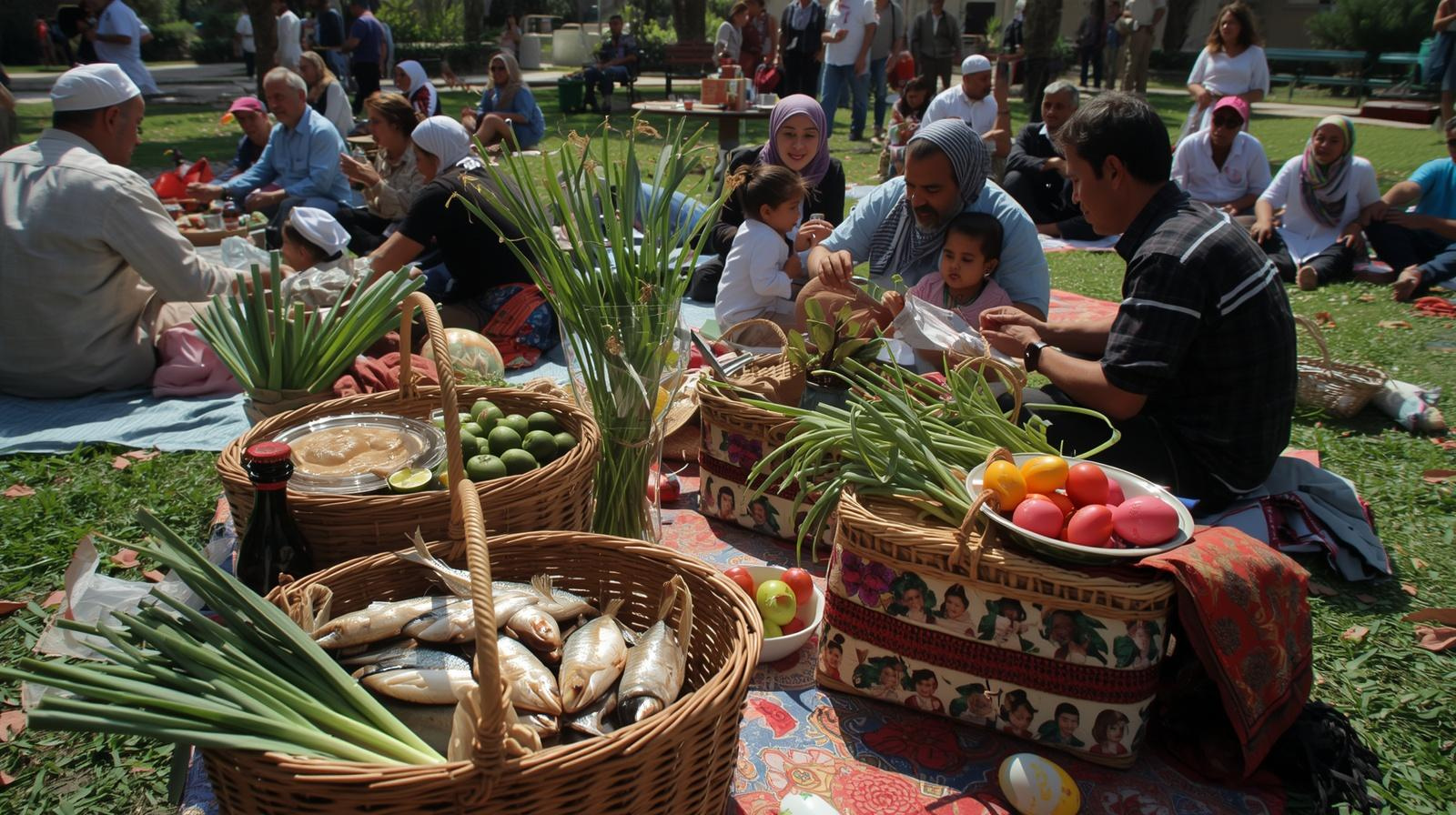
In Egypt, Coptic Easter (Sham el-Nessim — the Smelling of the Breeze) coincides with an ancient spring festival observed by Egyptians of all faiths and none: a public holiday in which families gather outdoors in parks and gardens with picnic baskets containing the traditional Sham el-Nessim foods of feseekh (salted mullet), green onions and coloured eggs. This remarkable blending of the Christian Easter with a pre-Christian spring festival that goes back to ancient Egypt is a striking example of the way Easter has absorbed and transformed older seasonal celebrations.
United States of America
Easter in the United States reflects the extraordinary diversity of American Christianity, from the elaborate Easter Vigils of Catholic and Episcopal cathedrals to the sunrise services on hillsides, stadium Easter celebrations drawing tens of thousands, and everything in between.
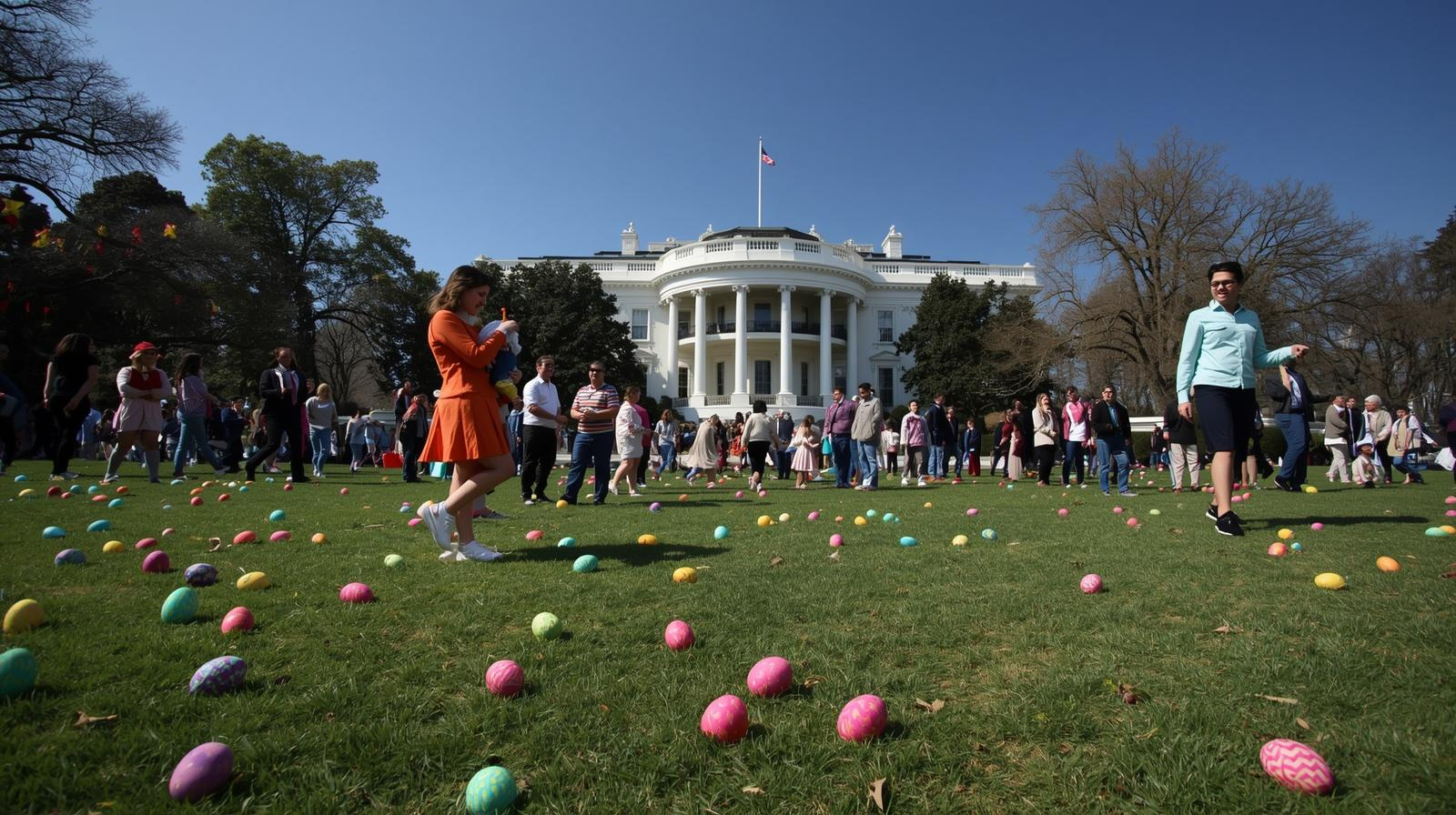
The White House Easter Egg Roll, held on the South Lawn of the White House on Easter Monday, is one of the most photographed public Easter events in the world, a tradition dating back to 1878 under President Rutherford B. Hayes. Each year, thousands of children roll coloured hard-boiled eggs across the White House lawn in a custom that has become an American institution.
American Easter is also heavily associated with the Easter Basket, filled by the Easter Bunny with chocolate eggs, candy and small gifts, and with new spring clothing, a custom with roots in the Christian tradition of new white garments worn by the newly baptised at Easter. The famous Easter Parade on Fifth Avenue in New York City, in which participants compete to wear the most elaborate Easter hats and costumes, is a colourful expression of this spring and celebration aspect of the American Easter.
Theologically, Easter remains central to American Christian life. The Southern and Midwest Bible Belt, with its vast evangelical Protestant communities, celebrates the resurrection with packed church services, dramatic sunrise celebrations, and the full force of contemporary Christian music. The liturgical traditions of Catholic, Episcopal, Lutheran and Orthodox churches celebrate with equal intensity but in very different forms. Easter in America is, in microcosm, Easter in the world.
Eggs, Rabbits and the Question of Pre-Christian Origins
No discussion of Easter is complete without addressing the eggs, the rabbits, the chocolate and the springtime symbolism that surround the Christian feast in its popular cultural expression. These elements are frequently cited as evidence of pre-Christian origins, a theory that deserves careful examination.
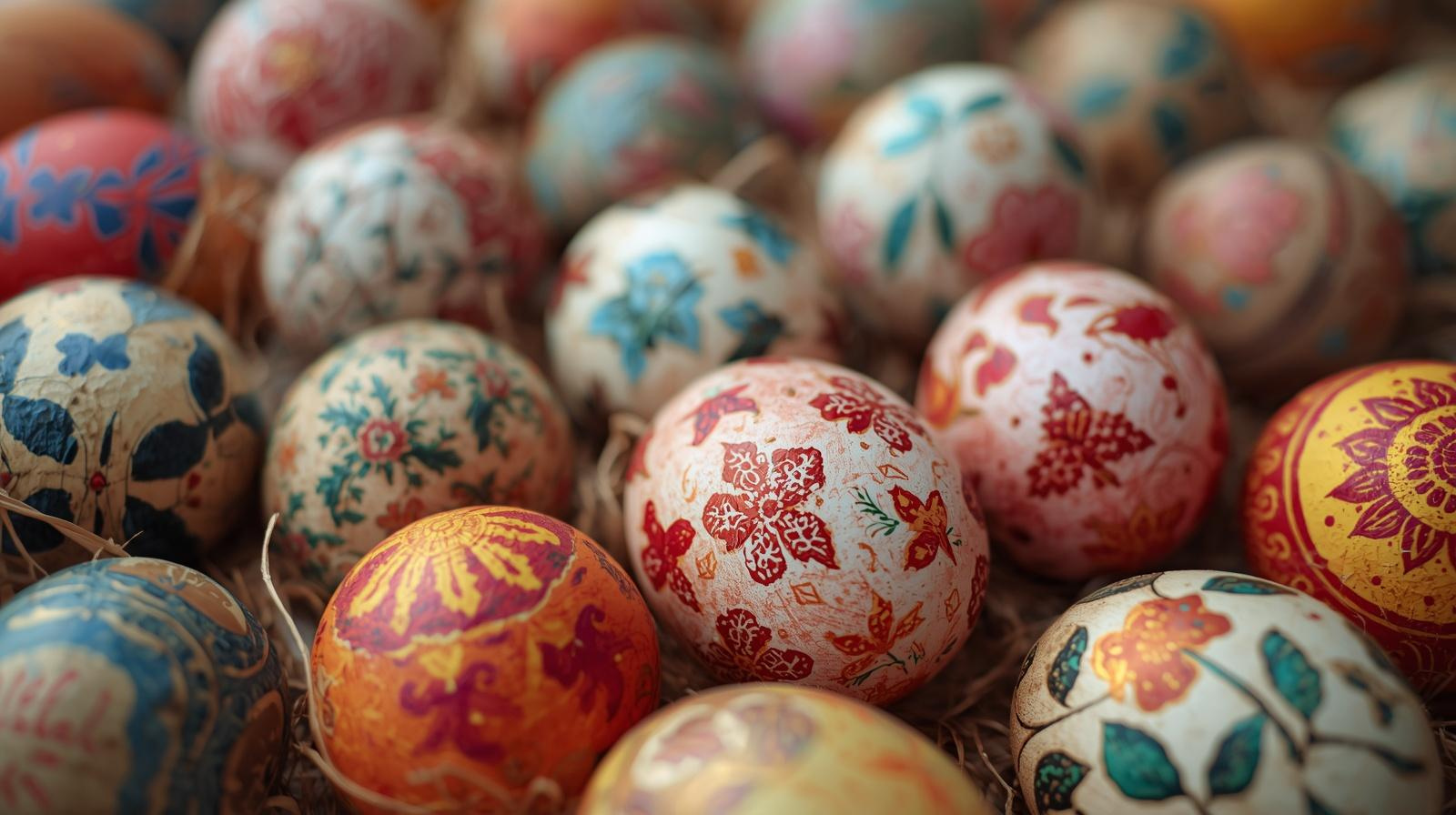
The egg has been a symbol of new life and fertility across many cultures since ancient times, and it would be surprising if early Christians had not found in it a natural symbol of the resurrection. But the specific custom of decorating and giving Easter eggs appears to be Christian in origin rather than borrowed from pagan predecessors. In the Eastern Church, eggs were painted red to symbolise the blood of Christ, and the legend of Mary Magdalene presenting a red egg to the Emperor Tiberius with the cry “Christ is Risen” is one explanation for the tradition. In the Western Church, eggs accumulated during the Lenten fast, when they were traditionally forbidden, were given away at Easter in celebration of the fast’s end.
The Easter hare or rabbit is more difficult to trace. The Venerable Bede’s claim that Easter derived from a goddess named Eostre whose symbol was a hare has never been corroborated by any other source, and many modern scholars doubt that Eostre existed as a major deity. The Easter Bunny as a gift-bringer appears to be a German innovation of the 17th century, spread to America by German immigrants. Whatever its origin, it has proved extraordinarily durable.
The springtime associations of Easter, flowers, new life, the warmth returning after winter, reflect the natural world’s resonance with the Christian message of resurrection and new creation. The Church has generally been comfortable with these associations, seeing in the natural order of death and rebirth a parable of the paschal mystery rather than a pagan competitor to it.
The Feast That Cannot Be Contained
Easter is, in the most literal sense, an overflowing feast. It overflows from the church into the street, from the liturgy into the kitchen, from the individual believer’s heart into the life of the community and the natural world coming alive with spring. No other religious observance in human history has generated such a wealth of music, art, custom, food, liturgy and cultural expression across so many different peoples and traditions.
From the haunting midnight cry of Christos Anesti in a Greek mountain village to the roar of a stadium Easter sunrise service in Texas; from the swaying paso of a Seville cofradia in the night streets to the quiet blessing of a Ukrainian pysanka; from the Ethiopian faithful beating their drums through the small hours to the English family unwrapping Easter eggs on a Sunday morning, all of these, in their very different ways, are responses to the same proclamation: the tomb is empty, death has been defeated, and everything, from this moment forward, is new.
Easter is not simply a date on the calendar. It is a lens through which Christians have understood the whole of human experience, suffering and joy, death and life, exile and homecoming, winter and spring. In the words of the ancient Easter proclamation sung at the Vigil each year: this is the night that truly frees all who believe from worldwide guilt, restores lost innocence, and brings mourners joy. No wonder the world has found so many ways to celebrate it.
“Christ is risen from the dead, trampling down death by death, and upon those in the tombs bestowing life.”
*
The Paschal Troparion, sung throughout the Orthodox Easter season since the 4th century
Easter
The Resurrection of Jesus Christ
Faith, Tradition and Celebration Across the Christian World
What Is Easter?
Easter is the most important feast in the Christian calendar. It celebrates the resurrection of Jesus Christ from the dead on the third day after his crucifixion, the event that Christians of every tradition regard as the cornerstone of their faith, the moment that vindicates everything Jesus taught and did, and the pledge of eternal life for all who believe.
Unlike Christmas, which celebrates the beginning of Christ’s earthly life, Easter marks its culmination and its transformation. The cross and the empty tomb are the two poles around which the whole of Christian theology revolves, and Easter Sunday is the feast on which the empty tomb is proclaimed with every resource of song, light, colour and joy that the Church can muster.
St Paul, writing to the early Christians in Corinth around AD 55, expressed the absolute centrality of the resurrection with characteristic bluntness: if Christ has not been raised, he wrote, then Christian preaching is useless and faith is futile. Easter is therefore not a peripheral observance or a seasonal decoration; it is the very reason Christianity exists.
The word Easter itself is of disputed origin. In most languages, French Paques, Spanish Pascua, Italian Pasqua, Russian Paskha, the feast takes its name directly from the Hebrew Pesach (Passover), reflecting the deep connection between the death and resurrection of Christ and the Jewish festival commemorating the Exodus from Egypt. In English and German (Ostern), however, a different name prevails. The Venerable Bede, writing in the 8th century, suggested it derived from Eostre, a Germanic goddess of spring, though modern scholars debate this derivation. Whatever its etymology, the English name has come to carry the full weight of Christian resurrection faith.
The Resurrection Narrative
All four Gospels record the resurrection of Jesus, though with differences of emphasis and detail that have generated centuries of theological and historical discussion. The broad narrative, however, is consistent across all accounts.
On the morning of the first day of the week, what we now call Sunday, a group of women, led by Mary Magdalene, came to the tomb where Jesus had been buried on Friday evening. They came expecting to complete the burial anointing that had been left unfinished before the Sabbath. What they found instead was a tomb that was open and empty.
In Matthew’s account, a great earthquake had occurred, an angel had rolled back the stone sealing the entrance, and the guards posted by the authorities had fallen to the ground in terror. In Luke’s account, two men in dazzling clothes announced to the bewildered women that the one they sought was not there: he had risen. In John’s Gospel, the account is extraordinarily intimate: Mary Magdalene, weeping outside the tomb, encounters a figure she takes for the gardener, until he speaks her name, “Mary”, and she recognises him.
In the days that followed, according to all four Gospels and the letters of Paul, the risen Christ appeared to his disciples on multiple occasions: in a locked room in Jerusalem, on a road to the village of Emmaus, beside the Sea of Galilee, and finally on a hillside where, before ascending to the Father, he commissioned his followers to go into all the world and make disciples of all nations.
These resurrection appearances are the foundation on which the entire edifice of Christian faith was built. The disciples who had scattered in fear after the crucifixion became, within weeks, the bold proclaimers of resurrection who turned the ancient world upside down. Easter is the feast on which Christians celebrate that transformation and claim it for themselves.
When Is Easter? The Question of Dating
One of the most practically confusing aspects of Easter is that its date changes from year to year. Unlike Christmas, which is fixed on 25th December, Easter is what is called a movable feast; it falls on a different Sunday each year, anywhere between 22nd March and 25th April.
The standard Western rule, established by the Council of Nicaea in AD 325, is that Easter falls on the first Sunday after the first full moon following the spring equinox. This lunar basis reflects the feast’s connection to Passover, which is itself calculated according to the Hebrew lunar calendar.
The matter is complicated further by the fact that Eastern Orthodox churches, and some other Eastern Christian bodies, calculate Easter using a different method, following the older Julian calendar rather than the Gregorian calendar adopted in the West in 1582. As a result, Orthodox Easter (called Pascha) often falls one, four, or five weeks after Western Easter, though in some years the dates coincide. For millions of Christians in Greece, Russia, Serbia, Romania, Ethiopia, Egypt and elsewhere, the Orthodox calculation determines when Easter is celebrated.
The divergence between Eastern and Western Easter dates has been a source of both practical inconvenience and theological reflection for centuries, and proposals for a common date have been periodically discussed without yet achieving consensus. In 2025, Western and Orthodox Easter happened to fall on the same date, 20th April, a coincidence that occurs only occasionally.
Holy Week: The Journey to Easter
Easter does not arrive without preparation. The week before Easter Sunday, known as Holy Week, is the most intense and spiritually concentrated period in the entire Christian year, walking believers step by step through the final days of Jesus’s earthly life.
Holy Week begins with Palm Sunday, when Christians commemorate Jesus’s triumphal entry into Jerusalem riding on a donkey, welcomed by crowds waving palm branches and crying Hosanna. In many churches, palm branches or crosses woven from palm are blessed and distributed to the congregation.
Monday, Tuesday and Wednesday of Holy Week vary in observance, though many churches offer daily services or reflections. Holy Wednesday is sometimes observed as Spy Wednesday, marking the day on which Judas agreed to betray Jesus.
Holy Thursday, also called Maundy Thursday, commemorates the Last Supper at which Jesus instituted the Eucharist, washed his disciples’ feet, and prayed in the Garden of Gethsemane before his arrest. Many churches hold an evening Mass or service of the Lord’s Supper, often followed by a period of prayer watch through the night.
Good Friday, as explored in a companion article, is the day of the crucifixion, the day of fasting, silence, and sorrow. Holy Saturday is the in-between day, the day Christ lay in the tomb, a day of waiting and emptiness observed with particular solemnity in many traditions.
Then, in the darkness before dawn on Easter Sunday, the night is broken by fire.
The Easter Vigil: Mother of All Vigils
For Catholics, Orthodox Christians, many Anglicans, and Lutherans, the liturgical heart of Easter is not Sunday morning but the Easter Vigil, a nocturnal service celebrated in the darkness of Holy Saturday night, extending into the earliest hours of Sunday morning. The ancient Church called it the mother of all vigils, and there is nothing quite like it in any other religious tradition in the world.
In the Roman Catholic Rite, the Vigil begins outside the church in complete darkness. A large fire is kindled, and from it the Paschal Candle a great candle of wax representing the risen Christ, is lit. The deacon or priest carries it into the darkened church, pausing three times to sing the ancient proclamation: “The Light of Christ.” Candles held by the congregation are lit from the Paschal Candle until the whole church glows with flame.
The Exsultet, an ancient hymn of breathtaking beauty dating to at least the 4th century, is then sung, announcing the resurrection in language of soaring joy: it calls upon the heavens and the earth, the angels and the Church, to rejoice at the defeat of death and the return of light. The readings that follow span the entire history of salvation from the creation of the world through to the resurrection, up to nine readings drawn from the Old and New Testaments.
The Vigil climaxes in the Gloria, sung for the first time since it was silenced on Holy Thursday, in the renewal of baptismal promises by the entire congregation, and, in many parishes, in the baptism and reception of new members into the Church. Easter is the traditional night for baptism in the early Church, and this practice has been widely restored in the modern era.
The Orthodox Easter Vigil is similarly dramatic. At midnight, as the church waits in darkness, the priest emerges from the sanctuary with the light and proclaims, “Christ is risen!” (Christos Anesti!), and the congregation responds with rapturous joy: “Truly He is risen!” (Alithos Anesti!). Bells ring, fireworks may explode outside, and the church erupts in light and song. The Divine Liturgy that follows, often not ending until 2 or 3 in the morning, is one of the most exhilarating acts of Christian worship anywhere on earth.
Easter Across Christian Traditions
Roman Catholic
For Roman Catholics, Easter Sunday is the apex of the liturgical year, the culmination of the Sacred Triduum, the three days of Holy Thursday, Good Friday and Holy Saturday, and the Sunday of Sundays. Following the Vigil, Easter Sunday Mass is celebrated with maximum solemnity: the church adorned with white and gold, flowers filling every surface, the Gloria and Alleluia sung with voices that have been silent throughout Lent.
The forty days of Lent that precede Easter, beginning on Ash Wednesday, are a period of prayer, fasting and almsgiving in preparation. The traditional Lenten fast, which historically involved abstaining from meat, dairy and eggs throughout the season, gives Easter its association with the breaking of the fast: the egg, the lamb and the rich foods of Easter breakfast carry the joy of relief and abundance after weeks of restraint.
Easter Sunday is followed by the Easter Octave, eight days celebrated as a single great feast, and then the fifty days of Eastertide, which extends to Pentecost Sunday. Throughout this season, the Alleluia that was buried at the start of Lent rings out at every Mass, and the mood of the liturgy is one of unbroken resurrection joy.
Eastern Orthodox
In the Orthodox world, Pascha (Easter) is not merely the most important feast; it is the Feast of feasts, the celebration that gives all other celebrations their meaning. The entire liturgical year is oriented towards it, and no other observance comes close to it in theological centrality or liturgical splendour.
The Orthodox Holy Week is an immersion of extraordinary depth. Great and Holy Monday through Wednesday feature long services meditating on the approach of the Passion. Holy Thursday brings the Liturgy of St Basil and the washing of feet. Great and Holy Friday is the day of mourning, with the veneration of the Epitaphios. Great and Holy Saturday is a day of strange, solemn beauty, Christ in the tomb, yet the tomb already beginning to radiate light.
At midnight on Pascha, the church bursts into the Paschal troparion, the ancient hymn “Christ is risen from the dead, trampling down death by death, and upon those in the tombs bestowing life”, sung and re-sung with increasing exultation as the Divine Liturgy unfolds. The paschal greeting Christos Anesti is exchanged between all believers throughout the forty days of the Paschal season, which continues until Ascension Thursday.
After the long Lenten and Holy Week fast, the Paschal feast table is laden with traditional foods: kulichi (tall sweet bread), pashka (a rich cheesecake), and red-dyed eggs in Russia and Eastern Europe; tsoureki (braided sweet bread) and red eggs in Greece; lamb soup and spit-roast lamb in many Orthodox countries. These are often brought to church on Holy Saturday to be blessed before the feast.
Anglican
The Anglican Communion, encompassing the Church of England, the Episcopal Church in the United States, and churches across the Anglican world, celebrates Easter with a rich blend of liturgical tradition and theological breadth. Easter Sunday is marked with great joy in parishes of every theological stripe, from the incense-wreathed solemnity of Anglo-Catholic High Churches to the contemporary warmth of charismatic evangelical congregations.
The Church of England’s liturgy for Easter draws on centuries of tradition, combining elements of the ancient Western Rite with the distinctively English language of the Book of Common Prayer and its successors. The Easter Vigil has been significantly restored in Anglican practice since the mid-20th century, and many English cathedrals and parish churches now hold late-night or very early morning services of extraordinary beauty.
Easter morning in England has its own particular cultural character: the smell of spring in cold stone churches, the massed lilies and daffodils around the altar, the sudden lifting of the Lenten plainness, the organ unleashed at full swell. The ancient Easter greeting, “The Lord is risen! He is risen indeed, Alleluia!”, is exchanged between clergy and congregation, and the Easter Eucharist is celebrated with every festive resource the tradition offers.
Lutheran
Lutheran Easter observance combines profound theological seriousness about the resurrection with a rich tradition of music and communal celebration. The Lutheran Reformation did not abandon the Easter feast but deepened its theological content, insisting on the resurrection as the vindication of the doctrine of justification by faith alone.
The Easter Vigil has been significantly recovered in Lutheran practice, particularly in Scandinavian and German churches, and the Easter morning service, often beginning before dawn, is celebrated with great festivity. The great Easter chorales of Bach and the Lutheran hymn tradition are a particular gift to Christian worship: hymns such as “Christ the Lord is Risen Today”, “Now All the Vault of Heaven Resounds”, and the ancient Christ ist erstanden fill Lutheran churches with music of resurrection joy.
In Scandinavia, Easter Sunday is followed by an Easter Monday holiday, and the entire Easter period from Palm Sunday onwards is a time of family gathering, feasting and celebration in which Christian faith and Scandinavian cultural tradition are richly intertwined.
Methodist and Free Church
Methodist, Baptist, United Reformed and other Free Church traditions in Britain and beyond celebrate Easter with energetic joy, typically centred on a lively Easter morning service combining rousing hymns, preaching on the resurrection, and often a Communion service. The mood is one of triumphant celebration rather than liturgical solemnity, though many Free Churches have developed a growing appreciation for the richness of Holy Week observance.
Sunrise services, held outdoors or in large venues as dawn breaks on Easter morning, have become popular across many evangelical and charismatic traditions, drawing hundreds or thousands of worshippers to hillsides, beaches and parks to greet the resurrection with the rising of the sun. These services, often followed by a shared breakfast, have a particular freshness and joy that captures something of the experience of those first witnesses at the empty tomb.
Easter is also one of the key evangelistic moments in the Free Church calendar, with special services designed to welcome those who may not regularly attend church but who come at Easter as a cultural and spiritual touchstone.
Coptic and Oriental Orthodox
The Coptic Church of Egypt, the Ethiopian and Eritrean Orthodox Tewahedo Churches, the Armenian Apostolic Church and other Oriental Orthodox communions celebrate Easter according to their own ancient liturgical calendars and in forms that reflect the extraordinary antiquity of their traditions.
Coptic Easter (Feast of the Resurrection or Eid el-Qiyama) follows a period of fasting known as the Great Lent (Kiahk), which in the Coptic tradition lasts fifty-five days, one of the longest Lenten fasts in any Christian tradition. During this period, Coptic Christians abstain from all animal products. Easter Sunday breaks the fast with a richly laden table: fanid (sugar candy), coloured eggs, the traditional feteer pastry, and a feast of meat dishes prepared with joyful abandon.
Ethiopian Easter (Fasika) is similarly preceded by a long and strictly observed fast. The celebration includes elaborate church services with the distinctive Ethiopian liturgical chant, dancing priests in ornate vestments carrying the great processional Tabot (a replica of the Ark of the Covenant), and a nationwide atmosphere of celebration that spills out into the streets with feasting, singing and the exchange of gifts.
Armenian Easter (Zatik) is a national as well as religious occasion in Armenia, preceded by a fast and celebrated with red eggs, special lamb dishes and the singing of Sharakans (hymns) that preserve musical traditions stretching back over fifteen centuries.
Easter Around the World: Country by Country
United Kingdom
Easter in the United Kingdom blends Christian observance with customs that have accumulated over many centuries. The four-day bank holiday weekend, from Good Friday through Easter Monday, is one of the most cherished in the English calendar, associated with the first real warmth of spring, family gatherings, and the chocolate Easter egg.
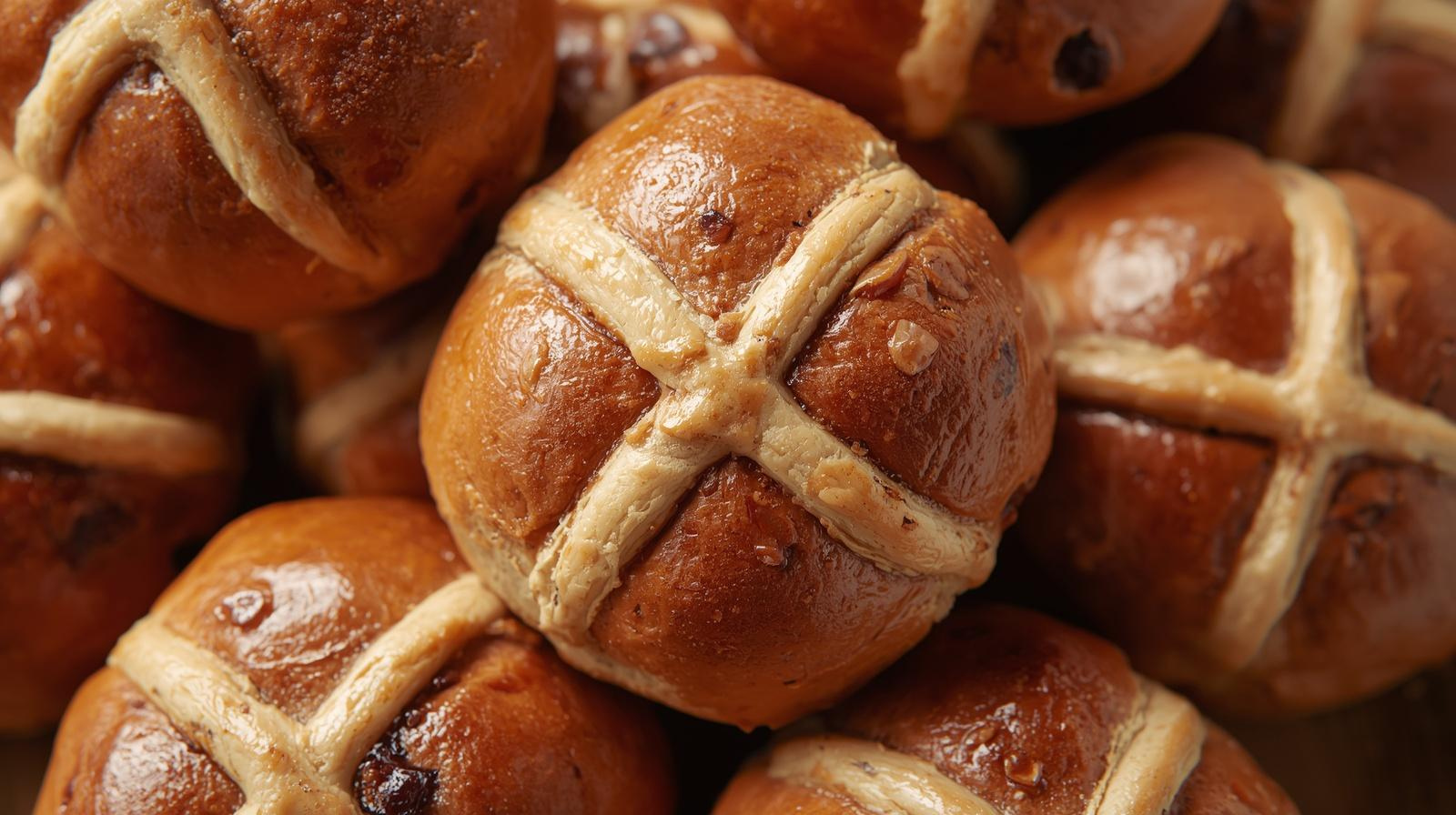
Hot cross buns, spiced and marked with a cross, are traditionally eaten on Good Friday and have become one of the most recognisable symbols of the British Easter. Their origins may lie in pre-Christian spring breads, but by the Tudor period, they had been Christianised and were associated specifically with Good Friday. Today they appear in British shops as early as January, to widespread annual complaint.
The chocolate Easter egg is a 19th-century development; the first commercial chocolate egg was produced in Britain in 1873, and has become central to the secular dimension of British Easter. Egg hunts in back gardens, the Cadbury Creme Egg, the great Easter egg mountain in every supermarket: these are as much a part of the British Easter as church attendance, and the two dimensions, sacred and confectionery, coexist with characteristic British pragmatism.
Morris dancing, egg rolling (rolling hard-boiled eggs down hillsides, as at Avenham Park in Preston), and the Hare Pie Scramble at Hallaton in Leicestershire are among the more unusual traditional Easter customs that survive in various parts of England.
Greece
Easter in Greece is, by common consent of both Greeks and visitors, one of the most spectacular and moving Easter celebrations in the world. It is emphatically the most important holiday in the Greek calendar, surpassing Christmas both in religious intensity and in the scale of national celebration.
The midnight Anastasi (Resurrection) service on Holy Saturday is the pivotal moment. As midnight approaches, the lights in packed churches are extinguished. The priest emerges from the altar with the Holy Light, symbolically brought from Jerusalem, where a flame is said to miraculously appear each year in the Church of the Holy Sepulchre, and the flame spreads from candle to candle until the church blazes with flame. The bells ring, fireworks explode in the night sky, and the cry of Christos Anesti! echoes across the hillsides of every Greek town and village.
The breaking of the Lenten fast at midnight involves the traditional magiritsa, a rich lamb offal soup that provides the first taste of meat after weeks of fasting. Easter Sunday brings the great feast: whole lambs roasted on spits from early morning, red eggs (kokkina avga) cracked against each other in a game of egg-tapping, tsoureki bread braided and flavoured with orange and spice, and tables spread under the open sky for hours of eating, drinking, singing and dancing.
On Easter Sunday evening, the traditional game of tsougrisma sees each person tap their red egg against another’s, saying Christos Anesti. The person whose egg survives uncracked is said to have good luck for the year ahead. Families who live away from their home villages make the journey back for Easter in a migration that rivals the August exodus to the islands.
Russia and Eastern Europe
In Russia, Ukraine, Serbia, Bulgaria, Romania, and across the Slavic Orthodox world, Pascha is a feast of ancient depth and extraordinary cultural richness, reclaimed in the post-Soviet era with particular fervour after decades of enforced secularisation.
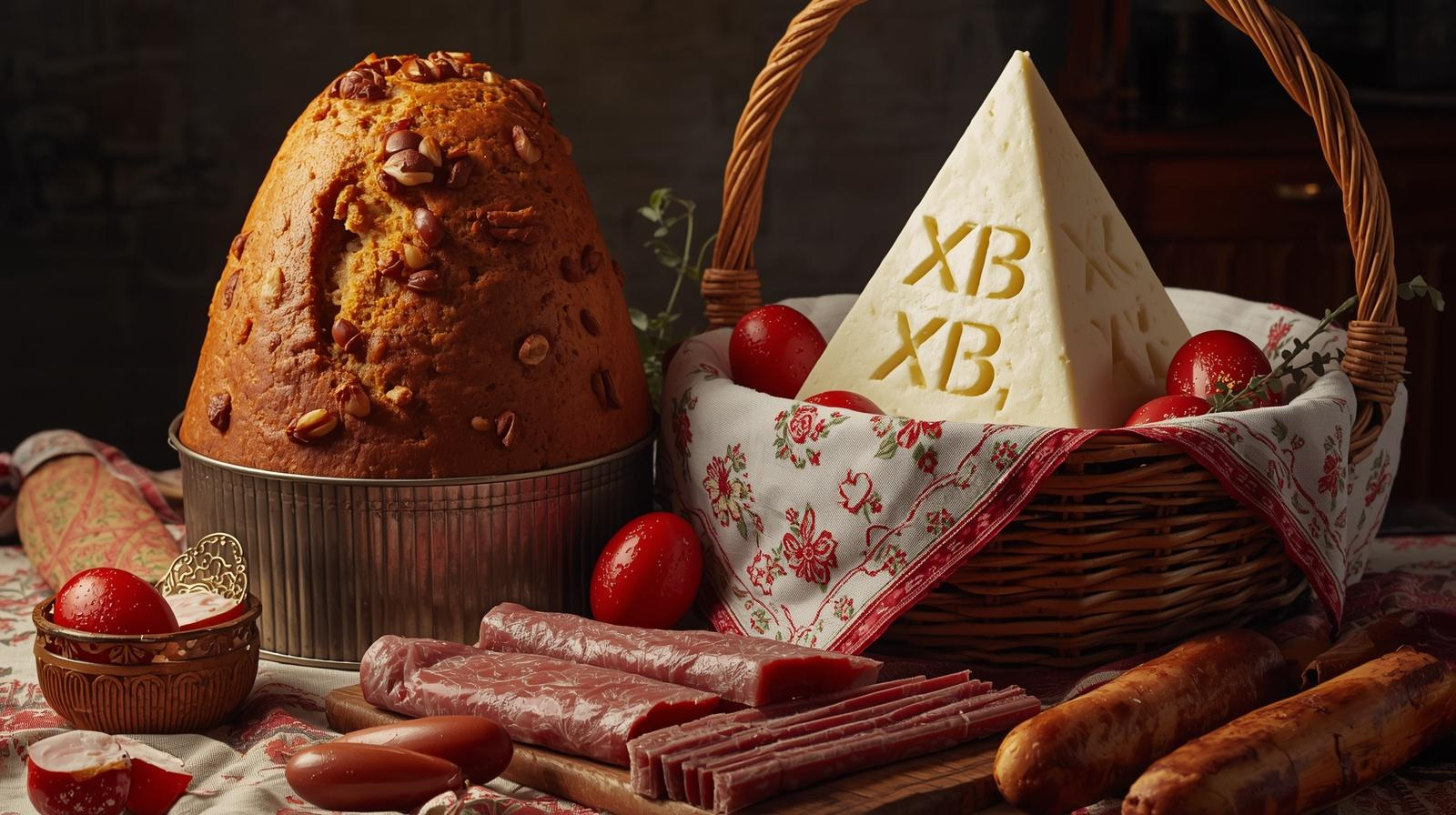
The Russian Easter tradition of the kulich, a tall, dome-shaped sweet bread enriched with eggs, butter, dried fruits and spices, and traditionally baked in a coffee tin, and the paskha, a pyramid-shaped cold cheesecake moulded with the letters XB (Khristos Voskrese, (Christ is Risen), are icons of the Russian Easter table. Both are brought to church in baskets lined with embroidered cloths on Holy Saturday, along with red eggs, cold meats and sausages, to be blessed by the priest before the Vigil.
The exchange of the paschal greeting Khristos Voskrese / Voistinu Voskrese (Christ is Risen / Truly He is Risen) is observed throughout the forty days of the Paschal season, replacing ordinary greetings of hello and goodbye. The triple kiss on the cheek that accompanies the greeting is one of the most tangible expressions of Easter joy in Slavic Christian culture.
Ukrainian Easter traditions include the famous pysanky, intricately decorated eggs created using a wax-resist method and covered with elaborate geometric and symbolic patterns, which are among the most beautiful folk art objects in European Christian culture. The craft of pysanka decoration is passed from generation to generation, and the eggs are traditionally given as gifts at Easter.
Italy
Italian Easter (Pasqua) is both deeply religious and exuberantly festive. Holy Week in Rome draws pilgrims from around the world, with the Pope presiding over the Palm Sunday Mass in St Peter’s Square, the Way of the Cross at the Colosseum on Good Friday, the Easter Vigil in St Peter’s Basilica, and the great Easter Sunday Urbi et Orbi blessing from the central loggia of the Basilica, broadcast live to hundreds of millions around the world.
Throughout Italy, elaborate processions mark Holy Week, with the most famous including the Processione dei Misteri in Trapani, Sicily, in which enormous floats depicting scenes of the Passion are carried through the streets for twenty-four hours by members of ancient confraternities, and the dramatic Good Friday procession at Chieti in Abruzzo, one of the oldest in Italy.
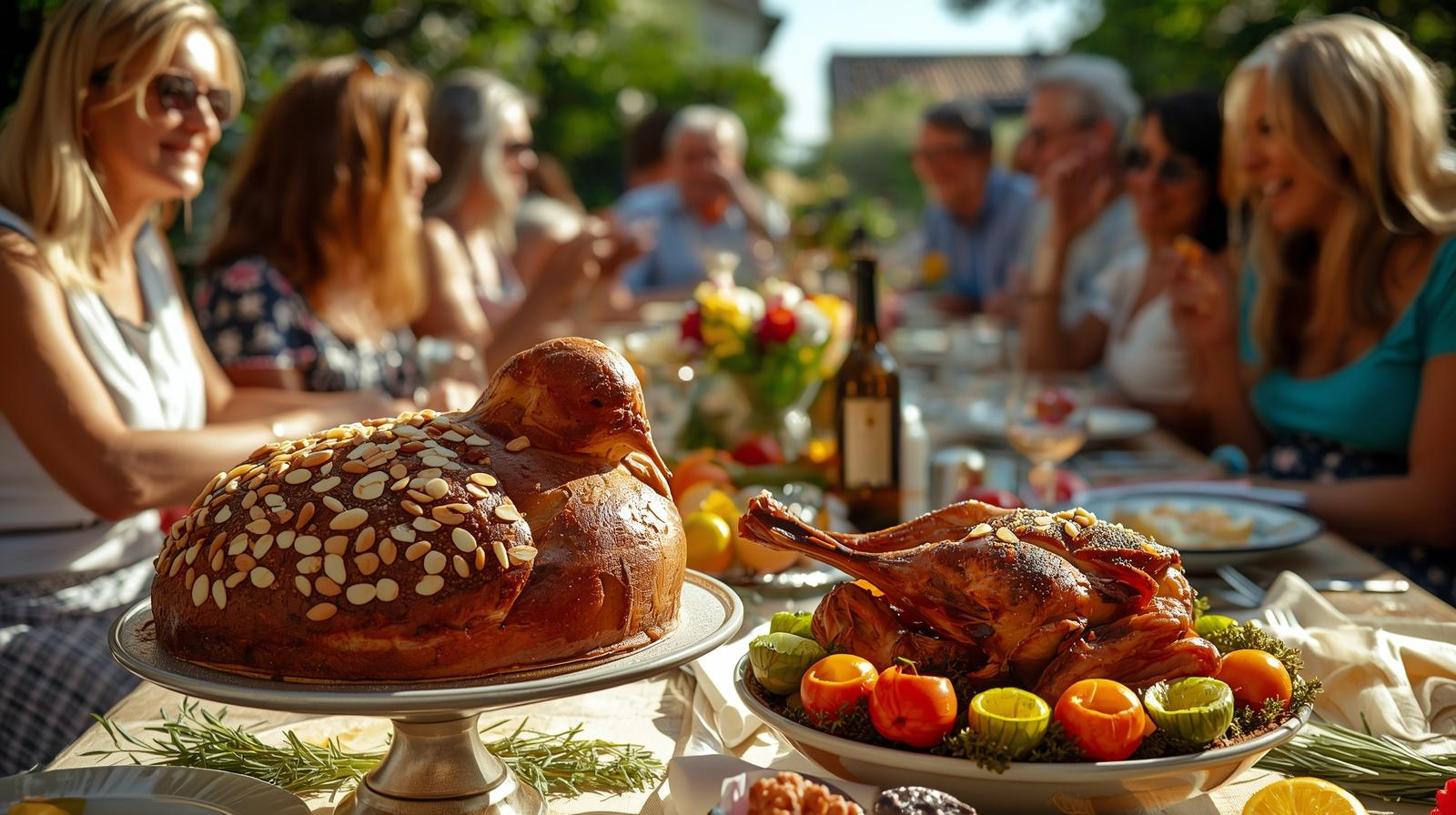
The Easter table in Italy centres on the Colomba di Pasqua, a dove-shaped sweet bread similar to the Christmas Panettone, made with candied peel and topped with almonds and sugar, and the traditional Easter lamb dish, agnello al forno, roasted with herbs and served at the extended family lunch that is the social heart of Italian Easter. The expression Natale con i tuoi, Pasqua con chi vuoi (Christmas with your family, Easter with whoever you want) reflects the somewhat more relaxed social character of the Italian Easter compared to Christmas.
Easter Monday in Italy is called Pasquetta (Little Easter) and is traditionally spent outdoors in the first warmth of spring, with family and friends gathering in parks and countryside for picnics and celebrations.
Spain
Spanish Easter (Semana Santa, Holy Week) is one of the most visually dramatic religious observances in the world. In cities and towns across Spain, but especially in Seville, Malaga, Valladolid, Toledo and Zamora, elaborate processions of religious brotherhoods (cofradias or hermandades) move through the streets carrying enormous pasos, floats bearing sculptural groups depicting scenes of the Passion, accompanied by thousands of nazarenos (penitents) wearing distinctive pointed hoods and carrying candles or wooden crosses.
The Seville processions are internationally famous: they last throughout Holy Week, each cofradia following its own ancient route through the narrow streets of the city, the paso swaying on the shoulders of costaleros (bearers who carry the float from within, invisible to spectators), preceded by bands playing the haunting Saeta music of Andalucia. The atmosphere combines intense religious devotion, civic pride and theatrical spectacle in a way found nowhere else on earth.
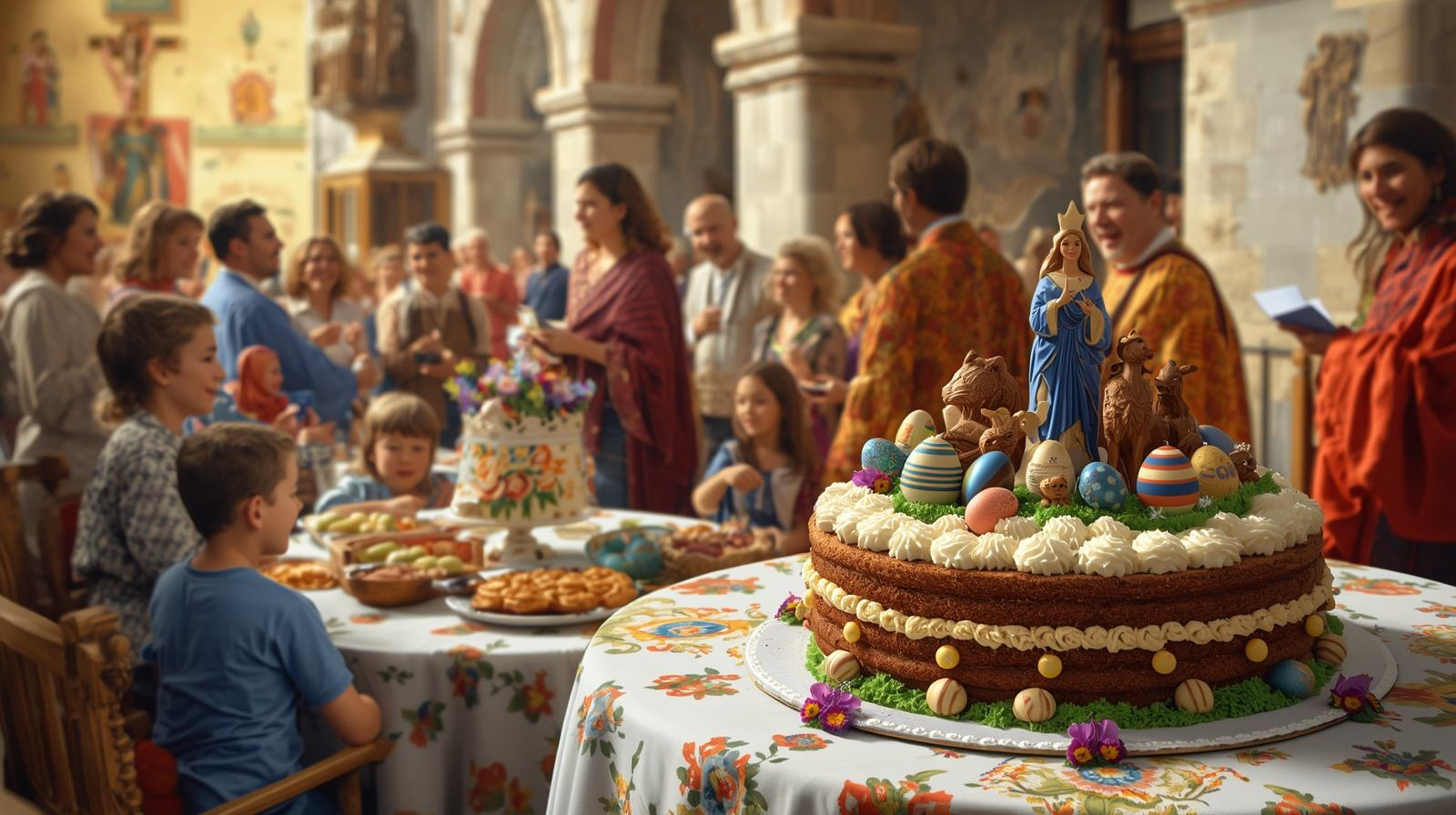
Easter Sunday in Spain brings the celebration of the resurrection with joyful Masses and family feasts, the Mona de Pascua (a traditional Easter cake given by godparents to their godchildren, decorated with chocolate eggs and figurines), and the beginning of the spring social season.
Germany and Austria
German Easter customs are among the most influential in the Western world, as many practices now considered universal, including the Easter egg hunt and the Easter Bunny (Osterhase), originated in the German-speaking lands and were brought to North America by German immigrants in the 18th and 19th centuries.
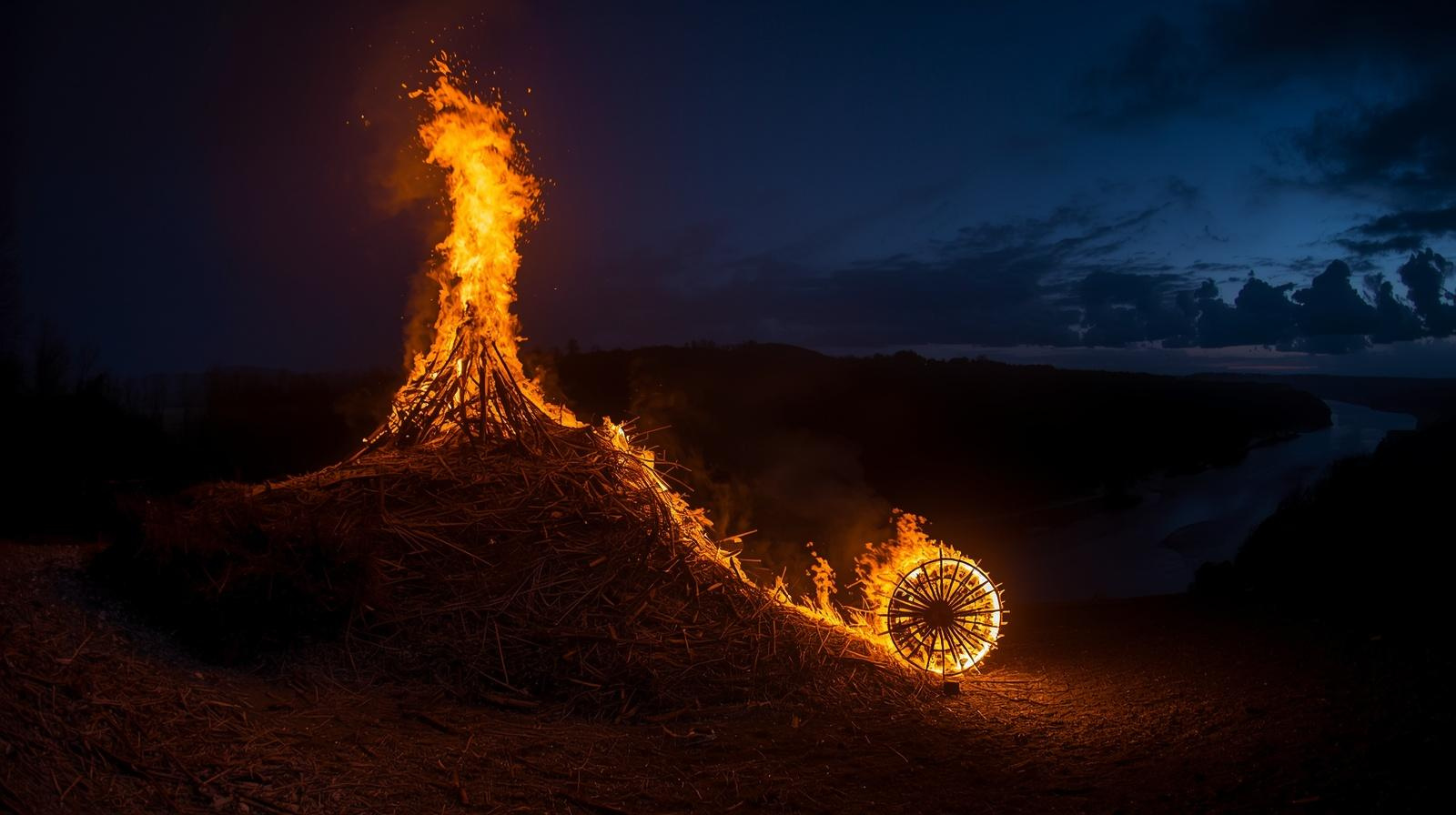
The Easter fire (Osterfeuer) is a widespread German custom: on Holy Saturday evening or Easter Sunday morning, great bonfires are lit on hillsides throughout Germany, symbolising the end of winter and the coming of the light of the resurrection. In some regions, a wheel of straw is set ablaze and rolled down a hill into a river, one of the more dramatic expressions of the universal fire symbolism of Easter.
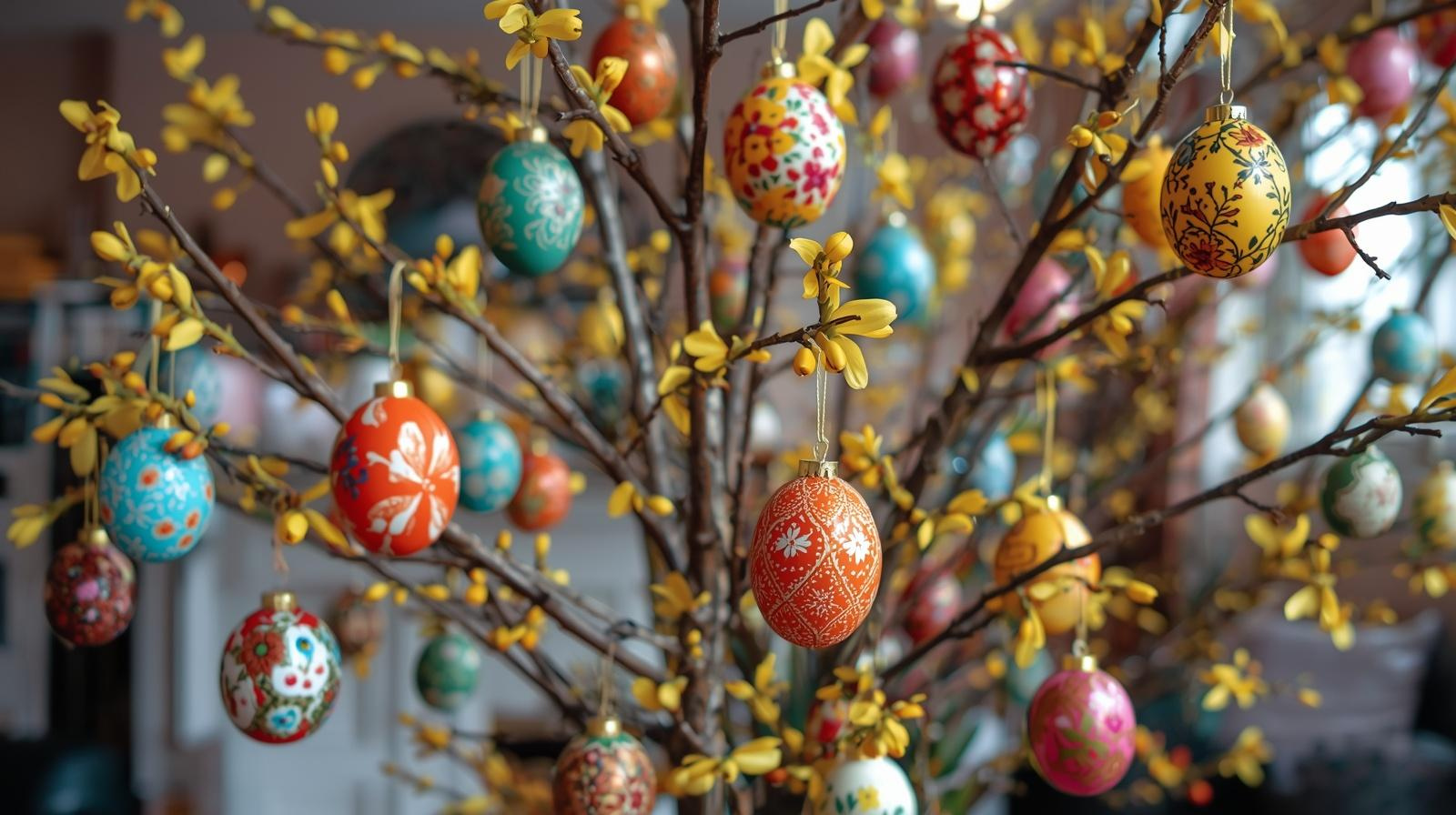
The Osterbaum (Easter tree) is a characteristically German tradition: branches, often of birch or forsythia, are decorated with painted and blown eggs and displayed indoors or in the garden. The custom has spread widely across Northern Europe and has found enthusiastic admirers internationally.
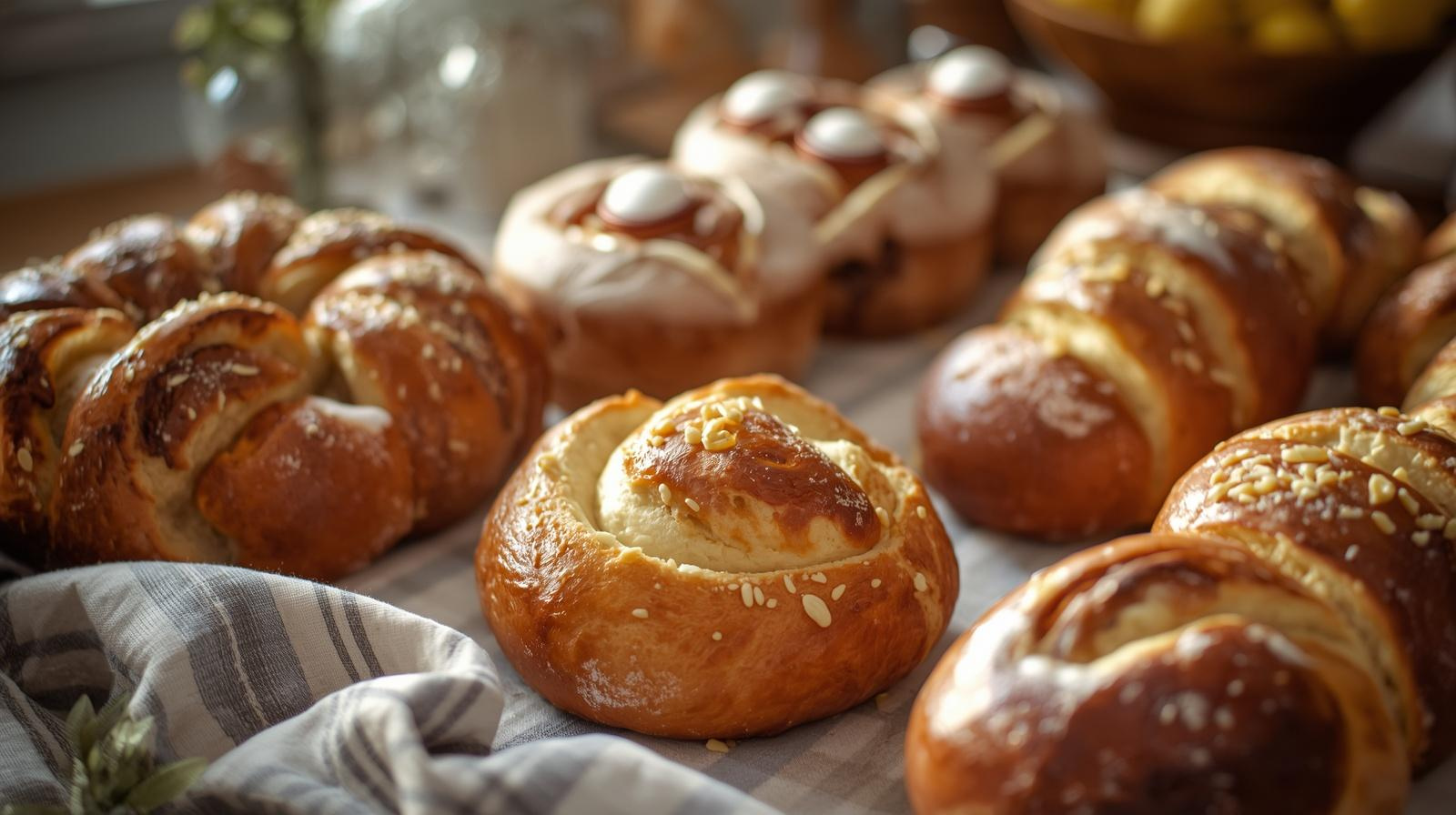
Austrian Easter is particularly associated with elaborate bread-making: the Osterpinze, a soft, sweet roll flavoured with aniseed and lemon, is traditional in the Alpine regions, and elaborate Easter breads of various forms are baked and blessed in churches throughout the country.
France
French Easter (Paques) has a distinctive cultural character shaped by the deep roots of both Catholicism and a strong secular tradition. The religious observance in France centres on the Easter Sunday Mass, celebrated in the great cathedrals and parish churches with particular solemnity, and on the Easter Vigil for those committed to liturgical practice.
A charming French tradition explains the church bells falling silent from Good Friday until Easter Sunday not by the theological reason (mourning the death of Christ) but by a folk legend: the bells have flown to Rome to be blessed by the Pope, and on Easter Sunday morning, they fly back, dropping chocolate eggs and bells into gardens for children to find. The Easter bells (cloches de Paques) are therefore a dual symbol of both religious and confectionery joy.
French Easter chocolatiers produce some of the finest Easter confections in the world, magnificent chocolate eggs, fish, hens, bells and rabbits in the windows of every patisserie and confiserie, reaching a level of artistry that is taken with great seriousness in a country where the quality of chocolate is a matter of national pride.
Poland
Polish Easter (Wielkanoc, Great Night) is one of the most richly detailed in all of Europe, combining intense Catholic religious observance with folk traditions of great beauty and antiquity.
Holy Saturday in Poland centres on the Swieconka, the blessing of the Easter basket, in which families bring baskets of Easter foods to church to be blessed by the priest. The basket traditionally contains: a lamb-shaped cake or butter lamb (baranek), hard-boiled eggs (pisanki), kielbasa sausage, ham, bread, horseradish, salt, and a small candle. The blessed foods form the centrepiece of the Easter Sunday breakfast, the most important meal of the Polish year.
Easter Monday in Poland is known as Smigus-Dyngus (Wet Monday), an ancient custom in which people drench each other with water, originally associated with spring purification rituals but now a day of boisterous fun in which no one, however formally dressed, is safe from a bucket of water or a well-aimed water pistol. The custom is observed with particular enthusiasm by children and young people, and in Warsaw, Krakow and other cities, the streets on Easter Monday can resemble a good-natured battle.
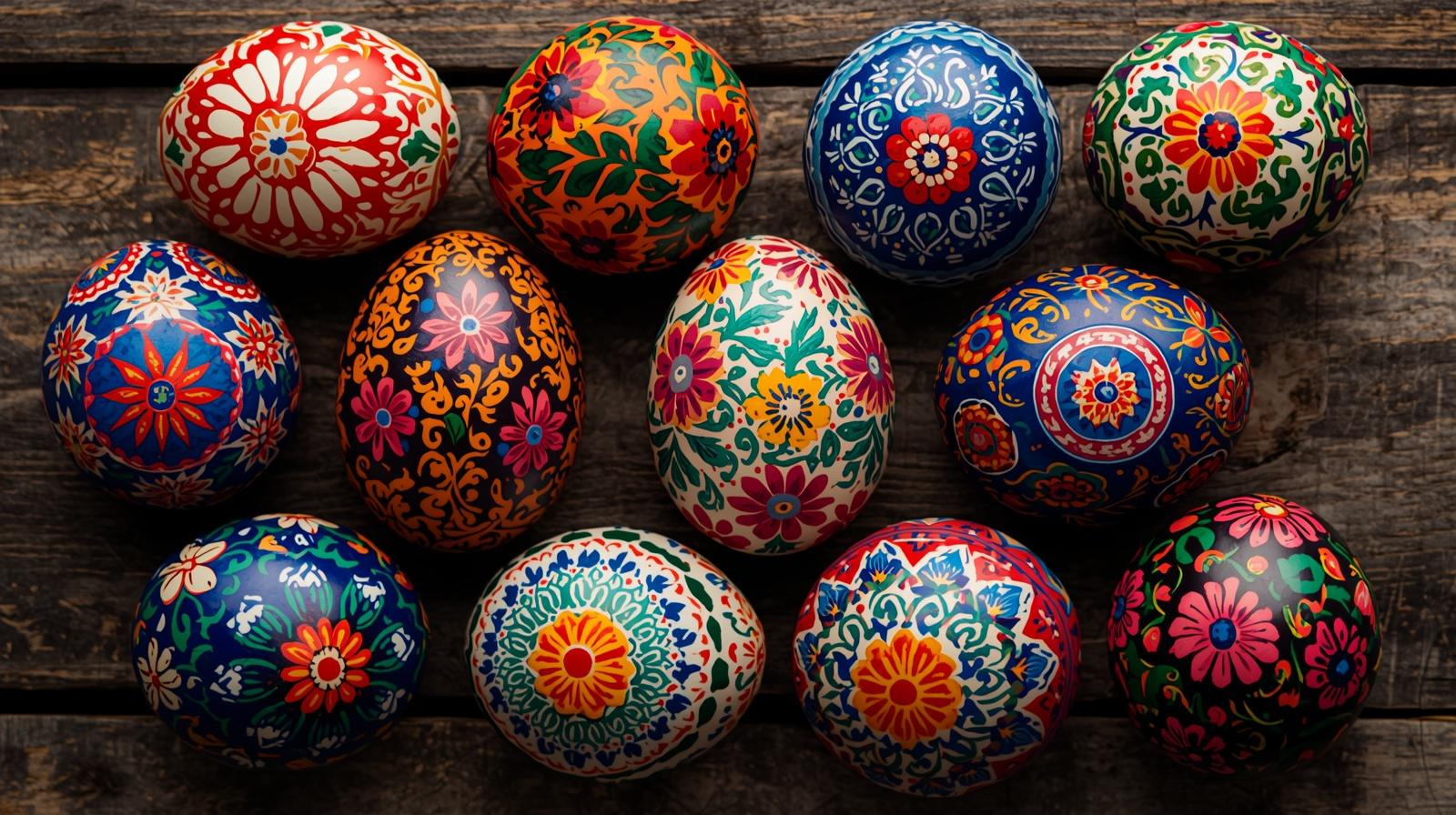
Polish pisanki (decorated Easter eggs) rival the Ukrainian pysanky in their beauty and intricacy, using a variety of techniques including wax-resist, etching, and paper applique, and they are treasured both as religious objects and as works of folk art.
The Philippines
Easter in the Philippines is observed with a fervour that reflects the country’s position as the most Catholic nation in Asia. The entire Holy Week (Mahal na Araw, Beloved Days) is a national holiday, and the religious observances draw virtually the entire population into participation.
The Salubong, celebrated in the early hours of Easter Sunday, is one of the most distinctive Filipino Easter customs. Two processions, one carrying a statue of the risen Christ, the other a statue of the Virgin Mary in black mourning, move through the streets from opposite directions and meet at the church entrance. An angel figure (often a young girl on a platform or carried aloft) descends to remove the black veil from the Virgin’s face in a dramatic gesture of joy at the resurrection, and the reunited figures are carried into the church for the Easter Mass. The Salubong is simultaneously a profound theological statement about the resurrection and a piece of theatrical community liturgy of great emotional power.
The Visita Iglesia custom, visiting seven churches during Holy Week to pray the Stations of the Cross,draws millions of Filipinos into extended acts of pilgrimage. In rural areas, Passion plays (Sinakulo) recreating the events of Holy Week are performed over multiple days, with local community members taking the roles of Jesus, Mary, the disciples and the soldiers.
Latin America
Across Latin America, Easter is observed with a blend of Catholic religious practice and rich local cultural traditions that varies considerably from country to country and even from region to region.
In Mexico, the Semana Santa processions rival those of Spain in their elaborateness and drama, particularly in cities such as Taxco, where thousands of flagellant penitents, wearing hoods and crowns of thorns, carrying heavy wooden crosses, process through the streets on Good Friday in acts of public penance that have been observed for centuries. The Easter Sunday celebration brings the contrasting joy of the resurrection with fireworks, mariachi bands, and extended family feasts.
In Brazil, Semana Santa is the occasion for the largest Passion play in the world: the Paixao de Cristo in Nova Jerusalem, a specially built “New Jerusalem” in the state of Pernambuco, performed to audiences of over 50,000 people per night. Ecuador, Peru and Colombia have similarly elaborate Holy Week traditions, including the famous carpet of flowers (alfombras) laid in the streets of Antigua in Guatemala, though technically in Central America, through which the Good Friday processions pass.
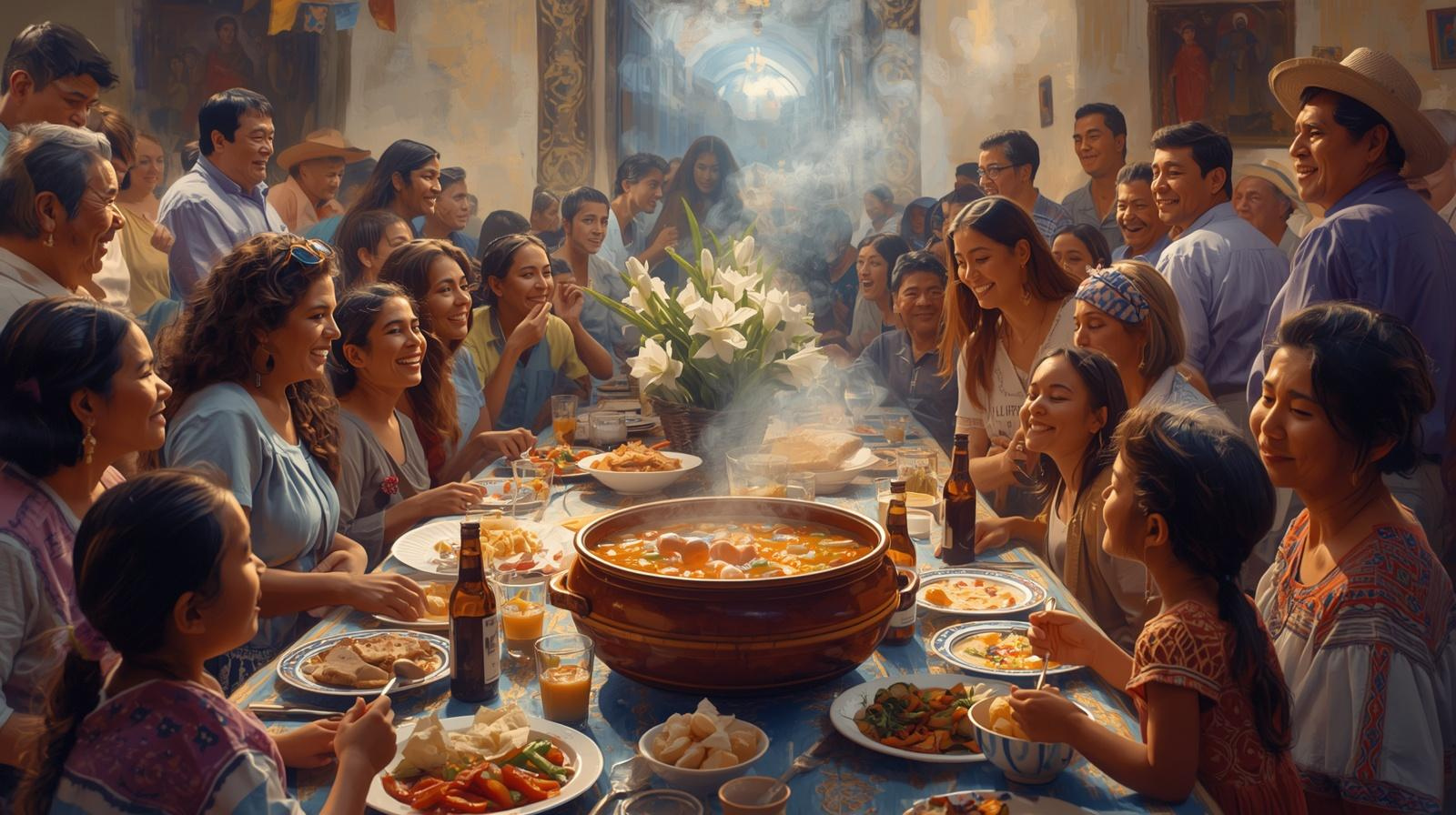
Easter Sunday across Latin America typically brings the breaking of the Lenten fast with a great family feast, often centred on the traditional Sopa de Semana Santa (Holy Week soup) specific to each country, and the joy of the resurrection is celebrated with music, dancing and the gathering of extended families.
Ethiopia and the Coptic World
Ethiopian Fasika is preceded by Tsome Filseta, the fifty-five-day fast observed by Ethiopian Orthodox Christians, one of the most demanding fasting disciplines in any Christian tradition. During this period, the faithful abstain from all animal products, eating only once a day after midday prayer.
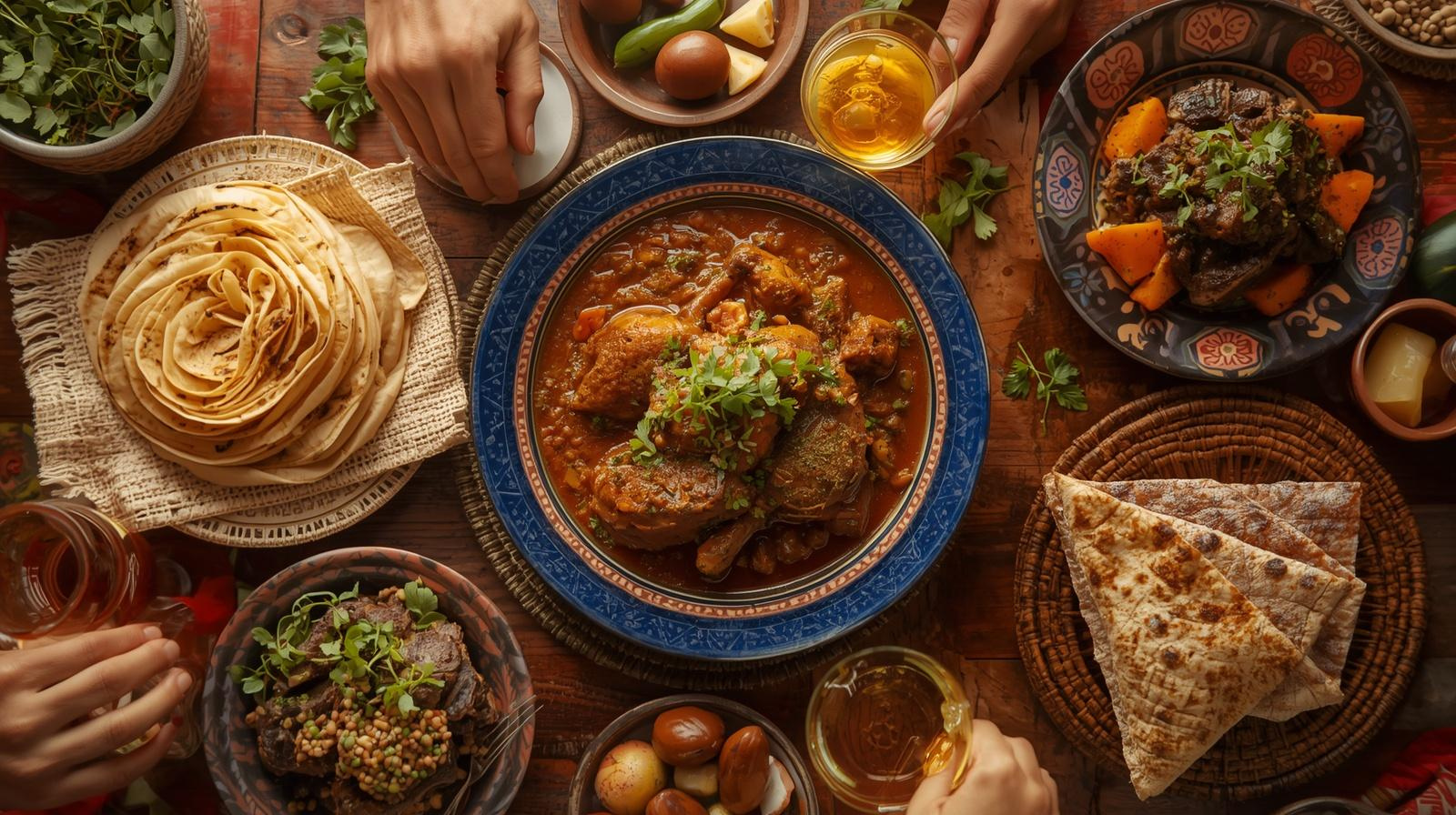
Easter Sunday breaks the fast with an explosion of colour, sound and flavour. Doro Wat, the rich, deeply spiced chicken stew that is Ethiopia’s national dish, and Injera (the spongy flatbread) form the centrepiece of the Easter feast, along with lamb dishes and tej (honey wine). Churches are packed from the early hours, the liturgy accompanied by the rhythmic beating of the kebero drum and the chanting of Ge’ez hymns in a continuous act of worship that can last many hours.
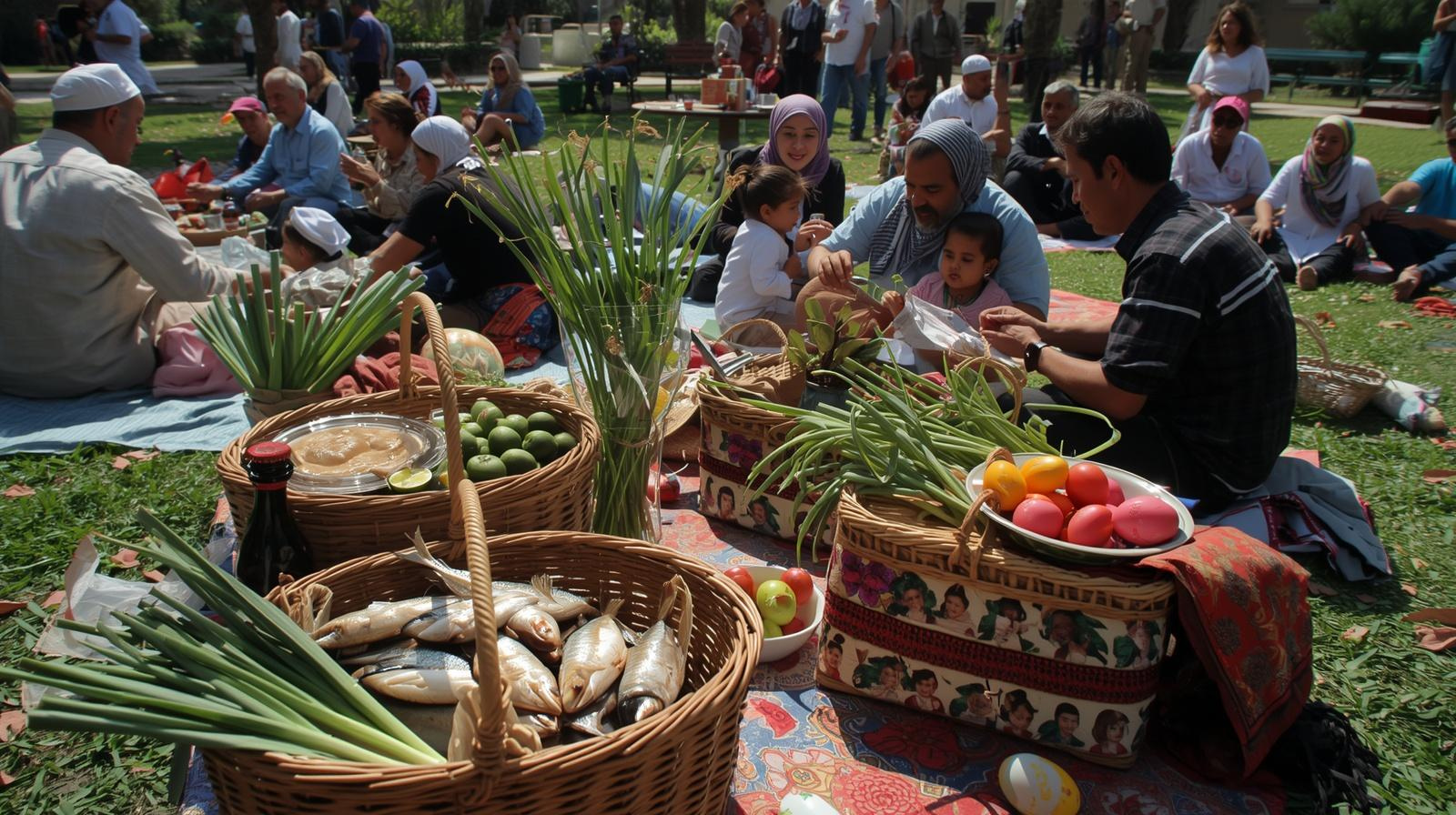
In Egypt, Coptic Easter (Sham el-Nessim — the Smelling of the Breeze) coincides with an ancient spring festival observed by Egyptians of all faiths and none: a public holiday in which families gather outdoors in parks and gardens with picnic baskets containing the traditional Sham el-Nessim foods of feseekh (salted mullet), green onions and coloured eggs. This remarkable blending of the Christian Easter with a pre-Christian spring festival that goes back to ancient Egypt is a striking example of the way Easter has absorbed and transformed older seasonal celebrations.
United States of America
Easter in the United States reflects the extraordinary diversity of American Christianity, from the elaborate Easter Vigils of Catholic and Episcopal cathedrals to the sunrise services on hillsides, stadium Easter celebrations drawing tens of thousands, and everything in between.
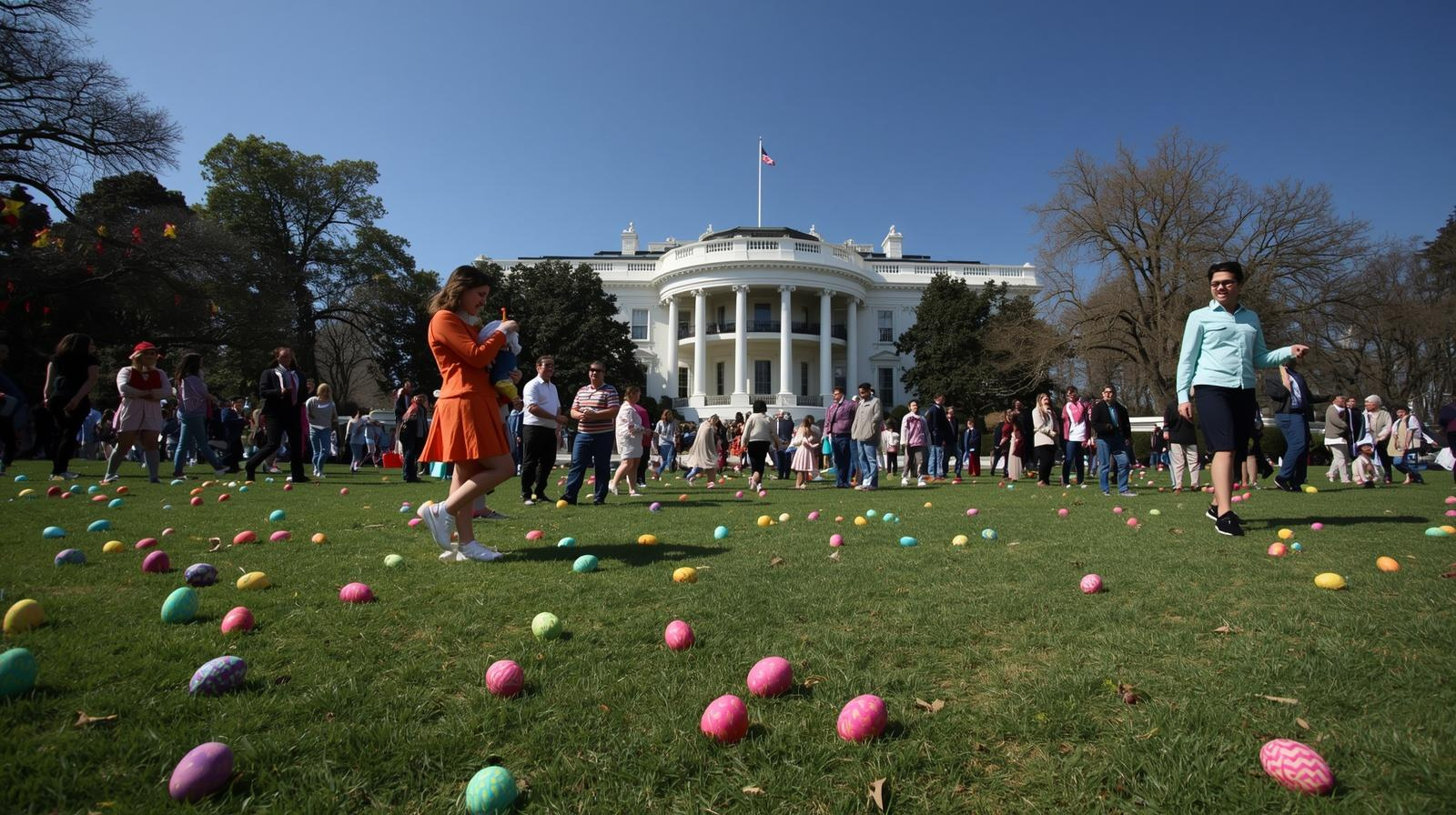
The White House Easter Egg Roll, held on the South Lawn of the White House on Easter Monday, is one of the most photographed public Easter events in the world, a tradition dating back to 1878 under President Rutherford B. Hayes. Each year, thousands of children roll coloured hard-boiled eggs across the White House lawn in a custom that has become an American institution.
American Easter is also heavily associated with the Easter Basket, filled by the Easter Bunny with chocolate eggs, candy and small gifts, and with new spring clothing, a custom with roots in the Christian tradition of new white garments worn by the newly baptised at Easter. The famous Easter Parade on Fifth Avenue in New York City, in which participants compete to wear the most elaborate Easter hats and costumes, is a colourful expression of this spring and celebration aspect of the American Easter.
Theologically, Easter remains central to American Christian life. The Southern and Midwest Bible Belt, with its vast evangelical Protestant communities, celebrates the resurrection with packed church services, dramatic sunrise celebrations, and the full force of contemporary Christian music. The liturgical traditions of Catholic, Episcopal, Lutheran and Orthodox churches celebrate with equal intensity but in very different forms. Easter in America is, in microcosm, Easter in the world.
Eggs, Rabbits and the Question of Pre-Christian Origins
No discussion of Easter is complete without addressing the eggs, the rabbits, the chocolate and the springtime symbolism that surround the Christian feast in its popular cultural expression. These elements are frequently cited as evidence of pre-Christian origins, a theory that deserves careful examination.
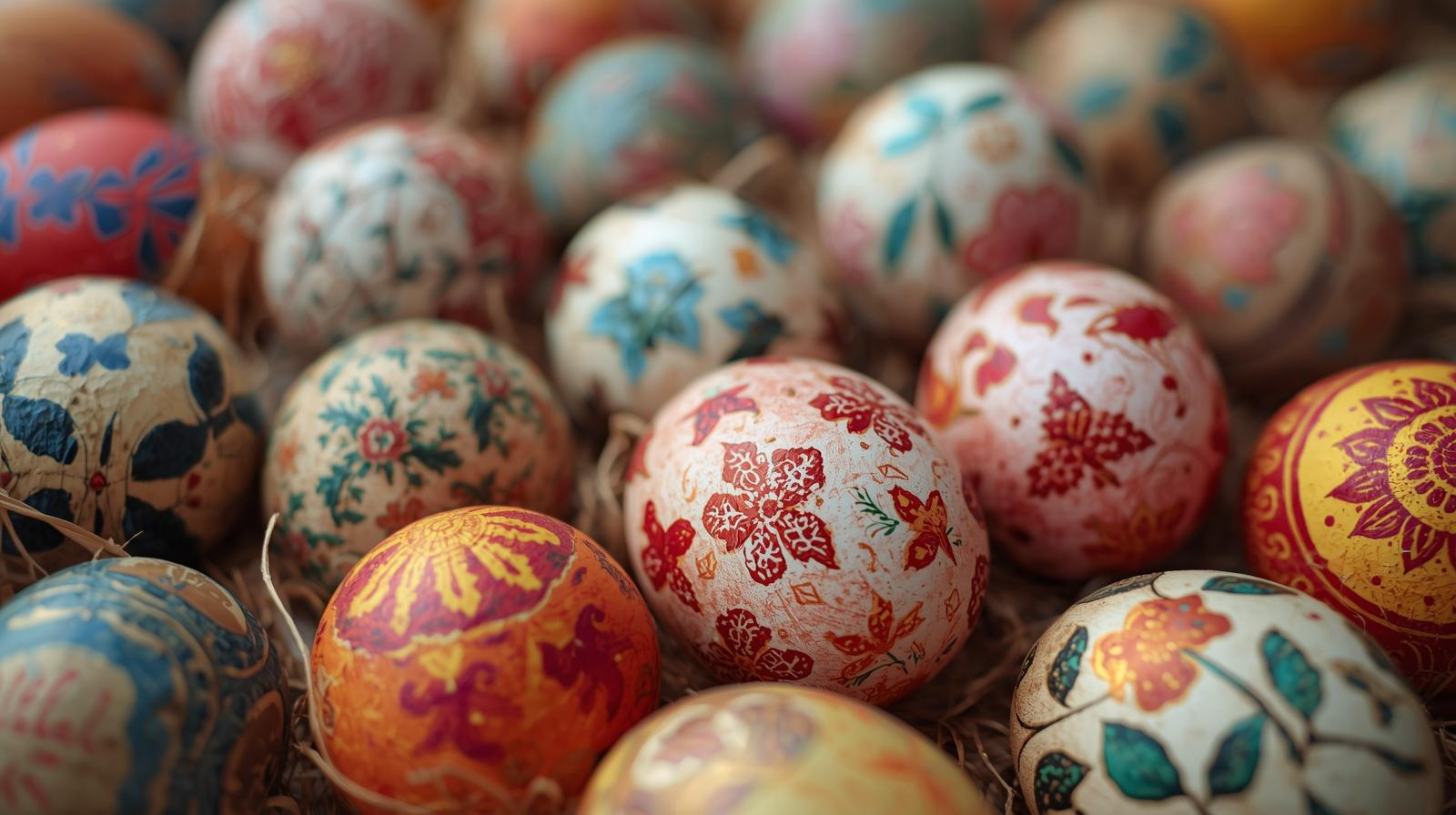
The egg has been a symbol of new life and fertility across many cultures since ancient times, and it would be surprising if early Christians had not found in it a natural symbol of the resurrection. But the specific custom of decorating and giving Easter eggs appears to be Christian in origin rather than borrowed from pagan predecessors. In the Eastern Church, eggs were painted red to symbolise the blood of Christ, and the legend of Mary Magdalene presenting a red egg to the Emperor Tiberius with the cry “Christ is Risen” is one explanation for the tradition. In the Western Church, eggs accumulated during the Lenten fast, when they were traditionally forbidden, were given away at Easter in celebration of the fast’s end.
The Easter hare or rabbit is more difficult to trace. The Venerable Bede’s claim that Easter derived from a goddess named Eostre whose symbol was a hare has never been corroborated by any other source, and many modern scholars doubt that Eostre existed as a major deity. The Easter Bunny as a gift-bringer appears to be a German innovation of the 17th century, spread to America by German immigrants. Whatever its origin, it has proved extraordinarily durable.
The springtime associations of Easter, flowers, new life, the warmth returning after winter, reflect the natural world’s resonance with the Christian message of resurrection and new creation. The Church has generally been comfortable with these associations, seeing in the natural order of death and rebirth a parable of the paschal mystery rather than a pagan competitor to it.
The Feast That Cannot Be Contained
Easter is, in the most literal sense, an overflowing feast. It overflows from the church into the street, from the liturgy into the kitchen, from the individual believer’s heart into the life of the community and the natural world coming alive with spring. No other religious observance in human history has generated such a wealth of music, art, custom, food, liturgy and cultural expression across so many different peoples and traditions.
From the haunting midnight cry of Christos Anesti in a Greek mountain village to the roar of a stadium Easter sunrise service in Texas; from the swaying paso of a Seville cofradia in the night streets to the quiet blessing of a Ukrainian pysanka; from the Ethiopian faithful beating their drums through the small hours to the English family unwrapping Easter eggs on a Sunday morning, all of these, in their very different ways, are responses to the same proclamation: the tomb is empty, death has been defeated, and everything, from this moment forward, is new.
Easter is not simply a date on the calendar. It is a lens through which Christians have understood the whole of human experience, suffering and joy, death and life, exile and homecoming, winter and spring. In the words of the ancient Easter proclamation sung at the Vigil each year: this is the night that truly frees all who believe from worldwide guilt, restores lost innocence, and brings mourners joy. No wonder the world has found so many ways to celebrate it.
“Christ is risen from the dead, trampling down death by death, and upon those in the tombs bestowing life.”
The Paschal Troparion — sung throughout the Orthodox Easter season since the 4th century
Leave a Reply