
TREADING THE BOARDS SERIES
GREAT OPERA HOUSES OF THE WORLD
No. 6
London’s Great Opera House
Few theatres anywhere have burned to the ground twice, been requisitioned as a wartime furniture depot, spent a stretch of the 1940s as a public dance hall, and still emerged as one of the world’s great homes of opera and ballet. The Royal Opera House, almost always known simply as Covent Garden after the district, and the fruit and vegetable market, that once surrounded it, has done all of this across nearly three centuries on a single site in Bow Street. It is the third theatre to stand there, the current building dating from 1858, and today it is the residence of The Royal Opera, The Royal Ballet, and the Orchestra of the Royal Opera House.
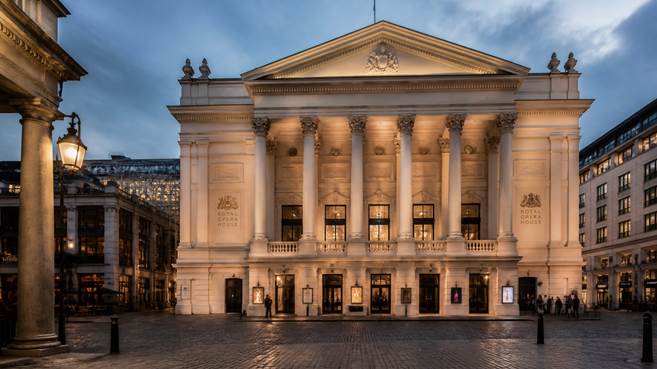
This article traces the house through its architects, its patrons and proprietors, its long and sometimes riotous relationship with opera and ballet, the composers and singers who made their names on its stage, and the two catastrophic fires that repeatedly forced it to rebuild itself, right up to the extensive reconstruction of the 1990s that gave the building the form it has today.
At a Glance
| Location | Bow Street, Covent Garden, London |
| Site occupied since | 1732 (theatre); site itself linked to a medieval convent garden |
| Present building | Opened 6th May 1858, to designs by E. M. Barry |
| Theatres on this site | Three — 1732 (Shepherd), 1809 (Smirke), 1858 (Barry) |
| Resident companies | The Royal Opera, The Royal Ballet, Orchestra of the Royal Opera House |
| Seating capacity | Approximately 2,256–2,268, across stalls, four tiers and the amphitheatre |
| Status | Grade I listed building |
| Major reconstruction | 1997–1999, architects Dixon Jones, cost around £213 million |
Architects
The story of Covent Garden’s architecture is, in effect, the story of the theatre rebuilding itself after disaster, three times over, plus one thoroughgoing modernisation. The first Theatre Royal, Covent Garden, opened on 7th December 1732, was designed by Edward Shepherd on a site that had been part of a former convent garden, redeveloped a century earlier by Inigo Jones with a piazza and church. Shepherd’s playhouse served London for sixty years before the architect Henry Holland rebuilt its auditorium in 1792, enlarging it within the existing shell to increase capacity, a rebuilding that proved short-lived when fire destroyed the theatre in 1808.
The second Theatre Royal was designed by the young Robert Smirke, later famous for the British Museum, and opened in September 1809. Contemporary accounts describe its severe Greek Revival portico as having been modelled on the Temple of Minerva in Athens, an appropriately classical face for a house that increasingly staged opera alongside drama. When this second building was in turn destroyed by fire in 1856, the management engaged E. M. Barry, son of Sir Charles Barry, architect of the Houses of Parliament, to design the third and present theatre. Barry’s building, with its grand Corinthian portico fronting Bow Street, opened in May 1858 and its facade, foyer and auditorium substantially survive today.
The twentieth century brought two further campaigns of architectural change. In the early 1970s the Victorian auditorium was remodelled under Sir Hugh Casson, updating technical facilities while retaining the historic exterior. Far more extensive was the reconstruction of 1997–1999, led by Jeremy Dixon and Ed Jones of Dixon Jones, working with the engineering firm Arup and acoustic designers Rob Harris and Jeremy Newton of Arup Acoustics. This project rebuilt almost everything behind Barry’s facade, restored and incorporated the long-derelict Floral Hall, originally part of the old Covent Garden fruit and vegetable market, into the opera house as a new public gathering space, and added the Linbury Studio Theatre along with substantially improved rehearsal, office and education facilities.
Patrons
Covent Garden’s origins lie in patronage of a very particular, and very English, kind. In 1660 Charles II granted letters patent to Sir William Davenant, permitting his company to become one of only two enterprises licensed to perform spoken drama in London, a duopoly that shaped the city’s theatrical map for well over a century. It was under the shadow of this system that the actor-manager John Rich, having made his fortune from the phenomenal success of John Gay’s The Beggar’s Opera, built the first Theatre Royal, Covent Garden, opening it in December 1732.
*
For most of the theatre’s history, the freehold of the ground itself belonged to the Dukes of Bedford, whose family estate encompassed the surrounding district; successive Dukes, from the third through to the eleventh, appear as ground landlords across the record of the theatre’s ownership even as the leases and management passed through a long line of actor-managers, syndicates and impresarios, the Kembles, Frederick and Ernest Gye, the Grand Opera Syndicate, and others. This layered structure of patron, landlord and manager was typical of the great London patent theatres, and it meant that rebuilding after fire was never simply an architectural question but also a financial one, requiring patrons and subscribers willing to underwrite each new house.
That pattern persisted into the modern era. The 1990s reconstruction depended on a similarly mixed base of support: funding from the Arts Council’s National Lottery programme combined with substantial private fundraising, the whole effort overseen by the Royal Opera House’s chairman at the time, Sir Angus Stirling. Public subsidy, philanthropic patronage and paying audiences together, much as in the eighteenth and nineteenth centuries, kept the house standing.
Opera and Ballet
It is easy to assume that a house now devoted to opera and ballet was always built for that purpose, but Covent Garden spent roughly its first hundred years primarily as a playhouse, staging drama, pantomime and variety entertainment as much as music. Ballet and opera nonetheless arrived early: 1734 saw both the theatre’s first ballet, Pygmalion, and the opening of its first season of opera, the beginning of a long association with George Frideric Handel, who gave regular seasons there from 1735 until his death in 1759.
The theatre’s identity shifted further in 1847, when the auditorium was completely remodelled and the house reopened as the Royal Italian Opera, signalling a decisive turn toward opera as the primary business of the building. It was, however, the twentieth century that fixed the house’s present character. Requisitioned for furniture storage during the First World War and used as a public dance hall through the Second, the theatre reopened as a performance venue on 20 February 1946 with a gala performance of The Sleeping Beauty, danced by the resident Sadler’s Wells Ballet with Margot Fonteyn as Aurora.
With no established opera company in residence, the conductor Karl Rankl built one from scratch that same year; the fledgling Covent Garden Opera Company and the resident ballet company shared a stage from the outset, most notably in a December 1946 production of Purcell’s The Fairy Queen. Both companies were later granted Royal Charters, the ballet company becoming The Royal Ballet in 1956, the opera company becoming The Royal Opera in 1968, formalising an arrangement that continues to define the house: one building, one orchestra, and two resident companies performing opera and ballet in alternation.
Famous Composers and Singers
Handel’s long residency set the pattern for what would follow: a stage where major composers wrote directly for the house and where the finest singers of the age chose to appear. A royal performance of Messiah in 1743 was successful enough to establish a lasting tradition of Lenten oratorio performances at Covent Garden, and Handel eventually bequeathed his own organ to John Rich, who placed it prominently on the stage, until it was lost, along with many of the composer’s manuscripts, in the fire of 1808.
The rebuilt nineteenth-century house drew some of the era’s most celebrated voices. The soprano Adelina Patti made a notable debut there in 1861, and the Australian soprano Nellie Melba followed in 1884; the tenor Enrico Caruso also appeared on the Covent Garden stage, part of a period in which the theatre established itself as one of Europe’s leading opera destinations.
The postwar company built its reputation through a succession of distinguished music directors: Karl Rankl from 1946, followed by Rafael Kubelík, whose tenure brought UK premieres including Berlioz’s Les Troyens and Janáček’s Jenůfa; Georg Solti; Colin Davis, under whom the house saw the premieres of Michael Tippett’s The Knot Garden and The Ice Break, alongside the first British staging of the three-act version of Berg’s Lulu; and Bernard Haitink, who took up the post in 1987. The repertoire broadened accordingly to include twentieth-century composers such as Benjamin Britten and Harrison Birtwistle, and the house has continued to commission new work from composers including Mark-Anthony Turnage and Thomas Adès.
Among the singers most closely associated with the modern Royal Opera are Joan Sutherland and Luciano Pavarotti, whose Covent Garden partnership became legendary, alongside Plácido Domingo, Bryn Terfel, Angela Gheorghiu, Renée Fleming, Jonas Kaufmann and Anna Netrebko, a roll call spanning from the 1960s to the present day and confirming the house’s enduring claim to be among the foremost opera stages in the world.
Two fires in under fifty years might have ended a lesser theatre; at Covent Garden, each one produced a grander building than the last.
Fires and Reconstruction
Fire was the great occupational hazard of the pre-electric theatre, lit as such buildings were by candles and, later, gas, and stocked with timber, canvas scenery and paint. Covent Garden suffered twice, on a scale that each time destroyed the building completely. The first Theatre Royal burned down on the night of 20 September 1808, a blaze that consumed not only Shepherd and Holland’s building but also Handel’s organ and a number of his manuscripts, which had been kept on the premises since his death half a century earlier.
Rebuilding began within months. The foundation stone of the second theatre was laid by the Prince of Wales on 31st December 1808, the same year the first house had burned, and Robert Smirke’s replacement opened on 18th September 1809 with a performance of Macbeth. That reopening brought its own upheaval: the actor-manager John Philip Kemble raised seat prices to help cover the roughly £150,000 cost of rebuilding and an increased ground rent from the Duke of Bedford, and audiences responded with two months of sustained disruption, beating sticks, hissing, booing and dancing in the auditorium, remembered as the Old Price Riots, which ended only when management restored the earlier prices.
Disaster struck again on 5 March 1856, when the second theatre was completely destroyed by a fire that began during a masked ball. Rebuilding was, once more, remarkably swift: work on the third and present theatre began in 1857 to E. M. Barry’s designs, and the new building opened in May 1858 with a performance of Meyerbeer’s Les Huguenots. In a deliberate act of continuity, the decorative frieze on the façade, sculpted by John Flaxman, depicting ‘ancient’ and ‘modern’ drama and inspired by the Parthenon marbles, was salvaged from the ruins of the 1809 building and reinstalled on Barry’s new facade, where it remains visible today.
Later reconstructions were driven by need rather than disaster. Wartime requisitioning during both world wars, and the increasingly inadequate technical facilities of a Victorian theatre trying to stage twentieth-century opera and ballet, prompted the remodelling of the early 1970s under Sir Hugh Casson and, far more extensively, the £213 million reconstruction of 1997–1999 under Dixon Jones. That project, the most complete rebuilding of the house since 1858, preserved Barry’s historic facade, foyer and auditorium while replacing almost everything else behind them, finally giving the Royal Opera House the backstage, rehearsal and public spaces its two resident companies had needed for decades.
From Edward Shepherd’s playhouse of 1732 to Dixon Jones’s reconstruction of the 1990s, Covent Garden’s history is one of repeated renewal: rebuilt after fire, repurposed after war, and continually reshaped to meet the demands of the opera and ballet it now houses. Few opera houses anywhere can claim quite so eventful, or quite so resilient, a history on a single site.
Leave a Reply