
Every 2nd February, Christians across Western traditions observe Candlemas, a feast day that marks the presentation of Jesus at the Temple and the purification of the Virgin Mary. Known by various names, the Presentation of the Lord, the Purification of the Blessed Virgin Mary, or simply Candlemas, this ancient celebration sits at a unique crossroads where biblical narrative meets seasonal transition, where pre-Christian customs blend with Christian theology, and where the symbolism of light pierces the darkness of winter.
The feast commemorates an event recorded in the Gospel of Luke: forty days after Jesus’s birth, Mary and Joseph brought the infant to the Temple in Jerusalem to fulfil Jewish law. According to the Law of Moses, a woman who had given birth was considered ritually impure for forty days, after which she was to present herself at the Temple with a purification offering. For the firstborn son, there was also a separate requirement of presentation and redemption.
At the Temple, the holy family encountered two prophetic figures. Simeon, described as righteous and devout, had been promised by the Holy Spirit that he would not die before seeing the Messiah. Taking the infant Jesus in his arms, Simeon proclaimed the words now known as the Nunc Dimittis: “Lord, now let your servant depart in peace, according to your word; for my eyes have seen your salvation.” He prophesied that Jesus would be “a light for revelation to the Gentiles, and for glory to your people Israel”, words that would give this feast its distinctive association with light and candles.
The elderly prophetess Anna also recognised the child’s significance, giving thanks to God and speaking about Jesus to all who were awaiting Jerusalem’s redemption. These encounters transformed what might have been routine religious observance into a moment of divine revelation, when Jesus’s identity as the long-awaited Messiah was proclaimed in the very heart of Jewish worship.
The name “Candlemas” derives from the medieval Christian practice of blessing all the candles that would be used in the church throughout the coming year on this day. These blessed candles were considered sacramentals, sacred objects that prepared believers to receive grace. The lighting and blessing of candles connected to Simeon’s prophecy about Christ as “a light to enlighten the nations,” making the feast a celebration of Jesus as the light of the world coming into the Temple, God’s dwelling place.
The candlelight processions that became central to Candlemas celebrations carry rich symbolism. Congregations would gather outside or in a designated area of the church holding unlit candles. After prayers and blessings, the candles would be lit from a central flame, and the congregation would process into the darkened church singing hymns. The movement from darkness to light, from outside to inside the sacred space, enacted the theological journey from ignorance to enlightenment, from separation to communion with God.
In medieval Europe, Candlemas marked an important point in the liturgical and agricultural calendar. It fell exactly forty days after Christmas, formally concluding the Christmas season and the period of celebration surrounding Christ’s birth. Church decorations, the greenery, nativity scenes, and festive adornments, would traditionally be removed on Candlemas, with the church returning to its ordinary appearance. This made Candlemas a threshold moment, the hinge between the joy of Christmas and the approach of Lent.
The date’s proximity to the old Celtic festival of Imbolc and other pre-Christian celebrations of mid-winter isn’t coincidental. Ancient peoples across Europe marked early February as a turning point when winter’s harshest grip began loosening, when daylight noticeably increased, and when the first signs of spring appeared. Christianity absorbed and transformed these seasonal observances, baptising them with new meaning while acknowledging the human need to mark nature’s rhythms.
This syncretism appears in folk traditions surrounding Candlemas. Weather prognostication became attached to the day, with various regions developing sayings about what Candlemas weather portended for the remaining weeks of winter. In Britain, the rhyme goes: “If Candlemas Day be fair and bright, winter will have another flight; If Candlemas Day be clouds and rain, winter is gone and will not come again.” These folk beliefs travelled to America, where they evolved into Groundhog Day, a secular descendant of Candlemas weather lore.
The blessing of throats on or near Candlemas, using two crossed candles, represents another folk-Catholic tradition. This custom honours St. Blaise, whose feast day falls on 3rd February, and who is invoked against throat ailments. The blessed Candlemas candles were considered particularly powerful for this blessing, connecting the feast’s emphasis on light and sanctification with popular piety and concern for physical wellbeing.
Different Christian traditions have emphasised different aspects of Candlemas. In Catholic and Orthodox churches, the feast highlights Mary’s purification and obedience to Jewish law, while also celebrating Christ’s presentation. Protestant churches, particularly Lutheran and Anglican, tend to emphasise the presentation of Christ and the prophetic recognition of his identity. These varying emphases reflect broader theological differences about Mary’s role and significance in Christian faith.
The candles themselves carried deep symbolic weight beyond their practical function of providing light. They represented Christ, “the true light that enlightens everyone,” according to the Gospel of John. They symbolised faith that must be kindled and kept burning. They evoked the wise virgins of Jesus’s parable who kept their lamps trimmed and ready. They recalled the pillar of fire that guided the Israelites through the wilderness. The simple candle became a multivalent symbol connecting scripture, theology, and lived experience.
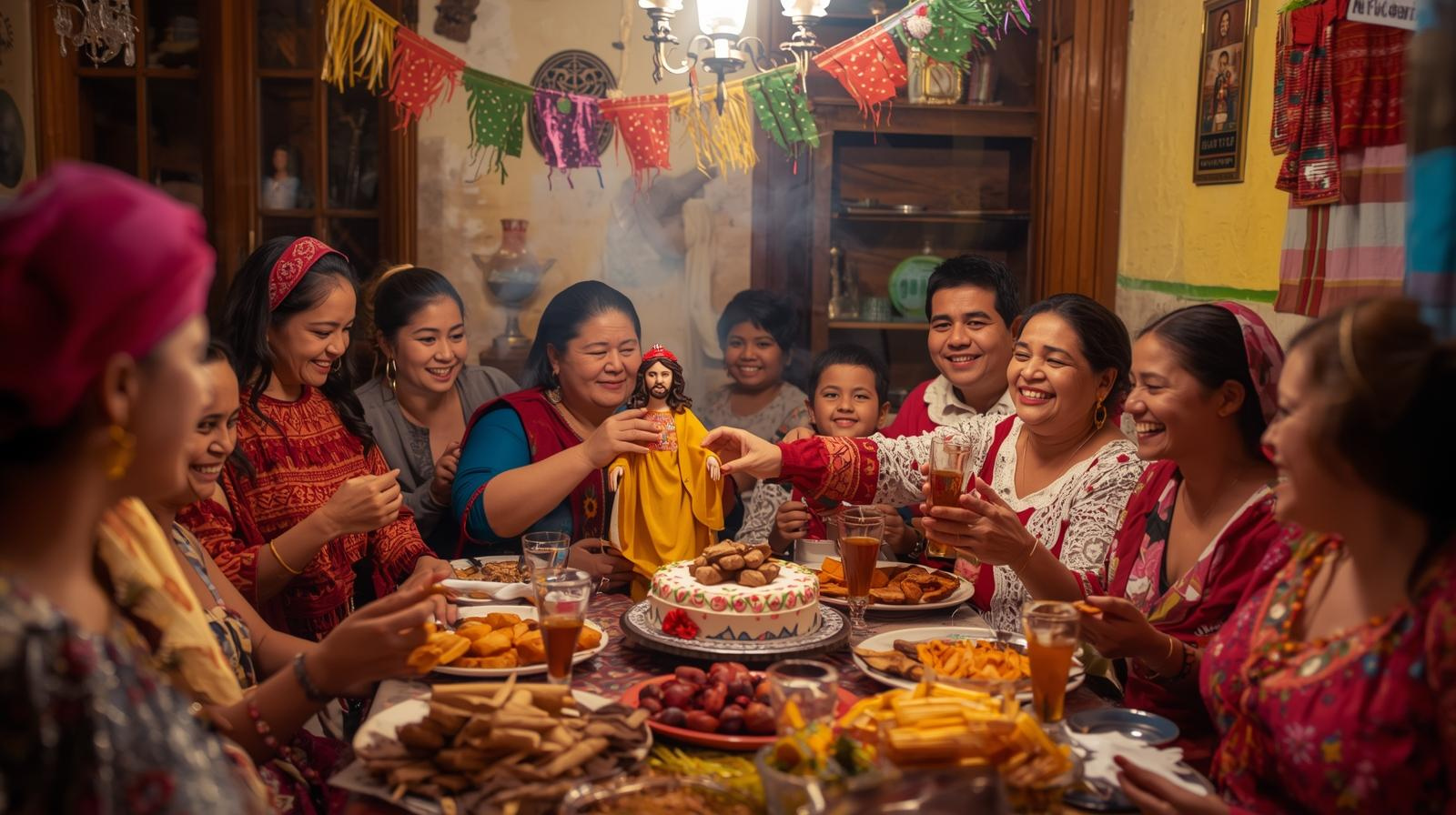
In many Catholic regions, particularly in Latin America and Mediterranean Europe, Candlemas evolved into elaborate celebrations. In Mexico, Día de la Candelaria combines religious observance with cultural traditions. Families who received the figurine of baby Jesus from the Epiphany cake (Rosca de Reyes) host parties and provide tamales. The Christ child figurine is dressed in special clothes and brought to church to be blessed, a practice that personalises the scriptural narrative and weaves it into family and community life.
The Counter-Reformation saw renewed emphasis on Candlemas celebrations as Catholic identity was reinforced through distinctive liturgical practices. Baroque churches staged increasingly elaborate candlelight ceremonies with processions, music, and visual splendour designed to inspire devotion and demonstrate Catholicism’s sacramental richness. These celebrations continued in Catholic regions even as Protestant areas simplified or eliminated Candlemas observances.
In Orthodox Christianity, the feast, known as the Meeting of the Lord, holds particular significance as one of the twelve Great Feasts. The “meeting” refers to Christ’s encounter with Simeon and Anna, understood as the meeting between the Old and New Covenants, between prophecy and fulfilment. Orthodox services include processions with candles and special hymns that meditate on Christ as the “Sun of Righteousness” entering his Temple.
The contemporary observance of Candlemas varies widely across denominations and regions. Traditional Catholic and Anglo-Catholic parishes maintain elaborate blessing and procession ceremonies. Many Protestant churches mark the day with special Scripture readings and sermon themes but without the candle rituals. Some churches have recovered or adapted ancient practices as part of liturgical renewal movements. Others barely acknowledge the day, focusing instead on the unfolding Sundays of Ordinary Time or the approach of Lent.
The theological richness of Candlemas deserves attention even where practice has diminished. The feast presents Jesus simultaneously as the fulfilment of Jewish law and the light for Gentile nations, a both/and rather than either/or identity. It shows Mary and Joseph as faithful Jews observing Torah while unwittingly presenting the one who would transform Judaism’s relationship to the world. It depicts aged prophets who waited faithfully for promises they might never have expected to see fulfilled.
Simeon’s prophecy also contains warning alongside wonder. He tells Mary that “a sword will pierce through your own soul also,” foreshadowing her suffering at the crucifixion. Even in this moment of recognition and celebration, the shadow of the cross appears. Candlemas thus balances joy and sorrow, fulfilment and cost, present celebration and future suffering, a distinctly Christian mingling of themes that refuses easy sentiment.
The placement of Candlemas in the liturgical year creates theological connections often overlooked. It stands between Epiphany (celebrating Christ’s manifestation to the world) and Lent (commemorating his journey toward crucifixion). It links Christmas (the incarnation) with Easter (the resurrection) through the motif of light. Christ enters the world at Christmas, is revealed to the nations at Epiphany, is recognised in the Temple at Candlemas, and will eventually enter Jerusalem for his passion, all movements of divine light into human darkness.
In an age of electric illumination, the symbolism of candlelight can seem quaint or merely aesthetic. Yet candles retain power to evoke something electric light cannot, fragility, warmth, community, and the victory of small light over vast darkness. A single candle in total darkness transforms everything visible; additional candles create communion as their light mingles. These realities remain metaphorically potent for faith communities navigating contemporary darkness.
Some churches have creatively adapted Candlemas for modern contexts. Congregations bless not just church candles but candles families take home, connecting worship to domestic life. Services include reflections on being “light-bearers” in a dark world, applying Simeon’s prophecy to contemporary Christian calling. Youth groups explore themes of light and dark through art, music, and discussion. These adaptations maintain the feast’s core symbolism while making it accessible to new generations.
Environmental consciousness has also influenced Candlemas observance. The connection between light and seasons resonates with ecological awareness about humanity’s relationship to natural rhythms. Some churches explicitly connect Candlemas themes to creation care, reflecting on Christ as the light by which all creation is sustained and renewed. The temporary, renewable nature of candlelight contrasts with humanity’s unsustainable consumption of fossil fuels, offering a gentle ecological witness.
The ecumenical potential of Candlemas deserves recognition. Unlike some feasts divided by theological controversy, Candlemas celebrates scripture, light, and divine revelation, themes that cross denominational boundaries. Joint ecumenical candlelight services can gather Christians from various traditions in shared worship without compromising distinctive beliefs. The visual and participatory nature of candlelight processions creates unity through common experience even amid theological diversity.
As 2nd February arrives each year, whether marked by elaborate processions or quiet acknowledgment, Candlemas offers the church a moment to pause and recognise Christ as the light who enters our darkness. In the depths of winter, when nature seems dormant and nights remain long, the feast proclaims that light has come and darkness cannot overcome it. It’s a message the world perpetually needs, in the literal darkness of winter, in the metaphorical darkness of suffering and injustice, and in the spiritual darkness of doubt and despair.
For believers walking through their own dark valleys, Candlemas proclaims that Simeon’s patient waiting was rewarded, that Anna’s faithful service was vindicated, that promises kept across generations will ultimately be fulfilled. The feast says that the light we carry, however small, however fragile, participates in the Light of the World, and that even a candle’s modest flame pushes back the darkness.
Whether celebrated with ancient ceremony or simple acknowledgment, whether understood as the end of Christmas or the prelude to Lent, whether approached through Marian devotion or Christological focus, Candlemas continues speaking to Christian communities about light, revelation, faithfulness, and hope. In a world that seems increasingly dark, that’s a message worth proclaiming every 2nd February and living every day thereafter.
Leave a Reply