
The Teatro Colón
Part III — The Great Opera Houses of the World | 17
Introduction
Across the Atlantic from the opera capitals of Europe, in a city that once styled itself the “Paris of South America”, stands one of the finest opera houses in the world. The Teatro Colón in Buenos Aires seats around 2,500 people on seven levels, boasts an auditorium famed for its acoustics, and has hosted most of the great singers, conductors, and dancers of the twentieth century. Its story is also one of ambition and delay: a building that took some twenty years to complete, passed through the hands of three architects, and carried the hopes of a young, wealthy, and rapidly changing nation.
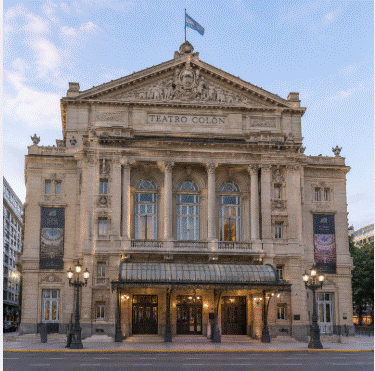
This article follows the Teatro Colón from the arrival of opera in South America to the opening of the present house in 1908, examines the Italian and European influences that shaped it, and looks at the society of Buenos Aires that filled its boxes and galleries.
Opera Arrives in South America
Opera reached Latin America with the Spanish and Portuguese colonial courts and, after independence in the early nineteenth century, with touring Italian companies. In Buenos Aires the first performances of Italian opera took place in the 1820s, and Rossini’s The Barber of Seville is generally regarded as one of the earliest works to be staged in the city. As the century advanced, travelling troupes crossed the Atlantic, and the operas of Rossini, Bellini, Donizetti, and above all Verdi became immensely popular.
The passion for opera was strengthened by migration. From the middle of the nineteenth century, and especially from the 1880s, huge numbers of Italians, together with Spaniards and other Europeans, settled in Argentina. They brought with them not only their languages and cuisines but also an appetite for the operatic repertory of their homeland. By the end of the century Buenos Aires had one of the largest opera audiences outside Europe, and Italian singers regarded the southern hemisphere season, which fell in the European summer, as a lucrative addition to their calendars.
The First Teatro Colón
The theatre’s name honours Christopher Columbus (Cristóbal Colón in Spanish). The first Teatro Colón was opened in 1857 on the Plaza de Mayo, in the heart of the city, with a performance of Verdi’s La traviata. For three decades it served as the principal opera house of Buenos Aires, hosting the leading Italian and European artists of the day. But the city was changing rapidly: its population was exploding, its fortunes were rising on the back of the grain and beef trade, and the old theatre, with its limited capacity and aging facilities, no longer seemed adequate. In 1888 it was closed and the building was sold to the Banco de la Nación, which still occupies the site.
Buenos Aires in the Belle Époque
The decision to build a new Colón reflected the confidence of the Argentine elite. In the late nineteenth century, Argentina was among the richest countries in the world per head, thanks to its vast agricultural exports to Europe, and Buenos Aires was a boomtown of broad avenues, grand cafes, and new public buildings. The landowning families who dominated politics and society looked to Paris as their model of taste and sought to turn their capital into a monument to progress and modernity. The sophisticated cosmopolitan culture of the city was to be displayed above all in the opera house.
The new theatre was planned on a grand scale, on a site near the Plaza Lavalle, a little to the north-west of the old centre. It was conceived not simply as a place of entertainment but as a national symbol, and the ambition behind it helps to explain the length and difficulty of its construction.
A Complicated Construction
The story of the building of the Teatro Colón is, in many respects, as dramatic as any opera on its stage. Work began in 1889, and the project was entrusted to the Italian architect Francesco Tamburini, who had already worked in Argentina and who drew up the first designs, in the manner of the great Italian theatres. He died in 1891, early in the project, and the work passed to his associate Vittorio Meano, another Italian, from Piedmont, who was also responsible for the Argentine National Congress building.
The project then ran into repeated trouble. The financial crisis of 1890, which shook Argentina and damaged European confidence in its economy, slowed funding. Plans were revised and enlarged. The site and the city authorities changed their minds about the details of the scheme more than once, and the work proceeded in fits and starts. Then, in 1904, Meano was murdered in Buenos Aires, in a case that shocked the city and left the project once more without a leader.
The task of completing the theatre fell to a third architect, the Belgian Jules Dormal, who had been associated with the project and who supervised the final stages. He altered parts of the interior and was responsible for much of the decorative finish. The theatre finally opened on 25 May 1908, the anniversary of the 1810 May Revolution, with a performance of Verdi’s Aida. Nearly two decades had passed since the foundation stone was laid.
Italian and European Influences
The Teatro Colón is a distinctly European building on South American soil, and its design is an eclectic blend. The basic conception, a horseshoe-shaped auditorium with tiers of boxes around a central stage, descends from the Italian opera house tradition, perfected in La Scala in Milan. Tamburini and Meano’s Italian training is evident in the Renaissance-inspired architecture and in the use of Italian materials, including marble from Carrara, while the French influence of Beaux-Arts taste, then the world standard of civic elegance, shows in the grand staircases, the lavish decoration, and the stained glass. Elements from German and Greek classical traditions can also be found.
Much of the fabric was imported from Europe or created by European craftsmen. Marble, mosaics, and decorative metalwork came from Italy and France, and the interior sparkles with gilt, mirrors, and crimson velvet. The result is not a copy of any single European house but a fusion of many, reflecting the cosmopolitan outlook of the city that built it. Visitors have often compared its sumptuous halls to those of Paris, Milan, and Vienna.
The auditorium itself is famous for its acoustics, regarded by many singers and conductors as among the finest in the world. The shape of the horseshoe, the use of wood, and the careful proportions of the room combine to produce a clear and warm sound. In 1966, the ceiling dome was painted with a vast mural by the Argentine artist Raúl Soldi, adding a distinctly local artistic voice to the European setting.
Buenos Aires Society at the Opera
From its opening night, the Colón was a social stage as much as a musical one. The opera season was the highlight of the city’s social calendar, and the wealthy families of the landowning aristocracy kept their own boxes (palcos), where they displayed their fashions, their jewels, and their standing. Evening dress was expected, and arriving at the theatre was a carefully choreographed event.
Yet the theatre was also unusually democratic in some respects, thanks to its seven levels and the large standing galleries at the top. Immigrant families, students, and ordinary music-lovers crowded into the upper tiers, from which they could hear the music, if not always see it, for a modest price. The cazuela, a gallery traditionally associated with women, and the high gallery known as the paraiso made the Colón a place where different social classes, from the oligarchy to the immigrant workers of the barrios, shared the same music. This mixture is part of the reason the theatre has retained a special place in Argentine affections.
A Stage for the World’s Great Artists
Throughout the twentieth century, the Colón was a magnet for international stars. Its Southern Hemisphere season attracted conductors such as Arturo Toscanini, singers including Enrico Caruso, and, later, Maria Callas, who sang there in the late 1940s and early 1950s. Dancers from the Ballets Russes, among them Vaslav Nijinsky, and later Anna Pavlova performed on its stage, and composers including Richard Strauss and Igor Stravinsky conducted their own works there. In later years Luciano Pavarotti, Plácido Domingo, Daniel Barenboim, and many others have appeared.
The theatre has also nurtured Argentine talent. It has its own permanent orchestra, choir, and ballet, together with a ballet school, and its workshops, which produce scenery, costumes, and shoes on site, are among the most complete of any opera house. Argentine composers, most notably Alberto Ginastera, saw their works staged there, and Argentine singers and dancers have used its stage as a springboard to international careers.
Decline, Crisis, and Restoration
The later twentieth century brought political and economic upheaval to Argentina, and the Colón, like the country, suffered from periods of unrest and underinvestment. By the early twenty-first century the building showed its age, and in 2006 it was closed for a major restoration. The work involved repairing the historic fabric, upgrading stage machinery, and improving the acoustics and safety of the building, while preserving its original character. The theatre reopened on 24th May 2010, on the eve of Argentina’s bicentennial celebrations, and today it remains the heart of the country’s musical life.
Key Dates
| Year | Event |
| 1825 | Rossini’s The Barber of Seville reaches Buenos Aires, among the earliest operas staged in the city |
| 1857 | First Teatro Colón opens on the Plaza de Mayo with La traviata |
| 1888 | First theatre closed and sold to the Banco de la Nación |
| 1889 | Work on the new theatre begins under Francesco Tamburini |
| 1891 | Tamburini dies; Vittorio Meano takes over |
| 1904 | Meano is murdered; Jules Dormal completes the project |
| 1908 | New Teatro Colón opens on 25 May with Aida |
| 1966 | Raúl Soldi paints the ceiling dome |
| 2006–10 | Closed for restoration; reopens 24 May 2010 |
Conclusion
The Teatro Colón is a building of many layers. It is an Italian opera house in the heart of South America, designed by Italian and Belgian architects, decorated with European materials, and filled by the hopes of a society that aspired to stand among the great nations of the world. Its construction was long and troubled, marked by crisis and tragedy, but the result has endured for more than a century as one of the finest places in the world in which to hear opera. For Buenos Aires, it is a monument to the ambitions of the Belle Époque and a living theatre where the city still comes together, from the grandest boxes to the highest gallery, to share the music.
Leave a Reply