
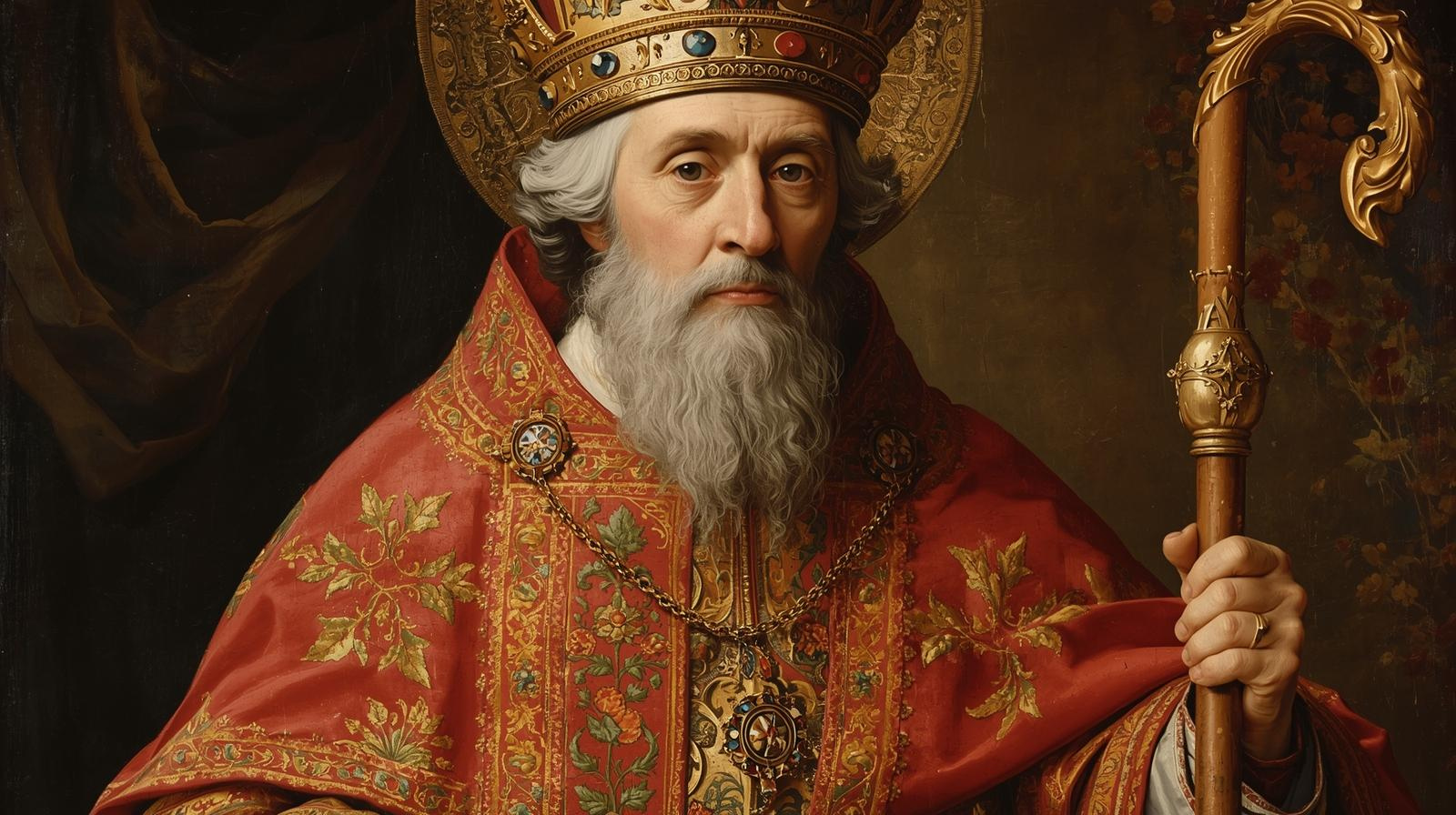
Saint Sylvester’s image in Christian art and hymnography presents him as a confessor pope and a stabilising presence at one of the most transformative moments in Church history, when Christianity moved from persecution to imperial favour. Visual and liturgical traditions together emphasise his role not primarily as a dramatic miracle-worker, but as a shepherd who guides the Church through a new relationship with power and public life.
Early images and legends in art
Medieval visual culture drew heavily on the legendary Acts of Sylvester, which embellished his historical papacy with stories of dragons, debates, and emperors. These legends, though not strictly historical, were crucial in shaping how artists and viewers understood his authority as a pope who could “tame” chaos, symbolised by dragons and imperial crises, through faith and teaching.
In the 13th-century Chapel of Saint Sylvester at Santi Quattro Coronati in Rome, a fresco cycle illustrates key scenes from the Acts: the taming of a dragon, the baptism of Constantine, and the “Donation,” in which the emperor hands Sylvester the imperial insignia. The imagery makes Sylvester visually superior, seated higher, receiving a tiara, and being led on a white horse, signalling spiritual authority over imperial power and the pope’s role as a steadying force in a reordered Christian society.
Trecento painters such as Maso di Banco in Santa Croce (Florence) depicted Sylvester confronting a dragon in the Roman Forum, then raising the dragon’s victims from the dead, reading the beast as an emblem of pagan ignorance or spiritual danger. Here Sylvester is shown neither as a warrior nor a politician, but as a calm, vested bishop whose prayer and sacramental authority restore life and order, underlining his identity as a confessor rather than a martyr.
Constantine, baptism, and papal stability
Later medieval and Renaissance art often focuses on Sylvester’s legendary relationship with Constantine, visually encoding a theology of papal primacy and continuity.
The frescoes in the St. Sylvester Chapel, and later works inspired by the Golden Legend, show Constantine bedridden with leprosy, instructed in a dream by Saints Peter and Paul to seek Sylvester, and ultimately healed in baptism. The sequence culminates in a serene baptismal scene where the emperor kneels before the pope, a composition that places Sylvester at the centre of a new Christian order, mediating grace to the very figure who symbolises worldly power.
Renaissance cycles, including those in the Vatican’s Room of Constantine, continue to represent Sylvester baptising the emperor and receiving symbolic gifts of Rome, even after the Donation of Constantine was recognised as a forgery. These works transmit a visual memory of Sylvester as the pope who anchors the Church at the threshold of Christendom, suggesting a stable line of spiritual authority that outlives empires and political myths.
Iconographic symbols of a confessor pope
Across centuries, artists used a consistent set of visual cues to identify Sylvester and to express his character as a confessor and guardian of orthodoxy.
He is frequently depicted in papal vestments with tiara or mitre, pallium, and crosier, underlining his office as bishop of Rome rather than as a martyr bearing instruments of torture. In some devotional images, a dove hovering above his head signals the Holy Spirit’s guidance, visually connecting him to Pentecost and to the enduring guidance of the Church through doctrinal conflict.
Scenes of him receiving the Lateran Palace or presiding in majestic cathedrals stress his role in consolidating worship and ecclesial structures in Rome. Instead of bloodshed, the emphasis is on institutions, sacraments, and teaching, features that suit the spiritual profile of a confessor who maintains the faith in changing external circumstances.
Hymnography and liturgical memory
Feast‑day liturgies, especially in the West, reinforce this same profile: Sylvester is remembered in texts not for martyrdom, but for steadfast leadership at a turning point in history.
In the Roman tradition, his optional memorial on 31st December places him at the close of the civil year, and liturgical prayers typically thank God for raising up a pastor who “governed” the Church during the era of peace after persecution. The orations and readings chosen for his day frequently highlight themes of shepherding, wisdom, and the transition from darkness to light, echoing the historical passage from clandestine worship to public ecclesial life.
Hymnographic traditions and commemorative reflections often call him a defender of the faith and associate his name with the emergence of Christianity in public space, basilicas, councils, and imperial cities, rather than with military conquest. This language presents Sylvester as a stabilising figure who shepherds the People of God safely into a new historical epoch, trusting more in the Spirit’s quiet work than in worldly power.
Art, liturgy, and a “stabilising” saint
Taken together, visual and liturgical portrayals of Saint Sylvester form a coherent spiritual portrait: a pastor who stands at the threshold between persecution and imperial favour and helps the Church cross that threshold without losing its soul. Art dramatises his interactions with dragons and emperors; hymnography and prayers interpret those same stories as symbols of interior conversion, ecclesial continuity, and the enduring primacy of spiritual authority over political might.
Leave a Reply