
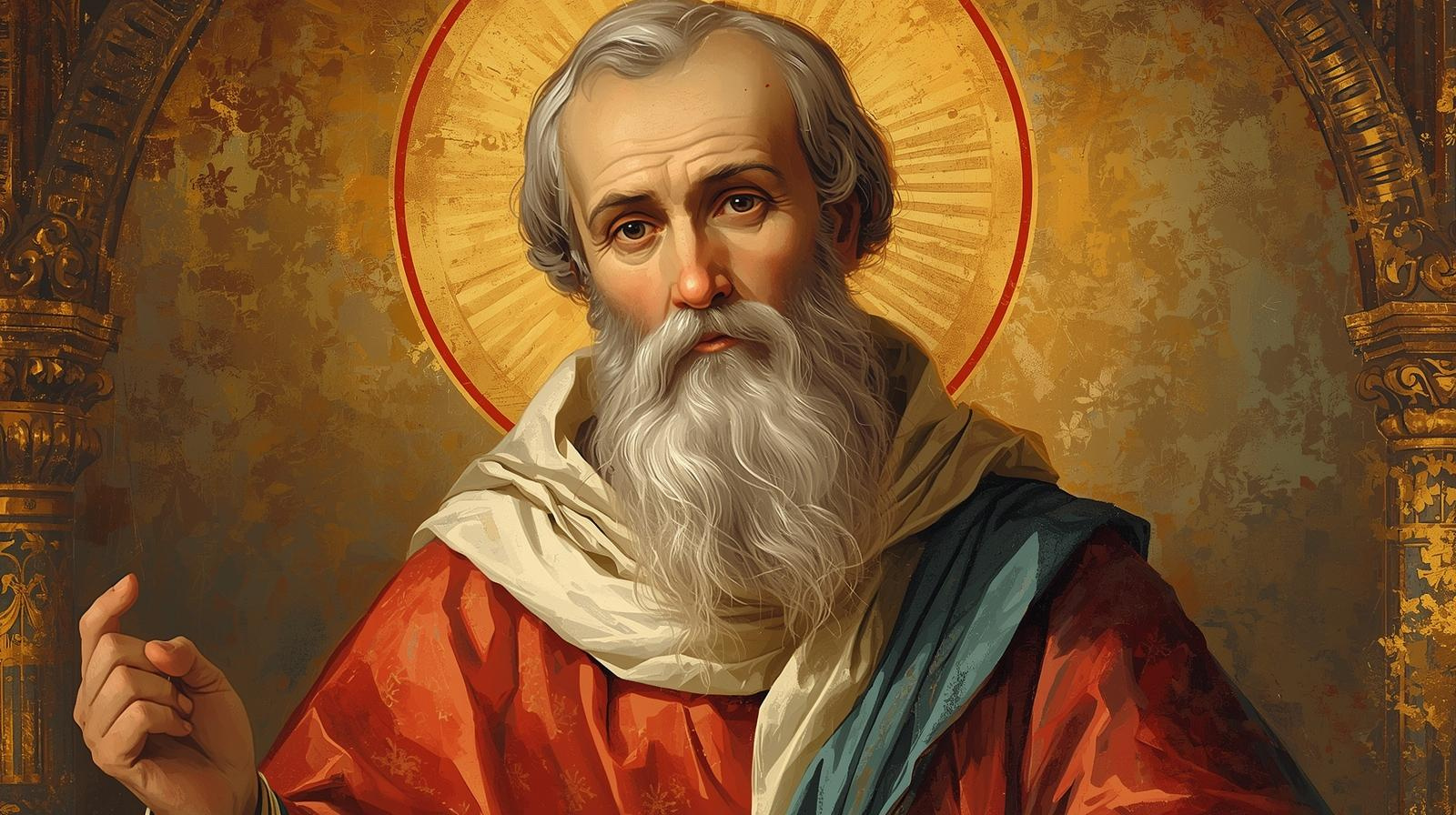
Who Was Saint Basil the Great?
Saint Basil the Great (c. 330-379 AD) was one of the most influential figures in early Christianity, revered as a theologian, bishop, monastic reformer, and champion of the poor. He is honoured as one of the three Cappadocian Fathers (along with his brother Gregory of Nyssa and his friend Gregory of Nazianzus) who shaped Christian theology during a critical period in church history.
Born into a wealthy and pious Christian family in Caesarea, Cappadocia (in modern-day Turkey), Basil combined brilliant intellectual training with deep spiritual commitment and practical compassion. As Bishop of Caesarea, he defended orthodox Christian doctrine against heresy, reformed monastic life, established ground breaking social welfare institutions, and authored liturgical prayers still used by millions of Orthodox Christians today.
Saint Basil is venerated as a saint in both Eastern Orthodox and Catholic traditions, celebrated on 1st January in churches using the Gregorian or Revised Julian calendar, and on 14th January (Gregorian) in churches using the Julian calendar. His feast day’s coincidence with New Year’s Day has made him particularly associated with new beginnings, generosity, and the blessing of the coming year.
Early Life and Education
Family Background
Basil was born around 330 AD into an extraordinarily devout Christian family in Caesarea, the capital of Cappadocia (a region in central Anatolia, now part of Turkey). His family had suffered persecution under Emperor Maximinus Daia, with both his paternal and maternal grandfathers enduring exile for their faith.
His family’s spiritual legacy was remarkable:
Basil’s grandmother, Macrina the Elder, had been instructed by Gregory Thaumaturgus (Gregory the Wonderworker) and preserved orthodox teaching during the Arian controversies
Basil’s father, Basil the Elder, was a renowned rhetorician and Christian teacher
Basil’s mother, Emmelia, came from a martyred Christian family and raised all ten of her children in deep faith
Four of Basil’s siblings became recognised saints: Gregory of Nyssa (his younger brother, also a Cappadocian Father), Macrina the Younger (his elder sister, a monastic pioneer), Naucratius (who devoted himself to ascetic life), and Peter of Sebaste (who became a bishop)
This family environment of learning, piety, and commitment to Christian truth profoundly shaped Basil’s character and vocation.
Education and Intellectual Formation
Basil received the finest education available in the 4th century:
Caesarea: He studied rhetoric and philosophy in his hometown, developing skills in classical learning and Christian theology
Constantinople: Around 347-349 AD, Basil studied in the imperial capital, exposed to sophisticated intellectual currents and debates
Athens: From approximately 349-355 AD, Basil studied at the prestigious schools of Athens, the intellectual centre of the classical world. Here, he deepened his knowledge of philosophy, rhetoric, mathematics, and natural sciences
In Athens, Basil formed a lifelong friendship with Gregory of Nazianzus, who would become his theological collaborator and biographer. They studied together under the same masters, shared a simple lifestyle despite the temptations of student life, and bonded over their Christian faith and intellectual pursuits.
Basil’s education in classical Greek philosophy, particularly Platonic and Stoic thought, would profoundly influence his theological work, allowing him to articulate Christian doctrine using philosophical concepts accessible to educated contemporaries.
Spiritual Crisis and Conversion
After completing his studies, Basil returned to Caesarea around 355 AD to teach rhetoric. Despite his Christian upbringing, he had not yet been baptised (a common practice at the time was to delay baptism until adulthood).
His sister Macrina played a crucial role in his spiritual transformation. She challenged him about his worldly ambitions and pride in his rhetorical abilities, urging him to pursue a deeper Christian commitment. Her words precipitated a spiritual crisis that led Basil to seek baptism and abandon his career as a rhetorician.
After his baptism, Basil embarked on a journey through Egypt, Palestine, Syria, and Mesopotamia, visiting monastic communities and studying various forms of ascetic life. This journey profoundly influenced his understanding of Christian spirituality and would inform his later monastic reforms.
Monastic Life and Reforms
Retreat to Pontus
Around 358 AD, Basil withdrew to Pontus (northern Anatolia) on family property along the Iris River. His mother Emmelia, and sister Macrina had already established a monastic community for women nearby. Basil established a male monastic community, living a life of prayer, manual labour, and study.
This was not a hermit’s complete isolation but a cenobitic (communal) monasticism. Basil gathered like-minded companions, including his friend Gregory of Nazianzus, who joined him for a time. They devoted themselves to prayer, Scripture study, manual work, and contemplation.
The Longer and Shorter Rules
During this period, Basil developed his monastic regulations, which would become foundational for Eastern Christian monasticism. His guidelines are preserved in two collections:
The Longer Rules (Regulae Fusius Tractatae): Fifty-five detailed responses to questions about monastic life, covering theological, practical, and disciplinary matters
The Shorter Rules (Regulae Brevius Tractatae): Three hundred thirteen brief answers to specific questions about daily monastic practice
Basil’s approach to monasticism was distinctive:
Community over Solitude: While respecting hermits, Basil emphasized communal monasticism as more aligned with Christian love and mutual support. He argued that solitary life could foster pride and provided no opportunity to practice charity and humility.
Balance and Moderation: Basil rejected extreme asceticism in favour of balanced discipline. Monks should fast, but not to the point of harming health; they should pray continually, but also work productively
Prayer and Work: Basil established a rhythm combining liturgical prayer, private devotion, manual labor, and study. The famous Benedictine motto “ora et labora” (pray and work) reflects principles Basil articulated centuries earlier
Service Orientation: Monasteries should serve the surrounding community through hospitality, care for the poor, education, and example
Obedience and Humility: Monks should live under the guidance of a spiritual father (abbot), practicing obedience as a virtue that curbs pride and self-will
Scripture-Centred: Daily life should be saturated with Scripture reading, memorization, and meditation
Basil’s monastic rules influenced not only Eastern monasticism but also, through translations and adaptations, Western monasticism, including the Rule of Saint Benedict.
Episcopal Ministry
Reluctant Bishop
In 370 AD, the bishop of Caesarea died, and Basil was chosen as his successor, becoming Bishop of Caesarea and Metropolitan of Cappadocia at about 40 years of age. This position made him one of the most important church leaders in the Eastern Roman Empire, with authority over numerous suffragan bishops.
Basil was reluctant to leave monastic life for episcopal responsibility, but he accepted out of obedience and commitment to serving the church. His episcopate, though lasting only nine years until he died in 379 AD, was extraordinarily productive and influential.
Theological Controversies: The Arian Dispute
Basil’s episcopate occurred during one of Christianity’s most contentious theological periods, the Arian controversy. This dispute centred on the nature of Christ and his relationship to God the Father.
Arianism, named after Arius of Alexandria, taught that Christ was a created being, subordinate to the Father—”there was when he was not.” This view had gained significant support, even among emperors and bishops.
Orthodox Christianity (supported by Basil and the Cappadocian Fathers) insisted that Christ was “of the same essence” (homoousios) as the Father, fully divine, not created, co-eternal with the Father.
The stakes were enormous: if Christ were merely a created being, however exalted, the entire Christian understanding of salvation would collapse. Only if God himself entered human existence could humanity be truly redeemed.
Basil devoted enormous energy to defending Nicene orthodoxy:
Theological Writing: He composed detailed treatises explaining Trinitarian theology, particularly his work “On the Holy Spirit,” which articulated the full divinity of the Holy Spirit
Ecclesiastical Diplomacy: Basil worked tirelessly to build consensus among bishops, correspond with church leaders, and counteract Arian influence
Clarifying Language: The Cappadocian Fathers developed precise theological language distinguishing “essence” (ousia) and “person” (hypostasis), clarifying how God could be one essence in three persons
Resisting Imperial Pressure: Emperor Valens supported Arianism and pressured Basil to accept Arian bishops and teachings. Basil courageously refused, even when threatened with exile, confiscation of property, and death
The Famous Confrontation with Prefect Modestus
A legendary account illustrates Basil’s courage. When the emperor’s prefect Modestus threatened Basil with punishment if he didn’t submit to Arian teachings, their exchange allegedly went:
Modestus: “Do you not fear my authority?”
Basil: “What could you do to me?”
Modestus: “Confiscation of property, exile, torture, death.”
Basil: “None of these affect me. You cannot confiscate property from one who has nothing. Exile means nothing to one for whom the whole earth is God’s. Torture cannot harm a body already so weakened that the first blow would kill it. And death would be a kindness, sending me sooner to God.”
Modestus: “No one has ever spoken to me like this!”
Basil: “Perhaps you have never encountered a bishop before.”
While the exact wording may be embellished by later hagiography, the confrontation reflects Basil’s genuine courage in defending orthodox faith against imperial pressure.
The Basiliad: Revolutionary Social Welfare
Perhaps Basil’s most remarkable achievement was establishing what became known as the “Basiliad” or “Basileias”, a vast complex outside Caesarea that functioned as an early hospital, hospice, and social welfare centre.
This revolutionary institution included:
Hospital: Medical care for the sick, including lepers who were typically ostracized from society
Hospice: Care for travellers, pilgrims, and the homeless
Poor Relief: Distribution of food and resources to those in need
Church: A basilica for worship
Residences: Housing for clergy, monks, nuns, and staff
Workshops: Places for the poor to learn trades and become self-supporting
The Basiliad was revolutionary in several ways:
Institutional Healthcare: It represented one of the first organized healthcare institutions in Christian history, a precursor to modern hospitals
Social Integration: By placing the institution outside city walls where lepers and outcasts lived, Basil challenged social stigma and brought dignity to the marginalised
Holistic Care: The Basiliad addressed not just physical needs but spiritual, social, and economic needs
Sustainable Model: By including workshops and training, it aimed to empower people for self-sufficiency rather than creating dependency
The Basiliad became so famous that it attracted visitors from across the empire. Emperor Julian even grudgingly praised the Christian charitable institutions that put pagan philanthropy to shame. The model influenced the development of hospitals and social services throughout the Christian world.
Liturgical Contributions
Basil also made lasting contributions to Christian worship. The “Divine Liturgy of Saint Basil the Great,” one of the principal Eucharistic liturgies used in Eastern Orthodox churches, is attributed to him (though likely incorporating earlier elements and later refinements).
This liturgy is celebrated on:
- The eve of Christmas and Epiphany
- Saint Basil’s Day (January 1st)
- The Sundays of Great Lent (except Palm Sunday)
- Holy Thursday and Holy Saturday
The Basilian liturgy is longer and more elaborate than the standard Liturgy of Saint John Chrysostom, with longer prayers and a more solemn character. Its beautiful prayers express deep theology about God’s nature, human sinfulness, and divine grace.
Theological Legacy
The Trinity
Basil’s most significant theological contribution was clarifying Trinitarian doctrine. Working with the other Cappadocian Fathers, he developed language that would be formalised at the Council of Constantinople in 381 CE (two years after his death).
Key concepts include:
One Essence, Three Persons: God is one in essence (ousia) but three in persons (hypostases), Father, Son, and Holy Spirit
Distinct but Inseparable: The three persons are distinct in their relations to each other but inseparable in essence and action
Full Divinity of the Spirit: Against those who accepted Christ’s divinity but questioned the Spirit’s, Basil argued that the Holy Spirit is fully divine, “worshipped and glorified together with the Father and the Son”
Analogies: Basil used analogies (like the rainbow with its distinct colours in one light) to help people grasp this mystery, while acknowledging that all analogies ultimately fail before divine transcendence.
This theological framework became foundational for Christian orthodoxy and remains the standard articulation of Trinitarian faith in both Eastern and Western Christianity.
Creation and the Natural World
Basil’s “Hexaemeron” (nine homilies on the six days of creation) demonstrates his approach to Scripture and science. He drew on contemporary natural philosophy while reading Genesis theologically, seeing creation as revealing God’s wisdom, power, and care.
Basil’s approach was:
- Respectful of scientific knowledge while recognising its limits
- Focused on the theological meaning of creation rather than merely physical mechanisms
- Attentive to creation’s beauty and order as revealing divine attributes
- Concerned with ethical implications, how should humans relate to the created world?
His work influenced both theological and scientific thought in subsequent centuries.
Theological Method
Basil exemplified a theological method combining:
Scripture: The Bible as primary authority, to be interpreted within the church’s tradition
Reason: Philosophical reasoning as a tool for understanding and articulating faith
Tradition: The received teaching of the church, particularly as expressed in the Nicene Creed
Pastoral Concern: Theology should serve the church’s life, not mere academic speculation
Spiritual Experience: Personal holiness and prayer as necessary for theological insight
This balanced approach characterised Cappadocian theology and influenced Christian thought for centuries.
Social Teaching and Care for the Poor
Basil’s concern for the poor was not merely practical charity but flowed from deep theological convictions:
Theological Foundations
Imago Dei: All humans are created in God’s image, giving each person inherent dignity regardless of social status, health, or wealth
Incarnation: God became human in Christ, identifying with humanity’s suffering and vulnerability
Judgment: Christ identifies with the poor, serving them is serving Christ; ignoring them is rejecting Christ (Matthew 25:31-46)
Stewardship: Wealth is not absolute private property but a trust from God to be used for the common good
Radical Economic Teaching
Basil’s sermons contain some of the most radical economic teaching in Christian history:
On hoarding wealth while others starve: “The bread which you do not use is the bread of the hungry; the garment hanging in your wardrobe is the garment of him who is naked; the shoes that you do not wear are the shoes of the one who is barefoot; the money that you keep locked away is the money of the poor; the acts of charity that you do not perform are so many injustices that you commit.”
On the obligation to share: “When someone steals another’s clothes, we call them a thief. Should we not give the same name to one who could clothe the naked and does not? The bread in your cupboard belongs to the hungry; the coat unused in your closet belongs to the one who needs it; the shoes rotting in your closet belong to the one who has no shoes; the money which you hoard up belongs to the poor.”
These teachings challenged the wealthy Christians of his diocese and continue to challenge comfortable Christianity in any age.
Practical Implementation
Basil didn’t merely preach, he acted:
Personal Example: He lived simply, using his family wealth and episcopal resources for the poor
Organized Relief: He established systematic distribution of food and aid during famines
Institutional Solutions: The Basiliad represented long-term structural response to poverty and illness
Advocacy: He challenged the wealthy and powerful to fulfil their obligations to the poor
Empowerment: His programs included education and job training, not just handouts
Basil’s integration of theological conviction, prophetic preaching, and practical action created a model of Christian social engagement that influenced both Eastern and Western Christianity.
Death and Immediate Impact
Saint Basil died on 1st January 379 AD, at approximately 49 years old. His health had been weakened by years of ascetic practices, intensive work, and the stress of theological and political battles. His death was mourned not only by Christians but even by Jews and pagans who had experienced his charity and integrity.
Gregory of Nazianzus delivered a famous funeral oration celebrating Basil’s life and contributions. He praised Basil’s combination of intellectual brilliance, spiritual depth, administrative skill, courage, and compassion, a rare synthesis of qualities that made him truly “great.”
Just two years after Basil’s death, the Council of Constantinople (381 AD) affirmed the Nicene Creed and the full divinity of the Holy Spirit, vindicating the theology Basil had defended so vigorously. While he didn’t live to see this triumph, his work had made it possible.
How Saint Basil’s Day is Celebrated
In the Eastern Orthodox Church
Saint Basil’s feast day on 1st January (or 14th January for Julian calendar churches) is celebrated with special significance as it coincides with New Year’s Day:
Divine Liturgy: The Divine Liturgy of Saint Basil the Great is celebrated, one of the few times during the year this longer, more elaborate liturgy is used
Hymns and Readings: Special hymns (troparia and kontakia) honour Saint Basil, and readings recount his life and teachings
Blessings: Priests may bless homes, families, and the coming year, invoking Saint Basil’s intercession
Sermons: Homilies often focus on Saint Basil’s charity and encourage generosity in the new year
The Vasilopita Tradition
The most beloved tradition associated with Saint Basil is the Vasilopita (Basil’s Bread or Basil’s Cake), particularly prominent in Greek Orthodox tradition but observed in various forms across Orthodox communities.
The Custom: A special bread or cake is baked with a coin (or sometimes a cross or other object) hidden inside. On New Year’s Day (Saint Basil’s feast), the Vasilopita is blessed and cut, with slices distributed in a specific order.
The Cutting Ceremony:
- The head of household or a priest makes the sign of the cross over the Vasilopita with a knife
- The first slice is for Christ
- The second slice is for the Theotokos (Virgin Mary)
- The third slice is for Saint. Basil
- The fourth slice is for the house itself
- Subsequent slices go to family members, often in order of age
- Additional slices may be set aside for the poor or absent family members
Finding the Coin: Whoever receives the slice with the hidden coin is believed to have special blessings for the coming year, good luck, health, prosperity, and happiness. In some traditions, the finder must donate to charity, reflecting Saint Basil’s care for the poor.
The Legend: Various legends explain the tradition’s origin. One popular account says that when barbarians threatened to sack Caesarea, the citizens collected gold and valuables to pay them off. When the threat passed and the treasure was returned, there was no way to identify whose gold was whose. Saint Basil had the gold baked into loaves of bread and distributed to the citizens, with each person miraculously receiving bread containing exactly their own contribution. While historically dubious, the story emphasises Basil’s concern for justice and divine providence.
Gift-Giving Traditions
In Greek tradition, especially, Saint Basil’s Day (New Year’s Day) is the primary time for gift-giving rather than Christmas:
Agios Vasilis: Saint Basil plays a role similar to Santa Claus in Western tradition, bringing gifts to children on New Year’s Eve. He is often depicted as a bishop in traditional vestments rather than the red-suited Santa
Children’s Excitement: Greek children eagerly await Saint Basil’s arrival on New Year’s Eve, leaving out treats for him
Family Exchanges: Families exchange gifts on New Year’s Day, making it a festive family celebration
Charitable Giving: In keeping with Saint Basil’s concern for the poor, the day often includes donations to charity or giving to those in need.
New Year Customs
Saint. Basil’s feast, coinciding with New Year’s Day, creates a blend of sacred and celebratory traditions:
New Beginnings: Saint Basil is invoked for blessings on the new year, health, prosperity, spiritual growth, and success
First Footing: In some traditions, the first person to enter a home on New Year’s Day brings luck; they may carry symbolic items or perform small rituals
Renewal: The day is seen as an opportunity for spiritual renewal and rededication to Christian living
Hope: Saint Basil’s example of courage, charity, and faith inspires hope for facing the new year’s challenges
Charitable Activities
Many Orthodox communities observe Saint Basil’s Day with special emphasis on charity, honouring his legacy:
Food Drives: Collecting and distributing food to the needy
Fundraisers: Organising collections for hospitals, orphanages, or relief organisations
Service Projects: Engaging in hands-on service to the poor and marginalized
Hospital Visits: Visiting the sick, especially in church-run hospitals or facilities
Donations: Making contributions to charitable causes, sometimes from the Vasilopita celebration
These activities make Saint Basil’s teachings concrete and ensure his feast is not merely ceremonial but lived.
In Catholic Tradition
While the Eastern Orthodox Church particularly emphasizes Saint Basil, he is also honoured in Catholic tradition:
Feast Day: Catholics celebrate Saint Basil on 2nd January (to avoid overlap with the Solemnity of Mary, Mother of God on 1st January)
Doctor of the Church: Basil is recognized as one of the Doctors of the Church, an honour given to saints whose theological writings are particularly significant
Monastic Influence: Basil’s monastic rules influenced Western monasticism, and Benedictine monks often studied his works
Social Teaching: Catholic social teaching draws on Basil’s writings about economic justice and care for the poor
Liturgical Commemoration: Special Mass readings and prayers honour Saint. Basil on his feast day.
Regional Variations
Different Orthodox cultures have their own Saint Basil traditions:
Greek: Elaborate Vasilopita tradition with coin, major gift-giving day, and family celebrations
Russian: Less emphasis on Vasilopita, but celebration of the New Year with Saint Basil’s intercession invoked (celebrated 14th January on Julian calendar)
Serbian: Some Vasilopita tradition, blended with Serbian New Year customs
Romanian: Celebration combines New Year’s customs with honouring Saint Basil
Arab Orthodox: Middle Eastern Orthodox churches honour Saint Basil with special services and may have regional cake traditions
Modern Celebrations
Contemporary Orthodox communities maintain these traditions while adapting to modern contexts:
Parish Celebrations: Churches host Vasilopita cutting ceremonies after liturgy, sometimes with multiple cakes for large congregations
Community Gatherings: Orthodox centres and organizations host New Year’s celebrations centred on Saint Basil
Online Sharing: Orthodox Christians share photos of homemade Vasilopita, family celebrations, and coin findings on social media
Educational Programs: Churches teach children about Saint Basil’s life and charitable work
Interfaith Dialogue: Sa Basil’s social teaching provides common ground for interfaith conversations about justice and poverty
Continuing Influence and Relevance
Monastic Tradition
Basilian monasticism continues to shape Orthodox spiritual life:
Basilian Order: In Catholic tradition, the Basilian Order of Saint. Josaphat follows Basil’s rule
Eastern Monasticism: Most Orthodox monasteries follow principles articulated by Saint Basil
Mount Athos: The monastic republic in Greece maintains traditions rooted in Basilian spirituality
Spiritual Direction: Basil’s writings on prayer, asceticism, and spiritual growth remain influential guides
Social Justice
Saint Basil’s teachings on wealth, poverty, and social responsibility remain provocatively relevant:
Economic Ethics: His radical statements about wealth distribution challenge contemporary economic systems
Healthcare: The Basiliad model influenced Christian healthcare institutions worldwide
Structural Solutions: His combination of immediate relief and long-term institutional responses informs modern social service approaches
Prophetic Voice: Churches and activists cite Saint Basil when advocating for economic justice
Theological Importance
Basil’s theological contributions remain foundational:
Trinitarian Theology: His articulation of one essence in three persons is standard Christian orthodoxy
Pneumatology: His defence of the Holy Spirit’s full divinity shaped the doctrine of the Spirit
Theological Method: His balanced approach to Scripture, tradition, and reason influences theological education
Liturgical Prayer: His liturgical compositions continue to shape Orthodox worship
Ecumenical Significance
Saint Basil is one of the few figures honoured across Christian divisions:
Orthodox Churches: Revere him as one of the greatest fathers and hierarchs
Catholic Church: Honour him as a Doctor of the Church
Anglican Communion: Commemorate him in liturgical calendars
Protestant Recognition: Even Protestant traditions that don’t formally venerate saints acknowledge his theological importance
This universal respect makes Saint Basil a figure who can unite Christians across denominational boundaries.
Lessons from Saint Basil’s Life
Saint Basil’s life offers enduring lessons:
Integration: He integrated intellectual excellence, spiritual depth, pastoral care, and social action, refusing to separate theology from life
Courage: He stood firm for truth against imperial pressure, demonstrating that Christian conviction sometimes requires costly resistance
Compassion: His care for the poor, sick, and marginalised wasn’t optional piety but essential Christianity
Balance: He advocated moderation over extremism, balanced discipline over harsh asceticism, communal life over isolated heroics
Practical Holiness: He didn’t just theorise about Christian life but created institutions, wrote rules, and established systems that embodied his vision
Theological Clarity: He articulated complex doctrines in accessible ways, making profound theology available to ordinary believers
Friendship: His lifelong friendships, especially with Gregory of Nazianzus, show the importance of spiritual companionship
Humility: Despite his brilliance, aristocratic background, and episcopal authority, he lived simply and served humbly.
Conclusion
Saint Basil the Great stands as one of Christianity’s most complete figures: brilliant theologian, courageous bishop, monastic reformer, social revolutionary, and spiritual guide. His life of less than 50 years produced a legacy that has shaped Christian faith and practice for over 1,600 years.
In defending Trinitarian orthodoxy, Basil helped preserve the heart of Christian faith—that in Jesus Christ, God truly entered human history for human salvation. In establishing the Basiliad, he demonstrated that Christian love requires not just good intentions but practical institutions that address human suffering. In reforming monasticism, he created a balanced spiritual path that has nurtured countless seekers. In challenging the wealthy about their obligations to the poor, he articulated a vision of economic justice that remains uncomfortably relevant.
The traditions surrounding his feast day, the Vasilopita with its hidden coin, the gifts to children, the emphasis on charity, and the blessings for the new year keep his memory alive not as a distant historical figure but as a beloved saint whose intercession is sought and whose example is celebrated.
As Orthodox Christians cut the Vasilopita each January, searching for the lucky coin, they participate in a tradition that connects them to centuries of believers and to a saint who taught that true luck, true blessing, comes not from chance but from God’s grace, grace that calls us to love God with all our heart, mind, and strength, and to love our neighbours, especially the poor and suffering, as ourselves.
Saint Basil’s life poses challenging questions to every generation: How do we integrate faith and action? What does it mean to care for the poor in our economic context? How do we stand for truth in the face of pressure to compromise? What does an authentic Christian community look like? How do we balance contemplation and service, prayer and work, spiritual discipline and compassionate engagement?
These questions ensure that Saint Basil the Great remains not a relic of the past but a living voice calling Christians to a faith that is intellectually robust, spiritually deep, courageously prophetic, and practically compassionate, a faith worthy of the One whose birth we celebrate at Christmas and whose coming year we entrust to Saint Basil’s prayers each 1st January.
Leave a Reply