
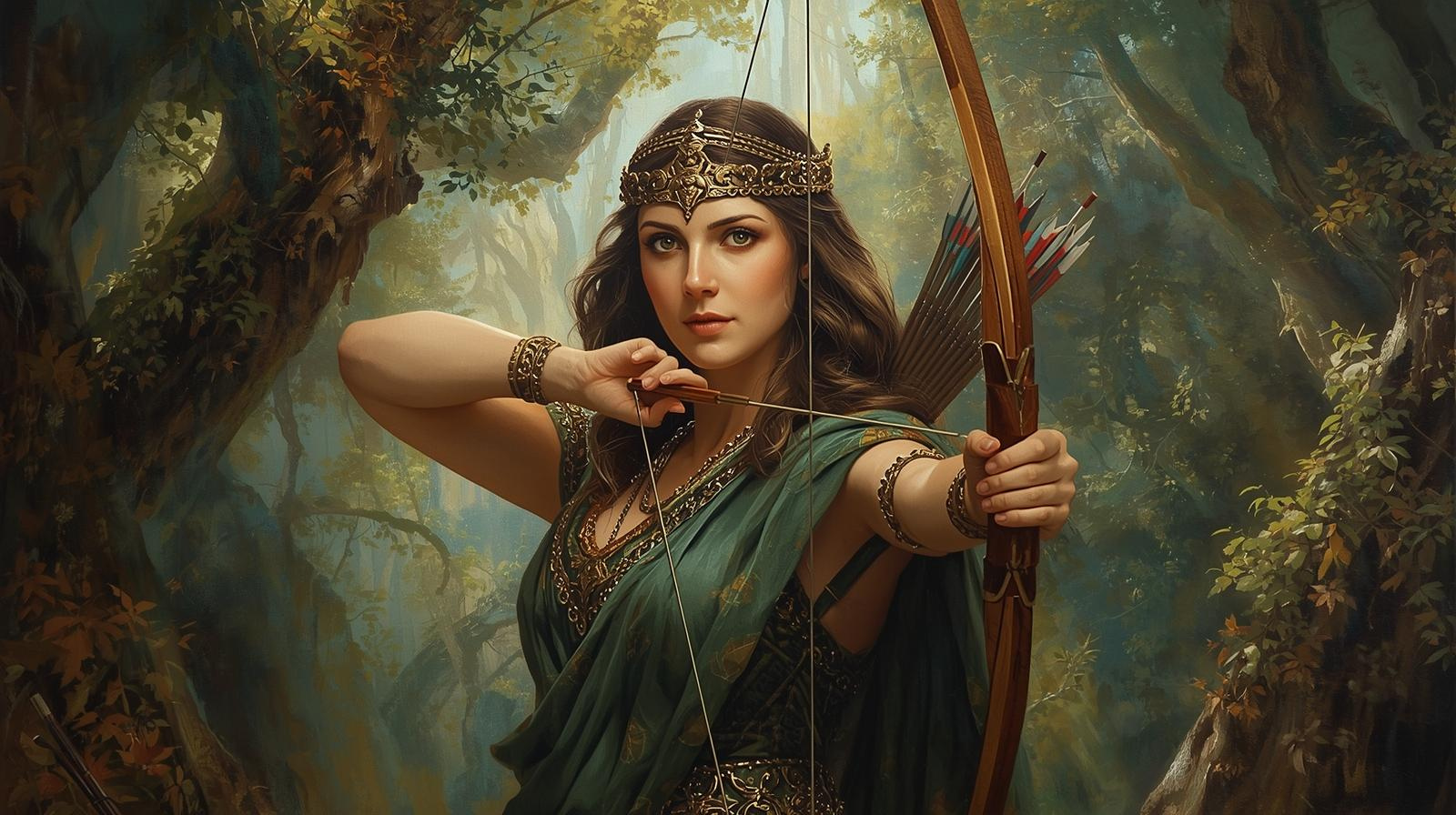
Artemis, the ancient Greek goddess of the hunt, wilderness, and childbirth, stands as one of the most widely venerated deities of the classical world. Her worship spanned centuries and continents, with cult sites scattered across the Mediterranean that reveal the complexity and evolution of her divine identity.
The Goddess of Many Faces
In Greek mythology, Artemis was the daughter of Zeus and Leto, and the twin sister of Apollo. She embodied a fascinating paradox: a virgin goddess who presided over childbirth, a protector of young women who could strike them down with arrows, and a guardian of wild animals who was also the patron of hunters. Ancient Greeks envisioned her roaming forests with her band of nymphs, bow in hand, fiercely independent and often merciless to those who offended her.
Yet Artemis was not merely a Greek invention. Her origins likely trace back to pre-Greek Anatolia, where she absorbed characteristics from earlier mother goddesses and nature deities. This syncretic quality made her particularly adaptable, allowing her worship to flourish across diverse cultures and regions.
Ephesus: The Crown Jewel of Artemis Worship
No site exemplifies Artemis’s religious significance more than Ephesus, located on the western coast of modern-day Turkey. The Temple of Artemis at Ephesus, known in antiquity as the Artemision, was celebrated as one of the Seven Wonders of the Ancient World. This massive marble structure, rebuilt several times between the 8th century BCE and the 3rd century AD, stood as a testament to the goddess’s enduring appeal.
The Ephesian Artemis differed markedly from her Greek mainland counterpart. While Greek art typically depicted Artemis as a lithe huntress, the Ephesian version appeared as a standing figure adorned with what scholars have variously interpreted as multiple breasts, bull testicles, or egg-shaped decorations, symbols of fertility and abundance. This distinctive iconography reflected the influence of earlier Anatolian mother goddesses, particularly Cybele.
The temple functioned as far more than a place of worship. It served as a major economic centre, housing a treasury that operated as an ancient bank and asylum for refugees. The cult employed hundreds of priests, priestesses, and attendants, and the annual festival of Artemis drew pilgrims from across the Mediterranean world. Silversmiths crafted miniature shrines and statues of the goddess, creating a thriving industry around her worship, a practice famously mentioned in the New Testament’s Book of Acts, where craftsmen rioted against early Christians who threatened their lucrative trade.
Other Significant Sanctuaries
While Ephesus claimed the most magnificent temple, Artemis commanded devotion at numerous other locations throughout the ancient world.
Brauron in Attica housed one of the most important Greek sanctuaries to Artemis. Here, young Athenian girls between the ages of five and ten served the goddess as “little bears” (arktoi) in a coming-of-age ritual called the arkteia. These initiates wore saffron-coloured robes and participated in dances and races, preparing for their transition from childhood to marriage. The site has yielded hundreds of votive offerings, including small statues of children and carved reliefs depicting ritual activities.
Delos, the sacred island birthplace of Artemis and Apollo, maintained twin temples to the divine siblings. According to myth, their mother, Leto gave birth to them beneath a palm tree on Delos after wandering the earth seeking refuge from Hera’s jealous wrath. The island became one of the most important pan-Hellenic religious centres, and its sanctuary to Artemis attracted pilgrims who sought the goddess’s favour.
In Sparta, Artemis Orthia received worship in a distinctive and brutal form. Young Spartan boys underwent ritual whippings at her altar as a test of endurance, a practice that evolved from earlier, possibly sacrificial rites. The Spartans particularly venerated Artemis as a goddess of military training and youthful discipline, aligning with their warrior culture.
The sanctuary at Aulis in Boeotia held dark significance in Greek mythology. Here, Agamemnon famously sacrificed his daughter Iphigenia to appease Artemis and obtain favourable winds for the Greek fleet sailing to Troy. Though this myth represented an extreme example of the goddess’s demand for blood sacrifice, it illustrated her power over sailors and her capacity for both mercy and vengeance.
Arcadia, the mountainous heartland of the Peloponnese, claimed to be Artemis’s spiritual home. Multiple sanctuaries dotted this rugged landscape, where the goddess was worshipped in her most primal aspect as mistress of wild places. The Arcadians believed their land had been Artemis’s favoured hunting ground since time immemorial.
The Evolution and Decline of the Cult
As the Roman Empire absorbed Greek culture, Artemis merged with the Roman goddess Diana, though her distinct Ephesian form maintained its unique identity well into the Christian era. The rise of Christianity posed the ultimate challenge to Artemis worship. In 268 AD, Goths destroyed the Temple of Artemis at Ephesus during their raids. Though later rebuilt, the temple never regained its former glory.
By the late 4th century AD, as Christianity became the Roman state religion, pagan temples faced systematic closure and destruction. In 401 AD, a Christian mob destroyed what remained of the Ephesian temple. A church dedicated to the Virgin Mary was eventually constructed near the site—an ironic continuity, as both figures embodied aspects of divine femininity and protection, though in vastly different theological contexts.
Legacy
Today, only scattered ruins and a single reconstructed column mark the site of the once-magnificent Temple of Artemis at Ephesus. Yet the goddess’s cultural impact endures. Artemis represents an archetype of female independence and power that continues to resonate in modern interpretations. Her image as a protector of the vulnerable, mistress of wild places, and symbol of female autonomy finds echoes in contemporary environmental and feminist movements.
The archaeological remains at Ephesus, Brauron, and other sites continue to yield insights into ancient religious practices, economic systems, and the role of women in classical societies. Through these fragments of her once-mighty sanctuaries, Artemis still speaks to us across millennia, a reminder of humanity’s enduring need to find divinity in nature and to seek protection from forces beyond our control.
Leave a Reply