
On 19th December 1843, a small crimson-and-gold bound book appeared in London bookshops. Within five days, all 6,000 copies had sold out. By the end of 1844, thirteen editions had been released. The book was Charles Dickens’s “A Christmas Carol: In Prose. Being a Ghost Story of Christmas,” and it would not only rescue its author from financial ruin, but it also fundamentally reshape how the English-speaking world celebrates Christmas.
Nearly two centuries later, “A Christmas Carol” remains one of the most adapted, performed, and beloved stories in English literature, never once going out of print. But this tale of ghosts and redemption was far more than a simple Christmas story. It was a passionate social crusade wrapped in supernatural fiction, a political manifesto disguised as entertainment, and a revolutionary act that helped save Christmas itself.
*equivalent to about $113,000 today) from a Christmas book if he could produce one in time for the holiday season.
But financial necessity alone doesn’t explain the white-hot passion with which Dickens threw himself into writing “A Christmas Carol.” Something else had ignited in him, a burning rage at social injustice that transformed what might have been a simple money-making venture into something far more profound.
A Journey North That Changed Everything
In October 1843, Dickens travelled to Manchester to speak at the Manchester Athenaeum, an organisation dedicated to providing education to working-class people. What he witnessed there shook him to his core. Manchester stood at the brutal heart of Britain’s Industrial Revolution, a city of smoking factories, overcrowded slums, and desperate poverty existing side by side with unprecedented wealth.
During his visit, Dickens toured one of the city’s “ragged schools”, charity-run institutions attempting to provide basic education to destitute children. He was horrified by what he saw: overcrowded rooms, pestilent conditions, children who had never known a day without hunger. He later wrote to a friend about the “taint and dirt and pestilence” he encountered, describing the conditions as “sickening.”
Britain’s child labour crisis had recently been documented in government reports that Dickens had read with mounting horror. Eight-year-old children dragged coal carts through subterranean passages for eleven hours a day. Young boys and girls worked in factories, their small fingers perfect for operating dangerous machinery. An estimated 100,000 children in London alone had never attended any school whatsoever.
These weren’t exceptional cases; this was ordinary life for the poor in 1840s Britain, a period that would come to be known as “the Hungry Forties” due to economic depression, mass unemployment, and repeated harvest failures that drove bread prices beyond the reach of working families.
Dickens himself had lived this reality as a child. When his father was imprisoned for debt, eleven-year-old Charles had been forced to leave school and work in a shoe-blacking factory, gluing labels onto bottles hour after hour, day after day. The shame and trauma of that experience never left him. The children he saw in Manchester were the children he once was, and could have remained.
Initially, Dickens planned to write a political pamphlet titled “An Appeal to the People of England on Behalf of the Poor Man’s Child” to be published in the Edinburgh Review. But within a week, he changed his mind. A dry pamphlet read by politicians and intellectuals would never reach the hearts of ordinary people, the middle-class families whose attitudes needed to change. He needed to tell a story, something that would make people feel the urgency of the crisis, not just understand it intellectually.
He called it his “sledgehammer blow” against social indifference.
Six Weeks of Feverish Creation
What followed was an act of creative combustion. Dickens completed “A Christmas Carol” in just six weeks, writing from early October to early December 1843. The story consumed him completely. He built much of it in his head during long night time walks around London, walks of fifteen to twenty miles through the gas-lit streets, working out scenes and dialogue as he paced.
His sister-in-law later recalled watching him write: “He wept, and laughed, and wept again, and excited himself most extraordinarily, in composition.” Dickens was experiencing the story as intensely as he hoped his readers would. When he finished the final pages in early December, he knew he had created something special, but he couldn’t have imagined it would still be read and performed nearly two centuries later.
The book Dickens produced was deliberately designed for the Christmas market. He insisted on expensive production values, embossed red leather binding, gold gilt edges, and hand-coloured illustrations by John Leech. He wanted it to look like a precious gift, something worthy of the holiday season. Ironically, these expensive touches meant that despite the book’s phenomenal sales, Dickens made far less money than he’d hoped; the lavish materials ate into his profits.
The Story That Captivated a Nation
“A Christmas Carol” tells the story of Ebenezer Scrooge, an elderly miser whose very name has become synonymous with heartlessness and greed. On Christmas Eve, Scrooge is visited by the ghost of his former business partner, Jacob Marley, who drags the chains he forged in life through his own selfish actions. Marley warns Scrooge that he too will suffer this fate unless he heeds the message of the three spirits.
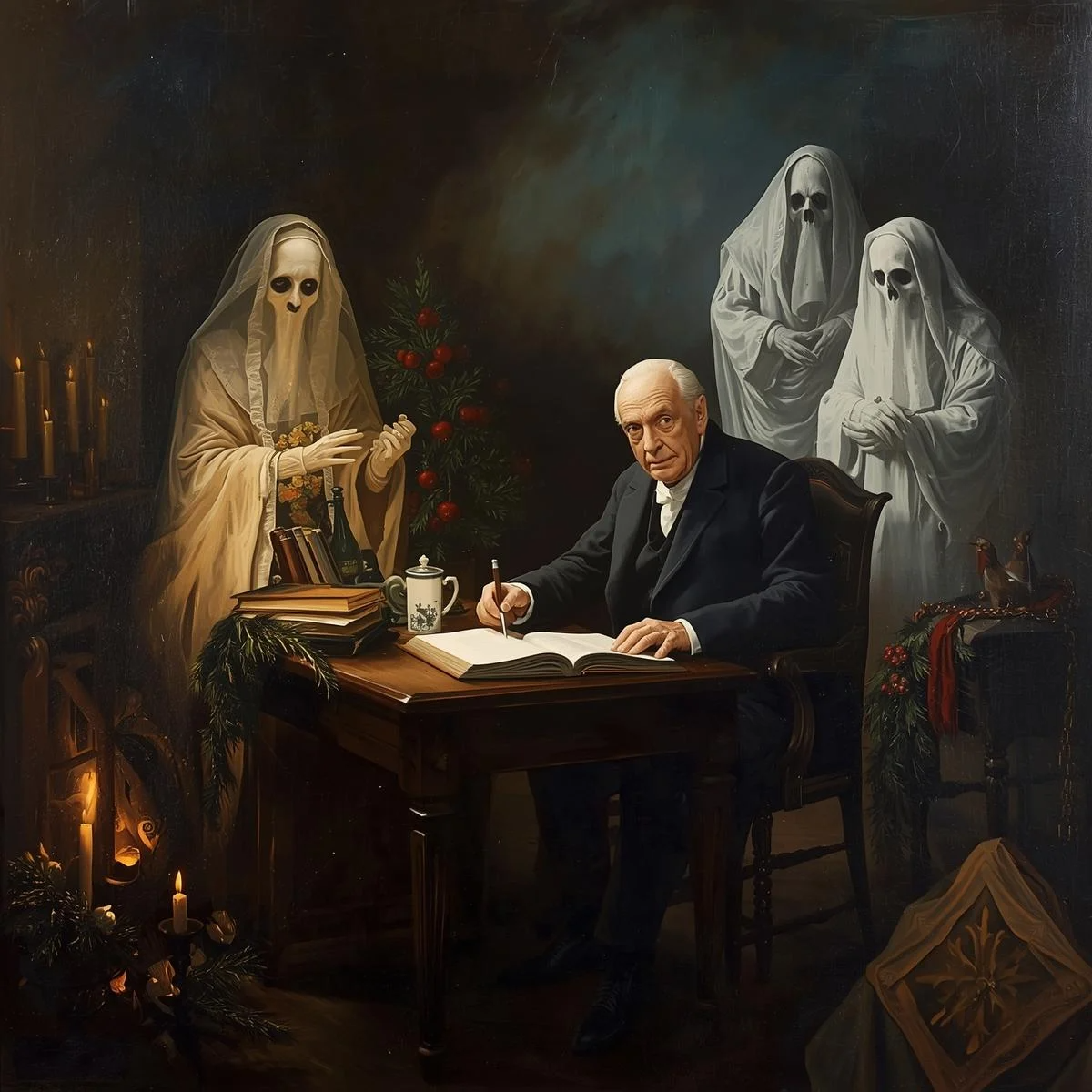
The Ghosts of Christmas Past, Present, and Yet to Come take Scrooge on a journey through his own life, showing him the lonely boy he once was, the man he became through fear and pain, the joy he’s missed, and the bleak future that awaits him if he doesn’t change. Most devastatingly, he sees the Cratchit family, his underpaid clerk’s family, celebrating Christmas with love despite their poverty, and their son Tiny Tim, who will die if Scrooge doesn’t intervene.
The story builds to a confrontation with two children hiding beneath the robe of the Ghost of Christmas Present, two wretched, inhuman creatures that the spirit identifies as Ignorance and Want. “Beware them both,” the spirit warns, “and all of their degree, but most of all beware this boy, for on his brow I see that written which is Doom, unless the writing be erased.”
This scene, often omitted from modern adaptations, was Dickens’s most direct political statement. Ignorance and Want weren’t just abstract concepts, they were the actual children he’d seen in Manchester, children whose futures were being stolen by a society that refused to educate them or ensure they had basic necessities. Dickens was warning Victorian England that neglecting its poor children would create a generation of criminals and victims, and that the responsibility for this doom lay with those who had the power and wealth to prevent it.
Scrooge awakens on Christmas morning transformed. In one of literature’s most famous redemptions, he becomes generous, joyful, and engaged with the world around him. He raises Bob Cratchit’s salary, becomes a second father to Tiny Tim, and embodies the spirit of Christmas charity. The story ends with Tiny Tim’s famous line: “God bless us, every one!”
A Revolutionary Message in a Ghost Story
What made “A Christmas Carol” revolutionary wasn’t just its story of personal redemption; it was Dickens’s argument about economic responsibility. At a time when the prevailing philosophy held that the poor were poor because of their own moral failings, and that “surplus population” was best handled through workhouses and prisons, Dickens presented a radical alternative.
Through Scrooge’s initial attitude, “Are there no prisons? Are there no workhouses?” Dickens exposed the cold logic of political economists like Thomas Malthus, who argued that helping the poor only encouraged overpopulation and that poverty was nature’s way of controlling human numbers. When the Ghost of Christmas Present throws Scrooge’s words back at him while Tiny Tim’s death looms, the ghost roars: “Will you decide what men shall live, what men shall die? It may be that in the sight of Heaven, you are more worthless and less fit to live than millions like this poor man’s child.”
Dickens was making a simple but radical argument: employers are responsible for the well-being of their employees. Workers aren’t valuable only to the extent they contribute to products at the cheapest possible labour cost. They are “fellow-passengers to the grave,” in the words of Scrooge’s nephew, human beings of equal worth, no better but no worse than their employers.
This message directly contradicted the modern economic thinking of the time, which treated labour as just another commodity to be bought at the lowest price. Five years after “A Christmas Carol,” Karl Marx would publish “The Communist Manifesto,” advocating for revolution. Dickens took a different path; he believed that individual hearts could be changed, that Scrooges could be redeemed, that the wealthy could be moved to compassion.
Whether this optimism was justified remains debatable, but Dickens’s approach proved extraordinarily influential in shaping attitudes toward poverty and charity.
The Immediate Impact
The first reviews recognised “A Christmas Carol” as something special. The poet Thomas Hood wrote: “If Christmas, with its ancient and hospitable customs, its social and charitable observances, were ever in danger of decay, this is the book that would give them a new lease.” The critic Theodore Martin, usually sceptical of Dickens, called it “a noble book, finely felt and calculated to work much social good.”
Within Victorian society, the book’s impact was immediate and profound. One contemporary observer noted that it was regarded as “a new gospel,” and that the book was unique in that it made people behave better. Anecdotal evidence suggests that employers raised wages, that charitable donations increased, and that the wealthy began to reconsider their obligations to the poor, at least during the Christmas season.
But Dickens faced immediate problems too. Within a month of publication, pirated copies appeared. Dickens sued the publishers who had illegally copied his work, and while he won the case, the pirates declared bankruptcy, leaving Dickens with legal bills and no compensation. It was a bitter irony, his attempt to solve his financial problems had created new ones.
Despite these setbacks, “A Christmas Carol” secured Dickens’s place as the voice of Victorian Christmas. He went on to write four more Christmas books, though none achieved the same iconic status. Beginning in 1849, Dickens began giving public readings of “A Christmas Carol,” performances that became enormously popular. He would perform the story 127 times over the next two decades, until the year of his death in 1870. These readings were emotional, dramatic events. Dickens was a natural performer who brought his characters vividly to life, often moving audiences to tears.
Saving Christmas Itself
To understand the full significance of “A Christmas Carol,” we must recognise that Christmas as we know it barely existed when Dickens wrote his story. The holiday had nearly died out in Britain. The Puritans of the 17th century had banned Christmas entirely, viewing festive celebrations as pagan and inappropriate. While the ban was lifted after the Restoration, Christmas remained a minor holiday well into the 19th century, nothing like the major cultural event it is today.
The early Victorian era saw the beginning of a Christmas revival, with traditions from various sources being newly popularised: German Christmas trees introduced by Prince Albert, the first commercial Christmas card produced in 1843 (the same year as “A Christmas Carol”), and a renewed interest in Christmas carols. But these were scattered elements, not yet coalescing into a coherent holiday tradition.
Dickens didn’t invent modern Christmas, but he did something almost as significant: he gave it meaning and moral purpose. Before “A Christmas Carol,” Christmas was associated primarily with rural, peasant celebrations, eating, drinking, and revelry disconnected from the urban, industrialised world where most Victorians now lived. Dickens proved that Christmas could be a city celebration, that it belonged to factory workers and clerks as much as to country squires.
More importantly, Dickens infused Christmas with a philosophy, his “Carol philosophy,” as he called it in a letter to a friend: “cheerful views, sharp anatomisation of humbug, jolly good temper, and a vein of glowing, hearty, generous, mirthful, beaming reference in everything to Home and Fireside.” Christmas became about family gatherings, about the warmth of home and hearth, about seasonal food shared in community, and crucially, about charitable giving and concern for those less fortunate.
The elements of Christmas we consider traditional, family dinners, decorated homes, gift-giving, expressions of goodwill, charitable donations to help the poor- all of these were shaped and popularised by Dickens’s vision in “A Christmas Carol.” Even the greeting “Merry Christmas,” though it existed before, became the standard holiday salutation largely through the influence of this book.
Why It Still Matters Today
In 2025, nearly 182 years after its publication, “A Christmas Carol” remains astonishingly relevant. The story continues to be adapted, retold, and reimagined across every conceivable medium, from traditional stage productions to animated films, from serious dramatic interpretations to the Muppets’ delightfully irreverent take. The story has never been out of print, making it one of a tiny handful of books (along with the Bible and Shakespeare’s works) to claim such endurance.
The Timeless Theme of Redemption
At its heart, “A Christmas Carol” offers something humanity seems to perpetually hunger for: the possibility of redemption. Scrooge’s transformation from miser to benefactor, from isolated to connected, from bitter to joyful, speaks to our deep desire to believe that people can change, that it’s never too late to become better than we’ve been.
In an age often characterised by cancel culture and permanent judgment, Scrooge’s story offers a counter-narrative: no one is beyond redemption. The worst person you know could wake up tomorrow and become someone who brings joy and help to others. This message resonates perhaps even more strongly today than it did in Victorian England.
Economic Inequality: Then and Now
The economic conditions that outraged Dickens haven’t disappeared, they’ve merely changed form. While we no longer have children dragging coal in mines or Victorian workhouses, we have different manifestations of the same fundamental problem: vast wealth inequality, vulnerable children living in poverty, and ongoing debates about society’s responsibility to its most vulnerable members.
When we read about Scrooge initially refusing to help the poor because there are “prisons” and “workhouses,” we might uncomfortably recognise similar arguments in contemporary political debates about social programs, minimum wage, and welfare. The specific circumstances have changed, but the tension between individual wealth and collective responsibility remains.
Tiny Tim, Dickens’s symbol of childhood vulnerability, finds modern equivalents in discussions about child poverty, healthcare access, and educational opportunity. The characters of Ignorance and Want, those feral children hidden beneath the Ghost’s robe, still haunt our world, manifesting wherever children are denied education, nutrition, and opportunity.
The Loneliness Epidemic
Perhaps unexpectedly, “A Christmas Carol” speaks powerfully to contemporary concerns about isolation and loneliness. Scrooge begins the story not just as miserly but as profoundly alone, having pushed away everyone who might have loved him. His redemption isn’t just about becoming generous with money; it’s about reconnecting with humanity, about allowing himself to be part of a community.
In an era of increasing social isolation, where many people report having fewer close friendships than previous generations and where loneliness is recognised as a serious public health issue, Scrooge’s journey from isolation to connection resonates deeply. His transformation reminds us that wealth without relationship is poverty, that human connection is not a luxury but a necessity.
“A Christmas Carol” offers what might be called therapeutic optimism, the idea that self-reflection, confronting painful truths about ourselves, and choosing to change can lead to genuine transformation. The structure of the story, with its journey through past, present, and future, mirrors therapeutic processes of examining how we became who we are, acknowledging present reality, and envisioning different futures.
Modern readers often interpret the ghosts as manifestations of Scrooge’s own psyche, a kind of forced therapy session where he must confront what he’s become and what he’s lost. This psychological reading makes the story feel relevant even to secular audiences who don’t interpret it as a religious or supernatural tale.
Christmas as Counter-Cultural Practice
Dickens’s vision of Christmas as a time to step back from commercial concerns and focus on human connection feels almost radical in our hyper-commercialised holiday season. While Christmas has undeniably become entangled with consumer capitalism in ways that might have horrified Dickens, the core message of “A Christmas Carol” still offers an alternative vision: that the meaning of Christmas lies not in the presents under the tree but in the presence of loved ones around it, not in material wealth but in generosity of spirit.
The Cratchit family’s celebration, joyful despite their poverty, rich in love despite material want, presents a vision of Christmas that challenges our culture’s equation of holiday success with spending power. In this sense, “A Christmas Carol” remains quietly subversive, suggesting that the truest Christmas joy is available to everyone regardless of economic status.
The Structure That Endures
Part of the story’s continued relevance lies in its brilliant structure. Dickens wrote “A Christmas Carol” in five “staves” (a musical term instead of “chapters,” emphasising the story’s carol-like nature), each the perfect length for an evening’s reading aloud around the fire, exactly how many Victorians first experienced it.
The theatrical structure, with Scrooge serving as a kind of audience surrogate taken through scenes and acts by the ghosts, makes it endlessly adaptable to performance. From solemn dramatic interpretations to comedic retellings, from faithful period pieces to modern updates where Scrooge might be a corporate CEO or social media influencer, the story’s bones support countless variations.
This adaptability means each generation can find its own way into the story, making it contemporary while preserving its essential meaning.
The Social Significance: Past and Present
When “A Christmas Carol” appeared in 1843, it contributed to what historians recognise as a fundamental shift in attitudes toward poverty and social responsibility. While we shouldn’t overstate the impact of a single book, Dickens’s story was part of a broader humanitarian movement that eventually led to reforms in child labour laws, education, and working conditions.
The story helped make charity fashionable. It reframed generosity not as occasional noblesse oblige but as a moral obligation, even a joy. December became, and remains, the most charitable month of the year, with donations spiking as people feel moved by the “Christmas spirit” that Dickens helped define.
More subtly, “A Christmas Carol” influenced how we think about wealth and responsibility. The idea that business leaders have obligations beyond maximising profit, that they should consider the welfare of their employees and communities, owes something to Dickens’s vision. While corporate responsibility remains contested and imperfectly practiced, the expectation that businesses should consider their social impact reflects values that Dickens championed.
In contemporary culture, “A Christmas Carol” continues to provide language and reference points for discussing economic morality. Calling someone a “Scrooge” immediately communicates a judgment about their relationship to money and generosity. The story provides a shared cultural vocabulary for talking about selfishness, transformation, and the true meaning of prosperity.
Why We Keep Returning to This Story
Every December, millions of people engage with “A Christmas Carol” in some form, reading it aloud, watching an adaptation, or seeing it performed on stage. This annual ritual matters because the story does something simple yet profound: it asks us to examine our own lives with the same scrutiny the ghosts applied to Scrooge.
Are we living as we should? Have we allowed fear or pain or ambition to close our hearts? Do we see the suffering around us, or have we learned to look away? Are we connected to others in meaningful ways, or have we isolated ourselves behind walls of wealth, work, or distraction? What legacy are we creating? What would we change if we could see our future?
These questions don’t have easy answers, and “A Christmas Carol” doesn’t pretend they do. But by embodying them in a ghost story with a happy ending, Dickens created space for us to sit with difficult truths while still believing in the possibility of change.
The story’s endurance also reflects something about human nature that Dickens understood: we want to believe that the powerful can become good, that the wealthy can be moved to compassion, that tomorrow could be better than today. We want to believe that Scrooges can be redeemed because we want to believe that we ourselves can be redeemed, that our mistakes, failings, and small meanness’s don’t define us permanently.
“A Christmas Carol” is ultimately hopeful in a way that feels both naive and necessary. It suggests that individual transformation matters, that personal choices accumulate into social change, and that the world can be made better one converted heart at a time. Whether this optimism is justified remains an open question, but the alternative, cynicism and resignation, offers little to sustain us.
The Living Legacy
Charles Dickens wrote “A Christmas Carol” in six weeks under intense financial pressure, intending to make £1,000 and solve his immediate money problems. He succeeded in the latter goal only partially, the book’s expensive production ate into his profits. But he accomplished something far more valuable: he created a story that has earned hundreds of millions in adaptations, inspired countless charitable acts, and fundamentally shaped how English-speaking cultures understand and celebrate Christmas.
More than that, he wrote a story that continues to challenge us. Beneath the sentimentality and the happy ending, “A Christmas Carol” asks uncomfortable questions about how we live, what we value, and what we owe to one another. It presents Christmas not as an excuse for consumerism or empty ritual, but as an opportunity for genuine reflection and transformation. At this yearly checkpoint, we’re invited to examine whether we’re living as our best selves or our worst.
In 1843, Dickens set out to open the hearts of the wealthy and powerful to the plight of the poor and powerless. Nearly two centuries later, that work remains unfinished. The story endures because its central question, how those with plenty respond to those with little. Remains as urgent today as it was in Victorian Manchester. And because beneath the ghosts and Christmas cheer, Dickens asks us the most important question of all: Are we living in a way that honours our shared humanity, or are we forging chains we’ll regret forever?
Every December, as we return to Scrooge’s story, we’re given another chance to answer that question differently. And that, perhaps, is why “A Christmas Carol” has never stopped being relevant, because the invitation to become better than we’ve been never goes out of style.
God bless us, everyone!
Leave a Reply