
The Man from Stratford
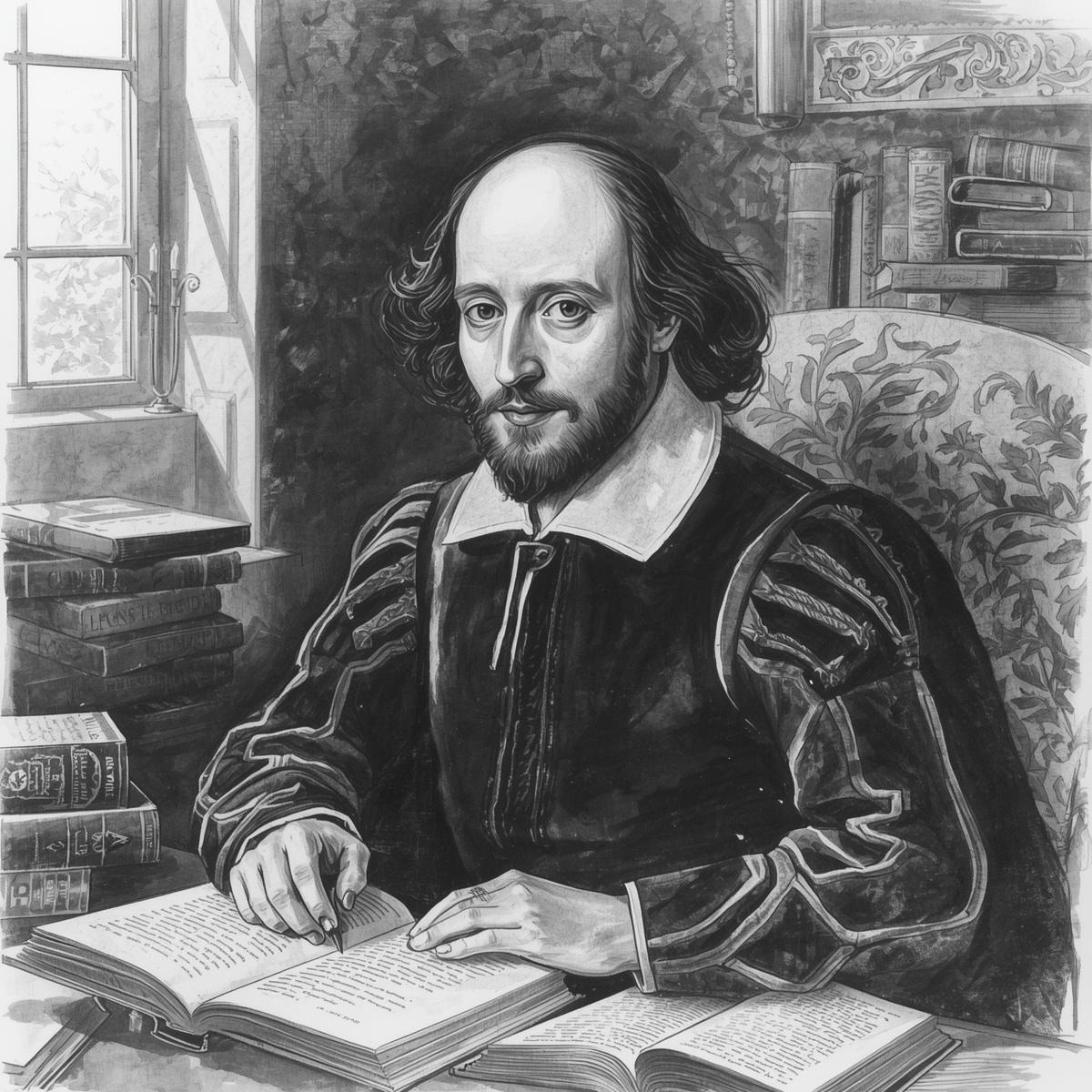
William Shakespeare was born in April 1564 in Stratford-upon-Avon, a market town in Warwickshire, England. Though the exact date of his birth is not recorded, tradition holds it to be 23rd April, a date that also, poignantly, marks the day of his death 52 years later in 1616. He was the third child of John Shakespeare, a glove-maker and local alderman, and Mary Arden, the daughter of a prosperous farming family.
Shakespeare grew up in comfortable, middle-class surroundings. He almost certainly attended the King’s New School in Stratford, where he would have received a rigorous education in Latin, rhetoric, logic, and classical literature, all of which would leave unmistakable fingerprints on his later writing. There is no record of him attending university, which has long fascinated and frustrated scholars.
At eighteen, Shakespeare married Anne Hathaway, a farmer’s daughter eight years his senior. The couple had three children: Susanna, and twins Hamnet and Judith. Hamnet, his only son, died at the age of eleven, a loss that many scholars believe found its echo in some of Shakespeare’s most grief-laden writing.
The years between his marriage and his emergence as a playwright in London, roughly 1585 to 1592, are largely undocumented. Historians call this the “Lost Years,” and speculation about what Shakespeare did during this period has ranged from the plausible (school teaching, working with a travelling theatre company) to the fanciful. What is certain is that by the early 1590s, he had arrived in London and was making a name for himself on the theatrical scene.
London and the Theatre
Shakespeare’s London was a city of extremes, vibrant, overcrowded, dangerous, and creatively electric. The theatre was one of its great institutions, and Shakespeare threw himself into it with extraordinary energy, working simultaneously as an actor, playwright, and eventually a shareholder in one of the most successful theatrical companies of the age.
He became a key member, and part-owner, of the Lord Chamberlain’s Men, later known as the King’s Men following the patronage of King James I. The company built the famous Globe Theatre on the south bank of the Thames in 1599, and it was here that many of Shakespeare’s greatest plays were first performed before audiences that ranged from penny-paying groundlings standing in the yard to wealthy patrons seated in the galleries above.
Shakespeare was prolific. Over roughly two decades, he wrote approximately 37 plays, 154 sonnets, and several longer poems. His output spans tragedy, comedy, history, and romance, a range that no other playwright of his era, or perhaps any era, has matched.
The Plays
Shakespeare’s dramatic work is customarily divided into four broad categories.
The Histories
Shakespeare drew heavily on English history for a significant portion of his output, producing a cycle of plays that dramatise the reigns of kings from Richard II through to Henry VIII. These are not history lessons in any dry sense, they are explorations of power, legitimacy, ambition, and the human cost of political violence.
Richard III (c. 1592) presents one of literature’s most compelling villains: a physically deformed, intellectually brilliant schemer who claws his way to the English throne through manipulation and murder. Henry IV, Parts 1 and 2 introduce the immortal figure of Sir John Falstaff, perhaps the greatest comic creation in all of English literature, alongside the reformation of the wayward Prince Hal into the heroic King Henry V. Henry V itself is a stirring meditation on kingship, war, and national identity, containing the famous St. Crispin’s Day speech that has echoed down through centuries of rhetoric and conflict.
The Comedies
Shakespeare’s comedies are not merely light entertainment, they are sophisticated explorations of love, identity, disguise, and social order, typically ending in marriage and reconciliation.
A Midsummer Night’s Dream (c. 1595) weaves together the worlds of Athenian nobility, working-class craftsmen, and supernatural fairy beings in a dreamlike forest adventure that remains one of the most performed plays in the world. Much Ado About Nothing gives us the sparring, brilliant Beatrice and Benedick, a template for the romantic comedy that has never been surpassed. Twelfth Night, As You Like It, and The Merchant of Venice each demonstrate Shakespeare’s ability to blend laughter with genuine emotional depth and, at times, unsettling darkness.
The Tragedies
It is arguably Shakespeare’s tragedies that have secured his place at the pinnacle of world literature. These plays explore the full catastrophic range of human experience, ambition, jealousy, madness, betrayal, love, and death, with an insight into the human mind that feels as urgent today as it did four centuries ago.
Hamlet (c. 1600) is perhaps the most analysed work in the English language. Its brooding, philosophical prince, paralysed by grief and indecision following his father’s murder, has become an archetype of the introspective modern individual. The play’s central question, “To be, or not to be”, has become the most famous line in all of literature.
Othello (c. 1603) is a devastating study of jealousy and manipulation, driven by the incomparable villain Iago, whose psychological cruelty toward the noble Moorish general Othello charts the destruction of a great man by his own worst impulses.
King Lear (c. 1605) is widely considered one of the greatest artistic achievements in any language. An ageing king divides his kingdom between his daughters and is repaid with betrayal and abandonment, descending into madness on a storm-battered heath. It is a play about power, love, ingratitude, and the terrifying fragility of the human mind.
Macbeth (c. 1606) is the shortest and most intense of the great tragedies, a ferocious examination of unchecked ambition and its moral consequences, driven forward by two of literature’s most unforgettable characters in Macbeth and his formidable wife.
Romeo and Juliet remains the world’s defining love story: two young people destroyed not by their own failings but by the ancient hatred of the families into which they were born.
The Romances
In the later years of his career, Shakespeare moved toward a new form, the “romance” or “tragicomedy”, that combined darker themes with elements of fantasy, reconciliation, and redemption. The Tempest (c. 1611), thought by many to be his final solo work, features the magician Prospero on a remote island, orchestrating the fates of those who wronged him. It is a play of power, forgiveness, and art itself, and many have read it as Shakespeare’s own farewell to the stage.
The Sonnets and Poetry
Beyond the plays, Shakespeare produced 154 sonnets, fourteen-line poems exploring love, time, beauty, mortality, and desire with extraordinary compression and craft. The sonnets are addressed to two mysterious figures: a young man of great beauty and a “Dark Lady.” They remain among the most celebrated poems in the English language, and their autobiographical dimensions have been debated endlessly by scholars.
His longer narrative poems, including Venus and Adonis and The Rape of Lucrece, were the works that first established his literary reputation during his own lifetime.
Why Shakespeare Matters
The question of why a playwright who died over four hundred years ago continues to matter so profoundly is one worth answering carefully.
He understood people. At the most fundamental level, Shakespeare’s characters are not historical curiosities, they are human beings animated by recognisable desires, fears, and contradictions. Hamlet’s paralysis in the face of an impossible moral task, Iago’s cold-blooded envy, Lear’s wounded pride, Juliet’s defiance of her family — these resonate because they map onto experiences that are timeless.
He shaped the English language. Shakespeare’s influence on the English language is without parallel. He is credited with coining or popularising over 1,700 words still in common use today, including bedroom, lonely, generous, obscene, gloomy, radiance, and countless others. Phrases such as “break the ice,” “foregone conclusion,” “heart of gold,” “wild goose chase,” “cold-blooded,” and “the green-eyed monster” all trace their origins to his pen.
He explored the great themes. Power and its corruption. Love and its madness. The terror of ageing and death. The complexity of identity. The gap between appearance and reality. Shakespeare returned to these themes not with the aim of resolving them but of illuminating them, holding them up to the light so that his audience could see their own lives more clearly.
He was a supreme craftsman. Shakespeare wrote primarily in iambic pentameter, a rhythm of ten syllables per line that mirrors, roughly, the natural cadence of English speech. His mastery of this form, and his ability to move fluidly between verse and prose to reflect character and social class, represents a technical achievement that writers and scholars continue to marvel at.
H51
Shakespeare retired to Stratford around 1613, living out his final years in comfort as a prosperous gentleman. He died on 23rd April 1616 and was buried in the chancel of Holy Trinity Church in Stratford-upon-Avon, where his grave remains to this day.
Seven years after his death, his fellow actors John Heminges and Henry Condell collected his plays into what is known as the First Folio (1623), one of the most important books ever published in the English language. Without it, roughly half of Shakespeare’s plays, including Macbeth, The Tempest, and Twelfth Night, might have been lost forever.
Since then, his legacy has only grown. His plays have been translated into every major language and are performed more frequently around the world than those of any other playwright. They have been adapted into films, operas, ballets, novels, and musicals. The Royal Shakespeare Company, founded in Stratford-upon-Avon, remains one of the world’s foremost theatrical institutions. The reconstructed Globe Theatre on London’s South Bank attracts hundreds of thousands of visitors each year.
Directors from Laurence Olivier to Kenneth Branagh, Akira Kurosawa to Baz Luhrmann have brought his work to the screen in wildly different visions. His characters, Hamlet, Falstaff, Lady Macbeth, Shylock, Prospero, have become universal cultural archetypes, recognised even by people who have never read a word of the original text.
In literature, the influence is immeasurable. Writers from John Keats and Herman Melville to James Joyce and Toni Morrison have cited Shakespeare as a foundational presence in their creative lives. The psychoanalyst Sigmund Freud drew on Shakespeare extensively in his theories of the human mind.
Conclusion
William Shakespeare was not a god or a myth, he was a man from a provincial English town who possessed a combination of gifts so rare and so potent that their effects have never diminished. He was a working playwright writing for popular audiences, concerned with filling seats and pleasing crowds, who somehow produced, in the course of that commercial endeavour, a body of work that speaks to the condition of being human as nothing else in the literary tradition quite does.
Four hundred years after his death, we still argue about his plays, still find new meanings in them, still perform them in languages and contexts he could never have imagined. That, perhaps, is the truest measure of his greatness: not that he was ahead of his time, but that he was, and remains, entirely beyond it.
Leave a Reply