
How two architects gave the Underground a face the city never forgot, from oxblood faience to modernist drums rising above the suburbs.
A city’s underground is invisible by definition, buried, functional, unglamorous. Yet the London Underground spent the first century of its life insisting otherwise. Its stations were not mere holes in the ground. They were declarations.
01
Leslie Green & the Language of Oxblood
In 1903, a thirty-year-old architect named Leslie Green was handed an extraordinary commission: design the surface buildings for an entire new generation of Underground stations for the newly formed Underground Electric Railways Company of London. He was not yet thirty-five when he died in 1908. In that narrow window, he shaped the face of the city.
Green’s answer was a signature so strong it became almost biological, a deep, dark red glazed terracotta known as “oxblood,” pressed into interlocking faience tiles that covered every façade from Covent Garden to Caledonian Road. The colour was practical: glaze resists soot, grime, rain. But it was also theatrical. Step out of a cab on a wet November evening and there it was, the Underground’s own red, claiming the corner.
FAÇADE MATERIAL
Oxblood Faience Tiles
Glazed terracotta in deep arterial red, laid across all 50 stations Green designed. Highly resistant to urban pollution, and unmistakable at a glance.
ARCHITECTURAL FORM
The Green Façade Template
Semi-circular arched windows, pressed terracotta friezes, and a low two-storey street presence, repeated across fifty stations with deliberate uniformity.
The genius was in the repetition. Green understood that a network must read as a network. A passenger arriving at Gillespie Road (today’s Arsenal) should feel, without quite knowing why, that they had arrived at the same family of place as Brompton Road or Warwick Avenue. The oxblood tile was, in modern terms, a brand. It preceded the roundel, preceded the Johnston typeface, preceded every piece of corporate identity that would follow.
Green’s buildings wore their arched windows like eyebrows, slightly raised, slightly curious, above deep-set doors that invited the city downward. The ground floors often housed shops, their rents subsidising the network. Commerce and transit, sharing a wall of dark red tile.
02
Charles Holden & the Modernist Drum
A generation later, the challenge was different. Frank Pick, the Underground’s relentlessly visionary commercial manager, looked at the spreading suburbs of North London and asked: what should a station look like when it has room to breathe? When it sits not on a dense Victorian street corner but at the edge of a field that will, in five years, become a neighbourhood?
His answer came through Charles Holden, a Bristol-born Quaker who had designed memorials for the dead of the Western Front and who brought to station architecture the same gravity he brought to commemoration. Holden toured Scandinavia and the Netherlands in 1930 with Pick, returning galvanised by brick modernism: clean volumes, honest materials, light flooding downward through glass.
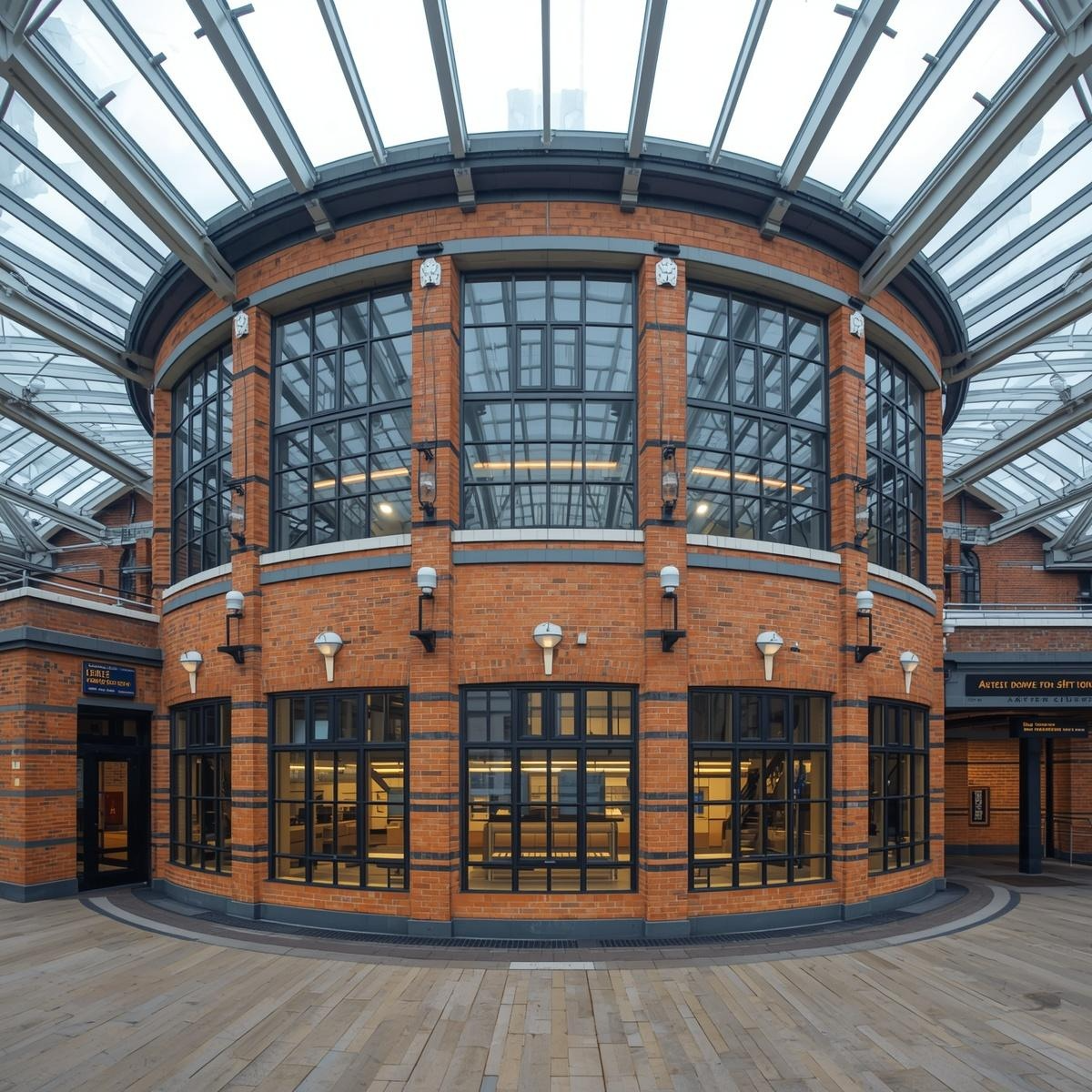
PICCADILLY LINE · 1932
Arnos Grove
The archetypal Holden drum, a cylinder of brick and glass that became his signature form, housing the ticket hall with generous natural light.
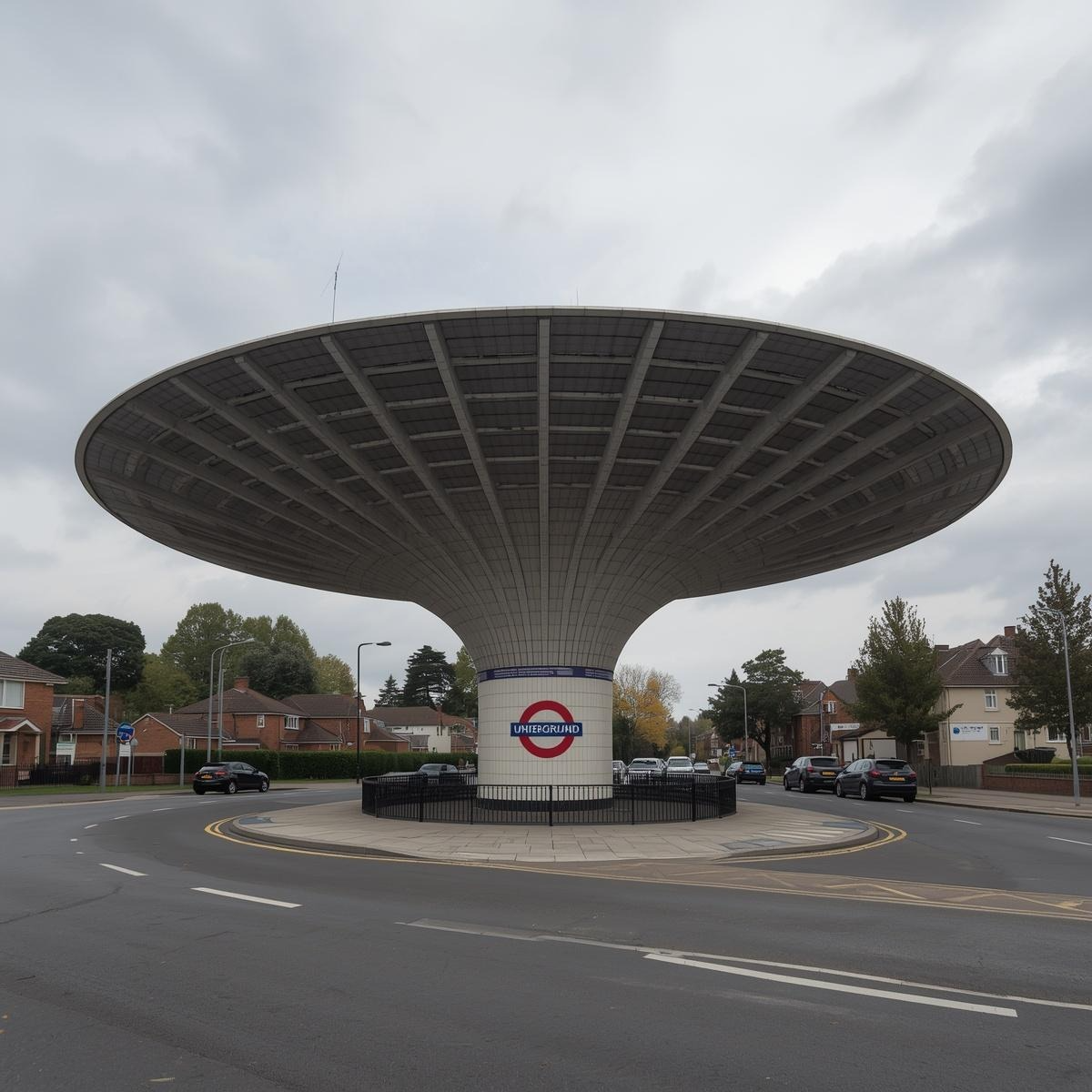
PICCADILLY LINE · 1933
Southgate
Holden’s most theatrical suburban station, a flying-saucer canopy suspended above the road, anchored by a strikingly slim central drum.
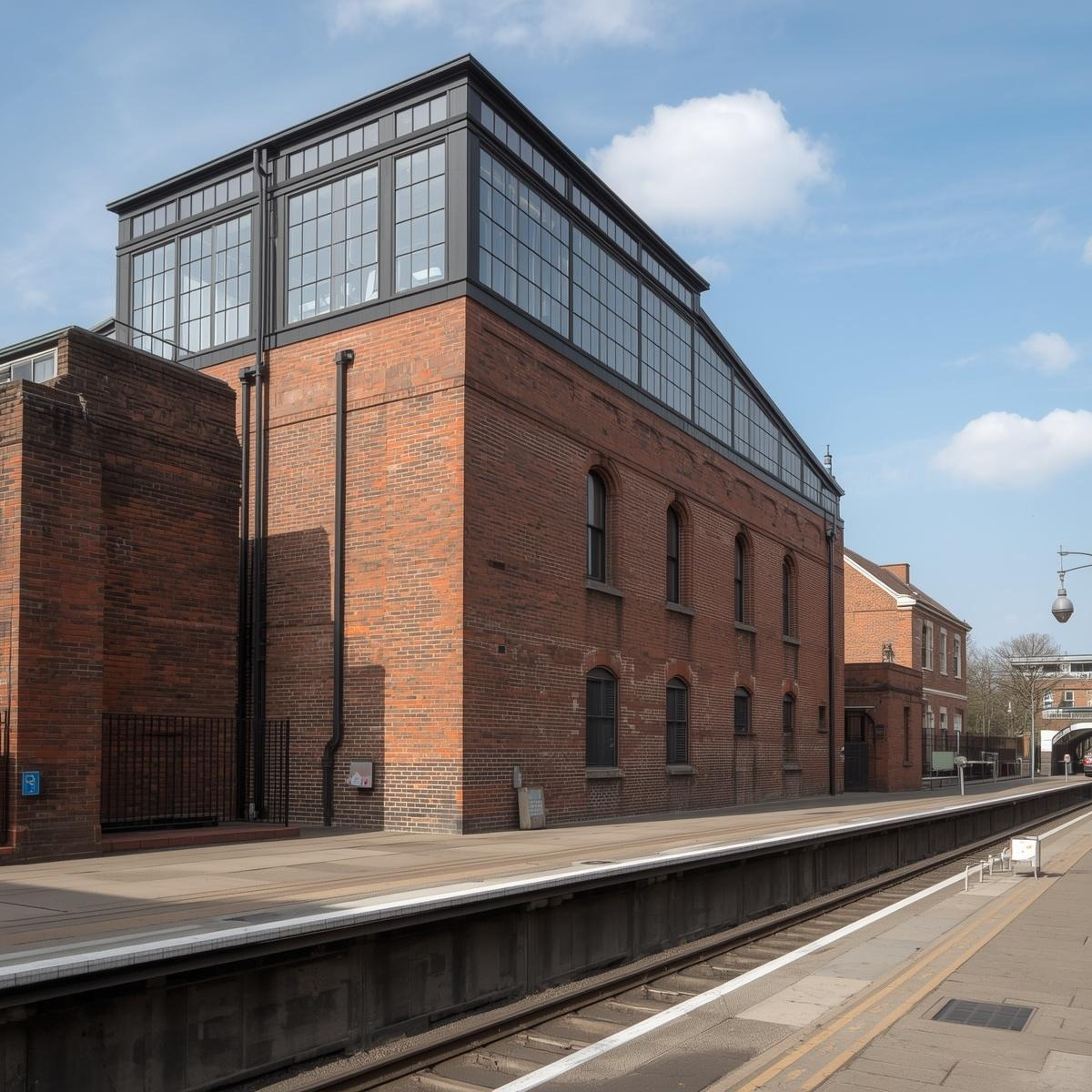
DISTRICT LINE · 1931
Sudbury Town
Holden’s first great experiment, a severe brick box with a tall glazed clerestory. Critics called it industrial. Passengers called it airy and legible.
What Holden created was a new civic typology: the suburban temple. His stations didn’t apologise for their presence among the semis and the ribbon-development shops. They asserted it. The drum at Arnos Grove, brick below, glass above, a flat concrete lid, announced that the city had arrived, that this junction of road and rail was a place worth marking with architecture of genuine ambition.
Inside, the effect was equally deliberate. Light fell through horizontal clerestory windows onto ticket halls of unusual generosity, wide, unhurried, easy to read. Holden had absorbed the lesson of the best Dutch railway architecture: that passengers moving through a space for thirty seconds still deserve to be treated with dignity.
“The station is not a gateway to somewhere else. It is, for the thirty seconds you stand in it, somewhere itself.”
— Architectural Review, on Holden’s Piccadilly Line extensions, 1933
03
The Underground as Civic Monument
What Green and Holden achieved together, separated by a generation, united by the same patronage, was something English architecture rarely manages: a coherent civic aesthetic spread across an entire city. Paris had Hector Guimard’s Art Nouveau entrances (and then abandoned them). New York had Beaux-Arts grandeur (and then abandoned it). London kept building, kept refining, kept insisting that the Underground was not infrastructure but institution.
The civic ambition was conscious. Frank Pick wrote and spoke extensively about the duty of large public organisations to raise the visual quality of urban life. A station that looked cheap, he argued, told passengers that their time and their eyes were not worth attending to. The station’s architecture was a form of respect, paid in brick and tile and glass, charged back at tuppence a journey.
WAYFINDING · VISUAL IDENTITY
The Roundel’s Century of Refinement
From a plain red circle in 1908 to Edward Johnston’s weighted bar-and-circle in 1916 to the precisely engineered symbol still used today, each iteration more legible, more authoritative.
TYPOGRAPHY · 1916
Johnston Sans: The Underground’s Voice
Commissioned from calligrapher Edward Johnston in 1916, the humanist sans-serif became the first corporate typeface in British history, influencing Eric Gill and, through him, almost all of modernist type design.
The architecture, the roundel, the typeface, these were not separate projects. They were, under Pick’s direction, a unified argument: that a public transport system was a civilising force, and ought to look like one. Green had given the system a complexion. Holden gave it a posture. Johnston gave it a voice. Together they gave the Underground what no amount of engineering alone could: a sense that it belonged to the city and the city belonged to it.
04
Wayfinding: The Evolution of Legibility
Architecture and identity converge most practically in wayfinding, the system by which a stranger, emerging blinking from a staircase in an unfamiliar part of the city, understands where they are and how to leave. The Underground’s approach to this problem evolved across the entire twentieth century, each decade adding a layer of considered design.
1908 The First Roundel
A simple red disc with the station name across it, imprecise, inconsistently applied, but the germ of a system. Recognition depended on colour alone.
1916 Johnston Sans & the Bar-and-Circle
Edward Johnston’s typeface, commissioned by Frank Pick, was paired with the refined bar-and-circle roundel. For the first time, the network had a legible, unified voice across every surface.
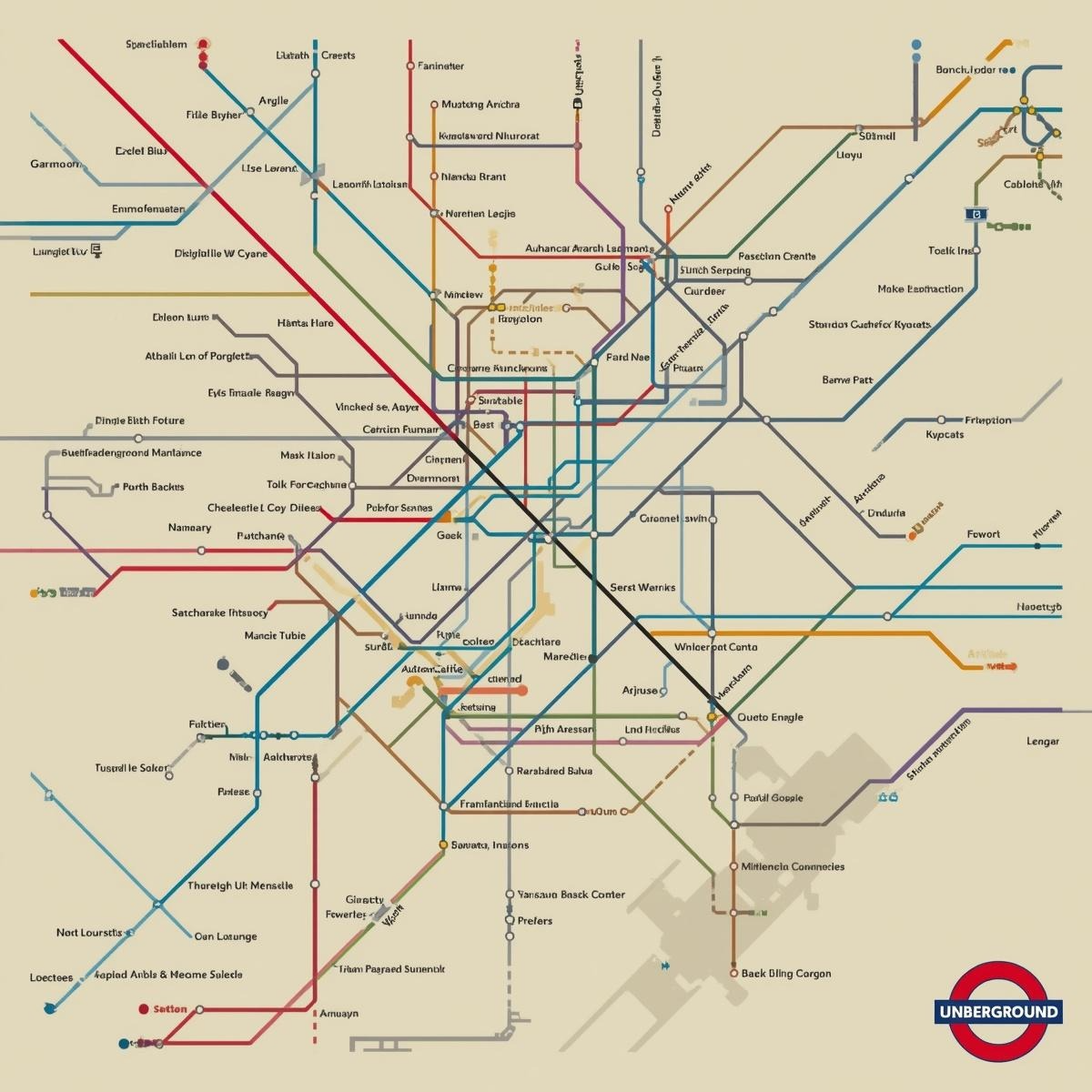
1933 The Diagrammatic Map
Harry Beck’s radical underground map, abandoning geographical accuracy for topological clarity, transformed the network’s self-image. Distance became irrelevant; connection became everything.
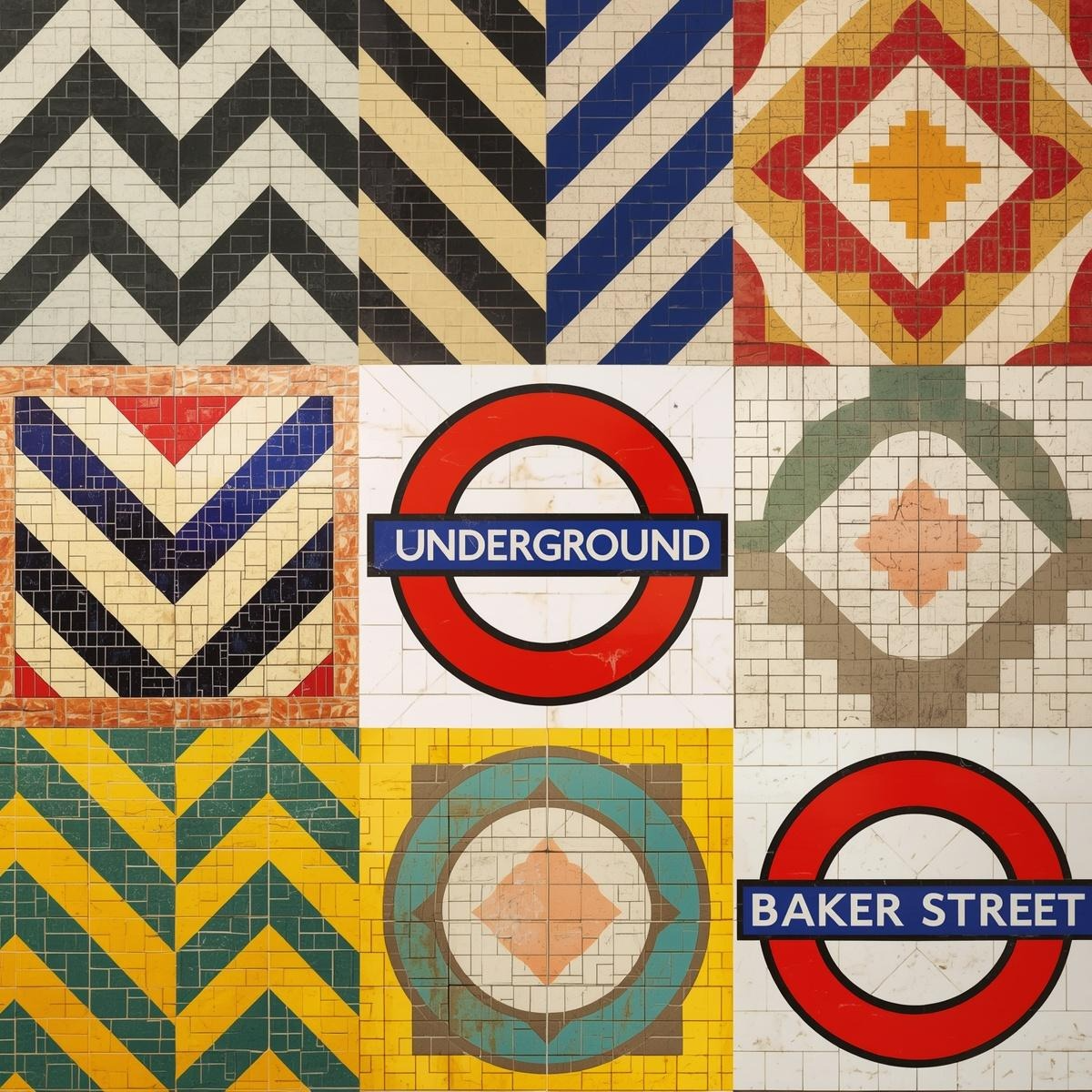
1960s–80s Station Tiles as Address
Each station’s platform tiling became its address: the slashed chevrons of Tottenham Court Road, the ox-eye roundels of Baker Street. Tile pattern became a form of wayfinding.
2010s–present New Johnston & Digital Integration
Johnston 100, a digital-age revision of the original typeface, was introduced in 2016. The roundel migrated onto screens, apps, and real-time departure boards, still recognisable, still legible, still the face Green and Pick imagined.
What is remarkable is how little the fundamental system has changed. The roundel on a 2024 digital display is recognisably the ancestor of the roundel on a 1916 enamel sign. The Johnston letterform has evolved but its character, humanist, legible, neither stiff nor casual, remains intact. Architecture tends to fix itself in stone. The Underground’s identity, by contrast, has been a living thing, tended by a succession of designers who understood they were stewards, not authors.
❖
The Argument in Brick and Tile
Stand outside Gloucester Road station on a grey afternoon. The oxblood tiles are still there, slightly more faded, slightly more loved. The arched windows still carry their faint Edwardian grandeur. The roundel still glows above the door. Somewhere behind those tiles, Green’s ghost is making the same argument he made in 1906: that the city’s underground deserves to look like a city.
Holden made the same argument in brick on the Piccadilly extension, in a modernist idiom that Green would not have recognised but might, if he’d had the time and the health, have admired. Both were answering the same question that Pick kept asking, that every good piece of public architecture must answer: what does it say to the person who encounters it, who didn’t ask for it, who simply turned a corner and there it was?
6
The answer, when the architecture is working, is always some version of the same thing: you matter enough for this.
Leave a Reply