
Gateway to a Nation in Motion
Beijing, China | High-Speed Rail Hub | Opened 2008
On 1st August 2008, just seven days before the opening ceremony of the Beijing Summer Olympics, China inaugurated what was then the largest and most technically sophisticated railway station ever built. Beijing South Railway Station, 北京南站, Běijĭng Nán Zhàn, opened as the southern terminus of the Beijing–Tianjin intercity railway, China’s first high-speed rail line operating at 350 kilometres per hour. In a single day, China announced to the world that it had not merely joined the era of high-speed rail, but intended to define it.
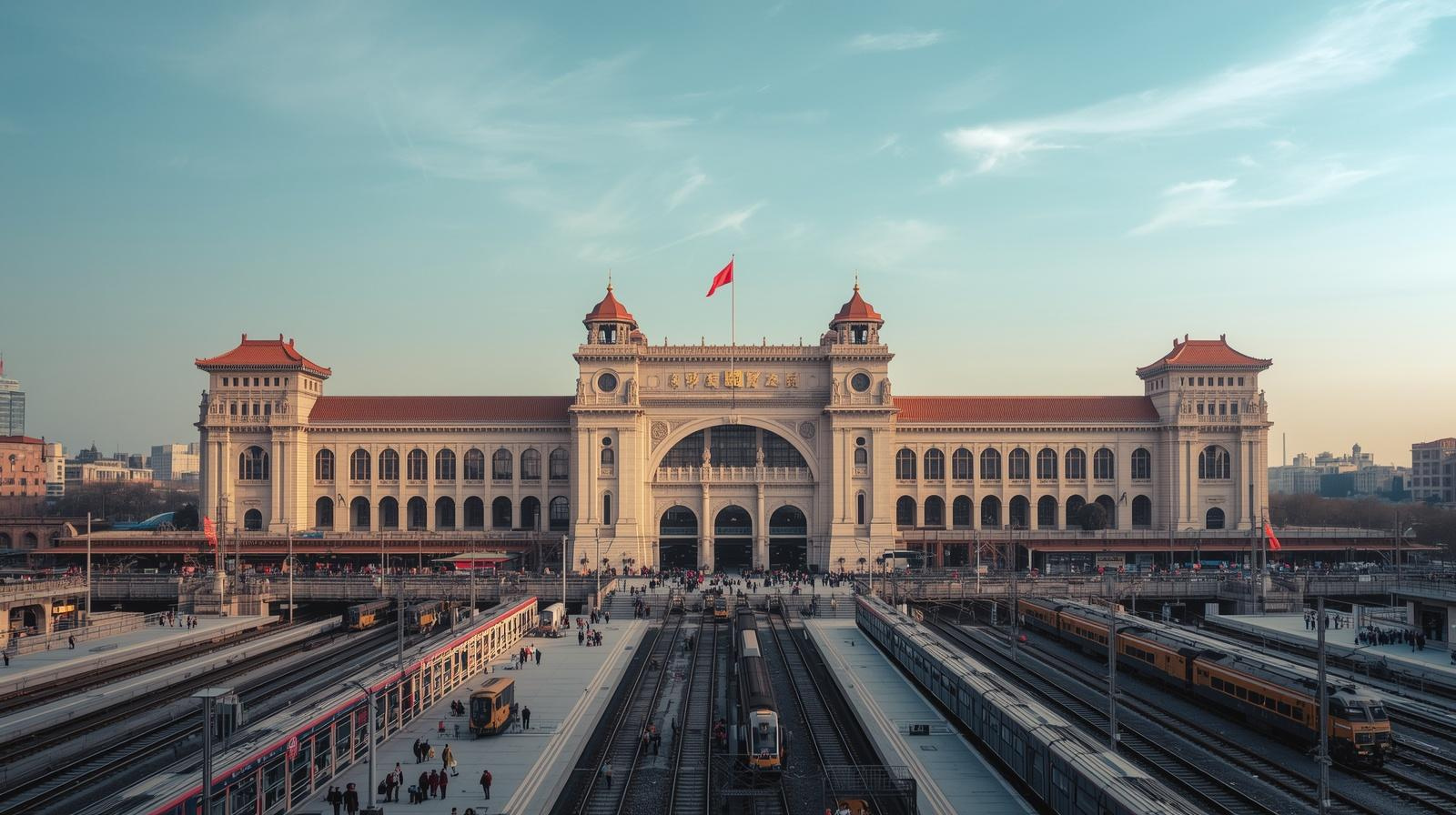
Today, Beijing South is far more than a station. It is the nerve centre of China’s extraordinary high-speed rail network, the largest in the world, connecting the nation’s capital to Shanghai, to Wuhan, to Guangzhou, and to dozens of cities in between, at speeds that have compressed distances once measured in days to journeys of a few hours. Its architecture, designed by Terry Farrell and Partners in collaboration with the Third Railway Survey and Design Institute, is one of the most ambitious feats of modern civic design in Asia: a vast elliptical disc of glass and steel that evokes the Temple of Heaven, the ancient altar at Beijing’s heart.
To visit Beijing South is to understand something essential about contemporary China: its appetite for scale, its command of technology, its desire to root the future in the symbols of the past, and its capacity to execute, at breath taking speed, projects that would take decades in other parts of the world.
Historical Context: China’s High-Speed Rail Revolution
To understand Beijing South, one must first understand the extraordinary context in which it was built. In the early 2000s, China’s transport infrastructure was straining under the demands of an economy growing at close to ten percent annually. The conventional rail network, built largely in the Maoist era, was overcrowded and slow. Roads were congesting. Domestic aviation was expanding rapidly but could not keep pace with demand. The government’s response was characteristically bold: a decision, taken at the highest levels of the State Council, to build a high-speed rail network from scratch.
China had been studying high-speed rail technologies since the 1990s, dispatching engineers to France, Germany, Japan and Canada to learn from their systems. Rather than simply copying foreign models, however, the Ministry of Railways adopted a strategy of “introduction, digestion, absorption, and re-innovation”,* acquiring technology through licensing agreements and joint ventures, then systematically improving upon it to develop a distinctly Chinese high-speed rail system adapted to the specific conditions of Chinese geography, climate, and demand.
The Beijing–Tianjin line, which opened with Beijing South station in 2008, was the proving ground for this system. At 120 kilometres in length and designed for 350 km/h operation, it demonstrated that China’s domestically developed CRH high-speed trains could match anything in Europe or Japan. The success of that line catalysed a national construction programme of extraordinary scale: by 2024, China’s high-speed rail network stretched to over 45,000 kilometres, more than the combined total of all other countries in the world.
Architecture: The Disc and the Temple
The design of Beijing South station is among the most distinctive pieces of contemporary transport architecture in the world. The commission went to Terry Farrell and Partners, the London-based practice known for its thoughtful engagement with urban context and Asian architecture, working alongside the Third Railway Survey and Design Institute (TRSDI), which handled the enormous technical complexity of the project.
The Temple of Heaven Inspiration
The central architectural concept is an explicit reference to the Temple of Heaven,- Tiantan, one of Beijing’s most sacred and internationally recognisable monuments. The Temple of Heaven is a circular structure set within a vast parkland south of the Forbidden City, used by the emperors of the Ming and Qing dynasties to pray for good harvests. Its circular geometry, its concentric rings of structure, and its relationship to the sky and horizon are among the most refined expressions of Chinese cosmological thinking in architectural form.
Farrell’s design echoes the Temple of Heaven’s circular plan in the overall elliptical footprint of the station. The roof, a vast, shallow dome of glass and steel framing, appears, from the air, as a luminous disc set into the urban fabric of southern Beijing. The reference is both visual and symbolic: the station, like the temple, is an object designed to be seen from above, and its circular geometry speaks to themes of completeness, cyclical movement, and the harmonious ordering of space that run deep in Chinese architectural tradition.
Scale and Dimensions
The numbers that describe Beijing South are staggering. The station covers a total floor area of approximately 320,000 square metres, making it, at the time of opening, the largest railway station in Asia and among the largest in the world. The main hall measures roughly 500 metres in length and 350 metres in width. The elliptical roof spans these dimensions without internal supports in the central volume, creating an unobstructed interior space of cathedral-like proportions.
The station operates on five levels. From top to bottom: the roof level houses photovoltaic solar panels; the ground-level concourse receives long-distance and high-speed rail passengers; below that, a second level handles suburban and intercity rail services; deeper still, two metro lines, Lines 4 and 14 of the Beijing Metro, connect the station to the broader city. This vertical stratification of different rail systems into a single integrated structure was, at the time of construction, highly unusual and represented a sophisticated approach to multi-modal transport planning.
The Roof: Glass, Steel, and Light
The roof of Beijing South is its most celebrated architectural feature. It consists of a steel space-frame structure supporting an outer skin of translucent glass panels, with an inne*r layer of polycarbonate sheeting for thermal insulation. The effect is a membrane that admits natural light throughout the day, washing the interior concourses in diffused, even illumination that reduces the need for artificial lighting and gives the vast space a sense of openness quite unlike the oppressive fluorescence of conventional stations.
The roof is divided into three concentric zones, each with a slightly different pitch and material treatment, creating a subtle visual hierarchy that reinforces the circular geometry of the plan. The outermost zone curves gently downward, softening the transition from the immense interior volume to the human-scaled entrance canopies at ground level. At night, the roof glows from within, transforming the station into a luminous landmark visible from considerable distance across the relatively flat terrain of southern Beijing.
Interior Design and Passenger Experience
The interior of Beijing South is organised around clarity of movement. The design team faced an extraordinary challenge: how to move tens of thousands of passengers per hour through a building of this size without confusion, crowding, or the kind of spatial anxiety that afflicts many large transport hubs. Their solution was a highly legible spatial hierarchy, a clear central spine running north–south through the building, with secondary circulation routes branching off at right angles, and the platform gates arranged in a logical sequence that allows passengers to navigate by intuition as much as by signage.
The palette of materials is restrained and confident: white and light grey polished stone for the floors, white-painted steel for the structural elements, and glass throughout. There is very little ornament in the Western sense; instead, the architecture derives its aesthetic quality from precision of proportion, perfection of detailing, and the quality of the light. Certain areas feature decorative screens with traditional Chinese geometric patterns, but these are deployed with restraint, serving as accents rather than covering surfaces.
Commercial facilities, restaurants, cafes, retail outlets, and service businesses, are concentrated along the edges of the main concourse, leaving the central passenger flow routes unencumbered. The departure waiting areas are generous in scale and furnished with seating designed for extended waits, acknowledging that Chinese rail passengers often arrive early and may spend significant time in the station before boarding. Separate zones for different classes of service, including dedicated first-class lounges for high-speed rail passengers, introduce a degree of spatial differentiation that recalls the class distinctions of nineteenth-century European stations, but executed with entirely modern materials and a different social logic.
Engineering Achievement: Building at Chinese Speed
The construction of Beijing South was itself a feat of engineering and project management that deserves recognition alongside the finished building. The project broke ground in 2005 and was completed, ready for operational use, in just three years, a timeline that Western construction professionals regard with a mixture of admiration and disbelief. At peak construction, more than 10,000 workers were on site simultaneously, working in multiple shifts around the clock.
The structural engineering challenges were formidable. The station had to accommodate the extremely stringent track geometry requirements of high-speed rail, any settlement or deformation of the track bed would be unacceptable at 350 km/h, while simultaneously supporting the enormous roof structure above. The solution involved deep pile foundations driven into the Beijing alluvial plain, a reinforced concrete base structure of extraordinary rigidity, and a carefully engineered separation between the structural elements that carry the roof loads and those that carry the rail-induced vibrations.
The roof structure itself required the fabrication and erection of a steel space-frame of unprecedented scale in China at the time. The individual steel elements were fabricated off-site and transported to Beijing, where they were assembled using a combination of crane erection and innovative on-site welding techniques. The total weight of structural steel in the roof is approximately 64,000 tonnes.
Sustainability Features
Beijing South incorporated a number of sustainability features that were advanced by the standards of 2008. The most visible is the photovoltaic solar panel array integrated into the roof structure, which at the time of installation was one of the largest building-integrated photovoltaic systems in China. The panels, covering approximately 3,246 square metres of the outer roof zone, generate electricity that supplies a significant portion of the station’s common area lighting needs.
The natural lighting strategy, implemented through the translucent roof, reduces dependence on artificial lighting during daylight hours, a significant energy saving in a building of this scale. The station’s mechanical systems were designed with energy efficiency in mind, including heat recovery systems for the ventilation network and a building management system that optimises energy use in response to real-time occupancy levels.
Operations: The Busiest Station in China
Beijing South operates on a scale that strains the imagination. On a typical weekday, the station handles upward of 300 high-speed train services, carrying in excess of 100,000 passengers. During the Chun Yun period, the annual Spring Festival travel rush that represents the largest annual human migration on earth, as hundreds of millions of Chinese travel home for the Lunar New Year, daily passenger numbers at Beijing South can exceed 200,000. On the busiest single days of Chun Yun, the station has handled more passengers than many European airports handle in a week.
The station serves as the northern terminus of the Beijing–Shanghai High-Speed Railway, the most heavily used high-speed rail corridor in the world. The 1,318-kilometre journey between Beijing and Shanghai, which took between 10 and 14 hours by conventional express train before the high-speed line’s opening in 2011, now takes as little as 4 hours 18 minutes on the fastest services. The frequency of service, trains departing every few minutes at peak hours, has given the corridor a genuinely metro-like quality, reducing the need to book far in advance and transforming the relationship between China’s two greatest cities.
Beijing South also anchors the Beijing–Guangzhou High-Speed Railway, which at 2,298 kilometres is the longest high-speed rail line in the world, connecting the capital to the great manufacturing heartland of the Pearl River Delta in approximately 8 hours. Other routes fan out to Tianjin (30 minutes), Jinan, Nanjing, Hangzhou, and numerous other destinations across eastern and central China.
Platform Configuration and Train Operations
The station has 24 platforms, all island platforms, meaning trains can board from both sides, arranged in twelve pairs beneath the main roof structure. The platform tracks are numbered from west to east in the Chinese convention. All platforms are at the same level as the main concourse, with passengers descending from the ticketing and waiting areas above to the platform level via escalators and lifts, a design that allows rapid, organised boarding and alighting and minimises the chaotic cross-flows that afflict stations where passengers must navigate stairs to reach different platform levels.
The trains that use Beijing South are operated by China Railway and its subsidiaries, using several generations of CRH (China Railway High-speed) rolling stock. The most capable of these, the CR400AF and CR400BF “Fuxing” (Rejuvenation) trains, introduced from 2017 onwards, are Chinese-designed and Chinese-manufactured, representing the full maturation of the technology transfer and re-innovation strategy that began two decades earlier. These trains operate at up to 350 km/h in regular service, making China’s network the fastest in the world for scheduled passenger operations.
Technology and Passenger Services
Beijing South has consistently been at the forefront of deploying new technology in railway operations. The station was among the first in China to implement fully automated ticket gates using QR-code scanning, which have since been rolled out across the national network. Passengers can purchase tickets through China Railway’s 12306 app or website, receive a QR code on their mobile phone, and proceed directly from entrance to platform without handling a physical ticket. The speed and efficiency of this system, a single gate can process a passenger in under two seconds, is crucial to managing the enormous passenger flows the station handles.
Real-name registration for rail tickets, introduced across the Chinese high-speed network in 2010, means that every journey on China’s high-speed rail is linked to the passenger’s identity card or passport. This has enabled the deployment of facial recognition technology at Beijing South: passengers can pass through designated gates simply by looking at a camera, which matches their face to the registered identity on the ticket. While this raises questions about privacy and surveillance that Chinese society is grappling with in a broader context, the operational efficiency it enables is remarkable.
The station’s commercial offerings have expanded considerably since opening, reflecting the evolution of Chinese consumer culture. A wide range of restaurants, from fast-food chains to full-service dining, serves both traditional Chinese cuisine and international options. Convenience stores, pharmacies, luggage-wrapping services, and a variety of retail outlets serve practical needs. Dedicated VIP lounges for business and first-class passengers offer enhanced facilities including separate check-in, private seating areas, and premium catering.
Urban Context: Beijing’s Southern Gateway
The siting of Beijing South was not merely a logistical decision but an urban planning choice with significant long-term consequences. The station occupies a large site in the Fengtai District, on Beijing’s southern periphery, historically a less-developed area of the city that the Beijing municipal government has been actively seeking to upgrade and integrate into the urban fabric.
The station has functioned as a catalyst for development in its surroundings, as large transport hubs almost invariably do. In the years since its opening, a significant volume of commercial and residential construction has been attracted to the area around Beijing South, drawn by the accessibility advantage conferred by its metro connections and its position on the national high-speed network. Hotels, office buildings, and mixed-use developments have progressively filled the formerly industrial and underused land in the station’s vicinity.
The station’s metro connections, it is served by Line 4, one of Beijing’s busiest metro lines, which links it directly to the city centre and to Beijing Capital Airport, and by Line 14, make it genuinely accessible from all parts of the city. A typical journey from Tiananmen Square to Beijing South by metro takes approximately 25 minutes, and from the northern part of the city, where many of Beijing’s universities and technology companies are concentrated, around 45 minutes.
Significance: A Symbol of China’s Transformation
Beijing South cannot be fully understood without reference to what it represents in the wider story of China’s development. The station opened at an extraordinary moment in Chinese history: 2008, the year that China presented itself to the world through the Beijing Olympics, was also the year of the Sichuan earthquake, of global financial crisis, and of intense international debate about China’s rising power. Against this complex backdrop, the opening of Beijing South and the Beijing–Tianjin high-speed line was a carefully orchestrated demonstration of Chinese technological and organisational capability.
The architectural choice to reference the Temple of Heaven was deeply intentional. It positioned Beijing South not as an imitation of European or Japanese high-speed rail infrastructure, but as a distinctly Chinese achievement, one that drew on China’s own architectural heritage to give contemporary engineering a cultural identity. The message was explicit: China was building the future in its own image.
More broadly, Beijing South embodies the model of infrastructure-led development that has characterised China’s economic rise. The high-speed rail network, of which Beijing South is the capital’s principal hub, has profoundly restructured the economic geography of China, pulling cities closer together, enabling the growth of megacity clusters, and redistributing economic activity in ways that continue to unfold. Transport economists estimate that the Beijing–Shanghai high-speed corridor alone has generated economic impacts measured in the hundreds of billions of renminbi through increased labour mobility, business connectivity, and tourism.
Comparison with Global High-Speed Rail Hubs
Beijing South is often compared with the great high-speed rail stations of Europe and Japan. Paris Gare du Nord, St Pancras International in London, Frankfurt Hauptbahnhof, Tokyo Station, these are its peers in terms of passenger volumes and operational complexity. Each reflects its own national railway tradition and urban context, and the comparison reveals much about the different approaches to high-speed rail development.
Where European high-speed terminals tend to be grafted onto existing historic station buildings, the Eurostar platforms at St Pancras, for example, occupy a Victorian Gothic train shed designed by William Barlow in 1868, Beijing South was built entirely from scratch, without the constraints of historic fabric or incremental operational continuity. This gave the designers a freedom that is rare in the history of railway architecture: the ability to design a major terminal entirely for the demands of high-speed rail, without compromise.
Japanese Shinkansen stations, by contrast, are typically compact and efficient, Tokyo Station is immensely busy but relatively modest in spatial terms, reflecting Japan’s long experience with high-density urban design and the premium placed on land in Japanese cities. Beijing South is far more expansive, reflecting both the availability of land on the capital’s southern periphery at the time of construction and a Chinese planning philosophy that favours generous public spaces as expressions of civic ambition.
Visiting Beijing South: A Traveller’s Perspective
For the visitor to Beijing, Beijing South is at once a transport necessity and an architectural experience worth seeking out in its own right. The most dramatic first approach is from the metro: arriving by Line 4, passengers ascend via a series of escalators and ramps through the building’s lower levels, each successive space larger than the last, before emerging into the main concourse beneath the vast luminous roof. The spatial experience is genuinely impressive, few buildings in the world can match the sense of scale and the quality of natural light in Beijing South’s main hall.
The station is also a useful base for day trips. The Beijing–Tianjin line, which takes just 30 minutes to cover the distance from capital to port city, offers perhaps the most dramatic demonstration of Chinese high-speed rail for the first-time traveller. Tickets are inexpensive by international standards and can be purchased at the station on the day of travel without a prior booking, making a spontaneous round trip to Tianjin entirely practical. The acceleration from Beijing South’s platforms, the train reaching 200 km/h within the first few kilometres of open track, is viscerally impressive.
The station is located in the Fengtai District, directly accessible from central Beijing by metro Line 4 (alighting at Beijing Nan Railway Station). Taxi and ride-hailing services via Didi Chuxing are readily available from the station’s forecourt. The surrounding area, while not particularly rich in tourist attractions, has developed into a functional commercial district with good hotel options for travellers with early morning departures.
Conclusion: Infrastructure as National Statement
Beijing South Railway Station is, finally, more than a building. It is an argument, made in steel, glass, and reinforced concrete, at a cost of approximately 6.6 billion renminbi, about what China is capable of and what China intends for its future. The argument has been made with considerable skill: the architecture is genuinely impressive, the engineering is world-class, and the operational performance of the station, by virtually any measure, matches or exceeds the best comparable facilities in Europe and Japan.
At the same time, the station raises questions that are worth sitting with. The speed of its construction, three years for a building of this scale, was possible only through a mobilisation of human and material resources that would be inconceivable in a democratic political system with normal protections for property rights and labour standards. The surveillance infrastructure embedded in the station’s ticketing and access control systems serves operational efficiency but also enables state monitoring of citizens’ movements on a scale without precedent in history.
These are not reasons to diminish the achievement, but they are part of its full meaning. Great infrastructure, like great architecture, is always embedded in the political economy that produces it. To understand Beijing South fully is to grapple with the full complexity of contemporary China: its ambition and its constraints, its extraordinary capabilities and the particular conditions under which they are deployed.
The trains depart on time, at 350 kilometres per hour, into a country remaking itself at a speed that history has no precedent for. Beijing South is where that journey begins.
Beijing South Rail%way Station • Opened 1 August 2008 | Fengtai District, Beijing, China
Leave a Reply