
A Crown of Stone, Steel & Empire
Mumbai, India | UNESCO World Heritage Site
In the heart of Mumbai, where the monsoon air mingles with the clamour of a city perpetually in motion, stands one of the most extraordinary railway stations on earth. Chhatrapati Shivaji Maharaj Terminus, known by Mumbaikars simply as CSMT, and to an older generation as Victoria Terminus, is far more than a transportation hub. It is a living monument, a grand Victorian fantasy transplanted to the tropics, and a mirror held up to the contradictions of colonial ambition and Indian identity.
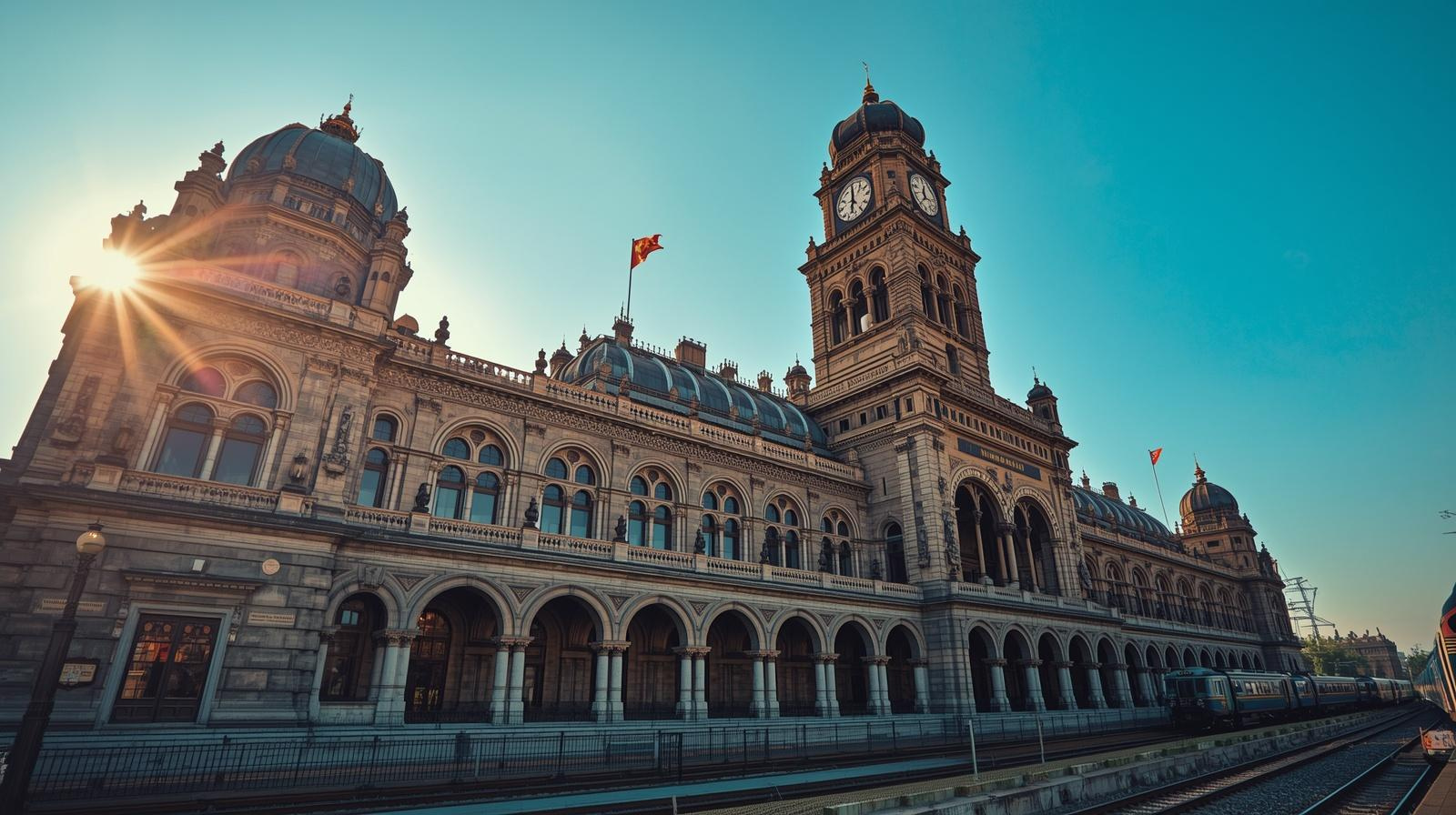
Inscribed as a UNESCO World Heritage Site in 2004, CSMT is recognised as an outstanding example of Victorian Gothic Revival architecture, fused with the traditional architectural traditions of India. Every day, millions of commuters stream through its arched entrances and beneath its soaring dome, making it one of the busiest railway stations in Asia, yet the building commands attention with an authority that no volume of human traffic can diminish.
Historical Background: A Station Born of Empire
The origins of CSMT lie in the remarkable ambition of British colonial rule and the expansion of the Great Indian Peninsular Railway (GIPR). By the mid-nineteenth century, the railway network had become both an economic artery and a symbol of imperial prestige. As Bombay grew into the commercial capital of British India, the need for a grand terminus to anchor the western rail network became undeniable.
Construction began in 1878 under the design of Frederick William Stevens, a consulting architect for the GIPR. The project took a full decade to complete, with the station finally opening on 20 June 1887, the year of Queen Victoria’s Golden Jubilee, in whose honour it was named Victoria Terminus. The timing was deliberate: the building was conceived not merely as a station, but as a statement of imperial permanence and civilisational confidence.
Following Indian independence and Maharashtra’s growing pride in its Maratha heritage, the station was renamed Chhatrapati Shivaji Terminus in 1996 in honour of the legendary seventeenth-century Maratha warrior king. It was further renamed Chhatrapati Shivaji Maharaj Terminus in 2017, adding the honorific “Maharaj” to fully acknowledge his royal legacy.
The Architect: Frederick William Stevens
Frederick William Stevens (1848–1900) was a British architect who spent the defining years of his career in India. Educated and trained in England, Stevens came to Bombay in 1867 as an assistant to the consulting surveyor for Bombay’s public works. He rose through the ranks and, by the time he received the commission for Victoria Terminus, was the foremost architect in the city.
Stevens was deeply influenced by the Gothic Revival movement championed in England by architects such as George Gilbert Scott and John Ruskin’s philosophy of ornament. His genius lay in understanding that a building in tropical India could not simply transplant a northern European medieval cathedral wholesale. He studied Indian architecture carefully, particularly the stone carvings, decorative motifs, and dome-work of Mughal and Rajput traditions, and wove these elements into his Gothic framework with exceptional skill.
CSMT stands as Stevens’ magnum opus, though he also designed several other significant Bombay landmarks, including the Municipal Corporation building (BMC Headquarters), which stands facing the terminus across Dr. D.N. Road. He died in 1900, just as the twentieth century was beginning to erode the Victorian confidence his buildings so perfectly embodied.
Victorian Gothic Revival Architecture: The Style Explained
To appreciate CSMT fully, one must first understand the Victorian Gothic Revival movement that shaped it. Gothic Revival was a nineteenth-century architectural trend that consciously looked back to the medieval Gothic architecture of Europe, characterised by pointed arches, ribbed vaults, flying buttresses, and elaborate stone ornamentation, and reinterpreted it for modern purposes.
The movement was partly aesthetic, partly moral. Influential critics like John Ruskin argued that Gothic architecture, with its handcrafted detail and honest use of materials, was morally superior to the cold classicism of Greco-Roman forms. Gothic became associated with authenticity, spiritual grandeur, and national identity, making it a natural choice for public buildings intended to project authority and permanence.
In Bombay, Gothic Revival had found a particularly fertile soil. The city’s Victorian-era building boom produced a remarkable cluster of Gothic buildings along what is now known as the Fort area: the Bombay University’s Rajabai Clock Tower, the High Court, the Public Works Department offices. CSMT crowned this ensemble, larger, more complex, and more richly ornamented than any of its neighbours.
Architectural Description: A Building of Extraordinary Complexity
The Facade and Central Dome
The first thing that strikes the visitor approaching CSMT from the street is the sheer vertical drama of its silhouette. The building rises in stages, from an elaborate ground-floor arcade of pointed arches, through turrets and gabled dormers, to a massive central dome crowned by a fourteen-foot-high statue representing Progress. This allegorical figure, a woman holding a torch aloft, gazes southward over the city, a secular echo of the pinnacle figures that crown medieval cathedrals.
The dome itself is a structural tour de force. Built of stone and decorated with ribbed vaulting, it rises to a height of approximately 33 metres above the ground. It is flanked by smaller turrets and conical rooftops that create a deeply irregular, organic skyline, deliberately evoking the texture of a medieval city rather than the imposing regularity of a classical building.
Stone, Colour and Material
Stevens chose his materials with great care. The building is constructed primarily from local buff-coloured sandstone from Kurla and blue-grey basalt, supplemented by Italian marble for interior elements. This combination gives CSMT a warm, honey-toned palette that softens its Gothic severity and makes it harmonious with the Indian landscape in a way that pure grey northern stone never could.
The contrast between the polished marble of the interior booking hall and the rough-hewn exterior stonework is deliberate: it speaks to the social choreography of a Victorian public building, where the grandeur builds as one moves deeper inside, rewarding those who linger.
Ornamentation: Stone Carving and Animal Symbolism
The ornamentation of CSMT is among its most celebrated features, and it is here that Stevens’ fusion of Gothic and Indian traditions is most vividly apparent. The building is encrusted with stone carvings executed by students of the Bombay School of Art under the supervision of John Lockwood Kipling, father of Rudyard Kipling. This detail alone charges the building with literary and cultural resonance: the hands that carved these gargoyles and floral capitals belonged to Indian craftsmen trained in the principles of English Gothic, working under the father of one of the greatest writers of the British Empire.
The carvings include gargoyles in the Western Gothic tradition, but alongside them sit distinctly Indian motifs: peacocks, monkeys, elephants, lotuses, and stylised floral patterns drawn from Mughal decorative vocabulary. The animal grotesques, carved high on the building’s exterior, include both the lion (symbol of Britain) and the tiger (symbol of India), a pairing that speaks, perhaps unconsciously, to the complex negotiation of power encoded in the building’s very walls.
The Interior: Booking Hall and Concourses
The interior of CSMT is as remarkable as its exterior. The main booking hall, now used for administrative purposes, is an extraordinary space with a ribbed vaulted ceiling, stained glass windows, and a floor of geometric marble tiles. Light falls through high arched windows in slanting columns, lending the room a quasi-sacred quality that its Victorian designers almost certainly intended: the booking hall as secular cathedral, the purchasing of a railway ticket as a kind of civic ritual.
The operational areas of the station, the platforms covered by an enormous wrought-iron and glass roof, represent a different but equally impressive architectural achievement. The iron structure, fabricated in England and assembled in Bombay, spans the tracks with confident engineering elegance. The contrast between the ornate masonry of the public facade and the spare industrial architecture of the platform canopy is characteristic of Victorian railway design, which treated the engine and the aesthetic with equal seriousness.
UNESCO World Heritage Inscription
In July 2004, CSMT was inscribed on the UNESCO World Heritage List as a site of Outstanding Universal Value. The citation recognised it as “an outstanding example of Victorian Gothic Revival architecture in Asia, fused with themes from Indian traditional architecture.” UNESCO specifically highlighted the building as representing an important interchange of human values and as a confluence of architectural traditions at a critical moment in both Indian and world history.
The World Heritage designation brought increased international attention to the building and prompted the Indian government and the Central Railway administration to invest in conservation efforts. However, the site faces ongoing challenges: the sheer volume of daily commuters, the demands of a functioning modern railway, atmospheric pollution, and years of improvised additions and alterations have left their marks.
Restoration work has been underway in phases since the early 2000s, involving careful cleaning of the stonework, repair of the ironwork roof, and restoration of the stained glass. The challenge of maintaining a World Heritage Site that is simultaneously one of the busiest commuter stations in Asia is formidable, requiring a constant negotiation between preservation imperatives and operational necessity.
The Fusion of Gothic and Indian: A Deeper Reading
It would be too simple to read CSMT merely as a colonial building, an imposition of foreign form on Indian soil. The reality is more nuanced and more interesting. Stevens himself was deeply interested in Indian architecture, and the craftsmen who built the building brought their own aesthetic intelligence to every carved surface. The result is a building that belongs to neither culture entirely, and to both cultures simultaneously.
Architectural historians have written at length about this quality of fusion. The writer and critic Rahul Mehrotra has described Victorian Bombay’s Gothic buildings as “hybrid structures” that are “neither purely European nor purely Indian, but something new”, a product of the encounter between two architectural traditions at a moment of intense cultural exchange. CSMT embodies this hybridity more completely than any other building in the city.
The Indian motifs are not merely decorative additions tacked onto a Gothic skeleton; they are integrated into the structural and ornamental logic of the building. The lotus capitals on interior columns, the peacock carvings on the exterior friezes, the Mughal-inflected patterns in the marble inlay, these are not afterthoughts. They suggest a building that is genuinely attempting to think through what architecture might mean in this particular place, on this particular subcontinent, at this particular moment in history.
CSMT in Culture and Memory
CSMT has embedded itself deeply in the cultural life of Mumbai and India. It has appeared in dozens of Bollywood films, from the gritty realism of “Slumdog Millionaire” (where it was used to depict the chaos of Mumbai’s transit system) to the romantic escapism of countless Hindi film sequences. Its facades and platforms have served as backdrop, symbol, and character in their own right.
The station also carries the weight of historical tragedy. On 26th November 2008, CSMT was one of the targets of the Mumbai terrorist attacks, in which gunmen opened fire on the crowded booking hall and platforms. Fifty-eight people were killed at the station alone. The attacks left deep scars on Mumbai’s collective memory, and CSMT, the city’s great gathering place, its democratic monument, became for a time a symbol of the city’s vulnerability. Its subsequent reopening, and the return of its millions of daily commuters, became equally a symbol of resilience.
Visiting CSMT: A Practical and Aesthetic Guide
For the visitor to Mumbai, CSMT rewards careful attention. The building is best appreciated from the outside first: approach from Dr. D.N. Road (formerly Hornby Road) and take the time to walk the full perimeter of the building before entering. The south-eastern corner, where the dome rises above the central pavilion, is particularly dramatic in the early morning or late afternoon light, when the honey-coloured stone glows warmly.
Inside, the contrast between the historic booking hall and the operational station is remarkable. Central Railway conducts guided heritage tours of the building, covering its architectural features, historical artefacts, and conservation work. The Heritage Gallery within the premises displays photographs, architectural drawings, and artefacts documenting the station’s history. Visitors should also look up: the ceilings of the main public areas are among the finest examples of Victorian Gothic craftsmanship in Asia.
The station is located in the Fort area of south Mumbai, easily accessible from Colaba and the city’s main tourist districts. It connects directly to the Metro network and is the southern terminus of the Central Railway’s suburban lines, which carry commuters to the distant northern suburbs. Even without boarding a train, the station is a compelling destination in its own right, a place where the living city and its deep history are simultaneously on display.
Conclusion: A Monument to the Possible
Chhatrapati Shivaji Maharaj Terminus is a building that refuses simple categories. It is neither purely British nor purely Indian. It is neither a relic of oppression nor a straightforward celebration of modernity. It is, rather, the product of a complex historical moment in which two civilisations collided with extraordinary force and, in that collision, produced something that neither could have created alone.
The statue of Progress that crowns its dome still looks southward over the Arabian Sea. Below her, every day, millions of Mumbaikars pass through the arches that a Victorian architect and Indian craftsmen built together more than a century ago, going about their lives, largely indifferent to the stones above their heads. This indifference is, perhaps, the greatest tribute the building could receive. It has become part of the city’s body, inseparable from its rhythms, as natural and as necessary as the sea itself.
That is what great architecture does: it outlasts the intentions of those who built it, transcends the politics of the moment, and becomes simply, irrevocably, itself.
UNESCO World Heritage Site • Inscribed 2004 | Central Railway, Mumbai, India
Leave a Reply