
Where Ancient Japan Meets the Future
Kyoto, Japan • Hiroshi Hara, Architect • Opened 1997
Few railway stations in the world command the awe that Kyoto Station inspires. Rising from the heart of Japan’s ancient imperial capital, a city of 1,600 temples, meandering bamboo groves, and centuries of living tradition, stands a structure that is, by every measure, a bold provocation: a vast, steel-and-glass colossus that refuses to whisper.
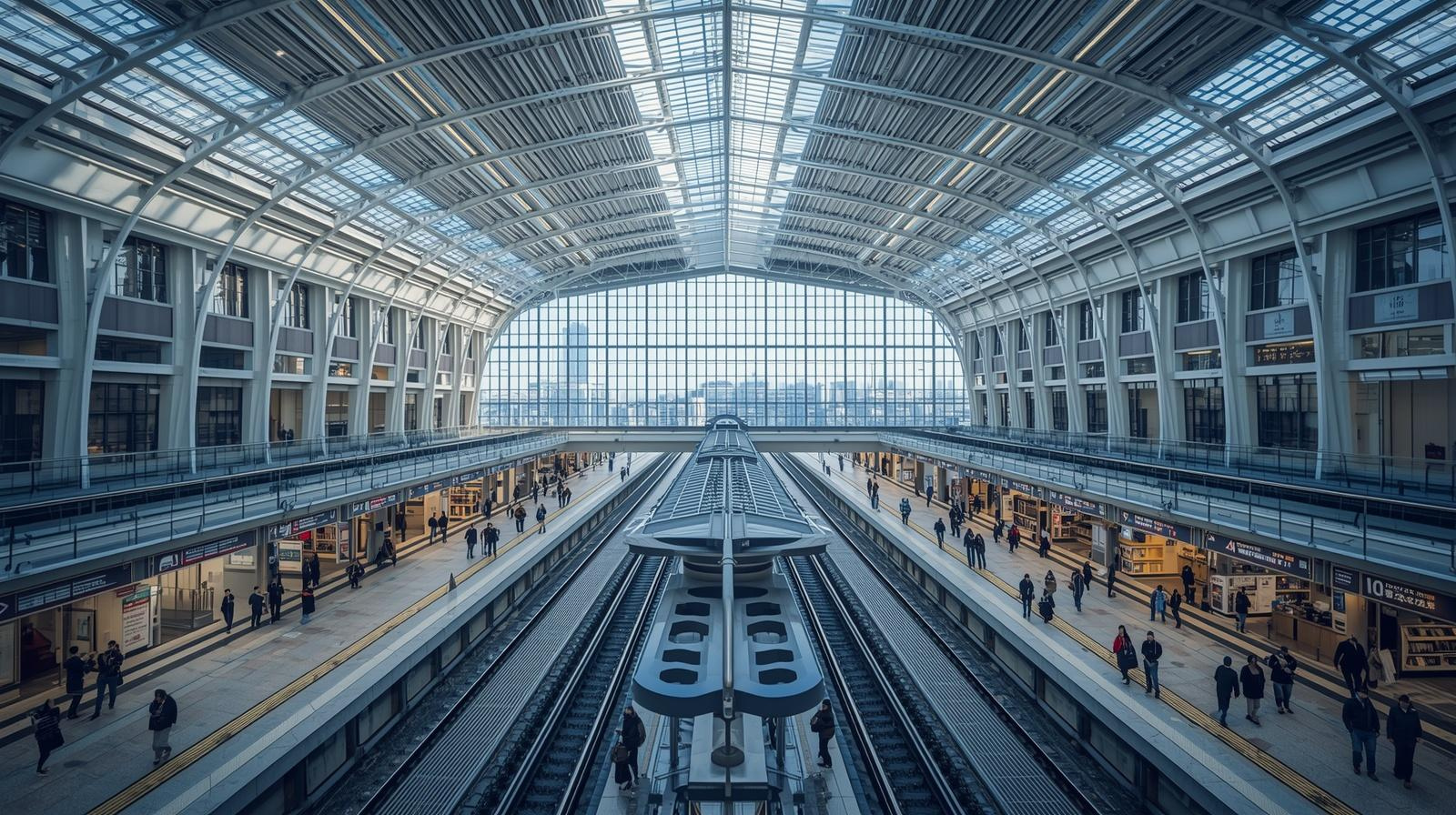
Built in 1997 to the design of architect Hiroshi Hara, Kyoto Station is not merely a transport hub. It is a cultural landmark, a civic plaza, a piece of theatrical architecture, and the main artery through which millions of visitors each year enter one of the world’s most celebrated cities. Love it or loathe it, and Kyoto’s citizens have argued about it fiercely since the day it opened, it is impossible to ignore.
At a Glance
| Location | Karasuma-dori, Shimogyo Ward, Kyoto, Japan |
| Opened | 11th September, 1997 |
| Architect | Hiroshi Hara (Hara + Associates) |
| Footprint | Approximately 238,000 m² (gross floor area) |
| Floors | 16 above ground, 3 below ground |
| Height | 60 m at the tallest atrium |
| Daily Passengers | Approx. 180,000+ (pre-pandemic figures) |
| Key Lines | Shinkansen (Tokaido/San’yo), JR Kyoto Line, Kintetsu Kyoto Line, Karasuma Subway Line |
| Connected Facilities | Isetan department store, Grand Via Hotel, Kyoto Theatre, shopping malls |
The Architecture: A Futuristic Landmark
Hiroshi Hara’s Vision
When the city of Kyoto held a design competition for the new station building in the early 1990s, the winning entry by Hiroshi Hara was simultaneously celebrated as a work of architectural genius and condemned as an act of cultural aggression. A city that had spent decades carefully limiting the height of buildings to protect its historic skyline, the Kyoto Landscape Policy stipulates that most buildings must not exceed 45 metres, was suddenly about to acquire a structure that punched through that ceiling in spirit if not always in strict letter.
Hara’s concept drew on the metaphor of a canyon or a valley carved into an urban hillside. He envisioned the station not as a building one passes through, but as a landscape one inhabits. The result is an enormous, stepped interior atrium, 470 metres long, that runs the full width of the structure from east to west, covered by a soaring glass-and-steel roof that floods the space with natural light.
“A station is not just a place to catch a train. It is a place where the city happens.” — Hiroshi Hara
The Grand Atrium
The centrepiece of Kyoto Station is its extraordinary atrium: a cathedral-like void that ascends sixteen storeys above the station concourse. The glass roof, composed of an intricate lattice of steel trusses and triangulated glass panels, admits diffused daylight that shifts colour and intensity with the weather and the seasons. On overcast winter mornings it glows a cool blue-grey; on summer afternoons it fills with warm gold.
A monumental escalator system, one of the longest outdoor escalator sequences in Japan, rises steeply from the ground floor to the rooftop Sky Garden on the tenth floor, offering progressively vertiginous views back across the atrium’s depths. Visitors who have made the ascent describe a feeling not unlike climbing the interior of a cathedral: a growing sense of height, exposure, and grandeur.
The stepped terraces that flank the escalators function as an informal amphitheatre. Community events, concerts, seasonal illuminations, and exhibitions are regularly staged here, turning the atrium into something closer to a city square than a conventional transport hall. During the winter holiday season, a vast illuminated Christmas tree installation fills the space, drawing crowds that have nothing to do with catching a train.
Rooftop Garden and Sky Walk
At the top of the building, the Sky Garden offers one of the finest panoramas of the Kyoto basin available anywhere in the city. On clear days, visitors can see the Higashiyama mountains to the east, Arashiyama to the northwest, and the densely packed urban fabric of the old city stretching in every direction below. The garden itself is planted with a mix of ornamental shrubs and seasonal flowers, and the terrace walkways are popular with photographers at sunrise and sunset.
A partially open-air sky walkway runs along the rooftop, connecting different sections of the building at altitude. The experience of standing on this exposed walkway, with the wind and the city below, makes for one of the more unexpectedly dramatic moments available in a Japanese train station.
Controversy and Cultural Debate
Few buildings in modern Japan have generated more sustained controversy than Kyoto Station. Critics, and there were many, from city councillors to Buddhist temple abbots, argued that the scale and aesthetic of the building were entirely out of keeping with Kyoto’s historic character. The station’s glass-and-steel modernism stood in stark contrast not only to the nearby Toji Temple (a UNESCO World Heritage Site whose five-storey pagoda had once been the tallest structure in the city) but to the prevailing philosophy of architectural restraint that had shaped Kyoto’s post-war urban landscape.
Supporters countered that Kyoto was not a museum, and that a city with a living, evolving population of 1.5 million people had the right, the obligation, even, to build infrastructure appropriate to its needs and its times. They pointed to the station’s extraordinary civic ambition: its ability to function simultaneously as a transport node, a shopping destination, a cultural venue, and a public plaza for a city that lacked other large-scale public gathering spaces.
Nearly three decades on, the controversy has not entirely subsided, but it has mellowed. Kyoto Station is now firmly embedded in the life and identity of the city. Locals meet friends under the atrium clock. Students eat lunch on the grand staircase. Tourists arrive from around the world to photograph the illuminated lattice roof at night. The building has earned its place, on its own terms, which were always those of confident modernity rather than apologetic heritage.
Shinkansen Access: The Heartbeat of the Station
Japan’s Legendary Bullet Train Network
For most international visitors, Kyoto Station’s primary significance is as a Shinkansen hub, a gateway into Japan’s extraordinary high-speed rail network. The Shinkansen (literally “new trunk line”) is one of the world’s great engineering achievements: a system of dedicated high-speed lines that has carried passengers since 1964 without a single fatality attributable to a train accident, and whose punctuality record, average delays measured in single-digit seconds, remains the envy of rail operators worldwide.
Kyoto sits on the Tokaido Shinkansen, Japan’s busiest and most storied high-speed corridor, which runs 515 kilometres between Tokyo and Osaka’s Shin-Osaka station. The line opened in October 1964, just ten days before the Tokyo Olympics, a piece of timing that was precisely calculated for maximum symbolic impact, and immediately transformed travel between Japan’s two great cities. What had been a six-hour journey by conventional rail became, overnight, a matter of hours. Today, the fastest services cover the Tokyo–Kyoto distance in around two hours and fifteen minutes.
Services Calling at Kyoto
Three distinct classes of Shinkansen service stop at Kyoto Station, each offering a different balance of speed and frequency:
| Nozomi | The fastest service. Tokyo–Kyoto in approx. 2 hrs 15 mins. Does not accept JR Pass. Runs frequently throughout the day. |
| Hikari | Slightly slower than Nozomi, with more stops. Tokyo–Kyoto in approx. 2 hrs 45 mins. Fully JR Pass compatible. |
| Kodama | All-stations service on the Tokaido Shinkansen. Slower but useful for intermediate destinations. JR Pass compatible. |
For travellers holding a Japan Rail Pass, the tourist pass that provides unlimited travel on the majority of JR services, the Hikari and Kodama services offer seamless, cost-effective connectivity to Tokyo in the east and to Hiroshima and Hakata (Fukuoka) in the west via the San’yo Shinkansen extension.
The Shinkansen Experience
The Shinkansen platforms at Kyoto Station, platforms 11 through 14, occupy the southern wing of the building, separated from the conventional rail concourse by a series of ticket gates. Boarding a Shinkansen at Kyoto is, for many visitors, one of the defining experiences of a trip to Japan: the departure boards listing imminent services to a dozen cities; the trains themselves pulling in with silent, uncanny precision, nose-cone to nose-cone with the platform edge; the white-gloved attendants who rotate every seat at the end of each journey so that all passengers face the direction of travel.
The Series N700 and N700S trains that operate most Tokaido Shinkansen services seat over 1,300 passengers across sixteen carriages. The interiors are clean, quiet, and comfortable, with reserved and non-reserved seating options. Large windows, particularly prized in the seats on the right-hand side of the train heading from Tokyo towards Kyoto, offer the celebrated view of Mount Fuji on clear days.
On the platform, the train arrives. Not early. Not late. At the precise second printed on the departure board. Japan, distilled into a single moment.
Connectivity Beyond the Shinkansen
Kyoto Station’s rail connectivity extends well beyond the bullet trains. The station is served by the Karasuma Line of the Kyoto Municipal Subway, which runs north-south through the city centre and provides direct access to Kyoto’s main shopping district at Shijo and to the Kyoto Imperial Palace area at Marutamachi. The JR Kyoto Line (Biwako Line) connects the station to Osaka’s Umeda district in around 30 minutes, offering a cost-effective alternative to the Shinkansen for short-hop travel between the two cities. The Kintetsu Kyoto Line, departing from a dedicated terminal within the station complex, provides a direct link to Nara, making it possible to visit Japan’s ancient deer-filled capital as a comfortable day trip.
An extensive bus terminal at the station’s north exit serves as the primary hub for Kyoto’s city bus network, arguably the most useful mode of transport for visiting temples and shrines scattered across the city’s suburbs, many of which are not directly served by rail.
Visiting Kyoto Station: Practical Notes
Getting There
From Tokyo: Tokaido Shinkansen Hikari services depart Tokyo Station (and Shinagawa) frequently throughout the day. The journey takes approximately 2 hours 40 minutes. Nozomi services are faster but not covered by the JR Pass.
From Osaka: JR Kyoto Line rapid services run frequently from Osaka (approx. 30 minutes) and Shin-Osaka (also approx. 15 minutes by Shinkansen or 30-35 minutes by rapid). Kyoto is extremely accessible as a day trip from Osaka.
From Nara: Kintetsu Limited Express services from Kintetsu Nara Station take approximately 45 minutes. JR services via Nara Station are also available but slower.
What to See at the Station Itself
Allow at least 30–45 minutes to explore the station building itself. Take the central escalators to the rooftop garden for city views. Walk the full length of the grand staircase at the western end of the atrium. In the evening, the lattice roof is illuminated, making the interior particularly photogenic. The basement food halls (depachika) beneath the Isetan department store offer an excellent introduction to Japanese food culture, with fresh sushi, wagashi sweets, bento boxes, and regional specialities from across Japan.
Onwards into Kyoto
The station’s location, on the southern edge of the traditional city centre, means that many of Kyoto’s most celebrated sites require onward travel. The Fushimi Inari Taisha shrine, with its thousands of vermilion torii gates, is ten minutes away by JR local train. Kinkakuji (the Golden Pavilion), Arashiyama, and the Philosopher’s Path are best reached by bus from the station’s north exit. The Gion district and Higashiyama temple corridor are accessible by subway or a pleasant 30-minute walk.
A City at the Crossroads
Kyoto Station is, in many ways, a perfect emblem of contemporary Japan: a country that has achieved a relationship with its past unlike any other, preserving it with extraordinary fidelity in some domains, departing from it with supreme confidence in others. The station does not pretend to be something it is not. It does not borrow the vocabulary of traditional Japanese architecture. It makes no gestures towards the temples and pagodas that surround it. It is simply, proudly, a great work of late-twentieth-century engineering and architecture, one that happens to stand at the entrance to one of the world’s oldest living cities.
Arriving at Kyoto by Shinkansen, stepping off the train and into the cathedral of steel and glass that greets you, is to experience that duality in a single, immediate moment. Behind you: 300 kilometres of track, covered in the time it takes to read a few chapters of a novel. Ahead of you: a city where the same tea ceremony has been performed, with the same gestures, in the same order, for four hundred years.
Welcome to Kyoto. You have arrived.
— END —
Leave a Reply