
ARCHITECTURE & HISTORY · LOS ANGELES, CALIFORNIA
The Last Great Station: Mission Moderne and the Dream of Southern California
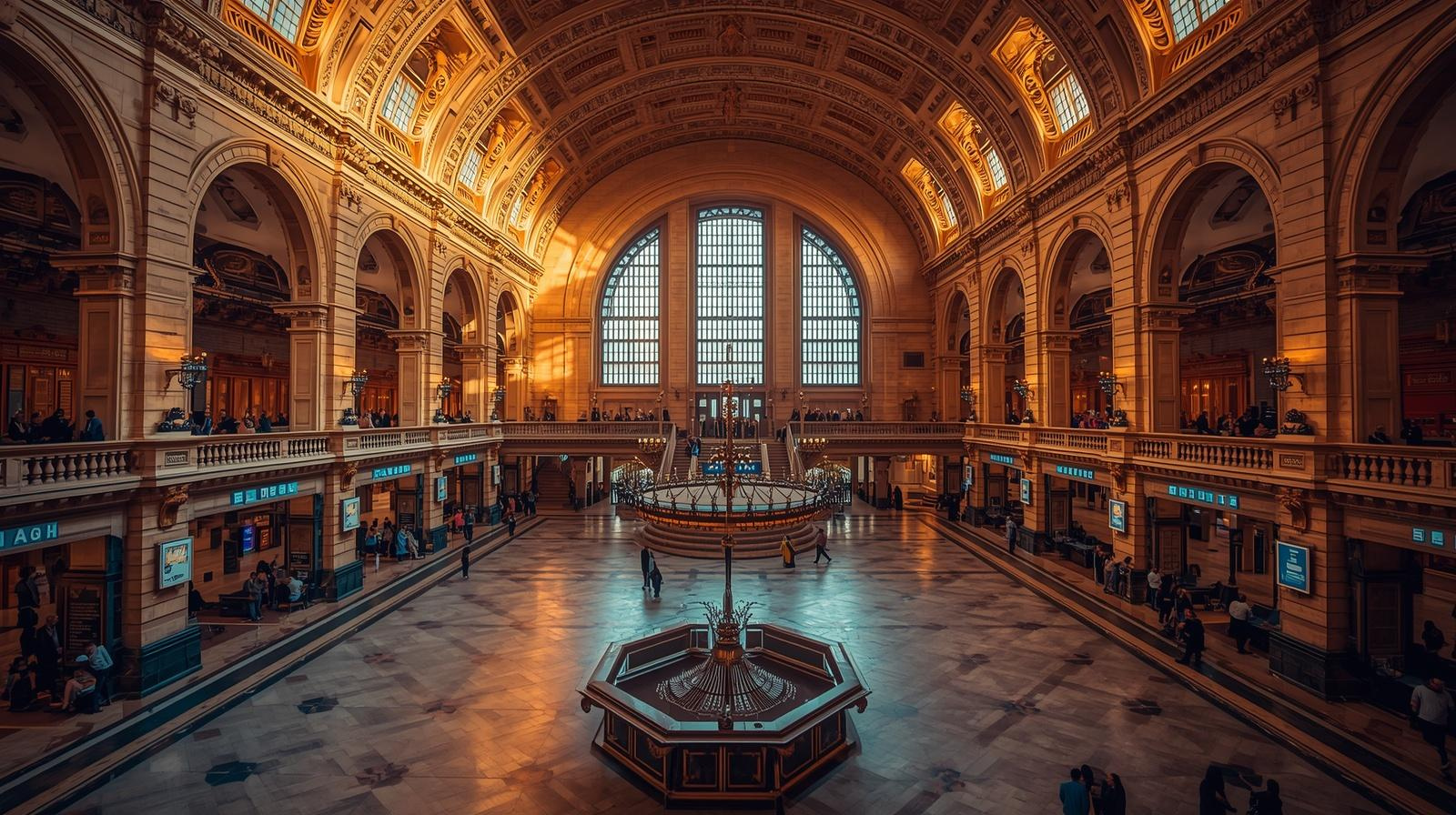
There is a building in downtown Los Angeles that stops people in their tracks. Not the glass towers of Bunker Hill, not the Disney Concert Hall’s swooping titanium, but a low, cream-coloured structure on Alameda Street, with red tile roofs, arcaded walkways, swaying palms, and a clock tower that rises above it all with quiet authority. Los Angeles Union Station opened in 1939 and was immediately recognised as something extraordinary: the last great railway terminal built in the United States, a building that distilled the romance, ambition, and peculiar cultural identity of Southern California into a single, unforgettable structure.
AT A GLANCE
| Opened | 7th May, 1939 |
| Architects | John Parkinson & Donald B. Parkinson (Parkinson and Parkinson) |
| Style | Mission Moderne, Spanish Colonial Revival, Mission Revival, and Art Deco |
| Location | 800 N. Alameda Street, Los Angeles, California |
| Cost | $11 million (constructed during the Great Depression) |
| Size | 161,000 sq ft terminal building; 38 acres total site |
| Listed | National Register of Historic Places (1980) |
| Ownership | Acquired by LA Metro in 2011 |
| Daily passengers | Approximately 110,000 |
Origins: The End of an 18-Year Battle
The story of Los Angeles Union Station is inseparable from the story of the city itself, a story of rapid, chaotic growth, rival corporate powers, and a civic ambition that consistently outran the available infrastructure. By the 1900s, three major transcontinental railroads served Los Angeles: the Southern Pacific, the Union Pacific, and the Atchison, Topeka and Santa Fe. Each operated its own separate depot, each in a different part of the city, each a source of confusion and inefficiency for passengers and civic planners alike.
The push for a consolidated union station began in earnest in the 1910s and quickly became one of the most contentious civic battles in Los Angeles history. The railroads were reluctant to surrender their independence and share facilities. Legal challenges, injunctions, and counter-proposals stretched the fight across nearly two decades. A 1926 public referendum finally broke the deadlock, with Los Angeles voters approving the union station concept by a wide margin. Even then, litigation continued for several more years before the railroads were compelled to co-operate and jointly fund construction.
The chosen site was historically and symbolically charged: the northern edge of El Pueblo de Los Angeles, the original Spanish settlement from which the city had grown, adjacent to the Plaza and within sight of the old mission buildings of Olvera Street. But that land was not empty. It was occupied by Old Chinatown, a thriving neighbourhood of families, businesses, temples, and associations whose roots in Los Angeles stretched back to the mid-nineteenth century. Hundreds of Chinese-American residents and business owners were displaced by the development, their community demolished to make way for the station and its rail approaches. A new Chinatown was subsequently built several blocks to the north, but the destruction of the old neighbourhood remains a defining and painful chapter in the station’s history. An archaeological mound in the station’s rotunda area still contains artefacts recovered from the demolition of Old Chinatown.
Construction began in 1936 and took three years, employing thousands of workers during the depths of the Great Depression. The total cost came to $11 million, a remarkable sum for the era, jointly borne by the three railroad companies. The station opened on 7th May 1939, with a three-day public celebration attended by nearly half a million Angelenos. Stars from the nearby film studios mingled with railway executives, politicians, and ordinary residents who had waited nearly two decades for this moment. It was, by any measure, the most glamorous railway opening in American history.
The Architects: John and Donald Parkinson
The men who designed Union Station were, in a real sense, the men who designed Los Angeles. John Parkinson (1861–1935) and his son Donald Berthold Parkinson (1895–1945) were together responsible for more landmark buildings in Los Angeles than any other architectural firm of their era. Their fingerprints are on the city’s skyline, its civic identity, and its sense of itself as a place worthy of grandeur.
John Parkinson was born on December 12, 1861, in Scorton, a small village in Lancashire, northern England, into a working-class family. He had no formal architectural training. Instead, he apprenticed in the building and stair-construction trades, attending night school at Bolton’s Mechanics Institute to study engineering and drafting, largely teaching himself architecture from books and journals borrowed from public libraries. As historian Kevin Starr observed, “John Parkinson should be considered one of the founders of Los Angeles.” The assessment is not hyperbolic.
*
He arrived in Los Angeles in 1894, when the city was a modest settlement of around 50,000 people. Within two years he had designed the city’s first Class A fireproof steel-frame building, the Homer Laughlin Building. In 1904, his Braly Block became the city’s first genuine skyscraper. He partnered with G. Edwin Bergstrom from 1905 to 1915, Bergstrom would later go on to design the Pentagon, and together they shaped the commercial character of downtown’s Spring Street corridor. John Parkinson participated in the design of twenty-one buildings on Spring Street alone, and most of them still stand.
In 1920, John was joined by his son Donald, who brought with him a degree from the Massachusetts Institute of Technology and a sophisticated grasp of the emerging Art Deco and Streamline Moderne styles that were transforming architecture in the 1920s and 1930s. The shift in the firm’s sensibility is visible in the buildings they produced together: the Los Angeles City Hall (1928), a soaring tower that became the defining silhouette of the civic centre; and Bullocks Wilshire (1929), an Art Deco department store of such elegance that it has been compared to the Chrysler Building in New York. Union Station would be the culmination of their partnership, and John Parkinson died in 1935, four years before the building he had helped conceive finally opened. Donald saw it through to completion.
The Parkinson archive, over 20,000 drawings, blueprints, photographs, and office records, was acquired by the Huntington Library in Pasadena and represents what curators there have called “a biography of modern Los Angeles.” Despite designing more than 400 buildings in Los Angeles, John Parkinson’s name remained largely unknown to the wider public until Stephen Gee’s 2013 biography, Iconic Vision: John Parkinson, Architect of Los Angeles, and the accompanying PBS documentary brought renewed attention to his extraordinary legacy.
The Design: Mission Moderne — California’s Own Style
The architectural style of Union Station defies easy categorisation, which is, in a sense, the point. The term most commonly used is Mission Moderne, a hybrid coined specifically to describe this building and its particular blending of historical references and contemporary techniques. It draws simultaneously from Spanish Colonial Revival, Mission Revival, and the sleek geometric vocabulary of Art Deco, holding all three in a relationship of surprising harmony.
The Parkinsons’ original design instinct had been toward Beaux-Arts monumentality, the grand classical language of their earlier civic work, including City Hall. But the three railroad companies, aware that Southern California had a distinct regional identity worth celebrating, pushed the designers toward something more local. The result was a building that evokes the whitewashed missions and Spanish colonial architecture of California’s past while embracing the clean lines and machine-age precision of the 1930s present. As the SAH Archipedia describes it, the station “continues to evoke Los Angeles’s Spanish past to arriving passengers with its arcaded walkways, swaying palm and pepper trees in outdoor courtyards, and majestic interior spaces with richly beamed ceilings and colourful tile accents.”
The exterior is clad in white stucco with terracotta roof tiles that sweep across multiple levels, punctuated by a distinctive 135-foot clock tower visible from Alameda Street. The main entrance is framed by a deeply recessed grand arch decorated with a pierced Moorish star-and-cross screen and vivid Spanish tile accents, an entrance that signals something between a mission courtyard and a Hollywood set, with an atmosphere entirely its own. Lush outdoor patios planted with orange trees, fan palms, espalier magnolias, and pepper trees complete the sense of arrival in a warm, sun-drenched landscape.
Inside, the architectural drama intensifies. The Main Waiting Room is one of the great interiors of twentieth-century American architecture: 52 feet high, with oversize steel and concrete beams painted and finished to resemble heavy wooden timbers, from which hang enormous circular light fixtures ten feet in diameter. Acoustic wall tiles dampen sound, while yellow Montana travertine and small Spanish tiles cover the lower walls. The floor is laid in red quarry tile inlaid with a “carpet” of coloured marbles and travertine, creating visual pathways that guide passengers through the room. A hard white plaster band with shell patterns encircles the space at mid-height, separating the tiled lower walls from the acoustic tile above.
The Historic Ticket Concourse, entered through the main arch, features 30 ticket windows made of American black walnut, with immense brass windows and a vaulted ceiling that draws the eye upward. When the station opened, it was the largest railroad passenger terminal in the western United States. Natural light floods the space through enormous glazed openings, softened by the arcade’s deep overhangs outside.
A separate jewel within the building is the Fred Harvey Restaurant, whose interiors were designed not by the Parkinsons but by Mary Colter, chief architect and decorator for the Fred Harvey Company from 1902 to 1948 and one of the most important designers in the American Southwest. Colter’s main dining room is a tour de force of Spanish Colonial Revival and Native American synthesis: high, slightly pointed arches, a recessed beam ceiling with metal pendant lights, and a geometric Navajo rug pattern executed in tile on the floor. Custom wall tiles decorated with a parrot motif line the walls. For the cocktail lounge, Colter took a completely different approach, Streamlined Moderne, with curving walls, curved cocktail booths, and a copper-fronted bar. The combination of Colter’s intimate interiors with the Parkinsons’ civic grandeur gives the station a richness and variety that few public buildings anywhere in the world can match.
A History Written in Departures and Arrivals
From the day it opened, Union Station was not merely a railway terminal but a stage for the most dramatic and consequential moments of Los Angeles life. The film industry, already flourishing when the station was built, embraced it immediately. Its arcades, waiting room, and courtyards appeared in films almost from the start, and the tradition has continued unbroken for more than eighty years.
The Second World War transformed the station into something else entirely: a pivot point for the entire Pacific war effort. As the westernmost major terminus of the transcontinental rail network, Los Angeles Union Station handled a staggering volume of military traffic. Soldiers, sailors, and marines passed through by the millions on their way to and from the Pacific. The waiting room became a place of farewells and homecomings, of reunions and grief. The station also witnessed one of the most shameful episodes in American wartime history: in 1942, Japanese-American families, many of them Angelenos for multiple generations, were assembled at Union Station for forced transportation to internment camps in the interior. They boarded trains here and departed from a city that was, in that moment, betraying them.
The post war decades brought the same pressures that afflicted every American railway station: the rise of the automobile, the construction of the Interstate Highway System, and the emergence of commercial aviation. Passenger numbers fell. The Harvey House restaurant, once the social heart of the station, closed in 1967. By the 1970s, Union Station had become a shadow of its former self, still beautiful, still used, but diminished.
The revival began slowly in the 1970s with the growth of Amtrak, and accelerated when the station was placed on the National Register of Historic Places in 1980. A major restoration completed in 1992 returned the building’s interiors to something approaching their original splendour. The opening of the Metro Red Line subway in 1993, with its terminus directly beneath the station, was a turning point: Union Station was now a genuine multimodal hub, not just a railway relic. The Los Angeles County Metropolitan Transportation Authority, Metro, acquired the station outright in 2011, assuming responsibility for its management and future development.
“The last of the great railway stations, an exciting site of colliding community histories.”
— Los Angeles Conservancy
Union Station Today: Hub, Stage, and Cultural Centre
Today, Los Angeles Union Station serves approximately 110,000 passengers every day, making it the busiest transportation hub in Southern California and the largest railroad passenger terminal in the western United States. It is simultaneously a working transit interchange, a historic landmark, a cultural venue, a film location, and an event space, one of the few public buildings in America that manages to be all of these things at once without feeling compromised in any of them.
The transit function is formidable. Union Station is the southern terminus and hub of the Amtrak network in California, serving long-distance routes including the Coast Starlight (to Seattle), the Sunset Limited (to New Orleans), and the Southwest Chief (to Chicago), as well as California regional services including the Pacific Surfliner to San Diego and Santa Barbara. Metrolink commuter trains fan out from the station across six county lines, reaching San Bernardino, Riverside, Orange County, Ventura County, the Antelope Valley, and the Perris Valley. Multiple Metro Rail lines connect directly beneath the station, including the B (Red) Line and D (Purple) Line subways, and the A (Blue) and L (Gold) Lines. Metro Bus and municipal bus services from surrounding cities serve the adjacent Patsaouras Transit Plaza. The LAX FlyAway bus provides a direct non-stop link to Los Angeles International Airport. In total, the station connects passengers to the entire Southern California region from a single, beautifully designed building.
The Historic Ticket Concourse, its black walnut windows and vaulted ceiling restored to their original brilliance, is now reserved for private events, corporate receptions, and film and television productions. The list of productions that have used Union Station as a location reads like a survey of Hollywood history: Blade Runner (1982), The Way We Were, Pearl Harbour, The Dark Knight Rises, Catch Me If You Can, Seabiscuit, and, perhaps most notably, Everything Everywhere All at Once, which filmed extensively at the station and went on to win the Academy Award for Best Picture in 2023. The station hosted the Academy Awards ceremony itself in 2021, when the COVID-19 pandemic necessitated a smaller, more intimate venue; the ceremony’s producers restored and repainted the waiting room’s vibrantly coloured ceiling for the occasion.
Beyond its role as a filming location, Union Station has become one of the most active cultural venues in downtown Los Angeles. Metro Art presents rotating exhibitions, live performances, and public programmes throughout the building. The outdoor North and South Patios, planted with the orange trees, palms, and magnolias that have shaded the station since 1939, host weddings, corporate events, concerts, and seasonal celebrations. The annual Train Festival, held in partnership with Metro, Amtrak, and Metrolink, draws rail enthusiasts, historians, families, and architecture lovers for a two-day celebration of Southern California’s rail heritage; the 2025 edition, held in September, featured live steam locomotive demonstrations, model train exhibits, and tours led by Los Angeles Conservancy docents. Holiday markets, film screenings, music festivals, and cultural exhibitions fill the calendar throughout the year.
The station’s future is also actively under construction. Metro’s Link Union Station (Link US) project will transform the station from a stub-end terminus, where trains must reverse direction, into a through-running facility, allowing Metrolink trains to continue north rather than terminating at Union Station. The project is designed to dramatically increase capacity and efficiency across the regional rail network and is essential to supporting California’s proposed high-speed rail service, which is eventually planned to connect Los Angeles to San Francisco via the Central Valley. Construction of a future high-speed rail concourse at the rear of the station has been designed to proceed without affecting the historic terminal building itself.
Legacy: The California Dream in Stone and Tile
Los Angeles Union Station is more than a beautiful building. It is a record of what Southern California has been, and what it has aspired to be. In its Spanish arches and Art Deco geometry, in the warmth of its tiled courtyards and the grandeur of its waiting room, it embodies the peculiar promise that Los Angeles has always made to those who arrive here, that this place is different, that the sunshine is real, that something extraordinary might happen.
It is also a building that carries difficult history honestly. The displacement of Old Chinatown, the internment of Japanese Americans, the racial and economic inequalities that shaped the city it served, these are not erased by the beauty of the architecture but held within it, legible to those who look. The permanent exhibition Where You Stand: Chinatown 1880 to 1939, installed in the station in recent years, invites visitors into the history of the community that once stood on this land.
When historian Kevin Starr described John Parkinson as “one of the founders of Los Angeles,” he was acknowledging something that the city has been slow to recognise: that the built environment is not mere backdrop, but the visible form of a community’s values, ambitions, and contradictions. Union Station is the fullest expression of Parkinson’s vision, a building designed to last, to serve, and to mean something. More than eighty-five years after its opening, it continues to do all three.
Leave a Reply