
ARCHITECTURE & HISTORY · WASHINGTON, D.C.
The Grand Gateway: Beaux-Arts Splendour and a Century of American Life
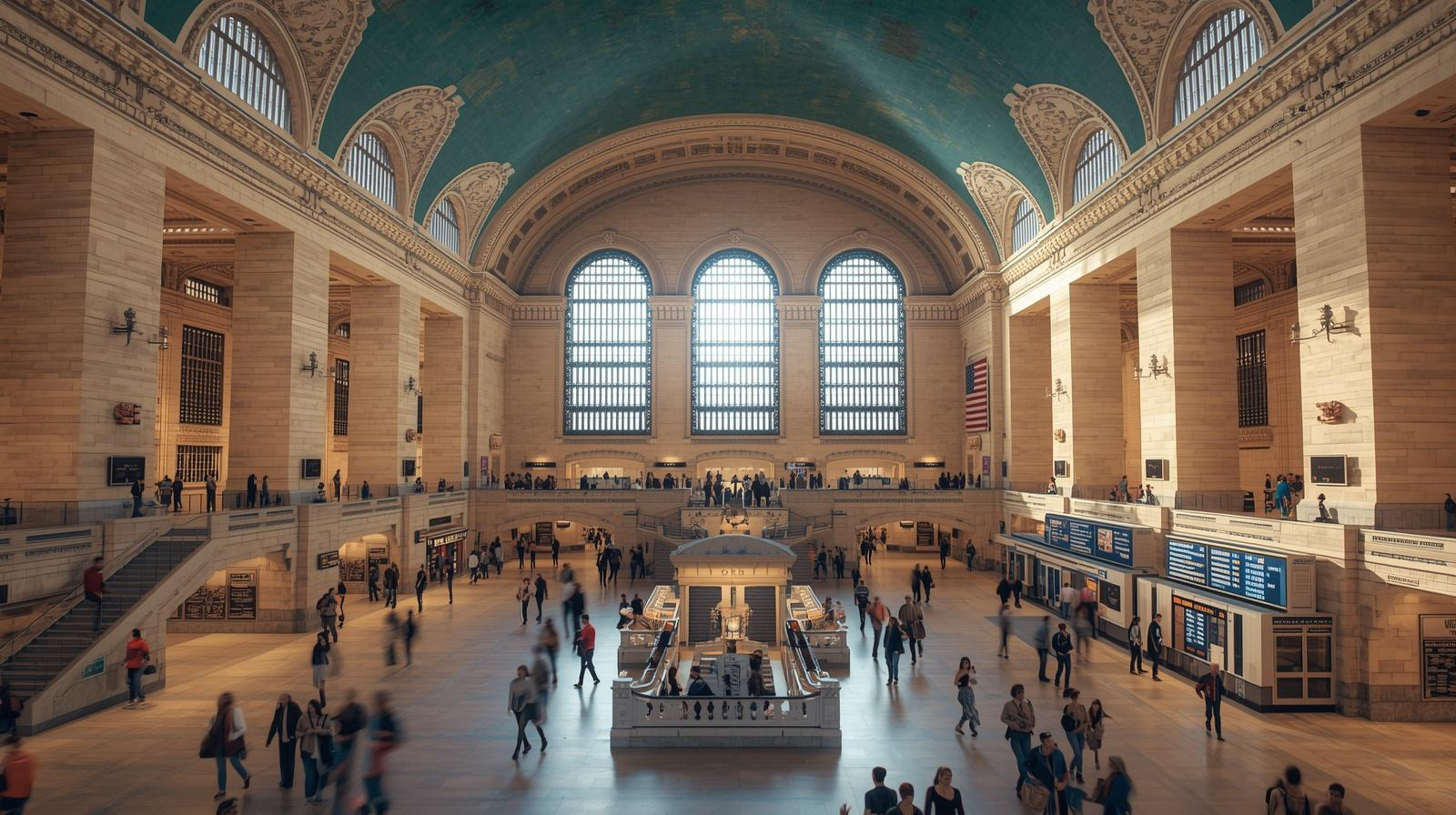
Few buildings in America announce a city with such authority. Rising at the foot of Capitol Hill, Washington Union Station presents itself not merely as a place to board a train, but as a monument, a declaration that the nation’s capital deserves an entrance worthy of its name. For more than a century, it has been the first thing millions of visitors see as they arrive in Washington, and it remains one of the most magnificent public spaces in the United States.
AT A GLANCE
| Opened | 27th October, 1907 (completed April 1908) |
| Architect | Daniel H. Burnham / D.H. Burnham & Company |
| Style | Beaux-Arts (Neoclassical) |
| Location | Columbus Circle, Massachusetts Ave NE, Washington, D.C. |
| Size at opening | Largest building in the U.S. at the time, 200 acres, 75 miles of track |
| Listed | National Register of Historic Places (1969) |
| Annual visitors | Over 40 million (pre-pandemic peak) |
Origins: Clearing the Mall
By the closing years of the nineteenth century, Washington had a problem. The sweeping public promenade envisioned by Pierre Charles L’Enfant in his 1791 plan for the city, the great National Mall, had been degraded by decades of misuse. Railroad tracks cut across it; a functioning station squatted near the base of the Capitol. The city that was supposed to embody republican grandeur was, in one of its most symbolic spaces, a tangle of coal smoke, freight lines, and disorder.
Relief came in the form of the 1902 McMillan Commission, formally the Senate Park Commission, which convened some of the finest minds in American architecture and planning: Daniel H. Burnham, Charles McKim, landscape architect Frederick Law Olmsted Jr., and sculptor Augustus Saint-Gaudens. The commission placed restoring L’Enfant’s vision at the heart of its mandate. Removing the railroads from the Mall was essential, and that meant building something to replace them: a great consolidated station that would unite the two major lines, the Pennsylvania Railroad and the Baltimore and Ohio, under one majestic roof.
In 1901, the railroads had already agreed in principle to the consolidation. Congress authorised the project in 1903. The chosen site was a boggy, low-lying neighbourhood north of Massachusetts Avenue, known locally as “Swampoodle.” Construction began that same year. Union Station welcomed its first train, a B&O passenger service from Pittsburgh, on 27th October, 1907, and was formally completed the following April.
The Architect: Daniel Hudson Burnham
Daniel Hudson Burnham was born on 4th September, 1846, in Henderson, New York, and grew up in Chicago after his family moved there when he was eight. He failed the entrance examinations for both Harvard and Yale, a setback that did nothing to dim one of the most expansive ambitions in the history of American architecture. By the turn of the twentieth century, he was widely regarded as the pre-eminent architect in the United States.
His early career was built in partnership with John Wellborn Root, with whom he established the firm of Burnham & Root in Chicago in the 1870s. Together they were pioneers of the skyscraper, designing buildings such as the Rookery (1886) and the Monadnock (1891) that helped define the new urban scale of the American commercial city. When Root died suddenly in 1891, Burnham reorganised the practice as D.H. Burnham & Company and continued to build on an ever-larger canvas.
The transformation of Burnham from a successful commercial architect into a figure of national significance came with the World’s Columbian Exposition of 1893 in Chicago, for which he served as Director of Works. The “White City”, its grand neoclassical buildings gleaming in coordinated Beaux-Arts splendour, was a sensation that drew millions of visitors and ignited a nationwide passion for civic beauty. It launched what became known as the City Beautiful movement, of which Burnham was the leading champion.
His famous maxim, “Make no little plans; they have no magic to stir men’s blood”, captured his approach perfectly. He went on to produce comprehensive plans for Washington D.C., Chicago, Cleveland, San Francisco, Manila, and Baguio in the Philippines. Union Station was the crowning physical realisation of his Washington work. Burnham died in Heidelberg, Germany, on June 1, 1912, just four years after the station’s completion. His legacy endures in every barrel vault and inscribed stone of the building he left behind.
“Make no little plans; they have no magic to stir men’s blood. Make big plans, aim high in hope and work.”
— Daniel H. Burnham
The Architecture: A Roman Dream in White Granite
Union Station is one of the finest, and largest, examples of the Beaux-Arts style in the United States. Beaux-Arts architecture, named for the École des Beaux-Arts in Paris, drew freely on the forms of ancient Greece and Rome, filtered through the grandeur of the French Renaissance. Its hallmarks are monumental scale, symmetrical composition, rusticated stone bases, elaborate sculptural programmes, and an unapologetic delight in ornament.
Burnham faced a design problem that had no classical precedent: ancient architects never built railway terminals. His solution was characteristically bold. He reached back to two Roman building types and fused them. The triumphal arch, specifically the Arch of Constantine in Rome, provided the model for the great triple-arched central entrance, symbolising Union Station as the gateway to the capital. The imperial bath, the vast, crowd-handling interiors of the Baths of Caracalla and Diocletian, inspired the station’s ability to move enormous numbers of people through a series of grand, interconnected spaces. The exterior is clad in white granite quarried in Maine, its clean classical lines setting a standard that would influence Washington architecture for the next four decades, including the Lincoln and Jefferson Memorials and the Supreme Court building.
The façade stretches for 626 feet and is punctuated by a 626-foot loggia of vaulted bays. Rostral columns, cast-iron pillars topped with gilded eagles, flank both main entrances. The sculptural programme, created by Louis Saint-Gaudens (brother of Augustus), fills the niches with 25-ton allegorical figures representing the forces of progress: Agriculture, Electricity, Fire, and Mechanics, alongside Freedom, Justice, Imagination, and Inspiration. Stone inscriptions chiselled into the granite proclaim the virtues of travel and commerce.
Inside, the Main Hall is overwhelming in its ambition. At the time of construction it was considered the largest room in the world: 120 feet wide, 220 feet long, with a Roman barrel-vaulted ceiling soaring 96 feet above the floor. The ceiling is coffered with 255 octagonal panels, each decorated with egg-and-dart moulding and gold leaf at the centre. A peristyle of Doric columns runs along the perimeter, above which 36 Roman Legionnaire statues stand in arched alcoves, each framed in gold-leaf coffers. The interior woodwork throughout is solid mahogany. When the station was built, it covered more ground than any other structure in the United States, 200 acres in total, served by 75 miles of railroad track. As one commentator put it, the Washington Monument could be laid on its side and fit within the concourse.
One famous detail: the large clock face in the Main Hall uses IIII rather than the standard Roman numeral IV, a quirk with medieval origins found in many ornamental clocks, where the symmetry of four strokes was considered more visually pleasing than the asymmetric combination of I and V.
A Century of Life: Glory, Decline, and Rescue
From the day it opened, Union Station was at the centre of the nation’s life. It included barber shops, a bowling alley, a mortuary, and what was once billed as Washington’s finest restaurant. It had a dedicated Presidential Suite, an elaborate suite of rooms on the southeast side, with grand wooden entryways and private offices, designed for the exclusive use of the head of state and visiting foreign dignitaries. During World War I, President Woodrow Wilson opened the suite to the American Red Cross, which ran a canteen there serving thousands of soldiers a day.
The station’s greatest moment of intensity came during World War II. As troop movements flooded the rail network, as many as 200,000 passengers passed through Union Station in a single day. Soldiers, nurses, Red Cross volunteers, officers, and civilians from every corner of the country poured through its arches. For a brief period, the station was the beating heart of a nation at war.
The post war decades brought a long, slow decline. As Americans shifted from rail to cars and air travel, passenger numbers fell sharply. Revenues collapsed. The Penn Central railroad went bankrupt in 1970. By the mid-1970s, the federal government had taken over the building with an ill-fated scheme to convert it into a National Visitor Centre, a project so poorly funded and designed that it failed almost immediately after opening in 1976. Union Station’s low point came in 1981, when heavy rain sent pieces of the deteriorating roof crashing into the Main Hall. Most of the building had to be shuttered.
Congress responded with the Union Station Redevelopment Act of 1981, which created what was at the time the largest public-private venture in American history. A $160 million restoration programme, managed by the newly formed Union Station Redevelopment Corporation (USRC), brought the station back from ruin. The exterior was preserved; the interior was restored and adapted to include shops and restaurants alongside the revived rail services. The station reopened in 1988. It was, and remains, a landmark achievement in the history of American historic preservation.
Union Station Today
Today, Union Station is one of the busiest and most visited places in the United States. It is Amtrak’s second-busiest station and a key southern terminus of the Northeast Corridor, the most heavily travelled passenger rail line in the country, with connections reaching north through Baltimore, Philadelphia, New York, and Boston. In a typical pre-pandemic year, more than 40 million people passed through its doors.
It is also a comprehensive multimodal hub. Alongside Amtrak long-distance services, the station handles MARC and VRE regional commuter trains, the Washington Metro (Red Line), the DC Streetcar, intercity bus services, local Metrobuses, taxis, ride-share vehicles, and bicycle-sharing facilities. The National Trust for Historic Preservation notes that it serves fourteen distinct types of transportation, making it arguably the most connected transit facility in the American capital.
The Main Hall, with its breath taking gilded vault, now hosts events, exhibitions, and formal receptions alongside the daily rush of travellers. Two levels of retail and dining serve commuters, tourists, and local office workers. The station sits just two blocks from the U.S. Capitol and is a frequent stopping point for anyone exploring the city’s monuments and museums.
Significant work is underway to secure Union Station’s future. Amtrak, which took operational control in 2024, is nearing completion of its Concourse Modernisation Project, which will double passenger capacity by the end of 2026 with expanded seating and upgraded boarding facilities. A broader expansion scheme, designed by the international architecture firm Grimshaw in collaboration with preservationists, aims eventually to triple capacity while respecting and reinforcing the historic building’s integrity. Plans for a major mixed-use development over the station’s rail yard, dubbed Burnham Place, in honour of the station’s architect, would add further housing, offices, and public space to the surrounding neighbourhood.
In March 2026, the National Capital Planning Commission approved a plan to install energy-efficient lighting across the station’s exterior, illuminating its white granite facade by night and improving public safety. The following month, the station hosted the annual Pink Tie Party as part of the National Cherry Blossom Festival, one of dozens of civic and cultural events it anchors each year.
Legacy
When Daniel Burnham designed Union Station, his ambition was clear: to build a gateway worthy of the greatest republic on earth. He succeeded. The building he left behind is not merely a beautiful piece of architecture, it is a living piece of American history. It has seen presidents and soldiers, immigrants and dignitaries, moments of national crisis and national celebration. It has survived neglect and been reborn. And every day, hundreds of thousands of people still walk through its triumphal arches, look up at its gilded ceiling, and, even if only for a moment, feel the weight and the wonder of the place.
Union Station was placed on the National Register of Historic Places in 1969. In 2008, the American Planning Association named it one of America’s Great Public Spaces. It remains the only railroad station in the United States specifically authorised by an Act of Congress, a distinction as fitting as it is unique.
Sources: Union Station Redevelopment Corporation; American Planning Association; National Trust for Historic Preservation; Wikipedia (Washington Union Station); Britannica (Daniel Burnham); SAH Archipedia.
Leave a Reply