
The Gateway to Ghent
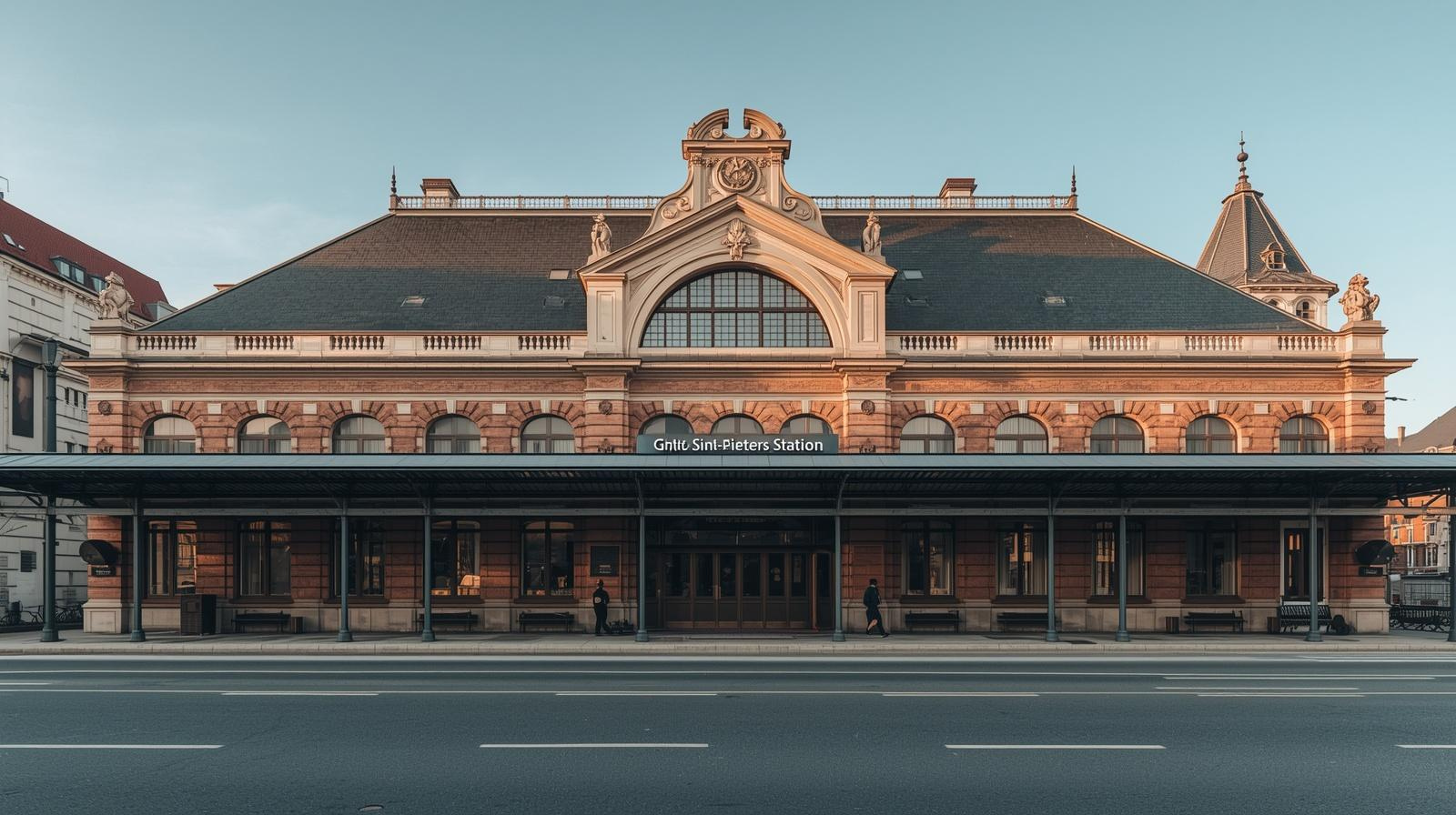
Few railway stations in Europe manage to be both a working transport hub and a work of art. Ghent-Sint-Pieters, named after the historic Sint-Pietersabdij (Saint Peter’s Abbey) that once dominated this southern corner of the city, is one of them. Opened in 1912 and still serving hundreds of thousands of passengers each year, the station is a monument to Belgian ambition at the height of the nation’s industrial and cultural confidence. But beyond its grand neoclassical façade, it is the extraordinary tilework inside that has captivated generations of travellers, historians, and artists alike.
Origins: Building a Station Worthy of Ghent
By the late nineteenth century, Ghent’s original railway terminus, a modest structure built in 1837, was buckling under the weight of a growing industrial city. Ghent was the textile capital of continental Europe, often called “the Manchester of the Continent,” and its merchants, workers, and civic leaders demanded infrastructure to match. In 1898, the Belgian state approved plans for a grand new station.
The commission fell to architect Louis Cloquet, a professor at Ghent University and a passionate advocate of what he called “rational historicism”, architecture that drew on the past not as mere decoration, but as a structural and civic language. Cloquet designed a station in the Eclectic style, blending neoclassical grandeur with elements of Flemish Renaissance and Art Nouveau. The result was a building of enormous scale: a monumental central hall flanked by two towers, a sweeping glass-and-iron roof over the platforms, and an interior that was planned, from the very beginning, to be covered in decorative tiles.
Construction was slow. The building was not completed until 1912, when it was inaugurated just in time for the World Exhibition held in Ghent in 1913, the Wereldtentoonstelling, which brought millions of visitors to the city and was intended to showcase Belgian modernity to the world.
The Architecture: Neoclassical Grandeur on the South Side
The station’s exterior is built in pale stone, with a central portico of Ionic columns, large arched windows, and ornate sculptural reliefs. The two flanking towers give it the silhouette of a civic palace rather than a transport facility, an intentional signal that Ghent regarded the railway not merely as a utility, but as a civilising force.
Inside, the central waiting hall rises to a dramatic height, lit by tall windows and a glazed roof that floods the space with diffuse northern light. Ironwork columns support the upper galleries, and every surface, floor, wall, and lower fascias is treated as an opportunity for decoration.
It is here, in the hall and along the concourses, that the tiles take over.
The Tiles: A Story in Ceramics
The Commission
Cloquet’s design called for extensive use of decorative ceramic tiles throughout the interior, a decision rooted in both practical and artistic reasoning. Glazed tiles were hygienic, durable, and easy to clean in a building that would be filled daily with coal smoke, crowds, and the general grime of industrial travel. But Cloquet and his patrons also saw tiles as a medium with a deep regional heritage; the Low Countries had been producing exceptional decorative ceramics since the fifteenth century, and Flemish tilework had a proud tradition of narrative imagery.
The tiles were manufactured primarily by the Belgian firm Gilliot & Cie, based in Hemiksem, near Antwerp, one of the most celebrated tile producers in early twentieth-century Europe. Gilliot had supplied tiles to some of the grandest public buildings in Belgium, the Netherlands, and Britain, and their collaboration with Cloquet produced some of their finest work.
The Imagery and Themes
The tile panels at Sint-Pieters are not mere geometric ornament. They form a coherent pictorial programme, a visual narrative of Ghent’s identity, history, and aspirations, laid out across the walls for every traveller to read.
The Trades and Industries of Ghent feature prominently. Panels depict weavers at their looms, dyers at their vats, merchants in their counting houses, and canal workers loading barges, a tribute to the labour that made the city prosperous. These scenes are rendered in a style that blends the realism of nineteenth-century genre painting with the flat, vivid palette that tile-making demands: deep blues, warm ochres, terracotta reds, and crisp whites.
Landscapes of the Flemish Countryside appear in sweeping panoramic panels, windmills turning in flat polder landscapes, church spires rising from medieval towns, the broad grey reaches of the Scheldt and the Leie rivers. These images spoke to travellers arriving in Ghent from the surrounding region, grounding the industrial city in its rural hinterland.
Historical and Mythological Scenes reference Ghent’s proud past. The city’s medieval golden age, its great guilds, its counts, its defiant civic spirit, is invoked in panels showing armoured knights, guild processions, and the distinctive silhouette of the Gravensteen castle. The figure of Jacob van Artevelde, the fourteenth-century statesman who led Ghent’s resistance against the French, appears in at least one celebrated panel as a symbol of Flemish determination.
Allegorical Figures representing Commerce, Industry, Agriculture, and the Arts occupy corner panels and lunettes, rendered in a stately classical manner that echoes the exterior architecture. These figures were a common vocabulary in public buildings of the period, but at Sint-Pieters they feel less like clichés and more like genuine expressions of civic pride.
Craftsmanship and Technique
The tiles are produced using a combination of techniques. Many of the pictorial panels are majolica tiles, hand-painted in coloured glazes on a white tin-glazed ground, fired at high temperature to fuse the colours into the surface permanently. The geometric border tiles and floor tiles use encaustic and pressed dust methods, producing the intricate interlocking patterns that frame the pictorial scenes.
What makes the Sint-Pieters tiles remarkable, even by the standards of Gilliot’s other commissions, is the scale of ambition. Individual panels span several square metres, requiring the design to be carefully divided across dozens of individual tiles while maintaining the integrity of the image. The registration, the precise alignment of tiles so that lines and colours match across joints, is extraordinarily consistent, a testament to the skill of both the designers and the craftsmen who installed them.
Decline, Neglect, and the Fight to Preserve
By the mid-twentieth century, Sint-Pieters had fallen on harder times. Rail traffic declined as road and air transport grew, and the grand waiting hall, once filled with the bustle of passengers, felt increasingly cavernous and underused. Successive decades of deferred maintenance took their toll. Grime accumulated on the tiles, some panels were damaged by moisture or physical impact, and the building’s heating systems, never adequate for a space of such volume, meant that the interior was frequently cold and uninviting.
There were periods when the tiles were simply painted over, a fate that befell many Victorian and Edwardian public interiors across Europe. Layers of institutional paint obscured entire panels, and it was not always clear what lay beneath.
The station’s listing as a protected monument, first at the city level and subsequently under Belgian federal heritage law, was the crucial turning point. From the 1980s onwards, there was growing recognition, driven in part by the broader revival of interest in Art Nouveau and Eclectic architecture, that Sint-Pieters was a building of exceptional significance. Heritage bodies, the city of Ghent, and the Belgian rail operator NMBS (Nationale Maatschappij der Belgische Spoorwegen) began to coordinate restoration efforts.
Restoration: Uncovering the Past
The most dramatic phase of the station’s recent history has been its ongoing restoration programme, which began in earnest in the late 1990s and has continued, in stages, into the twenty-first century. The work has been painstaking.
Where tiles had been painted over, restorers used careful chemical and mechanical stripping to reveal the original surfaces beneath, a process that sometimes uncovered panels in near-perfect condition, their colours as vivid as when they left the kiln. In other areas, tiles had cracked, spalled, or been lost entirely, requiring the manufacture of replacement pieces.
This replacement work presented a particular challenge. Gilliot & Cie ceased production in the mid-twentieth century, and the original tile designs, clay bodies, and glaze formulas were no longer available. Restoration ceramicists worked from historical photographs, surviving company records, and analysis of original tile fragments to recreate materials that would match the originals as closely as possible. Some sections were replicated by specialist tile manufacturers in Belgium and the Netherlands; others were made by hand by individual craftspeople.
The restoration has also involved the careful documentation of every tile panel, photographed, catalogued, and mapped, creating a comprehensive record of the station’s decorative programme for the first time. This archive, held by the city’s heritage service, has proved invaluable for ongoing maintenance and has contributed to broader scholarly understanding of early twentieth-century Belgian tile production.
Sint-Pieters Today: Living Heritage
The restored station is a genuinely remarkable place to spend time in. Passengers waiting for trains to Brussels, Bruges, or Antwerp find themselves surrounded by scenes from Flemish history and industry rendered in ceramic, glowing under the light that falls through the great glass roof.
The station remains a busy transport hub, handling intercity and international rail services, and it sits at the heart of Ghent’s public transport network. But it has also become a cultural destination in its own right. Guided tours specifically focused on the architecture and tiles are offered regularly, and the station features prominently in Ghent’s broader heritage tourism offer.
For visitors arriving in Ghent for the first time, perhaps coming to see the altarpiece by the van Eyck brothers at Saint Bavo’s Cathedral, or the medieval towers of Gravensteen, Sint-Pieters offers an immediate, immersive encounter with the city’s sense of its own identity. The tiles announce, before you have even left the station, that you are in a city that takes its history seriously and is not shy about displaying it.
A Legacy in Glaze and Fire
The tiles of Ghent-Sint-Pieters are, in the end, a kind of civic autobiography, a portrait of a city at a particular moment of confidence and ambition, rendered in the most permanent medium that the early twentieth century could offer. They have survived two world wars, decades of neglect, and the long slow attrition of institutional indifference. They have been painted over and uncovered again, damaged and repaired, forgotten and rediscovered.
What makes them endure is not just their physical durability, remarkable as that is, but the quality of the storytelling they contain. The weavers and merchants, the river landscapes and medieval heroes, these images connect the station’s daily users to a version of Ghent that is both historical and aspirational, rooted in the past but designed to be encountered in the present.
In an era of interchangeable transport architecture, glass boxes and steel canopies indistinguishable from one city to the next, Sint-Pieters stands as a reminder that a station can also be a statement: about where a city has come from, what it values, and how it wishes to be seen by the world.
Ghent-Sint-Pieters station is a protected heritage monument and is open to the public as an active railway station. Guided heritage tours can be booked through Visit Ghent.
Leave a Reply