
Introduction
There are railway stations that impress, and there are railway stations that overwhelm. Milano Centrale belongs firmly to the second category. To enter it for the first time is to experience something close to architectural shock, a sudden, vertiginous confrontation with grandeur on a scale that the modern world rarely attempts and even more rarely achieves. The entrance hall rises above you like the nave of some impossibly ambitious cathedral; the stone is everywhere immense and cold and magnificent; the statues glower down from their niches; the vaulted ceilings soar away into a filtered light that seems to come from another age entirely.
This is, by almost any measure, the most theatrical railway station in the world. It is also one of the largest, one of the most architecturally complex, and one of the most historically layered. Milano Centrale is not merely a building, it is a monument to an idea: the idea that a railway station could and should be an expression of national greatness, built to a scale and with an ambition that would make every passenger who entered feel, however briefly, the weight and glory of the civilisation they inhabited.
That this idea was pursued to its logical extreme during one of the darkest chapters in Italian history, the Fascist era of Benito Mussolini, gives the building an unavoidable moral complexity that even the most ardent admirer cannot entirely set aside. Milano Centrale is, simultaneously, a work of extraordinary architectural ambition and a monument shaped by totalitarian politics. Understanding it requires holding both of these truths at once.
Origins and the First Station
The story of Milano Centrale begins not with the magnificent building that stands today, but with an earlier, more modest structure that occupied a different site entirely.
Milan’s first central railway station was built in 1864 in the area of the city then known as the Porta Nuova, serving the nascent Italian rail network that was being assembled in the years following national unification. This station, designed by the engineer Louis Favre, was a functional Victorian-era terminus, competent, relatively conventional, and entirely inadequate for the role that Milan was rapidly assuming as the industrial and commercial capital of the new Italian nation.
As Milan grew through the late nineteenth and early twentieth centuries, becoming the centre of Italian manufacturing, finance, and fashion, pressure mounted for a new, grander central station that would be worthy of the city’s ambitions and capable of handling the rapidly growing volume of rail traffic. The Italian state railway, the Ferrovie dello Stato, commissioned a competition for the new station in the early years of the twentieth century, and the winning design, submitted by the architect Ulisse Stacchini in 1912, proposed a building of truly imperial scale and ambition.
The Architect: Ulisse Stacchini
Ulisse Stacchini (1871–1947) was a Florentine-born architect who had established his reputation through a series of public buildings and competitions in the years around the turn of the twentieth century. He was a product of the Italian academic tradition, deeply versed in classical and Renaissance architecture, and his design for Milano Centrale drew on an extraordinarily wide range of historical sources, Roman imperial architecture, Lombard Romanesque, Art Nouveau ornamental detail, and the monumental classicism that was the shared international language of grand public buildings in the early twentieth century.
Stacchini’s winning design of 1912 proposed a building of exceptional ambition: a facade of monumental scale, a vast vaulted central hall, and train sheds of unprecedented size. It was, from the beginning, conceived as a building that would make a statement about Italy’s place among the great nations of Europe.
The gap between the winning of the competition and the opening of the building was, however, extraordinary. Construction began in 1906 on the preliminary works and site preparation, but the main structure was not begun until 1925 and was not completed and opened until 1931, a gestation of nearly thirty years from first design to inauguration. This extended timeline meant that the building was designed in one political and cultural moment, the liberal, internationally minded Italy of the Giolittian era, but completed and inaugurated in a very different one: the Fascist Italy of Mussolini, who had come to power in 1922.
Fascism and the Architecture of Power
The opening of Milano Centrale on 1st July 1931 was an event of enormous political significance for Mussolini’s regime. The building had been extensively modified and amplified during the years of Fascist rule, and it bore the unmistakable imprint of the regime’s architectural ideology: a preference for monumental scale, Roman imperial references, and a rhetoric of power expressed through sheer overwhelming size.
The Fascist Aesthetic
Fascist architecture in Italy was not a single, coherent style but rather a field of competing tendencies, ranging from the stripped classical rationalism of architects like Giuseppe Terragni to the more historicist monumentalism that characterised buildings like Milano Centrale. What these tendencies shared was an insistence on scale, buildings were to be big, imposing, overwhelming, and a desire to connect the Fascist present to the Roman imperial past.
Milano Centrale’s enormous scale, the facade stretches approximately 200 metres in width and rises to a height of over 70 metres, reflects this ideology directly. The building was designed to make the individual feel small: to communicate, through the sheer disproportion between the human body and the architectural container, the power of the state that had built it. Every element was maximised: the columns are enormous, the arches are colossal, the statues are gigantic, the spaces are vast.
The Fascist regime also left more direct marks on the building. The decorative programme includes imagery and symbolism associated with the regime, including the fasces, the bundle of rods that gave Fascism its name, which appear in various locations throughout the building. These elements were not removed after the war, and they remain visible today, making Milano Centrale a building where the political history of the twentieth century is literally written in stone.
The Winged Horses
Perhaps the most visually striking elements of the exterior, and the ones most clearly associated with the Fascist aesthetic, are the enormous winged horses, or hippogryphs, that adorn the roofline and the decorative panels of the facade. These mythological creatures, carved in stone on an enormous scale, were meant to evoke the power and dynamism of the new Fascist Italy, a nation reborn, airborne, freed from the constraints of the liberal past.
The hippogryphs are extraordinary works of sculptural craft, and they give the building a fantastical, almost dreamlike quality that sits in interesting tension with its otherwise austere monumentalism. They are among the most photographed elements of the building, and they have become, over the decades, something of an unofficial symbol of Milano Centrale. images of the station almost inevitably feature them.
Architecture and Design
The Exterior Facade
The main facade of Milano Centrale, facing onto the Piazza Duca d’Aosta, is one of the most imposing architectural compositions in Europe. It is built predominantly in Aurisina limestone, a light grey stone quarried in the Friuli region, which gives the building its characteristic pale, severe coloration. This restraint in colour throws the building’s sculptural and ornamental richness into sharp relief: against the uniform grey stone, the carved decoration, the enormous columns, the projecting cornices, and the sculptural groups read with exceptional clarity.
The facade is organised around a massive central triumphal arch, the main entrance, flanked by two projecting pavilions and flanked again by lower wings that extend outward to either side. The triumphal arch motif is unmistakably Roman in its reference: Stacchini was invoking the Arch of Constantine, the Arch of Titus, the imperial monuments of ancient Rome, and placing a railway station in that lineage. The suggestion was clear: modern Italy, heir to the Roman empire, was building its own monuments, and the railway was its instrument of civilisation and power.
The central arch is of truly colossal proportions, large enough to accommodate several storeys of a conventional building within its opening, and it is framed by massive engaged columns and elaborate carved stone surrounds. Above it, and above the flanking pavilions, the roofline is animated by the sculptural programme of winged horses, allegorical figures, and decorative panels that gives the building its extraordinary visual richness.
The Main Hall: The Galleria delle Carrozze
Passing through the central arch, the visitor enters a sequence of spaces that culminate in the Galleria delle Carrozze (Gallery of the Carriages), the great central hall of the station, and one of the most magnificent interior spaces in Italy.
The hall is a vast, barrel-vaulted space of immense height, its ceiling carried on enormous arches of stone and concrete, its walls lined with carved pilasters and decorative mouldings, its floor of polished stone. Natural light enters through the high-level windows at each end and through the clerestory windows set into the vault, creating a cool, theatrical illumination that emphasises the sculptural quality of the stonework.
The scale of the hall is genuinely staggering. To stand at one end and look towards the other is to understand, viscerally, what architectural monumentalism means: the human figure is reduced to near-irrelevance, dwarfed by the encompassing stone. This was, of course, entirely intentional, the building was designed to produce precisely this effect, to communicate the power and permanence of the state through the experience of physical smallness in the face of architectural immensity.
The hall connects the entrance sequence to the upper concourse and, via the great staircase, to the platforms above.
The Grand Staircase and Upper Concourse
The passage from the entrance hall to the platforms is made via a sequence of escalators and stairs, but the most ceremonial route is the grand staircase, a broad, sweeping ascent through elaborately decorated spaces to the upper concourse level, where the platforms begin. The staircase is flanked by carved stone balustrades and lit by the high-level glazing of the facade, and ascending it gives a sense of ceremonial procession that few railway stations anywhere in the world can match.
The upper concourse is itself a remarkable space, a long, wide hall running parallel to the platforms, with shops, restaurants, and waiting areas set into the flanking walls. The ceiling here is lower and more domestic in scale than the great entrance hall below, but it is still generously proportioned and richly detailed.
The Train Sheds
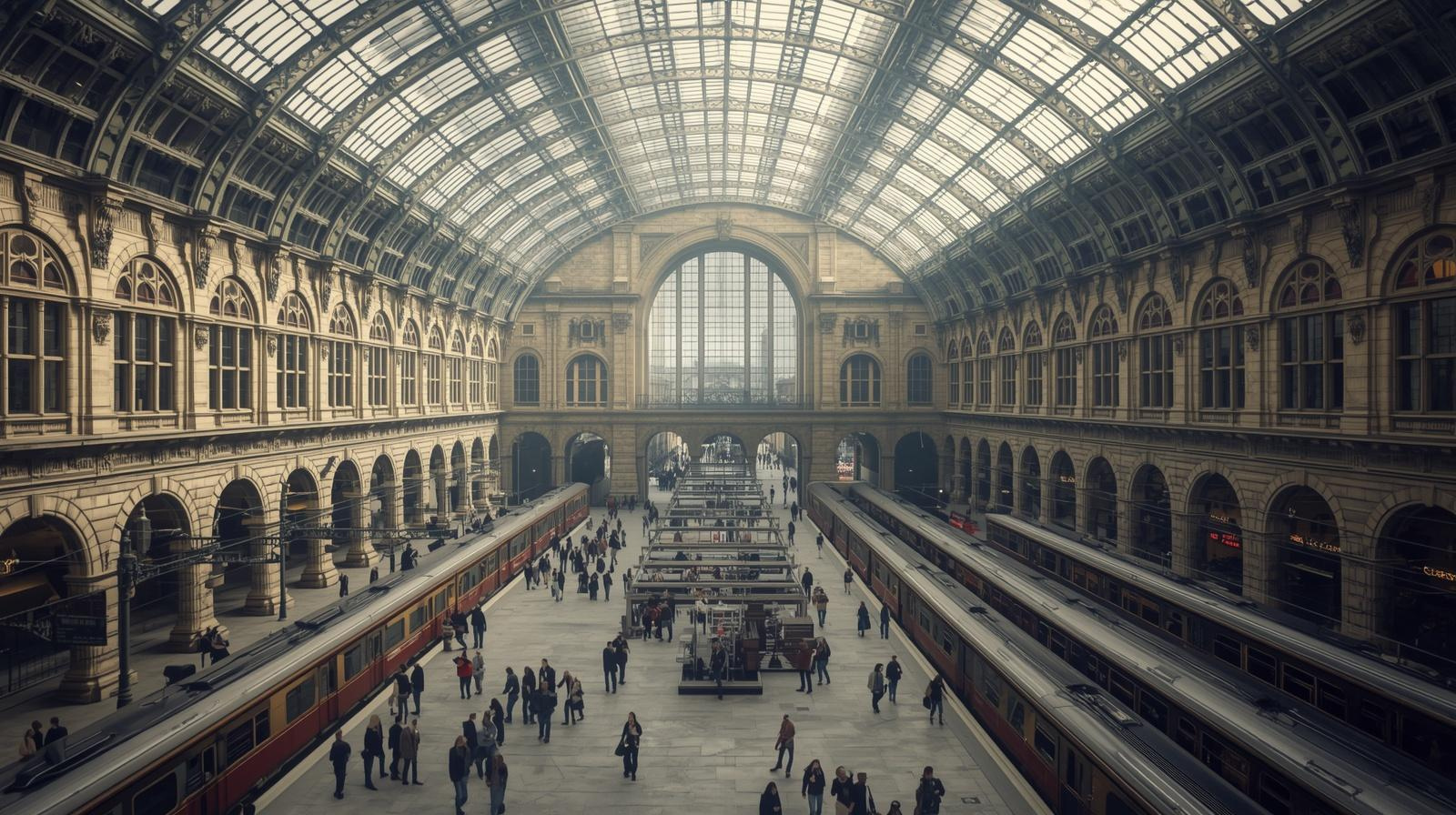
Behind the stone facade and the ceremonial halls, the functional heart of the station is the great train shed complex, a series of enormous iron and glass roof structures covering the platforms and tracks. The sheds were designed to accommodate the substantial traffic that was anticipated, and they are among the largest railway sheds in Europe: the three main arched roofs span the full width of the platform area, creating a covered space of some 200,000 square metres.
The design of the sheds is more restrained than the façade, this is engineering rather than architecture in the decorative sense, but the sheer scale of the ironwork, the quality of the riveted steel construction, and the generous proportions of the arched bays give the shed interior a dignity and presence that matches the grandeur of the spaces in front of it. The sheds were designed by the engineers of the Ferrovie dello Stato, and they represent Italian civil engineering at a high level.
Light filters through the glazed panels of the shed roofs in a way that transforms the platforms, particularly in the mornings, when the low sun catches the ironwork and creates a complex geometry of light and shadow across the stone platform surfaces and the waiting trains. It is one of the unexpectedly beautiful experiences that the station offers, and it is worth arriving early for a departure simply to witness it.
Art Nouveau Ornament
One of the aspects of Milano Centrale that surprises many visitors is the extent to which Art Nouveau, the sinuous, organic decorative style known in Italy as Stile Liberty, appears throughout the building alongside and within the dominant classicist and monumentalist vocabulary.
Stacchini’s original 1912 design was conceived in a moment when Art Nouveau was still a vital creative force in Italian architecture and design, and elements of this sensibility persisted into the final building despite the long delay and the modifications made during the Fascist period. The ironwork of the gates and railings, the detailing of some of the interior mouldings, the decorative treatment of certain doorways and windows, all carry the flowing, naturalistic ornament of the Liberty style.
This hybrid character, monumental classicism and Fascist rhetoric on the outside, lingering Art Nouveau flourishes on the inside, is one of the things that makes Milano Centrale architecturally fascinating. It is a building caught between two aesthetic worlds, and the tension between them generates a richness that neither world could have produced alone.
The Shadow of History: The Deportations
Like Amsterdam Centraal, Milano Centrale cannot be understood without confronting the darkest chapter in its history. During the German occupation of northern Italy from September 1943, the station was used as a transit point for the deportation of Italian Jews to the extermination camps of Nazi Germany and German-occupied Poland.
The deportees, many of them from Milan and the surrounding Lombardy region, were loaded onto cattle wagons in a part of the station that is now used for luggage handling, on Track 21, located in the lower level of the building beneath the main platforms. The location was deliberately chosen by the occupiers because it was hidden from the main concourse and from public view, the deportations were conducted, as far as possible, in secrecy.
Track 21, Binario 21, has been preserved as a memorial and museum, officially known as the Memoriale della Shoah di Milano (Milan Holocaust Memorial). Opened in 2013, the memorial occupies the actual space where the deportations took place, preserving the ramps, the tracks, and elements of the original infrastructure. It is a deeply affecting space: the cold, utilitarian architecture of the lower level, stripped of all the grandeur of the floors above, makes the contrast between the building’s public face and this hidden purpose starkly apparent.
The memorial receives hundreds of thousands of visitors each year and has become one of the most important Holocaust memorial sites in Italy. It is an inseparable part of what Milano Centrale is and means, the darkness beneath the marble and the stone.
Milano Centrale as a European Hub
Whatever its architectural and historical complexities, Milano Centrale is, in purely practical terms, one of the most important railway hubs in Europe, a position it has held since the nineteenth century and which has only been reinforced by the development of the high-speed rail network.
High-Speed Rail
Milan sits at the centre of Italy’s Alta Velocità (high-speed rail) network, and Milano Centrale is the principal gateway. High-speed Frecciarossa and Frecciabianca services connect Milan to every major Italian city: the journey to Rome takes approximately three hours; to Florence approximately one hour 40 minutes; to Naples approximately four hours 10 minutes; to Venice approximately two hours 20 minutes. These journey times have made high-speed rail the dominant mode of travel between Italian cities, comprehensively displacing domestic air travel on many routes.
International Connections
Milano Centrale’s international connections reflect Milan’s position at the crossroads of European transport. The station is the Italian terminus for a series of high-speed and intercity services that connect Italy to its northern neighbours via the great Alpine passes and tunnels.
Frecciarossa services run directly to Lyon and Paris via the Mont Cenis route, offering a Paris–Milan journey time of approximately seven hours, a compelling alternative to flying for environmentally conscious travellers. Services to Zurich and Geneva via Switzerland are operated by both Italian Trenitalia and Swiss SBB, with journey times of approximately three and four hours respectively.
The Venice Simplon-Orient-Express, the legendary luxury private train operated by Belmond, passes through Milano Centrale as part of its London–Venice itinerary, briefly connecting the station to the mythology of the grand European express tradition. The sight of the VSOE’s dark blue Pullman cars at the platform is one of the more romantically incongruous spectacles that the station periodically offers.
Night train services connect Milan to Paris, Vienna, and other European cities, part of the broader revival of overnight rail travel that has gathered momentum across Europe in recent years as awareness of aviation’s environmental impact has grown.
Italian Network
Beyond the high-speed services, Milano Centrale is the hub of a dense network of intercity, regional, and suburban services that connect Milan to every corner of Lombardy and to the wider north Italian rail network. The Passante Ferroviario, Milan’s underground suburban rail link, connects Centrale to the cross-city tunnel that distributes passengers to stations across the metropolitan area.
The station handles approximately 320,000 passengers per day, roughly 120 million per year, making it one of the busiest railway stations in Europe and comfortably the busiest in Italy.
Restoration and the Contemporary Station
The decades since the Second World War have seen the station progressively modernised and, more recently, carefully restored to address the deterioration that inevitably accumulates in a building of such age and complexity, carrying such volumes of traffic.
A major restoration programme was undertaken in the 2000s and 2010s, cleaning the limestone facades, repairing the ironwork of the train sheds, and restoring many of the interior spaces. Retail, dining, and service facilities were modernised and expanded, the station now contains an extensive range of shops, restaurants, and amenities, while care was taken to respect the historic character of the principal spaces.
The Sala delle Carrozze and the grand ceremonial sequence from entrance to platforms have been particularly well maintained, and the quality of the stonework restoration is generally high. The building looks today very much as it was intended to look in 1931, perhaps more so, in fact, since the limestone has been cleaned of the grime of decades and restored to something close to its original pale luminosity.
The Memoriale della Shoah in the basement, Binario 21, represents the most significant addition to the station in recent decades, and its presence gives the building a moral seriousness that complements and complicates its architectural grandeur.
Legacy and Significance
Milano Centrale is one of those buildings that lodges itself permanently in the memory. It is too big, too overwhelming, too insistently dramatic to be ignored or forgotten. You may arrive by accident and leave without a second glance, or you may arrive and find yourself unable to move for several minutes, simply looking, trying to absorb the scale and the detail and the sheer improbable ambition of the whole thing.
Its legacy is, inevitably, complex. It is a masterpiece of a deeply flawed tradition, monumental architecture in the service of authoritarian politics, and it is impossible to appreciate it fully without acknowledging that complexity. But it is also a building of genuine creative achievement: a work in which the architect’s ambition, the engineer’s skill, and the craftsman’s hand have combined to produce something that transcends its political context and stands as a monument to what architecture can do when it dares to think on the largest possible scale.
For the traveller arriving in Milan for the first time, stepping off the train and ascending the ramps to the great concourse and then to the thundering vault of the main hall, it is one of the defining architectural experiences in Europe. No amount of prior knowledge or preparation quite prepares you for the reality of the space. It simply has to be experienced.
That, in the end, is what the greatest buildings do. And for all its moral ambiguities and historical shadows, Milano Centrale is, unquestionably, one of the greatest.
Key Facts at a Glance
Location: Piazza Duca d’Aosta, Milan, Italy
Original station opened: 1864 (previous site)
Current building opened: 1 July 1931
Architect: Ulisse Stacchini (1871–1947)
Construction period: Main structure 1925–1931
Architectural style: Eclectic monumentalism — Roman Imperial, Lombard Romanesque, Art Nouveau (Stile Liberty), Fascist classicism
Facade width: Approximately 200 metres
Facade height: Over 70 metres
Primary building material: Aurisina limestone (Friuli region)
Train shed area: Approximately 200,000 square metres
Listed status: Italian national monument
Holocaust Memorial: Memoriale della Shoah di Milano — Binario 21 (Track 21), opened 2013
Daily passengers: Approximately 320,000
Annual passengers: Approximately 120 million (one of Europe’s busiest)
Principal services: Frecciarossa and Frecciabianca high-speed services to Rome, Florence, Naples, Venice and all major Italian cities; Frecciarossa to Paris and Lyon; intercity and Lyria services to Zurich and Geneva; night trains to Paris and Vienna; Venice Simplon-Orient-Express (seasonal); regional and suburban services across Lombardy; Milan Metro Lines 2 and 3
Leave a Reply