
Introduction
There are cities whose railway stations are merely functional, useful places to arrive and depart, but of no particular significance to the city’s identity or image. And then there are cities where the station is inseparable from everything the city means: where it stands not at the edge of civic life but at its very heart, where its silhouette is as recognisable as any cathedral or palace, and where arriving by train feels like an event rather than a transaction.
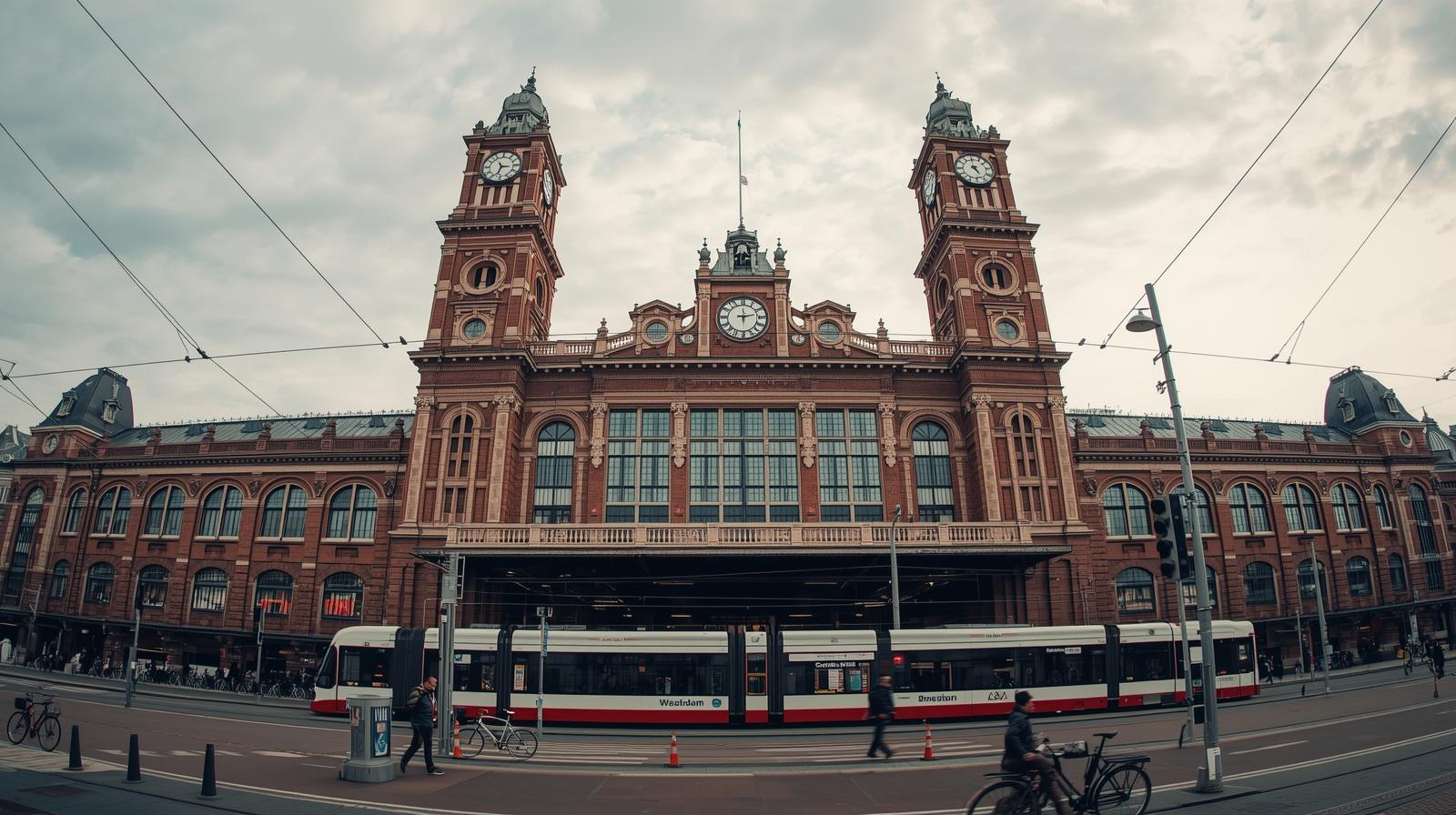
Amsterdam is emphatically the latter kind of city, and Amsterdam Centraal is emphatically that kind of station.
Rising from the waters of the IJ in a blaze of red brick, terracotta, and turrets, with its twin towers and ornate neo-Renaissance facade reflected in the harbour below, Amsterdam Centraal is one of the great architectural set-pieces of nineteenth-century Europe. It is the first thing most visitors see of Amsterdam, the gateway through which the city announces itself, and it has been performing that role with extraordinary confidence for nearly a century and a half. It is simultaneously a transport hub of immense practical importance and a building of genuine beauty: a station that manages to be both efficiently functional and architecturally magnificent, which is a harder combination to achieve than it sounds.
More than 200,000 passengers pass through Amsterdam Centraal every day, making it one of the busiest stations in the Netherlands. It handles intercity services to every major Dutch city, international trains to Belgium, France, Germany and the United Kingdom, high-speed Thalys and Eurostar services, regional rail, metro lines, trams, buses, ferries, and bicycles, an almost comically comprehensive range of transport modes for a single station building to absorb. That it does so while maintaining the dignity and coherence of a Victorian architectural masterpiece is one of its quieter miracles.
The Setting: A Station Built on the Water
Before the architecture, the geography, because Amsterdam Centraal’s setting is unlike that of almost any other major European railway station, and it shapes everything about the building’s character and significance.
Amsterdam is a city built on water. Its famous concentric canals, the Herengracht, Keizersgracht, and Prinsengracht, were dug in the seventeenth century as part of one of history’s most ambitious urban engineering projects, and the city’s relationship to water is fundamental to its identity. The old city faces north towards the IJ, the great waterway that connects Amsterdam to the North Sea and the wider world, and for centuries the IJ waterfront was the commercial heart of the city, the place where the ships of the Dutch East India Company loaded and unloaded their cargoes and where the wealth of a trading empire was concentrated.
When the decision was made in the 1870s to build a new central railway station for Amsterdam, the site chosen was the IJ waterfront itself, a location of enormous symbolic importance and considerable engineering complexity. To build on the waterfront, three artificial islands had to be created in the IJ, using approximately 8,687 wooden piles driven into the riverbed to support the station’s foundations. This was Dutch hydraulic engineering at its most characteristically audacious: a country that had spent centuries reclaiming land from the sea had no difficulty with the concept of building a major public monument on a foundation of water and wood.
The choice of location was not without controversy. By placing the new station directly on the IJ waterfront, the city effectively severed its historic connection to the open water, the view northward from the old city centre to the IJ was blocked by the new building, and the harbour that had defined Amsterdam’s character for centuries was suddenly hidden behind a railway station. This decision was debated at the time and has been discussed by urban planners ever since, though the magnificent building that resulted tends to soften any lingering regret.
The Architect: Pierre Cuypers
The man chosen to design Amsterdam Centraal was Pierre Cuypers (1827–1921), the dominant figure in Dutch architecture in the second half of the nineteenth century and the founding father of what would become known as the Dutch neo-Renaissance or Cuypers Gothic style, an architecture rooted in the Dutch and Flemish building traditions of the sixteenth and seventeenth centuries, enriched with Gothic and Renaissance detail, and expressed in the red brick that is so characteristic of the Low Countries.
Cuypers was, like his near-contemporary George Gilbert Scott in England, primarily known as a church architect and restorer. He had designed and restored dozens of Catholic churches across the Netherlands, and he was deeply versed in the Gothic tradition. But he was also a man of broad architectural culture, he had studied in Antwerp and travelled widely in Europe, and his architecture drew on a range of historical sources that went beyond pure Gothic to encompass the Dutch Renaissance of the Hendrick de Keyser tradition and the elaborate ornamental vocabulary of sixteenth-century Flemish civic architecture.
The commission for Amsterdam Centraal was the largest and most prestigious secular commission of Cuypers’s career, and he approached it with the full force of his considerable abilities. He worked on the design throughout the 1870s, in collaboration with the civil engineer A. L. van Gendt, who was responsible for the structural engineering of the train sheds and platform roofs.
Cuypers’s design won the commission against competition from other architects, and construction began in 1882. The station was opened on 15th October 1889 by King William III of the Netherlands, the same year, coincidentally, in which Cuypers’s other great masterpiece, the Rijksmuseum, opened just a few kilometres away. The two buildings share a family resemblance so strong that Amsterdammers sometimes jokingly refer to Centraal as the station where you leave your bicycle and the Rijksmuseum as the place where you leave your coat, both being vast, red-brick, turreted Cuypers productions that have become inseparable from the Amsterdam cityscape.
Design and Architecture
The Facade: Dutch Neo-Renaissance in Full Flower
The main facade of Amsterdam Centraal, facing south towards the city, is a composition of extraordinary richness and vitality. It extends approximately 300 metres in length and is articulated around a central pavilion flanked by two symmetrical wings, each terminating in a tower. The whole is built in red brick with extensive terracotta and natural stone dressings, the warm, reddish-gold palette that Cuypers used consistently throughout his career and that gives the building its particular visual warmth.
The central section of the facade is the most elaborate, rising through a series of registers of increasing decorative richness to a tall gabled roof crowning the composition. The gable is one of the building’s great set-pieces: it is stepped and curved in the Flemish manner, its surface alive with carved stone ornament, and it carries the coat of arms of Amsterdam, the three crosses of the city’s arms, prominently displayed, as if the building itself is declaring its civic allegiance. Flanking the central gable are the building’s two clock towers, each capped with a pointed roof and decorated with elaborate terracotta panels and carved stone detail.
The facade’s surface is organised around a series of arched windows of varying sizes, framed by carved stone surrounds and set within brick pilasters and arches. The overall rhythm of the composition, broad arches at street level, smaller arched windows above, dormers and gables above those, creates a layered, complex facade that repays extended looking. There is always more detail to notice: a carved cartouche here, an allegorical figure there, a panel of polychromatic terracotta in an unexpected location.
The Towers
The two towers that flank the central section are among the most distinctive elements of the building and contribute significantly to its skyline presence. Each tower rises through a series of stages, each slightly smaller and more elaborate than the one below, to a steeply pointed roof and an ornamental iron finial. The towers are clearly inspired by the great civic towers of the Dutch and Flemish Renaissance tradition, the towers of Hendrick de Keyser’s Amsterdam churches, the towers of the Antwerp and Ghent town halls, and they anchor the building firmly within that tradition.
Each tower contains a large clock face, a practical concession to the railway’s demand for timekeeping precision, but the clocks are set within such elaborate stone frames and surrounded by such quantities of carved decoration that they read as aesthetic objects as much as functional ones.
The Decorative Programme
One of the most striking aspects of Amsterdam Centraal’s facade is the richness and intentionality of its decorative programme. Cuypers was not a designer who scattered ornament randomly; his decorations tell stories and make arguments.
The facade carries an extensive series of sculptural reliefs and carved panels illustrating the history of Dutch trade and navigation, the industries and products of the Netherlands, the cities and regions connected by the railway, and allegorical representations of commerce, industry, and progress. These reliefs are executed in a combination of carved stone and high-quality terracotta, and they give the building a narrative dimension that enriches the experience of arriving at or departing from it.
The two hemispheres depicted on the façade, one showing the eastern hemisphere, the other the western, are a particularly notable feature. They speak to Amsterdam’s history as a global trading city, the centre of a seventeenth-century commercial empire that stretched from the East Indies to the Americas, and they connect the railway station to a much longer story of Dutch engagement with the wider world. To arrive in Amsterdam by train and to see those hemispheres above the entrance is to be reminded, immediately, that this is a city with an outward-facing, globally-minded identity.
The Train Sheds
Behind Cuypers’s ornate facade, the engineering of the station is the work of A. L. van Gendt, who designed the great iron and glass train sheds that cover the platforms. The sheds are an impressive feat of structural engineering in their own right, wide-span iron roofs of the kind that had become the standard solution for covering large numbers of railway tracks across Europe and North America in the second half of the nineteenth century.
The principal train shed has a wide central span flanked by lower side aisles, creating a cathedral-like cross-section that floods the platforms with diffused natural light through the glazed roof panels. The ironwork of the shed is detailed with care — the column capitals, the junction pieces, the decorative panels in the spandrels of the arches, reflecting the Victorian belief that even industrial structures deserved to be made beautiful.
The relationship between Cuypers’s ornate masonry facade and van Gendt’s utilitarian iron sheds is one of the characteristic dynamics of Victorian railway architecture: the decorative public face and the functional engineering backbone, each performing its role, each respecting the other’s territory, and together creating a building of both beauty and efficiency.
The Waterfront Setting and Urban Context
The decision to build Amsterdam Centraal on the IJ waterfront gave the station a setting unique among major European railway terminals. Where most great stations are approached from the land, down a long street or across a square, Amsterdam Centraal is approached across water: the ferry from Amsterdam Noord deposits passengers directly at the station’s northern entrance, and the panoramic view of the facade from the water is one of the great urban spectacles of northern Europe.
The station square, the Stationsplein, on the south side of the building is a vast open space that serves as the central node of Amsterdam’s surface transport network. Trams converge here from every direction; buses wait in ranks; cyclists, Amsterdam being the most bicycle-oriented major city in Europe, stream past in their thousands. The square is perpetually busy, perpetually animated, and it functions as the city’s informal centre of gravity, the place to which everything in Amsterdam seems, eventually, to lead.
The relationship between the station and the water it was built upon has become, over the decades, a source of ongoing urban design concern. The IJ to the north of the station is Amsterdam’s great underused asset, a vast waterway with a northern bank that was for many decades an industrial wasteland but has been progressively redeveloped since the 1990s into a vibrant new urban district. Free ferries connect the station’s northern exit directly to this emerging neighbourhood, and the station’s role as the hinge between old and new Amsterdam has never been more important.
The IJ tunnel and the North-South Metro Line (Line 52), which runs through the station and under the IJ, have further integrated the northern and southern parts of the city, and Amsterdam Centraal sits at the centre of this expanded urban geography.
History and Development
Opening and Early Years
When Amsterdam Centraal opened in 1889, it immediately assumed its role as the symbolic centre of the city. The building was acclaimed as one of the finest railway stations in Europe, a judgment that subsequent generations have consistently endorsed, and it rapidly became an icon of the Amsterdam cityscape.
The late nineteenth and early twentieth centuries were the station’s golden age. The Netherlands was a prosperous, internationally connected nation, and Amsterdam was its commercial and cultural capital. The station handled an ever-increasing volume of passengers and goods, and the Cuypers building proved well capable of accommodating the growth, its generous spaces, wide halls, and substantial construction making it more durable than many of its contemporaries.
The Second World War
Like all of Amsterdam, the station was profoundly affected by the Second World War. The Nazi occupation of the Netherlands from 1940 to 1945 transformed the station from a place of civilian travel into a staging post of a darker kind. Amsterdam Centraal was used as a transit point in the deportation of the Dutch Jewish population, a process in which approximately 102,000 Dutch Jews were murdered, the highest proportion of any occupied western European country.
The station’s association with this history is part of its identity. A small memorial near the station commemorates the deportees, and the broader history of the occupation and its consequences is inseparable from the urban geography of central Amsterdam, of which Centraal is the centrepiece.
The station was liberated on 5th May 1945, Liberation Day, along with the rest of the Netherlands, and it rapidly returned to civilian service.
Post war Expansion and Modernisation
The post war decades brought considerable pressures on the station’s capacity. The growth of the Dutch railway network, the expansion of Amsterdam as a city, and the increasing demands of international rail connections all required modifications to the original building and the addition of new facilities.
The Amsterdam Metro was extended to Centraal Station with the opening of the East-West line (Metrolijn 50/51) and subsequently the North-South line (Metrolijn 52), requiring the construction of underground platforms beneath the existing station. The engineering involved in tunnelling under a building founded on wooden piles in waterlogged ground was formidably complex, and the construction of the North-South line in particular, which ran dramatically over budget and behind schedule, became one of the most discussed infrastructure projects in Dutch history.
The station has been progressively modernised and expanded, with new retail and catering facilities integrated into the historic spaces, new bicycle parking facilities (the station’s bicycle parking, with capacity for some 10,000 bicycles, is the largest in the world), and continuous improvements to the passenger circulation systems.
The International Terminal
Amsterdam Centraal is one of the key nodes of the international high-speed rail network. Thalys services (now rebranded under the Eurostar umbrella following the 2023 merger) connect Amsterdam directly to Brussels, Paris and beyond; Eurostar services run directly to London; ICE high-speed trains connect to Germany; and a range of intercity international services connect the Netherlands to its neighbours.
The station’s role as an international hub reflects Amsterdam’s position as one of Europe’s most connected cities, a role that has its roots in the seventeenth-century trading empire whose hemispheres are carved above the station’s entrance.
The Rijksmuseum Connection
No article about Amsterdam Centraal is complete without noting its extraordinary architectural relationship with the Rijksmuseum, which opened in the same year, 1889, and was designed by the same architect, Pierre Cuypers, in a closely related style.
The two buildings face each other across the city, bookending the historic centre. Both are large, red-brick, multi-turreted neo-Renaissance structures with elaborately decorated facades, clock towers, and a similar palette of terracotta and carved stone detail. Both carry decorative programmes that celebrate Dutch history, commerce, and culture. Both were immediately controversial when built, critics at the time complained that they were too ecclesiastical in character for their secular purposes, and King William III reportedly refused to set foot in the Rijksmuseum because he thought it looked like a Catholic church, and both have become so integral to Amsterdam’s identity that it is now impossible to imagine the city without them.
The pairing of the two buildings is one of the great examples of architectural consistency in European city-making: a single architect, given two of the most important commissions in the country in the same decade, producing two masterpieces that together define the visual character of a major city. Cuypers was, in this sense, the shaper of modern Amsterdam’s self-image, the man who gave the city its architectural face.
Legacy and Significance
Amsterdam Centraal is a listed national monument (rijksmonument), the highest level of heritage protection in the Netherlands, and it has been extensively restored and maintained. The facade has been cleaned and repaired at various points, and the ironwork of the train sheds has been maintained to a high standard. The building looks today very much as it did when Cuypers completed it in 1889, which is a remarkable achievement given the pressures of 130-plus years of intensive use.
The station’s significance extends beyond architecture into the realm of urban identity. Amsterdam Centraal is, for most visitors and for many Amsterdammers, the city’s most immediately recognisable building, more famous in the world beyond Amsterdam’s borders, perhaps, than even the Rijksmuseum. It is the image that comes to mind when people think of arriving in Amsterdam; it is the backdrop to a thousand tourist photographs; it is the building that, more than any other, places Amsterdam on the mental map of European travel.
It is also, in the most practical sense, the hub around which Amsterdam’s daily life rotates. The trams, the ferries, the bicycles, the metro, the international trains, all converge here, all radiate from here. More than a century after Cuypers built it, Amsterdam Centraal continues to perform its essential civic function with the same confidence and grandeur that it had on opening day.
Key Facts at a Glance
Location: Stationsplein, Amsterdam Centrum, Netherlands
Opened: 15 October 1889
Architect: Pierre Cuypers (1827–1921); structural engineering by A. L. van Gendt
Architectural style: Dutch neo-Renaissance / Cuypers Gothic
Construction period: 1882–1889
Foundation: Three artificial islands supported by approximately 8,687 wooden piles
Listed status: Rijksmonument (national listed monument)
Daily passengers: Approximately 200,000
Annual passengers: Approximately 73 million
Bicycle parking capacity: Approximately 10,000, the largest in the world
Principal services: Intercity and sprinter services across the Netherlands; Eurostar to London; international Eurostar/Thalys to Brussels and Paris; ICE to Germany; Amsterdam Metro Lines 51, 52, 53, 54; multiple tram and bus lines; IJ ferry services
Sister building: Rijksmuseum, Amsterdam (same architect, same year, same style)
Leave a Reply