
Introduction
There are buildings that perform a function, and there are buildings that make a statement. And then, very occasionally, there are buildings that do both so completely and so magnificently that they transcend mere architecture and become symbols, of a city, of an age, of an idea. St. Pancras International in London is one of those buildings.
Rising above the rooftops of King’s Cross in a riot of red brick, pointed arches, turrets, and soaring clock tower, St. Pancras is arguably the most dramatic and romantic railway station ever built. It is a building that practically shouts its ambitions at you from across the street, a Victorian monument of extraordinary confidence, built at the height of British imperial and industrial power, and now reborn in the twenty-first century as the gateway through which millions of travellers pass between Britain and mainland Europe each year.
To walk through St. Pancras is to move between centuries: from the soaring Gothic Revival hotel facade of the 1870s, to the vast iron-and-glass train shed of the 1860s behind it, to the gleaming Eurostar terminal that occupies the extended platforms below ground. It is a building where the Victorian age and the European present exist side by side, each making the other more vivid by contrast.
The Railway and Its Origins
The story of St. Pancras begins not with architecture but with commerce and competition. By the 1860s, London was already served by several major railway termini, Euston, King’s Cross, Paddington, and the Midland Railway, one of England’s great Victorian railway companies, had grown frustrated at having no London terminus of its own. Its trains ran into St. Pancras Road from the Midlands and the north of England, but it was forced to share track and facilities with rival companies. The Midland Railway’s directors wanted their own station, their own entrance to London, and they wanted it to be the finest one in the city.
The site chosen was on the Euston Road in the parish of St. Pancras, immediately to the east of King’s Cross station. Acquiring the land required the demolition of a large portion of the St. Pancras burial ground, a morally troubling process that involved the removal and reinterment of thousands of bodies, an episode overseen in part by the young Thomas Hardy, then working as an architect’s assistant, who was reportedly haunted by the experience for the rest of his life.
Work on the station began in 1866, and the train shed was completed and opened to traffic in 1868. The hotel and the great Gothic facade followed over the subsequent years, opening fully in 1873.
The Train Shed: William Henry Barlow’s Engineering Marvel
Before the Gothic Revival facade that most people associate with St. Pancras, there was the train shed, and the train shed is, in purely engineering terms, one of the greatest structures of the Victorian age.
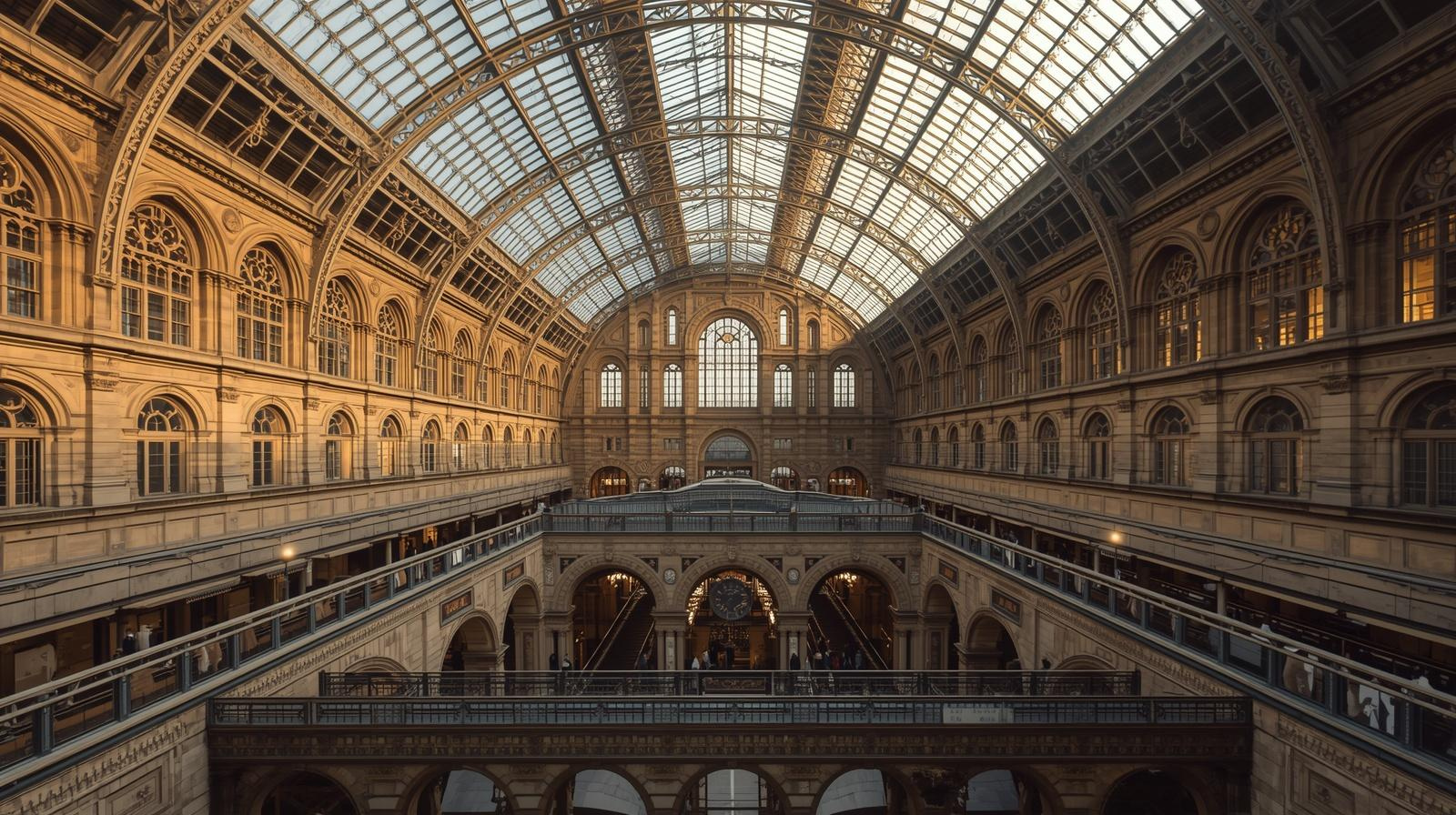
Designed by William Henry Barlow (1812–1902), the chief engineer of the Midland Railway, the shed’s single-span roof covers the entire station in one breathtaking sweep. When it was completed in 1868, it was the largest enclosed space in the world, with a span of 73 metres (240 feet) and a length of approximately 210 metres. No column interrupted the interior space; the entire roof was supported by the external walls and by a network of iron ribs that sprang from platform level and met in a pointed arch high above the tracks.
The choice of a pointed arch was partly structural, it distributed the forces more efficiently than a semicircular arch across such a wide span, and partly aesthetic, echoing the Gothic sensibility that would characterise the hotel facade added shortly afterwards. Whether this was a deliberate act of architectural coordination or a happy coincidence of engineering and style is a matter of debate, but the effect is harmonious: the train shed’s great pointed arch rhymes visually with the pointed arches of Gilbert Scott’s hotel, giving the whole complex a sense of unity despite having been designed by different men.
Barlow’s shed was also notable for its floor construction. The platforms were raised above the surrounding street level on a forest of cast-iron columns, creating a vast undercroft that was originally used by the Midland Railway to store barrels of Burton-on-Trent beer, the Midland Railway being the primary carrier for the Burton breweries. This subterranean space, known as the Undercroft or Barlow’s Beer Cellar, still exists today and has been repurposed as a commercial and event space.
The train shed’s iron and glass roof was restored during the station’s late twentieth-century renovation and is now painted in a luminous shade of deep blue and cream, a dramatic backdrop to the Eurostar terminal and one of the most uplifting interior spaces in London.
The Architect: George Gilbert Scott and the Gothic Revival
If Barlow’s shed represents the engineering genius of the Victorian railway age, the Midland Grand Hotel and its famous facade represent something equally extraordinary: the full flowering of the Gothic Revival in British architecture, expressed at its grandest and most theatrical scale.
The architect was Sir George Gilbert Scott (1811–1878), the most prolific and perhaps the most influential architect of the Victorian era. Scott was the undisputed master of Gothic Revival architecture in Britain, a movement that sought to revive the medieval Gothic style of pointed arches, ribbed vaults, flying buttresses, and elaborate stone carving, and apply it to the buildings of the modern age.
Scott’s Career and Philosophy
Scott had made his reputation through an enormous body of ecclesiastical work, the restoration of cathedrals and churches across Britain and beyond, as well as major public buildings such as the Foreign and Commonwealth Office in Whitehall (though that project famously forced him to abandon his preferred Gothic style in favour of an Italianate one, following a prolonged dispute with the Prime Minister Lord Palmerston). The Foreign Office episode left Scott deeply frustrated, and when the Midland Railway commission arrived, he seized it as an opportunity to build the Gothic building he had been denied in Whitehall.
Scott’s approach to Gothic Revival was scholarly and deeply felt. He believed that the Gothic style was not merely a historical curiosity but a living tradition, capable of expressing the values and ambitions of the nineteenth century just as it had expressed those of the thirteenth. He studied medieval buildings intensively, and his Gothic designs are characterised by a close attention to historical precedent combined with a willingness to adapt and elaborate for modern purposes.
The Midland Grand Hotel: Design and Features
The building Scott designed for the Midland Railway, officially the Midland Grand Hotel, was an exercise in Gothic Revival on the grandest possible scale. The commission called for a hotel that would serve the passengers of the Midland Railway and simultaneously advertise the company’s wealth, ambition, and good taste. Scott delivered something that exceeded even these ambitious requirements.
The Facade
The facade that faces onto the Euston Road is one of the most complex and richly ornamented in London. It is built in Nottinghamshire red brick with Rutland limestone dressings, a combination that gives the building its warm, reddish-gold colour and sets it apart visually from the grey stone of most Victorian public buildings. The choice of brick was itself a Gothic Revival statement: medieval brickwork had been an important tradition in parts of England, and Scott was making a deliberate connection to that heritage.
The facade is alive with Gothic detail: pointed arched windows of varying sizes, clustered columns of polished granite, elaborate stone carvings in the spandrels and cornices, decorative ironwork in the railings and balconies, and a skyline bristling with turrets, pinnacles, spires, and chimneys that give the building its unmistakable silhouette against the London sky.
The Clock Tower
The dominant feature of the composition is the great clock tower at the western end of the facade, which rises to a height of approximately 82 metres (270 feet). The tower is an essay in Gothic verticality, its surface articulated with blind arcading, pointed windows, and decorative stonework, and it culminates in a steeply pitched roof and an ornamental iron finial. The clock faces are large and clearly legible, a reminder that this is, above all, a functional building in service of the railway timetable.
The tower has become the defining image of St. Pancras, reproduced on countless postcards, paintings, and photographs, and it functions as a landmark visible from considerable distances across north London.
The Roofline
The roofline of the Midland Grand Hotel is one of its most theatrical features. Scott drew on a variety of medieval precedents, French Gothic chateaux, English Perpendicular towers, Venetian Gothic palaces, to create a skyline of extraordinary complexity and drama. The steep-pitched roofs are covered in Welsh blue slate, and the dormer windows that punctuate them are crowned with decorative ironwork cresting. No two sections of the roofline are quite the same, and the building rewards extended scrutiny: the more carefully one looks, the more detail reveals itself.
The Interiors
The interiors of the Midland Grand Hotel were among the most lavish in Victorian London. The Grand Staircase, which sweeps upward through the building in a double curve of breathtaking elegance, is perhaps the most celebrated room in the building. Its iron balustrade, painted brick walls, and ribbed vaulting overhead create an interior of operatic grandeur, a space that feels less like a hotel and more like a medieval cathedral reimagined for the railway age.
The hotel’s state rooms, corridors, and bedrooms were decorated in a rich palette of deep reds, golds, and blues, with encaustic tile floors, painted ceilings, and elaborate plasterwork. Scott brought in specialist craftsmen and decorators, and the quality of the workmanship throughout the building was exceptional by any standard.
The Ladies’ Smoking Room, the Coffee Room, and the various drawing rooms and dining rooms were all given individual characters while sharing the overarching Gothic vocabulary that Scott had established. Even the service corridors and functional spaces were treated with more care than most Victorian buildings gave to their principal rooms.
Indian and Orientalist Influences
While the primary stylistic language of St. Pancras is Gothic Revival, rooted in the medieval architecture of northern Europe, Scott’s design is not without more exotic references, and the building’s relationship to Britain’s imperial moment is embedded in its details as much as its rhetoric.
The Midland Railway operated lines to the ports from which travellers embarked for India and the wider Empire, and the station was, in a very real sense, the beginning of the route to the subcontinent. Some architectural historians have noted echoes of Mughal and Indo-Saracenic architecture in certain details of Scott’s design, particularly in the treatment of some of the smaller domed turrets and the polychromatic use of materials, which resonates with the blending of Hindu and Islamic architectural traditions that characterised the great buildings of Mughal India.
The pointed arch itself, of course, has a complex genealogy that links medieval European Gothic with Islamic architecture, the arch form having travelled from the Islamic world into Europe during the medieval period. In using pointed arches so insistently, Scott was drawing on a tradition that was never purely European, even if he would not necessarily have foregrounded that lineage.
More directly, the broader Gothic Revival movement was deeply entangled with Victorian Britain’s relationship to its imperial possessions. The revival of medieval Christian architecture was, for many of its practitioners, an assertion of British and Christian identity, but it was an identity defined, in part, against and through the encounter with non-European cultures. The Midland Grand Hotel, built at the height of British imperial confidence, participates in this complex cultural moment even if its forms are ostensibly purely Gothic.
The Indo-Saracenic style, a hybrid architecture that combined Gothic Revival elements with Mughal and Rajput motifs, was being deployed by British architects in India at precisely the time Scott was building St. Pancras. Buildings such as Bombay’s Victoria Terminus (now Chhatrapati Shivaji Maharaj Terminus), designed by F. W. Stevens and completed in 1888, represent the full flowering of this hybrid approach. St. Pancras is not itself an Indo-Saracenic building, but it inhabits the same imaginative world, a world in which the Gothic Revival was the architectural language of British imperial power, and in which the pointed arch signified both medieval Christian Europe and the wider world that empire had brought within Britain’s reach.
Decline, Near Demolition, and Rescue
For all its magnificence, the Midland Grand Hotel closed as a hotel in 1935, a victim of changing tastes and the practical difficulties of running a large Victorian building without the modern amenities, private bathrooms, lifts, central heating, that twentieth-century travellers had come to expect. It was converted into offices, used by British Rail, and fell into a state of increasing neglect and disrepair.
By the 1960s, the station itself was under threat. The Beeching cuts decimated the British railway network, and St. Pancras was identified as a candidate for closure and demolition. The destruction of the nearby Euston Arch in 1962, a magnificent Greek Revival propylaeum demolished to make way for the rebuilding of Euston Station, despite widespread public opposition, served as a warning of what could happen. The architectural establishment and the public rallied to St. Pancras’s defence, and the building was listed Grade I in 1967, giving it the highest level of statutory protection and making demolition effectively impossible.
This campaign was led in part by the poet and architectural writer Sir John Betjeman, who had championed the Victorian architectural heritage that was being swept away in the name of modernisation. Betjeman’s passionate advocacy for St. Pancras was part of a broader shift in public attitudes towards Victorian architecture, which had long been dismissed as overwrought and tasteless but was increasingly being recognised as a heritage of extraordinary richness and value. A statue of Betjeman, caught in characteristic pose, gazing upward at Barlow’s great roof with an expression of delighted amazement, stands on the upper concourse today, a permanent tribute to the man who helped save the building.
The Restoration and the Eurostar Terminal
The rescue of St. Pancras from demolition was one thing; its transformation into a world-class twenty-first-century station was another, and it required one of the most ambitious and expensive restoration projects in British architectural history.
The catalyst was the decision to route the Channel Tunnel Rail Link, now known as High Speed 1 (HS1), into St. Pancras rather than into Waterloo Station, which had been the London terminus for Eurostar since the tunnel opened in 1994. The transfer of Eurostar services to St. Pancras required an entirely new underground terminal, a major extension to the train shed, and a complete restoration of Scott’s hotel.
The project was led by the architects Alastair Lansley and the firm W. S. Atkins, with extensive consultation with conservation experts and English Heritage. The work took several years and cost in the region of £800 million.
The extension to the north of the original train shed provided the long platforms required for Eurostar trains, which at 400 metres are far longer than any Victorian railway ever contemplated. A new upper concourse was created at the level of the original platforms, with retail and dining facilities, while the Eurostar terminal occupies the lower level.
The hotel, rebranded the St. Pancras Renaissance Hotel and operated by Marriott, was painstakingly restored and reopened in 2011. The Grand Staircase was returned to something close to its original glory, and the principal state rooms were brought back to life. New bedrooms were created in the former offices, and modern facilities were installed throughout, but Scott’s essential vision was respected and honoured at every turn.
The restored St. Pancras opened as an international station on 6th November 2007, when the first Eurostar train departed for Paris. The opening was widely celebrated as one of the great moments in modern British architecture and infrastructure, a demonstration that it was possible to honour the past while building confidently for the future.
Legacy and Significance
The story of St. Pancras is, in the end, a story about how a society comes to understand and value what it has built. For much of the twentieth century, the Victorians’ legacy was viewed with embarrassment, their buildings too big, too ornate, too confident, too everything. St. Pancras was nearly demolished. The Euston Arch was demolished. Dozens of other fine Victorian buildings across Britain were swept away in the post war decades.
What saved St. Pancras was a change of heart, a gradual recognition, driven partly by Betjeman and others like him, that Victorian architecture represented a genuine and magnificent tradition worthy of respect and preservation. That recognition arrived just in time.
Today, St. Pancras is one of the most admired buildings in Britain. Its Gothic Revival facade, restored to its full brick-red splendour, is one of London’s great sights. Scott’s Grand Staircase is one of the finest interiors in the city. Barlow’s train shed, painted blue and soaring overhead, is an engineering masterpiece. And the Eurostar terminal below, sleek, efficient, thoroughly contemporary, completes a building that manages to be, simultaneously, a monument to the Victorian age and a functioning hub of twenty-first-century European travel.
It is, perhaps, the greatest railway station in the world. And it very nearly wasn’t there at all.
Key Facts at a Glance
Location: Euston Road, King’s Cross, London N1C 4QP
Opened: Train shed 1868; Midland Grand Hotel 1873; Eurostar terminal 2007
Architects: William Henry Barlow (train shed); Sir George Gilbert Scott (hotel and facade)
Architectural style: Gothic Revival; Victorian iron-and-glass engineering
Train shed span: 73 metres, the largest enclosed space in the world when built
Hotel: Midland Grand Hotel (1873–1935); St. Pancras Renaissance Hotel (2011–present)
Listed status: Grade I listed building (1967)
Services: Eurostar to Paris, Brussels, Amsterdam and beyond; Thameslink; East Midlands Railway; other domestic services; London Underground (Northern, Victoria, Piccadilly, Circle, Hammersmith & City, Metropolitan lines via King’s Cross St. Pancras)
Annual passengers: Approximately 37 million (pre-pandemic figures)
Leave a Reply