
Introduction
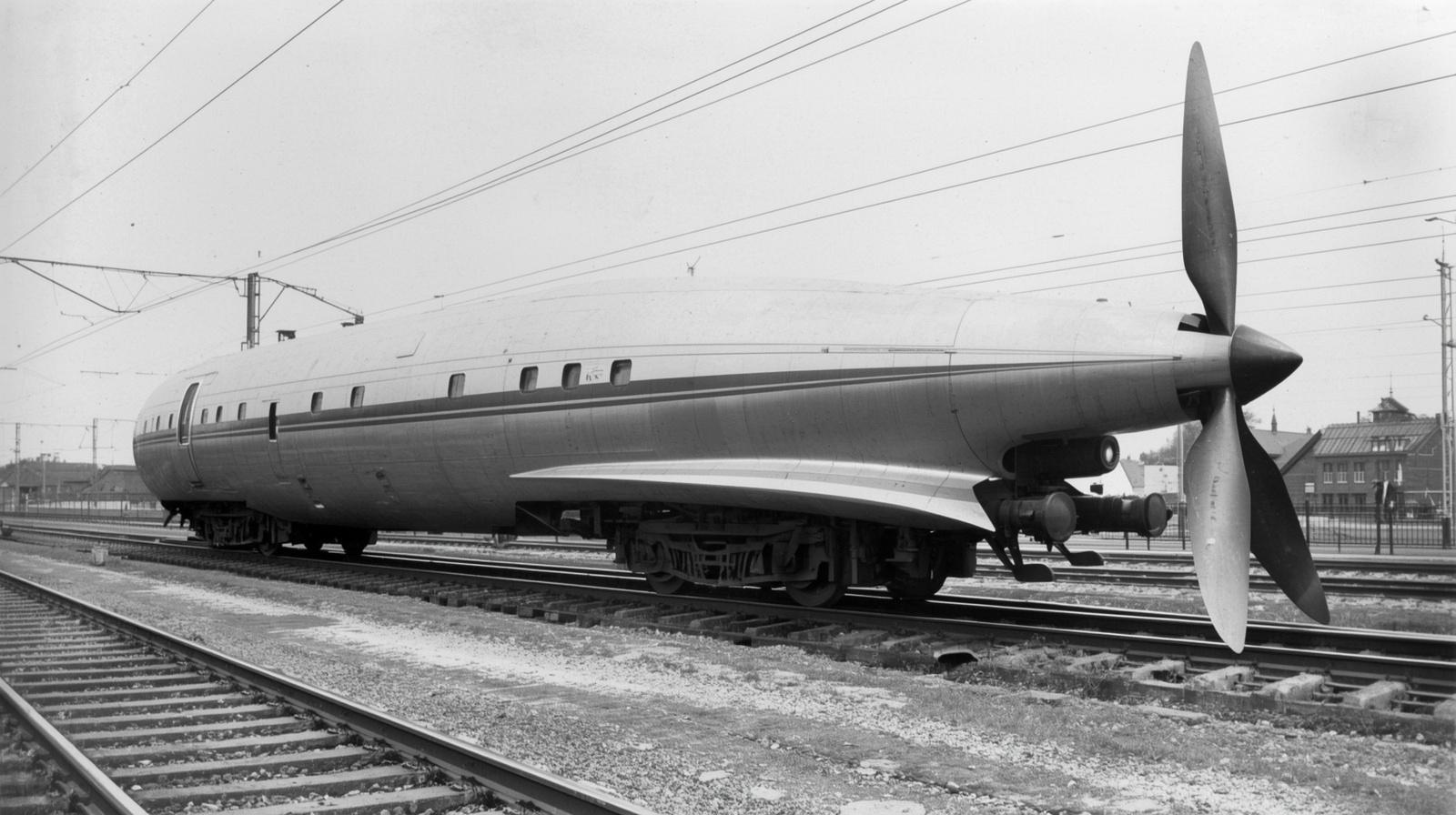
In the summer of 1931, passengers waiting at Berlin’s Lehrter Bahnhof witnessed something that seemed more science fiction than engineering reality: a sleek, cigar-shaped vehicle gliding along the tracks at breathtaking speed, driven not by a conventional steam engine or electric motor, but by an aircraft propeller mounted at its rear. This was the Schienenzeppelin, literally “Rail Zeppelin”, one of the most audacious and visually striking transport experiments of the twentieth century.
Origins and Concept
The Schienenzeppelin was the brainchild of Franz Kruckenberg, a German engineer with a passion for speed and aerodynamics. Kruckenberg had spent years studying how aircraft design principles could be applied to rail transport. His core insight was simple but radical: the greatest enemy of speed on land is air resistance, and the rounded, tapering shape of an airship offered the perfect aerodynamic form for a high-speed rail vehicle.
Inspired by the legendary Zeppelin airships that had made Germany famous in the 1920s, Kruckenberg designed a rail car that bore an unmistakable resemblance to them, long, streamlined, and pointed at both ends. Rather than fighting drag, the vehicle would slip through the air. And rather than using a traditional locomotive engine to push or pull it, he proposed something almost unthinkable for a train: a rear-mounted aircraft propeller powered by an aero engine.
Work began in the late 1920s, and the vehicle was built by the Hannover-based Waggonfabrik Wismar in partnership with Kruckenberg’s design team. The project received backing from the German state railway, the Deutsche Reichsbahn, which was eager to explore new technologies as German rail was under pressure to modernise and compete with road and air transport.
Design and Engineering
The Schienenzeppelin was, in almost every way, unlike any train that had come before it.
Body and Aerodynamics
The vehicle measured approximately 26 metres in length and was constructed largely from lightweight duralumin, the same aluminium alloy used in aircraft and airship construction. This kept the total weight down to around 20 tonnes, remarkably light for a rail vehicle of its size. The fuselage-like body tapered sharply at both ends, and the entire exterior was smooth and streamlined. There were no protruding fittings, no exposed undercarriage, nothing that might catch the wind. It looked less like a train than like a Zeppelin that had been gently lowered onto a railway track.
The passenger cabin ran the length of the vehicle and could seat around 40 passengers in relative comfort. Large windows gave travellers a panoramic view, though the noise from the propeller at the rear made the experience rather more exciting than a conventional rail journey.
Propulsion
The heart of the Schienenzeppelin’s propulsion system was a BMW VI aero engine, a water-cooled V12 aircraft engine of the kind found in German fighter and bomber aircraft of the era. This was connected to a large four-bladed wooden propeller mounted at the vehicle’s rear end. The engine produced around 600 horsepower, and with the lightweight aluminium body, this was more than sufficient to achieve extraordinary speeds.
One significant drawback of this arrangement was immediately obvious: the Schienenzeppelin could not reverse. There was no mechanism to reverse the propeller and drive the vehicle backwards, which meant it required a turntable at each end of its route. This was a serious operational limitation that would contribute to its eventual withdrawal.
The vehicle ran on two four-wheel bogies, and the design included no conventional locomotive coupling, meaning it could not pull other carriages. It was a standalone, single-vehicle express, a self-contained streak of metal.
Braking
Stopping a vehicle capable of extremely high speeds on rail track posed considerable engineering challenges. The Schienenzeppelin used a combination of mechanical brakes and, in an early form of regenerative concept, the propeller itself, by altering the engine throttle, the propeller’s resistance could be used to help slow the vehicle. Dedicated disc brakes were also fitted, but high-speed stopping remained one of the more nerve-testing aspects of operating the machine.
The Record-Breaking Journeys
The Schienenzeppelin was tested extensively on the German rail network from 1930 onwards, and it quickly demonstrated that Kruckenberg’s aerodynamic theories were not merely academic.
The World Speed Record — 21st June 1931
The defining moment in the Schienenzeppelin’s brief history came on 21st June 1931, when it achieved a world speed record for a rail vehicle on the line between Hamburg and Berlin. On that summer morning, the vehicle reached a speed of 230.2 kilometres per hour (approximately 143 mph), a figure that stunned the railway world and made headlines across Europe and beyond.
To put this in context, the fastest steam express trains of the period were operating at little more than 130–150 km/h under ideal conditions. The Schienenzeppelin had simply blown past everything that had come before it. The record was certified officially and stood as the fastest a rail vehicle had ever travelled.
The run was not a public passenger service but a dedicated speed trial, with the track cleared and observers stationed along the route. By all accounts, those who witnessed it described the vehicle as a silver blur, accompanied by the distinctive roar of an aircraft engine that bore no resemblance to the familiar rhythm of a steam locomotive.
Regular Demonstration Runs
Beyond the record attempt, the Schienenzeppelin made a number of demonstration runs on routes in northern Germany, including the Hamburg–Berlin corridor, which was one of the busiest and most prestigious routes in the German rail network. These runs attracted considerable public interest and media attention, and the vehicle became something of a celebrity, photographed, filmed, and discussed in newspapers and technical journals throughout Germany and abroad.
The Deutsche Reichsbahn used these runs partly as publicity, demonstrating German engineering prowess at a time when the country was still recovering from the economic and political upheavals of the Weimar period. The Schienenzeppelin fit neatly into a broader narrative of technological ambition.
Limitations and Operational Problems
For all its glamour and record-breaking achievement, the Schienenzeppelin was a deeply impractical vehicle for regular railway service, and its limitations became increasingly apparent.
The inability to reverse was the most immediate problem. Every terminal required a turntable or loop, which was expensive to install and limited the routes the vehicle could operate. The wooden propeller was also a safety concern, at high speeds, a propeller failure could be catastrophic, and the idea of a large spinning blade at the rear of a passenger vehicle travelling through stations and past platform crowds was difficult for railway operators to accept.
The propeller wash was another practical difficulty. At high speeds, the blast from the rear of the vehicle was powerful enough to cause significant disturbance, scattering trackside equipment, blowing debris, and posing a hazard to anyone near the tracks. This made it incompatible with conventional station operation without extensive precautions.
Furthermore, the vehicle required a clear, straight track with no other traffic, as the braking distances at high speed were considerable. It could not be integrated into normal timetabled services without effectively closing sections of line.
The noise, too, was extraordinary. The BMW V12 engine produced a sound closer to an aircraft at full throttle than anything associated with railways, and while this thrilled spectators, it was less welcome to those living along the route.
The End of the Schienenzeppelin
Despite the record and the public excitement, the Deutsche Reichsbahn concluded that the Schienenzeppelin could not form the basis of a practical high-speed service. The operational constraints were simply too severe, and the railways were already exploring more conventional but still innovative approaches to high speed, approaches that would eventually lead to the celebrated steam locomotive records of the mid-1930s and, decades later, to the InterCity Express.
The Schienenzeppelin made its last runs in 1939, having served for roughly nine years in an experimental and demonstration capacity. It never entered scheduled passenger service.
During the Second World War, the vehicle was scrapped. Its duralumin body, that same lightweight material that had made it so aerodynamically brilliant, was broken up and the metal recycled for the war effort. No part of the original vehicle survives today.
Legacy
The Schienenzeppelin’s world speed record of 230.2 km/h stood for nearly two decades, until it was finally surpassed in 1954. For a vehicle built in the early 1930s, this was a remarkable testament to Kruckenberg’s engineering insight.
Though the vehicle itself is gone, its influence on railway design was lasting. The principle of streamlining, which the Schienenzeppelin demonstrated so dramatically, became a central concern for train designers throughout the 1930s and beyond. The sleek profiles of German, British, French and American express locomotives of the late 1930s all reflect, at least in part, the aerodynamic lessons that Kruckenberg’s propeller train helped to prove.
The Schienenzeppelin also stands as an emblem of a particular spirit of inter-war engineering: bold, sometimes eccentric, willing to borrow ideas across disciplines, and unafraid to ask whether the rules that governed one technology might be broken by importing the principles of another. In an age of airships, it was not so unreasonable to wonder whether a train might fly along the ground. For one extraordinary summer morning in 1931, it did.
The Schienenzeppelin remains one of the most distinctive and captivating vehicles in railway history, a testament to what engineering imagination can achieve, and a reminder that even brilliant ideas sometimes meet their limits in the practical world.
Leave a Reply