
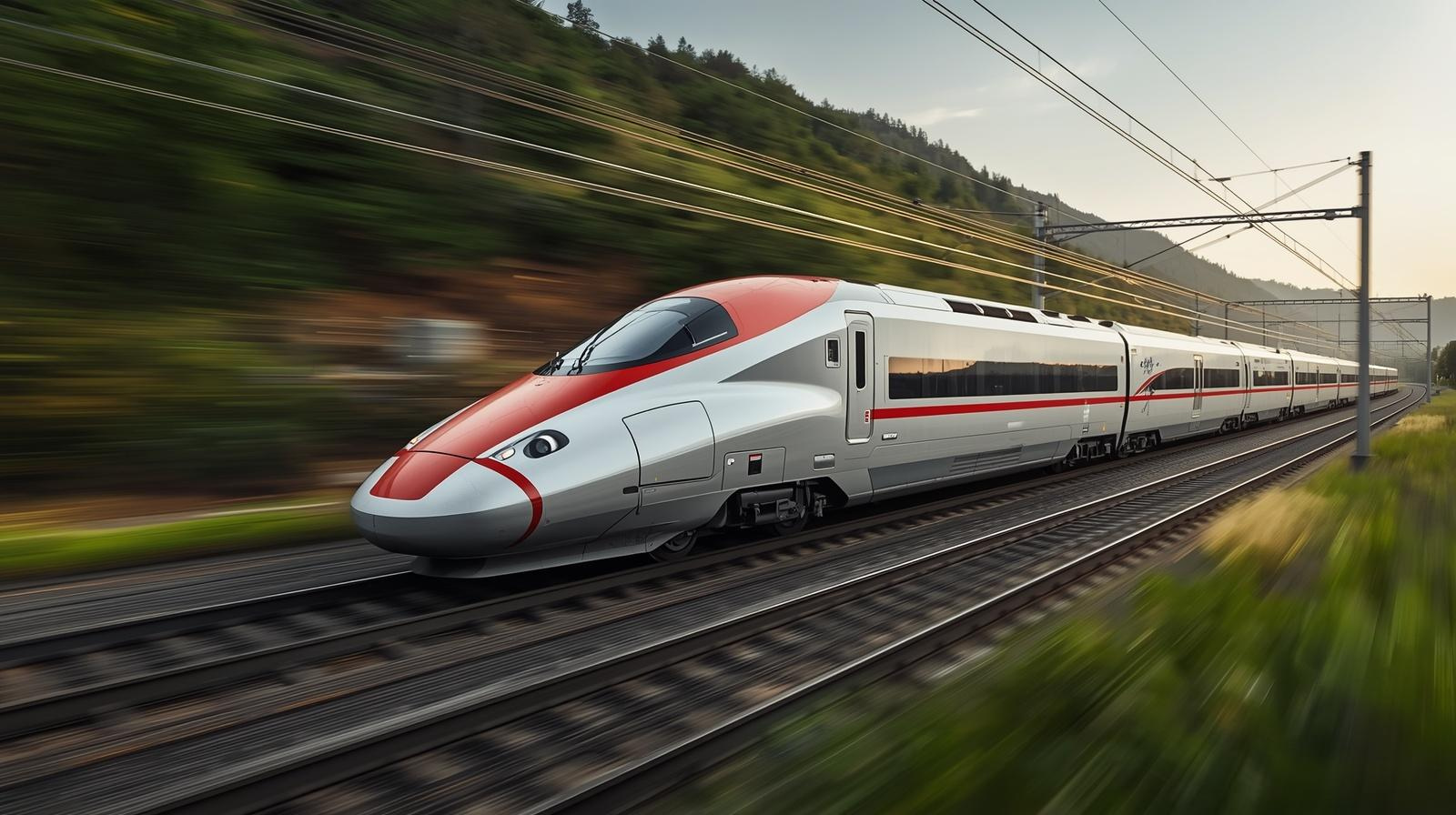
On 1st October 1964, nine days before the opening ceremony of the Tokyo Olympics, Japan unveiled something that would quietly redefine what human beings thought was possible in land travel. A sleek, white-nosed train glided out of Tokyo Station and reached Osaka, 515 kilometres away, in just four hours. The Shinkansen had arrived, and the world would never look at railways the same way again.
A Nation Rebuilding Its Identity
To understand the Shinkansen, you have to understand the Japan of the early 1960s. Less than two decades had passed since the devastation of World War II. The country was in the middle of an extraordinary economic resurgence, fuelled by industrial ambition and a fierce national determination to modernise. The Tokyo Olympics were to be Japan’s grand statement to the world, proof that the nation had not just recovered, but transformed.
The government knew the Olympics would bring a flood of visitors, and the existing rail network between Tokyo and Osaka, the Tōkaidō Line, was groaning under the weight of demand. The journey took nearly seven hours. Something had to change.
The man most associated with making it happen was Shinji Sōgo, the President of Japanese National Railways. He championed what many considered an absurdly ambitious project: a brand-new, dedicated railway line running between Tokyo and Osaka, engineered from scratch to carry trains at speeds previously unthinkable. His chief engineer, Hideo Shima, set about designing a machine and a track that could achieve it.
The project was, by any measure, audacious. Critics called it reckless. The budget overran dramatically. Sōgo himself was forced to resign before the line ever opened, a bittersweet footnote in the story of a man who gave everything to see it built.
Engineering a New Kind of Train
The Tōkaidō Shinkansen was not simply a faster version of an existing train. It was a completely new system, built on entirely new principles.
The track was laid on a dedicated, straight corridor with no level crossings, no sharp curves, and no freight traffic sharing the line. Stations were kept to a minimum to reduce stopping time. The trains themselves, the Series 0, with their distinctive aerodynamic nose that earned them the nickname “bullet train”, were electric multiple units, meaning every carriage contributed to the propulsion. This distributed the weight and allowed for rapid acceleration.
Standard gauge track (1,435 mm) was chosen over Japan’s existing narrow gauge network, which meant the Shinkansen infrastructure was entirely separate from conventional rail, a clean break that enabled the engineers to optimise everything from scratch.
Safety was built into the DNA of the system. An automatic train control system kept trains at safe speeds at all times, removing the possibility of human error causing an overspeed incident. The line was also engineered to cope with Japan’s ever-present seismic risk.
When it opened, the Hikari (meaning “light”) express service completed the Tokyo–Osaka journey in four hours. Within two years, that had been cut to just over three hours and ten minutes. Travelling at up to 210 km/h (130 mph), it was the fastest scheduled rail service on Earth.
Opening Day and the Olympic Stage
1st October 1964 was chosen deliberately. Japan wanted the world to see its new train during the Olympics, and the timing worked perfectly. Foreign visitors who arrived for the Games found themselves able to board a train in Tokyo and arrive in Osaka at a speed that felt, to many, almost science fiction.
The reaction was one of widespread astonishment. Journalists and dignitaries from across the world filed reports describing the smoothness of the ride, the punctuality of the service, and the extraordinary sensation of watching the Japanese countryside blur past at such velocity. It was a piece of theatre as much as engineering, Japan telling the world, in the most tangible terms imaginable, that it had arrived.
The Safety Record: A Story of Its Own
Perhaps the most remarkable aspect of the Shinkansen’s legacy is not its speed, but its safety. In over six decades of operation, carrying billions of passengers across thousands of kilometres of track, the Shinkansen has never suffered a single passenger fatality due to a train accident or derailment.
This is an achievement without parallel in the history of mass transit. The system’s earthquake detection technology, rigorous maintenance culture, and operational discipline have made it the global benchmark for safe high-speed rail. During the 2011 Tōhoku earthquake, one of the largest ever recorded, Shinkansen trains detected the tremors and stopped automatically before the worst of the shaking arrived. Not a single passenger was seriously injured.
Punctuality has become equally legendary. The average delay on the Shinkansen network is measured in seconds, literally. In a typical year, the average arrival delay across the entire network is under a minute. When a train runs even a few minutes late, the operator formally apologises to passengers and issues delay certificates for those who need to explain their lateness at work.
Expanding the Network
The original Tōkaidō Shinkansen line between Tokyo and Osaka remains the busiest high-speed railway in the world, carrying around 150 million passengers per year. But it was never going to remain the only line.
Through the 1970s and beyond, the network extended north to Sendai and Sapporo, west to Hiroshima and eventually the southern island of Kyushu, and northeast to Aomori. The famous Nozomi, Hikari, and Kodama services now connect virtually every major Japanese city at high speed. The extension to Hokkaido through the Seikan Tunnel, the world’s longest undersea tunnel, pushed the network’s reach to the northernmost reaches of the main Japanese archipelago.
New generations of trains pushed the boundaries of speed and design further. The Series 500 trains, introduced in the 1990s, reached 300 km/h in regular service. The maglev successor to the Shinkansen, the SCMaglev, has clocked 603 km/h in testing, the fastest any rail vehicle has ever travelled, and a commercial Tokyo, Osaka maglev line is planned for the 2030s.
The World Takes Notice
The Shinkansen did not just transform Japan. It changed the global conversation about transportation.
France launched the TGV in 1981, followed by Germany’s ICE and Spain’s AVE. China built the world’s largest high-speed rail network in a matter of decades. South Korea, Taiwan, and much of Europe followed. The language of “high-speed rail” that we use today only exists because Japan proved in 1964 that it was possible, economically, technically, and practically.
The lesson the Shinkansen taught the world was not merely about speed. It was about what happens when rail travel is made reliable, fast, and genuinely competitive with air travel over medium distances. Ridership soars. City economies integrate. Environmental benefits accumulate, a Shinkansen journey produces a fraction of the carbon emissions of an equivalent flight.
Countries that have been slower to embrace high-speed rail, including the United Kingdom and the United States, continue to grapple with the question Japan answered decisively sixty years ago: if you build it properly, people will come.
A Cultural Icon
In Japan, the Shinkansen has transcended transport to become a piece of the national identity. The image of a white bullet train gliding past the snow-capped cone of Mount Fuji is one of the most recognisable photographs in the world, modernity and tradition in a single frame.
For Japanese children, a ride on the Shinkansen is often a formative experience. For businesses, it has enabled a working culture where executives routinely commute between cities that would have been separate worlds a century ago. For the country as a whole, it represents something that Japan is quietly, justifiably proud of a solution to a hard problem, executed with extraordinary precision and care.
Conclusion
The Shinkansen was born out of necessity, national pride, and the vision of engineers willing to attempt something that had never been done. In the sixty years since that first run from Tokyo to Osaka, it has carried billions of passengers without a single passenger fatality from an accident, reshaped the Japanese economy, and inspired high-speed rail systems on every inhabited continent.
It is, in the truest sense of the phrase, one of the great engineering achievements of the twentieth century, a machine that does exactly what it was designed to do, and does it better than anyone thought possible.
When the first Series 0 train pulled out of Tokyo Station on the morning of October 1, 1964, it was carrying more than passengers. It was carrying a vision of what the future of travel could look like. Six decades on, that future is still running on time.
Leave a Reply