
THE PEOPLE, ROUTES AND ADVENTURES THAT CHANGED OUR UNDERSTANDING OF THE WORLD
Part I — The First Journeys
The settlement of a continent at least 50,000 years ago
This article follows the people who crossed the sea described in Article 2 and made a new continent their home. The Aboriginal and Torres Strait Islander peoples hold their own accounts of origin, rooted in the Dreaming and in Country; what follows presents the evidence of archaeology, genetics and environmental science, which is a different kind of knowledge, and the two are not in conflict as ways of valuing the past. Dates are approximate and “kya” means thousands of years ago.
1. Introduction and Historical Significance
Australia was settled by modern humans at least 50,000 years ago and quite possibly 65,000 years ago. That makes it, in the chronology of the human spread across the globe, one of the earliest places in the world beyond Africa and western Asia to be reached by our species, and earlier than Europe in most estimates. Its first people crossed the sea, adapted to landscapes unlike any they had known, and established societies whose descendants are among the longest continuous cultures on Earth.
The significance of the story is both scientific and human. For archaeologists, Australia is the clearest evidence that early Homo sapiens could plan and carry out sea voyages, and that people could rapidly adapt to extreme environments, from tropical coasts to deserts and glacial uplands. For the Aboriginal and Torres Strait Islander peoples, the same record speaks of an unbroken connection to land that spans many thousands of generations.
2. Historical and Geographical Context
The Ice Age continent of Sahul
For most of the last 100,000 years, sea levels were far below those of today, and Australia, New Guinea and Tasmania formed a single landmass, Sahul, about a quarter larger than modern Australia. The shallow Gulf of Carpentaria was at times a lake or a plain, and Bass Strait was dry land connecting Tasmania to the mainland, until rising seas separated them roughly 14,000–12,000 years ago. The first arrivals therefore stepped onto a continent with a different shape from the one on today’s maps.
A land of ancient isolation
Australia had been isolated from other continents for tens of millions of years, and its wildlife was unlike anything the newcomers had met. There were giant marsupials such as the rhinoceros-sized Diprotodon, the marsupial “lion” Thylacoleo, giant kangaroos and the flightless bird Genyornis. Plants and climate were also distinctive: the continent was already becoming drier and more variable, and its ecosystems were shaped by fire and by seasonal cycles of flood and drought.
The crossing
As Article 2 explained, reaching Sahul required crossing the islands of Wallacea, with several sea voyages that could not have been made on foot. Demographic modelling suggests that a founding population of the order of a thousand people or more would have been needed to survive and grow, an argument that colonisation was planned and repeated rather than the result of a single accidental raft.
3. The Journey and Its Route
No one can say exactly where the first boats landed, because the coast of that period now lies beneath the sea. The earliest dated sites are, however, clustered in the north, which is consistent with arrival on the north-west or northern shores.
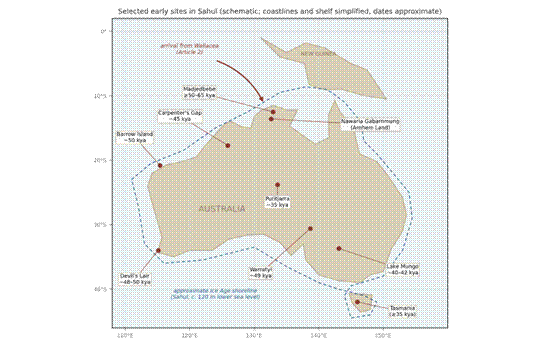
Figure 1. Schematic map of selected early sites in Sahul. The coastline and Ice Age shoreline are simplified and approximate; dates are indicative. Diagram prepared for this article.
The northern beachhead: Madjedbebe
The oldest widely discussed site is Madjedbebe, a sandstone rock shelter on Mirarr Country in Arnhem Land. Excavations there in 2012 and 2015 recovered stone tools, grindstones, ground ochre and fragments of axe heads in deposits that were dated by luminescence to about 65,000 years ago.[1] Plant remains from the lowest layers, including burnt fruits and nuts, suggest a varied diet drawing on the local savanna and woodland.[2] Some specialists dispute the oldest dates, arguing that artefacts may have moved down through the sediment and that a settlement date of about 50,000 years is safer.[3] The debate is about the age of the arrival, not about whether people were there.
Rapid spread around the continent
Within a few thousand years of arrival, the evidence suggests, people were living across the continent. At Barrow Island off the north-west coast, which was then a hill on the mainland, occupation dates to about 50,000 years ago, while at Devil’s Lair in the far south-west a sequence extends back about 48,000–50,000 years.[4] In the dry Flinders Ranges of South Australia the Warratyi rock shelter was in use around 49,000 years ago, and the arid centre of the continent was occupied by 35,000 years ago or earlier.[5] Settlement of the southern coast and the Tasmanian highlands followed, with people in Tasmania by about 35,000 years ago, living in an ice-age landscape of tundra and glaciers that was colder than anywhere else on the continent.
Genetic studies point the same way. Analysis of Aboriginal mitochondrial genomes from across Australia shows deep regional branches, indicating that populations moved quickly around the continent and then stayed within their regions for tens of thousands of years.[6] A large genomic study found that Aboriginal Australians and Papuans separated from one another roughly 25,000–40,000 years ago, after their shared ancestors had separated from the ancestors of other non-African peoples.[7]
Lake Mungo and the Willandra Lakes
The best-known early site in the south-east is Lake Mungo, part of the Willandra Lakes system in New South Wales. There, in the 1960s and 1970s, geologists and archaeologists discovered the remains of “Mungo Lady”, one of the world’s oldest known cremations, and “Mungo Man”, a burial with red ochre. Both have since been dated to about 40,000 years ago or slightly earlier.[8] The lakes were then full of fresh water, with fish, shellfish and waterbirds; fireplaces, middens and stone tools line the old shores. The Mungo remains were returned to the Traditional Owners of the Willandra region, Mungo Lady in 1992 and Mungo Man in 2017, and they are now cared for under Indigenous control.
Surviving the Ice Age
Around 26,000–19,000 years ago, at the height of the last glacial period, Australia became colder, drier and windier. Lakes such as Mungo dried out, and much of the interior became hostile. People retreated to refuges such as rivers, coasts and uplands, and the population is thought to have shrunk and fragmented. As the climate improved, they re-expanded across the continent. Rising seas after this period also drowned much of the northern and southern shelves, separating Tasmania and New Guinea from the mainland and flooding vast areas of coastal land, a loss that Aboriginal oral traditions in many regions remember in stories of drowned country.
Chronological timeline
| Years ago | Event |
| c. 65–50,000 | Arrival of the first people in Sahul; earliest dated occupation at Madjedbebe. |
| c. 50–48,000 | Occupation of Barrow Island, Devil’s Lair (south-west) and the arid Flinders Ranges. |
| c. 46,000 | Approximate time of most extinctions of the giant animals (debated). |
| c. 42–40,000 | Mungo Man and Mungo Lady; people living by the Willandra Lakes. |
| c. 35,000 | People in Tasmania and the arid centre. |
| c. 26–19,000 | Last glacial maximum: arid conditions, population contraction and refuge use. |
| c. 14,000–12,000 | Rising seas separate Tasmania from the mainland. |
| c. 8,000–6,500 | Sea level stabilises; the modern coastline forms. |
4. The People and Cultures Encountered
The first Australians met no other people. They were not, however, alone: they entered a continent with its own web of life, and over the following millennia they developed intimate knowledge of it. Over time, hundreds of distinct societies emerged, each with its own Country, language and law. When Europeans arrived in 1788 there were around 250 Indigenous languages, spoken by a population estimated at between several hundred thousand and over a million.
Their toolkit and way of life changed with the landscapes. People ground seeds and processed tubers on grindstones, shaped stone into tools and edge-ground axes, among the oldest known in the world, and developed complex hunting, fishing and trading networks. Trade routes carried ochre, stone and shell across the continent over very long distances. Art, from engraved designs to painted shelters, is found across Australia, and the oldest dated rock paintings in the Kimberley are about 17,000 years old, with older, undated art very probably still to be discovered.
Knowledge was carried in song, story and ceremony, including “songlines” that map routes, water and relationships across the land. Oral histories also preserve information about environmental change; scholars have argued that stories from coastal communities in many parts of Australia retain memory of the drowning of the continental shelf, over 7,000 years ago.
Genetic evidence shows that the ancestors of Aboriginal Australians and Papuans also carry a small proportion of DNA inherited from the Denisovans, whom they must have met in Asia before they reached Sahul. The Torres Strait Islander peoples, who live on the islands between Australia and New Guinea, have distinct cultures of their own, with strong Melanesian connections.
5. Evidence and Historical Sources
- Excavated sites: rock shelters, caves and lake shores preserve stone tools, ochre, food remains and burials. Dating them is the main challenge: radiocarbon dating is reliable only to about 50,000 years, so older sites such as Madjedbebe depend on luminescence dating, which measures when buried sand grains were last exposed to light.
- Genetics: the genomes of living Aboriginal people, some now analysed with community consent and in partnership with Indigenous communities, record deep population history. Research with ancient remains requires, and increasingly receives, the permission of Traditional Owners.
- Environmental records: pollen, charcoal and sediment cores from lakes show changes in climate and vegetation, including the arrival of more frequent fires.
- Megafauna remains: fossils and eggshell fragments provide evidence about the animals that people met and when they disappeared.
- Indigenous knowledge: oral tradition and cultural practice are sources in their own right, and in collaboration with Indigenous custodians can complement the scientific record.
As with the earlier articles, there are no written sources for this period. The first European records, from the seventeenth and eighteenth centuries, describe societies many thousands of years after the first settlement, and are shaped by the assumptions of their authors.
6. Consequences and Historical Interpretation
- The extinction of the giant animals: most of Australia’s large animals, more than 85 per cent of species over about 44 kilograms, disappeared in the late Pleistocene. A landmark study dated the main extinctions to around 46,000 years ago, soon after human arrival, pointing to human hunting and burning; other researchers argue that climate change was the main driver and that people played little role. A 2016 study concluded that climate change alone could not explain the pattern.[9] The question remains open.
- Fire and landscape: the anthropologist Rhys Jones coined the phrase “fire-stick farming” in 1969 to describe the deliberate burning of the landscape by Aboriginal people. Many researchers accept that sustained cultural burning shaped Australian ecosystems, although the timing and scale of its effects are still debated, and Indigenous land managers continue to use fire today.
- Continuity: genetic, archaeological and cultural evidence together support one of the longest known unbroken human presences in any region. This continuity has major implications for how Australian history is understood and for the standing of Aboriginal and Torres Strait Islander peoples’ knowledge.
- A challenge to old assumptions: nineteenth-century European theories treated Aboriginal people as survivors from an earlier stage of human development. The archaeological record shows the opposite: a creative, adaptable people who thrived in changing environments for many thousands of years.
The date of first settlement has moved back several times over the past century, from a few thousand years to over 40,000, then 50,000, and now possibly 65,000 years. It is likely to be revised again as new sites are explored, including those under the sea.
7. The Journey for Today’s Traveller
| Place | What to see |
| Willandra Lakes Region (Mungo National Park), NSW (UNESCO) | The dry lake, the “Walls of China” dunes and cultural interpretation, with visits led by Aboriginal guides. |
| Kakadu National Park, Northern Territory (UNESCO) | Rock-art sites such as Ubirr and Burrungkuy (Nourlangie), and the Bowali Visitor Centre. Madjedbebe itself is on Mirarr land and is not open to visitors. |
| Uluṟu-Kata Tjuṯa National Park, Northern Territory (UNESCO) | A landscape of deep cultural importance to the Anangu, with cultural centre and ranger-led walks. |
| Naracoorte Caves, South Australia (UNESCO) | Fossil caves with remains of the giant animals the first Australians knew. |
| Riversleigh, Queensland (UNESCO) | One of the world’s richest fossil sites for Australian mammals. |
| Budj Bim Cultural Landscape, Victoria (UNESCO) | The Gunditjmara people’s ancient eel-trap and aquaculture system, among the oldest in the world. |
| National Museum of Australia, Canberra; Australian Museum, Sydney | Collections and exhibitions on Aboriginal and Torres Strait Islander history. |
Many sites are on Aboriginal land and some are sacred. Visitors should seek permission where required, follow local rules, and, where possible, choose tours led by Traditional Owners, so that the knowledge and the benefits stay with the people to whom the places belong.
8. Conclusion, Bibliography and Further Reading
The first people to reach Australia accomplished something remarkable: they crossed the sea to a continent they could not see, and then made it a home across every climate it offered. Their story shows that the human capacity for exploration is very old, and that the spread of our species was not only a matter of walking into new lands but also of voyaging, adapting and staying. The next article in this series turns to the ice-age frontiers of the north, where other people were learning to live in cold, tundra and steppe.
Select bibliography
Allen, J. and O’Connell, J. F. (2020) ‘A different paradigm for the initial colonisation of Sahul’, Archaeology in Oceania, 55, pp. 1–14.
Bowler, J. M. et al. (2003) ‘New ages for human occupation and climatic change at Lake Mungo, Australia’, Nature, 421, pp. 837–840.
Bradshaw, C. J. A. et al. (2019) ‘Minimum founding populations for the first peopling of Sahul’, Nature Ecology & Evolution, 3, pp. 1057–1063.
Clarkson, C. et al. (2017) ‘Human occupation of northern Australia by 65,000 years ago’, Nature, 547, pp. 306–310.
Flood, J. (2006) The Original Australians: Story of the Aboriginal People. Sydney: Allen & Unwin.
Florin, S. A. et al. (2020) ‘The first Australian plant foods at Madjedbebe, 65,000–53,000 years ago’, Nature Communications, 11, article 924.
Griffiths, B. (2018) Deep Time Dreaming: Uncovering Ancient Australia. Melbourne: Black Inc.
Hamm, G. et al. (2016) ‘Cultural innovation and megafauna interaction in the early settlement of arid Australia’, Nature, 539, pp. 280–283.
Malaspinas, A.-S. et al. (2016) ‘A genomic history of Aboriginal Australia’, Nature, 538, pp. 207–214.
Mulvaney, J. and Kamminga, J. (1999) Prehistory of Australia. Sydney: Allen & Unwin.
Nunn, P. D. and Reid, N. J. (2016) ‘Aboriginal memories of inundation of the Australian coast dating from more than 7000 years ago’, Australian Geographer, 47, pp. 11–47.
Roberts, R. G. et al. (2001) ‘New ages for the last Australian megafauna: continent-wide extinction about 46,000 years ago’, Science, 292, pp. 1888–1892.
Saltré, F. et al. (2016) ‘Climate change not to blame for late Quaternary megafauna extinctions in Australia’, Nature Communications, 7, article 10511.
Tobler, R. et al. (2017) ‘Aboriginal mitogenomes reveal 50,000 years of regionalism in Australia’, Nature, 544, pp. 180–184.
Glossary
| Term | Meaning |
| Sahul | The Ice Age continent joining Australia, New Guinea and Tasmania. |
| Country | In Aboriginal English, the land, waters and sky to which a people belong, together with the relationships and responsibilities that go with them. |
| Dreaming | Aboriginal frameworks of law, creation and belonging; the term covers many different traditions. |
| Luminescence dating | A method that measures when buried sediment or stone was last exposed to light or heat; used for sites older than radiocarbon can reach. |
| Megafauna | Very large animals; in Australia, species such as Diprotodon and Genyornis that died out in the late Pleistocene. |
| Songlines | Songs, stories and routes that connect places across Country and carry knowledge and law. |
| Last Glacial Maximum | The coldest and driest phase of the last ice age, c. 26,000–19,000 years ago. |
Note: dates and interpretations in this field are revised frequently. Readers should consult recent literature for the latest findings, and, where possible, the work of Aboriginal and Torres Strait Islander scholars and communities.
[1]Clarkson, C. et al. (2017) ‘Human occupation of northern Australia by 65,000 years ago’, Nature 547: 306–310.
[2]Florin, S. A. et al. (2020) ‘The first Australian plant foods at Madjedbebe, 65,000–53,000 years ago’, Nature Communications 11: 924.
[3]Allen, J. and O’Connell, J. F. (2020) ‘A different paradigm for the initial colonisation of Sahul’, Archaeology in Oceania 55: 1–14.
[4]Veth, P. et al. (2017) Quaternary Science Reviews 168: 19–29; Turney, C. S. M. et al. (2001) Quaternary Research 55: 3–13.
[5]Hamm, G. et al. (2016) ‘Cultural innovation and megafauna interaction in the early settlement of arid Australia’, Nature 539: 280–283.
[6]Tobler, R. et al. (2017) ‘Aboriginal mitogenomes reveal 50,000 years of regionalism in Australia’, Nature 544: 180–184.
[7]Malaspinas, A.-S. et al. (2016) ‘A genomic history of Aboriginal Australia’, Nature 538: 207–214. An earlier study, Rasmussen, M. et al. (2011) Science 334: 94–98, argued for a separate early dispersal; most later work favours a single main dispersal.
[8]Bowler, J. M. et al. (2003) ‘New ages for human occupation and climatic change at Lake Mungo, Australia’, Nature 421: 837–840.
[9]Roberts, R. G. et al. (2001) Science 292: 1888–1892; Saltré, F. et al. (2016) Nature Communications 7: 10511. Interpretation remains contested.
Leave a Reply