
PART III — THE GREAT OPERA HOUSES OF THE WORLD
CHAPTER 11
_____________________________________________________
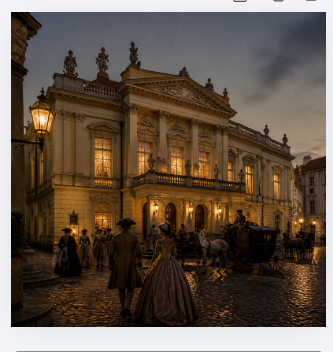
Among Europe’s surviving historic theatres, few possess the extraordinary musical legacy of Prague’s Estates Theatre. Standing in the heart of the Czech capital, this elegant neoclassical playhouse is one of the very few eighteenth-century theatres still in operation and, remarkably, the only surviving theatre in the world where Wolfagang Amadeus Mozart personally conducted the premiere of one of his operas. The building is inseparably linked with the composer, the city of Prague and the first performance of Don Giovanni, one of the masterpieces of Western music. More than two centuries after its opening, the theatre remains a living monument to the cultural life of Central Europe. Its survival through political upheaval, war and changing artistic fashions makes it one of the most important historic theatres in Europe.
The Construction of a Prague Landmark
The Estates Theatre was built during a period when Prague was emerging as one of the leading cultural centres of the Habsburg monarchy. The theatre was commissioned by Count Franz Anton von Nostitz-Rieneck, a wealthy Bohemian nobleman and patron of the arts who wished to provide Prague with a permanent venue worthy of the city’s growing reputation.
Construction began in 1781 and was completed in 1783. Designed in the refined neoclassical style popular throughout Enlightenment Europe, the building reflected contemporary ideals of reason, harmony and civic improvement. Unlike many court theatres that served only aristocratic audiences, the new theatre was conceived as a public institution. Above the stage appeared the motto Patriae et Musis (“To the Fatherland and the Muses”), expressing the belief that theatre and music should contribute to the cultural development of society.
When it opened in 1783 as the Count Nostitz Theatre, the building immediately became one of the finest theatrical venues in the Habsburg lands. Its elegant auditorium, excellent acoustics and central location attracted both local audiences and visiting performers. The theatre soon became an important stop on the artistic circuit linking Vienna, Prague and other major Central European cities.
Prague and Mozart
The story of the Estates Theatre cannot be separated from the story of Mozart himself. Although Vienna was the centre of the German-speaking musical world, Mozart often found that his works received warmer and more enthusiastic receptions in Prague than they did in the Austrian capital.
Prague audiences demonstrated an exceptional appreciation for his music during the 1780s. The extraordinary success of The Marriage of Figaro in Prague particularly impressed the composer. While the opera had enjoyed only moderate success in Vienna, Prague’s audiences embraced it enthusiastically. The city’s musicians and theatre-goers displayed a sophisticated understanding of Mozart’s style, and performances frequently attracted large and appreciative audiences.
Mozart was deeply moved by this reception. According to contemporary accounts, he recognised that Prague understood and valued his music in a way few other cities did. His affection for the city became mutual, establishing one of the most celebrated relationships between a composer and an audience in European cultural history.
When Mozart visited Prague in 1787, he found a city eager to celebrate him. Concerts featuring his works drew enthusiastic crowds, and the composer was welcomed as a musical celebrity. This atmosphere encouraged the commission of a new opera specifically for Prague, a decision that would result in one of the most important premieres in operatic history.
Don Giovanni and Its Historic Premiere
The defining moment in the history of the Estates Theatre occurred on 29 October 1787 with the premiere of Don Giovanni. Written by Mozart with a libretto by Lorenzo da Ponte, the opera drew upon the legend of the libertine Don Juan, combining comedy, drama, romance and supernatural elements in a groundbreaking musical drama.
Mozart himself conducted the first performance from the keyboard. The event was eagerly anticipated throughout Prague. Contemporary reports describe a capacity audience eager to witness the new work by a composer whose reputation in the city had reached extraordinary heights.
The premiere proved a triumph. Audiences responded enthusiastically to the opera’s musical richness, dramatic complexity and innovative orchestration. While Don Giovanni would later achieve worldwide fame, its first listeners experienced a work unlike anything previously heard on the operatic stage.
The association between Don Giovanni and the Estates Theatre remains unique. Modern performances within the same auditorium allow audiences to hear the opera in the very space for which it was created. Few cultural monuments provide such a direct connection to a masterpiece of world music.
The success of Don Giovanni further strengthened Prague’s reputation as one of Europe’s premier musical centres. It demonstrated that important operatic innovations could emerge outside Vienna and highlighted the cultural vitality of Bohemia within the Habsburg Empire.
The Sophisticated Audiences of Prague
The enthusiastic reception given to Mozart was not merely an accident of taste. Prague possessed a highly educated and musically literate public. The city had long-standing traditions of church music, aristocratic patronage and public performance, creating an environment in which complex musical works could flourish.
Bohemian musicians were widely respected throughout Europe, and Prague audiences had access to a rich variety of theatrical and musical experiences. The city’s middle classes, aristocracy and educated professionals regularly attended performances, fostering a vibrant cultural climate.
This sophisticated audience helped establish the Estates Theatre as more than a provincial playhouse. It became an important centre for German-language opera, drama and musical innovation. The success of Mozart’s works reflected the city’s broader commitment to artistic excellence.
During the nineteenth century the theatre continued to host important performances by leading composers and performers. It witnessed the development of Czech cultural nationalism, the growth of Czech-language drama and opera, and the emergence of Prague as one of Europe’s most important artistic capitals.
Survival Through Revolution, Empire and War
The survival of the Estates Theatre is one of the most remarkable aspects of its history. Many eighteenth-century theatres disappeared through fire, demolition or extensive rebuilding. The Estates Theatre, however, has preserved much of its original fabric and appearance.
Throughout the nineteenth century the theatre adapted to changing political and cultural circumstances. Under Habsburg rule it remained an important venue for both German and Czech productions. Following the revolutionary events of 1848 and the rise of Czech national consciousness, it increasingly became associated with the cultural aspirations of the Czech people.
The twentieth century brought even greater challenges. The collapse of the Austro-Hungarian Empire in 1918 transformed Prague into the capital of the newly independent state of Czechoslovakia. The theatre continued operating despite profound political changes.
During the Nazi occupation of the Second World War, cultural institutions across Central Europe faced severe restrictions and ideological control. The theatre endured these difficult years and survived physical destruction that claimed many historic buildings elsewhere on the continent.
After the war, the establishment of Communist rule in Czechoslovakia brought another period of political transformation. Despite ideological pressures, the theatre remained an important part of Prague’s cultural life. Preservation efforts gradually recognised its exceptional historical significance.
Restoration and Modern Recognition
Late twentieth-century restoration projects sought to preserve the building’s original eighteenth-century character while modernising technical facilities necessary for contemporary productions. These efforts allowed the theatre to retain its historic atmosphere without sacrificing modern performance standards.
Today the Estates Theatre forms part of the National Theatre of the Czech Republic and remains an active performance venue. Visitors can still experience the remarkably preserved auditorium whose appearance closely resembles that seen by Mozart and his contemporaries.
The theatre is internationally recognised as one of the most important surviving historic performance spaces in Europe. Musicologists, historians and opera enthusiasts regard it as an irreplaceable link to the musical culture of the Enlightenment.
The Legacy of Mozart’s Prague
The Estates Theatre occupies a unique place in European cultural history. It stands as a rare survivor from the age of Mozart, preserving a direct connection to one of history’s greatest composers. More significantly, it embodies the extraordinary relationship between Mozart and Prague, a city whose audiences recognised his genius during his lifetime and rewarded it with admiration and enthusiasm.
The premiere of Don Giovanni ensured the theatre’s place in musical history, but its importance extends beyond a single event. For more than 240 years it has reflected the changing fortunes of Prague, Bohemia, the Habsburg Empire, Czechoslovakia and the modern Czech Republic. Through revolutions, empires, wars and political transformations, the Estates Theatre has endured.
Today, as audiences continue to gather beneath its elegant neoclassical interior, the theatre remains what its founder intended: a home for the arts and a monument to the enduring power of music and drama. In an age when many historic theatres survive only in paintings and engravings, the Estates Theatre continues to fulfil the role it performed in Mozart’s day, making it one of the most precious cultural treasures of Europe.
Leave a Reply