
TREADING THE BOARDS
Chapter. 7
Napoleon’s Opera House
| Architect | Charles Garnier (1825–1898), aged 35 and unknown when he won the commission |
| Patron | Emperor Napoleon III, as part of Baron Haussmann’s rebuilding of Paris |
| Style | “Napoleon III style” — an eclectic synthesis of Baroque, Palladian classicism, and Renaissance ornament |
| Construction | 1861 (competition) – 1875, spanning 14 years and interrupted by war, siege, and revolution |
| Inaugurated | 5th January 1875, under the Third Republic, four years after Napoleon III’s fall |
| Location | Place de l’Opéra, at the head of the Avenue de l’Opéra, Paris |
On the night of 14th January 1858, Emperor Napoleon III’s carriage drew up outside the Salle Le Peletier, the Paris Opera’s cramped and unglamorous home on the rue Le Peletier. As he approached the entrance, three bombs thrown by the Italian revolutionary Felice Orsini exploded in the street, killing eight bystanders and wounding well over a hundred more. The Emperor and Empress Eugénie were unhurt, but the message was unmistakable: the old opera house, hemmed in by narrow streets, offered no safe approach and no dignified point of arrival for a sovereign. Out of that near-catastrophe grew one of the nineteenth century’s most extravagant works of architecture, a building conceived, from its very foundations, around the problem of how power should enter a room.
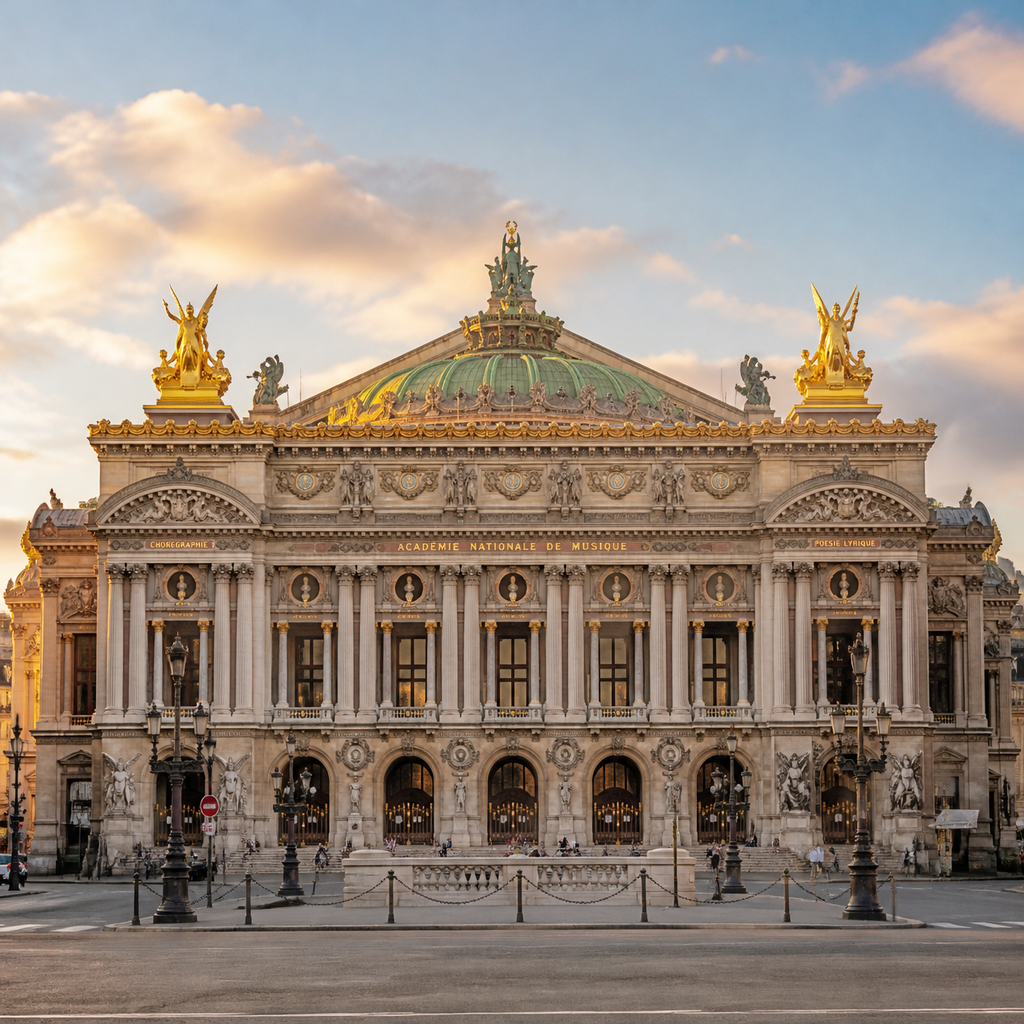
An Emperor Remakes His Capital
The new opera house did not rise in isolation. It was one gesture within a far larger project: Napoleon III’s transformation of Paris under his appointed prefect, Baron Georges-Eugène Haussmann. Through the 1850s and 1860s, Haussmann drove broad, straight boulevards through the medieval fabric of the city, replacing tangled lanes with axes of light, air, and sightline. A new opera house, the Emperor decided, would anchor one of these axes and terminate a grand new thoroughfare built expressly to reach it.
That thoroughfare, the Avenue de l’Opéra, was in fact a personal request from Napoleon III himself, who wanted an unbroken route from his residence at the Tuileries Palace to his new theatre. Unusually for a Parisian boulevard, it was never planted with trees, a choice the eventual architect insisted on, so that nothing would obstruct the view of his building from a distance.
In 1860, the government opened a public competition for the design of this new Académie Impériale de Musique. It drew 171 entries, including submissions from established figures such as Eugène Viollet-le-Duc. The commission’s requirements were exacting: a fireproof, structurally modern theatre; a separate, secure entrance for the Emperor’s own use, addressing the security failures so violently exposed at rue Le Peletier; and a building grand enough to represent the Second Empire to all of Europe.
The Unknown Architect
The winner, announced in 1861, startled Parisian society: Charles Garnier, a thirty-five-year-old architect who had never before built anything on this scale. Trained at the École des Beaux-Arts and a winner of the Prix de Rome, Garnier had spent years studying the classical and Renaissance buildings of Italy and Greece, absorbing a vocabulary of columns, pediments, and sculptural ornament that he would later recombine with startling freedom.
His design borrowed frankly and knowingly from many sources at once, the theatrical drama of the Baroque, the measured classicism associated with Palladio, and the ornamental richness of the Renaissance, fused into something that belonged to none of them exclusively. A well-worn anecdote, repeated in countless histories of the building though impossible to verify with certainty, holds that Empress Eugénie, baffled by the result, asked Garnier what style he had built in. “It is the Napoleon III style, Madame,” he is said to have replied, a quip that also functioned as a manifesto. The eclecticism was not indecision; it was itself the argument.
“It is the Napoleon III style, Madame.”
— Charles Garnier, attributed reply to Empress Eugénie
Garnier conceived architecture as a kind of choreography for the eye and the body alike. A visitor to his opera house was meant to move from compression to release, through a relatively modest entrance, up through rising volumes of space, until the Grand Staircase opened out beneath its coffered dome like a stage set awaiting its cast. The performance, in other words, began well before the curtain rose.
A Palace Built for a Performance
Though designed as a theatre, Garnier’s building took on the scale and ambition of a palace, a resemblance so pronounced that Parisians soon began calling it simply the Palais Garnier, a name that has endured beside its official title, the Opéra de Paris. Bronze, marble, and stone clad the exterior in tiers of columns, arches, and sculpture; the base of the principal façade carries four allegorical sculptural groups representing Poetry, Music, Dance, and Drama, each the work of a different sculptor, while two gilded sculptural groups, each some 7.5 metres tall, crown the roofline.
Inside, the Grand Staircase remains the building’s most celebrated set piece: a sweep of white marble edged in green and red, rising beneath a coffered and painted ceiling, designed expressly as a space for audiences to see and be seen before and between acts. Beyond it lies the Grand Foyer, a gallery of mirrors, gilding, and painted ceilings frequently likened to the Hall of Mirrors at Versailles. The auditorium itself, horseshoe-shaped in the French tradition, seats close to two thousand beneath a vast chandelier and a domed ceiling, repainted in 1964 by Marc Chagall, whose swirling, brightly coloured scenes now sit in deliberate, sanctioned contrast to Garnier’s nineteenth-century decoration.
Construction, which began in 1862, met an unexpected obstacle almost immediately: the site sat on unstable, waterlogged subsoil. Engineers were forced to excavate and construct a vast concrete cistern beneath the stage simply to stabilise the foundations against rising groundwater, a purely functional reservoir that nonetheless fed the later legend, popularised in fiction, of an underground lake beneath the opera house.
Interrupted by History
The building’s fourteen-year construction was repeatedly overtaken by the political convulsions of the era. The Franco-Prussian War of 1870–71 halted work outright: the half-finished shell was pressed into service first as a military storehouse and then, during the Siege of Paris and the Commune that followed, for purposes far removed from opera. The war also ended the regime that had commissioned the building, Napoleon III went into exile in England, and the Third Republic was proclaimed in his place.
For a time it was unclear whether the half-built opera house would ever be finished under a government that owed it nothing politically. The decisive push came from an unrelated disaster: on 28th October 1873, the old Salle Le Peletier, the very theatre outside which Napoleon III had nearly been assassinated fifteen years earlier, burned to the ground. With Paris suddenly without an opera house at all, the new Republican government recalled Garnier and ordered the building completed.
The Palais Garnier was finally inaugurated on 5th January 1875, in a ceremony attended by roughly two thousand guests, including Marshal MacMahon, President of the Republic, King Alfonso XII of Spain, and the lord mayors of London and Amsterdam. The Emperor who had commissioned it never set foot inside; he had died in exile in England the previous year.
The Social Theatre: Abonnés, Ballet, and the Foyer de la Danse
For the Parisian elite of the late nineteenth century, the Palais Garnier was as much a social institution as an artistic one. A subscription, an abonnement, bought a wealthy patron not merely a seat for the season but a recognised place within Parisian high society, conducted in the boxes and foyers as visibly as anything happening on stage. Contemporary accounts describe an auditorium as attentive to its own audience as to the performers: opera glasses turned as often toward other boxes as toward the stage.
Nowhere was this social dimension more concentrated than in the Foyer de la Danse, a lavishly appointed room set behind the stage where dancers of the Paris Opera Ballet warmed up before performances. Garnier incorporated the room following a precedent already established at the old rue Le Peletier theatre, and, like his predecessor, granted privileged access to a select category of subscribers, the abonnés, who alone were permitted behind the scenes.
This arrangement had a darker underside that historians and cultural critics have increasingly foregrounded. Many of the young dancers who trained at the Opera, often called petits rats in reference to their frequently impoverished origins, worked under gruelling conditions for little pay. The Foyer de la Danse, whatever its official purpose, functioned in practice as a meeting ground where wealthy male subscribers could scrutinise, socialise with, and in many documented cases proposition the dancers, an economy of patronage and exploitation that shaped the working lives of the ballet’s youngest and most vulnerable performers.
This world left an unmistakable mark on French art. Edgar Degas, granted access to the Opera’s rehearsal rooms and the Foyer de la Danse itself, returned to the subject of ballet dancers throughout his career, producing hundreds of paintings, pastels, and sculptures, among them the sculpture of the young dancer Marie van Goethem, who is understood to have moved within this same precarious world. Degas’s images are prized today for their formal innovation, but they also stand as some of the most detailed visual records of the social order the Palais Garnier was built to house.
The Foyer de la Danse was, in the words of one nineteenth-century witness, a place where “epic scenes took place backstage.”
— Comte de Maugny, contemporary account
Not every aspect of the building’s social life was so fraught. The Palais Garnier was also a showcase for the era’s technological confidence: it was among the earliest opera houses lit by electricity, replacing gas lighting in 1887, and it hosted some of the first public demonstrations of the phonograph and the théâtrophone, an early system for transmitting live performances by telephone line to subscribers listening at home.
A Legend That Outgrew Its Architect
The Palais Garnier’s mixture of grandeur, subterranean cistern, and backstage intrigue proved irresistible to storytellers. Gaston Leroux drew directly on the building’s underground reservoir and labyrinthine passages for his 1910 novel The Phantom of the Opera, which has since carried the building’s image far beyond Paris through stage and film adaptations. The Palais Garnier itself continued to serve as the Paris Opera’s principal home for both opera and ballet until 1989, when the new Opéra Bastille opened; today Garnier’s building is used chiefly for ballet, alongside tours, and remains one of the most visited monuments in Paris.
The building was formally listed as a Monument Historique by the French state in 1923 and underwent extensive restoration campaigns through the twentieth and twenty-first centuries. More than a century and a half after its difficult, war-interrupted construction, it stands much as Garnier intended: not simply a theatre, but an argument, made in marble and gilt, that the act of arriving and being seen could be as choreographed, and as consequential, as anything performed on its stage.
Sources consulted include the Opéra national de Paris’s official historical materials, the Palais Garnier’s published history, and academic and journalistic accounts of the Foyer de la Danse and its social history, including coverage drawing on the Musée d’Orsay’s holdings.
Leave a Reply