
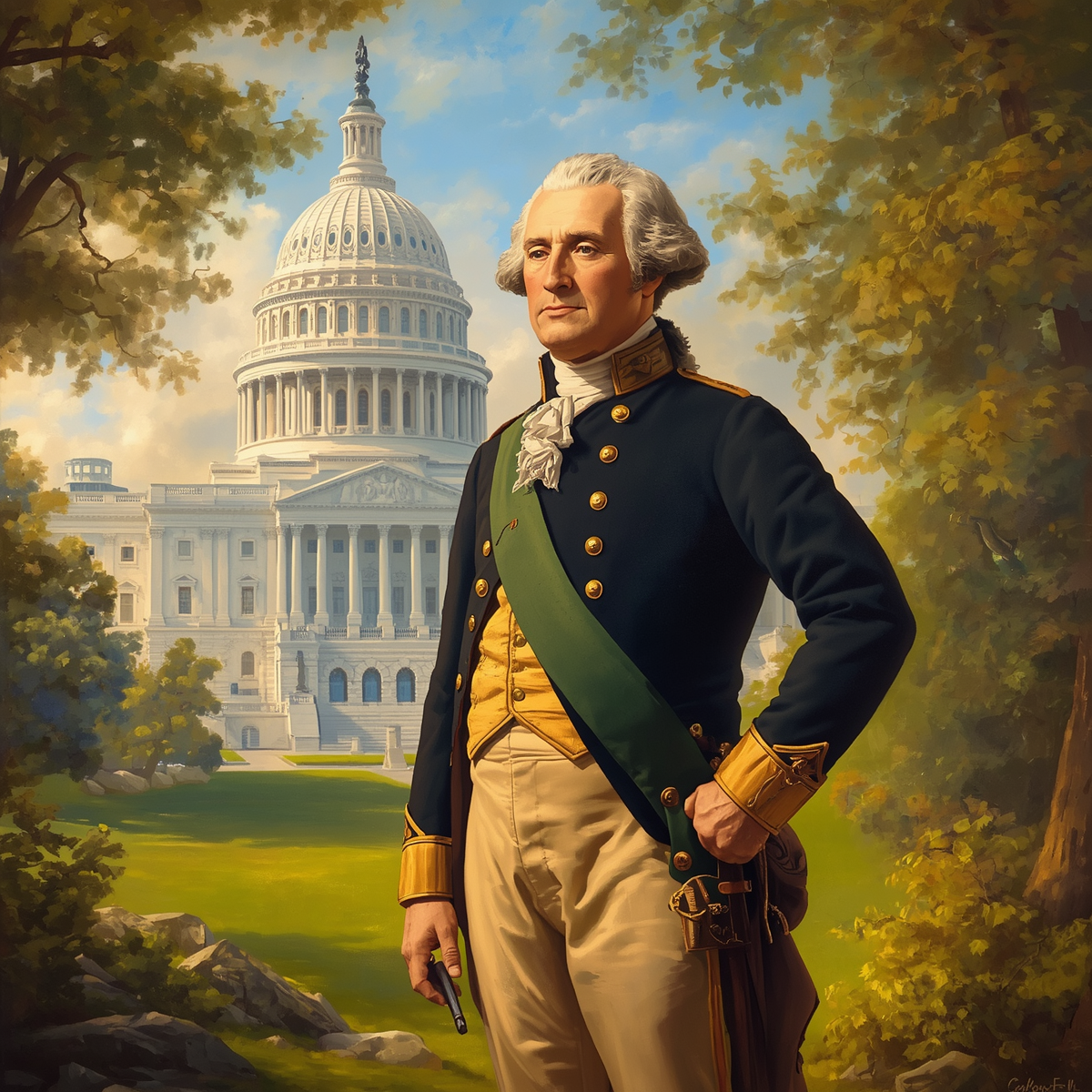
George Washington (1732–1799) stands as one of the most influential figures in American history, a military commander, statesman, and the nation’s first president. His leadership during the Revolutionary War and his role in establishing the foundations of the United States earned him the enduring title “Father of His Country.”
Early Life and Character
Born in colonial Virginia, Washington grew up on a tobacco plantation and developed skills in surveying, leadership, and frontier survival. These early experiences shaped his disciplined, resilient character.
Key aspects of his early life include:
- Work as a surveyor on the Virginia frontier
- Service in the French and Indian War
- Marriage to Martha Custis, a wealthy widow
- Rising prominence as a Virginia planter and legislator
Explore more about Washington’s early years or colonial Virginia society.
Commander of the Continental Army
Washington’s leadership reached national importance when the Continental Congress appointed him Commander‑in‑Chief of the Continental Army in 1775.
His achievements included:
- Holding the army together through hardship
- Leading the daring Crossing of the Delaware
- Securing victory at Yorktown in 1781
Washington’s steady leadership helped turn a fragile rebellion into a successful fight for independence.
Washington and the U.S. Flag
Washington is often linked to the creation of the Stars and Stripes, especially through the popular story of Betsy Ross sewing the first flag. While historians debate the details, Washington undeniably played a role in shaping early American symbols.
His connection includes:
- Supporting the need for a unified national flag
- Working with committees that oversaw military standards
- Inspiring the symbolism of a “new constellation” of states
.
First President of the United States
In 1789, Washington was unanimously elected the first President of the United States, the only president ever chosen unanimously by the Electoral College.
His presidency established many traditions still followed today:
- The two‑term limit (later formalised in the 22nd Amendment)
- The creation of a cabinet
- The practice of a peaceful transfer of power
- A foreign policy of neutrality
Washington refused to become a monarch or dictator, setting a precedent for democratic leadership.
Retirement and Final Years
After two terms, Washington retired to his beloved estate, Mount Vernon, where he managed his farm, corresponded with national leaders, and reflected on the future of the country he helped create.
He died in 1799 and was mourned across the nation as a unifying figure whose leadership had shaped the republic.
Legacy: Why George Washington Still Matters
Washington’s legacy endures because he embodied the ideals the United States aspired to:
- Courage in war
- Integrity in leadership
- Humility in power
- Unity in nation‑building
He remains a symbol of the American experiment, a leader who helped turn revolutionary ideas into a functioning nation.
His influence lives on in:
- The capital city Washington, D.C.
- The Washington Monument
- Countless schools, towns, and institutions bearing his name
- National memory and civic tradition
Leave a Reply