
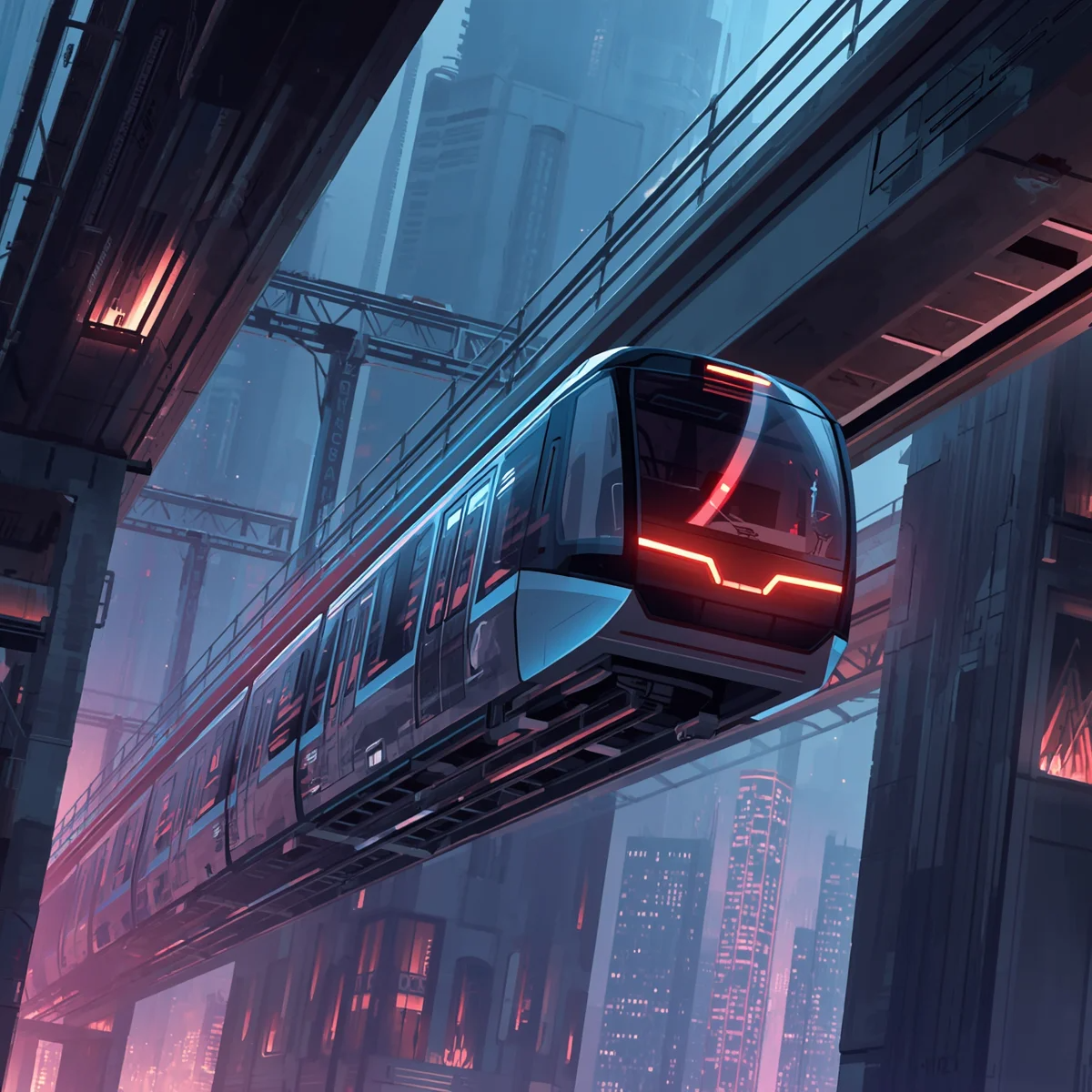
There is something almost defiant about a suspended railway. While the entire history of land transport has been devoted to keeping wheels firmly on the ground, the suspended railway does the opposite, it hoists the track into the air and lets the carriages dangle beneath it, passengers gliding over roads, rivers, and rooftops as if gravity were merely a suggestion. It is one of engineering’s most intriguing detours: a technology that seemed, at various moments in history, on the verge of transforming urban transport, yet never quite conquered the world. Today, only a handful remain in operation, and the oldest of them has been running continuously, above a river in western Germany, for more than 125 years.
What Is a Suspended Railway?
A suspended railway is a form of elevated monorail in which the vehicle hangs beneath a fixed overhead track, rather than sitting atop it. The track is carried on a series of pylons or steel frames, and the passenger carriages are attached from above — their wheels running along the rail above them, while the body of the carriage swings freely below. This is the key distinction from a conventional elevated railway or a standard monorail: in those systems, the train perches on top of the rail; in a suspension railway, it hangs below it.
The physics of the arrangement have an elegant logic. Because the carriage hangs from its centre of gravity, it is naturally self-stabilising. When the train rounds a curve, it tilts inward like a pendulum, counteracting centrifugal force and keeping passengers comfortable even at speed. Derailment, in the conventional sense, is almost impossible, there is nowhere for the carriage to fall to, since gravity holds it against the rail above.
Why Build One? The Advantages of Hanging Trains
The appeal of suspended railways is closely tied to the problems of dense, awkward urban geography. Where streets are congested, where rivers and valleys cut through cities, or where the ground beneath is too complex for tunnelling, a suspended line offers an elegant bypass. The track occupies only the airspace above a street or waterway. It does not need to acquire land at ground level, does not cut communities in two the way a surface railway might, and can snake across rivers and roads without building conventional bridges.
Their footprint is remarkably compact. A suspended railway requires only the narrow strip of pylons anchored along its route, leaving the streets, pavements, and waterways beneath it largely unaffected. This makes them particularly suited to cities that developed before the automobile era, with medieval street plans too narrow or winding for conventional infrastructure. Building costs are also substantially lower than underground railways; some estimates suggest a suspended monorail can cost as little as one-fifth the price of an equivalent subway.
*
There is also a safety advantage rooted in the basic physics of the design. Because the carriage is suspended rather than balanced, it is inherently more stable than a top-mounted monorail. The self-stabilising swing of the carriages means that a mechanical failure is far less likely to cause a catastrophic derailment.
For passengers, there is one further and often underappreciated benefit: the view. Suspended railways offer a form of urban travel quite unlike any other, gliding high above a city’s streets and rooftops, watching the world below in a way that no underground metro or ground-level tram can match.
A Brief History: From Horse Carts to Electric Trains
The concept of hanging a vehicle from a rail predates the railway age itself. In 1821, British engineer Henry Robinson Palmer filed a patent for a horse-drawn single-rail system in which carriages would be slung beneath a wooden beam. He built a small demonstration track at Woolwich Arsenal in London, and the idea attracted interest across Europe. In 1826, Prussian industrialist Friedrich Harkort built his own demonstration of the Palmer system in Elberfeld, in the Wupper Valley of Germany, dreaming of using it to carry coal from the Ruhr mining region to his factories. Practical opposition from rival mill owners killed the plan, but the seed was planted.
Over the following decades, inventors across Europe and America experimented with variations on the idea. An electric version was demonstrated at the Daft Electric Company in New Jersey in 1886. A wooden test track appeared near Saint Paul, Minnesota in 1888. A Russian engineer, Ippolit Romanov, built an electric monorail prototype in Odessa in 1895 and tested a short track in Gatchina in 1900. Each of these demonstrated that the concept worked, but none became a working public railway.
The breakthrough came in Germany, where engineer Eugen Langen, a business partner of Nicolaus Otto, inventor of the internal combustion engine, had been experimenting with a suspended system for moving materials around his Cologne sugar factory. He approached the cities of Berlin, Munich, and Breslau with a proposal for a full urban suspended railway. All three turned him down. But the industrial towns strung along the banks of the River Wupper, Barmen, Elberfeld, and Vohwinkel, were different. Hemmed in by hills, bisected by a river, and dense with factories and workers, they saw exactly what Langen’s system could offer.
Construction began in 1897, and on 1st March 1901, the world’s first electric suspended railway opened to the public.
The Oldest That Still Runs: The Wuppertal Schwebebahn
The Wuppertal Schwebebahn, Schwebe meaning “float” or “hover,” bahn meaning “railway”, is the oldest electric elevated railway with hanging cars in the world, and it is still very much in daily operation. Running for 13.3 kilometres through the city of Wuppertal in western Germany, it follows the course of the River Wupper for most of its route, suspended roughly 12 metres above the water. Where it crosses over streets rather than river, it drops to around 8 metres above the road.*
The railway carries approximately 85,000 passengers on a typical weekday, and around 25 million per year, not a museum piece or a tourist novelty, but a functioning piece of urban mass transit serving the commuters of a mid-sized German city, just as it has done for more than a century.
Its first passengers of note were German Emperor Wilhelm II and his wife Auguste Viktoria, who took a trial ride in October 1900, months before the line opened to the public. The original royal carriage, the Kaiserwagen. has been lovingly restored and can still be hired today for private tours and special events.
The railway survived Allied bombing raids during the Second World War, which caused severe damage in 1943 and again in 1945. Yet by Easter 1946, less than a year after the end of fighting in Europe, the entire route was back in operation. It survived a serious accident in 1999, when a train struck a 100-kilogram iron hook left behind by construction workers and plunged into the Wupper river below, killing five people and injuring 47. It survived a nine-month shutdown in 2018–19 after a power rail collapsed onto the street. Each time, it returned.
The Schwebebahn is, as Wuppertal’s tourism department puts it without much exaggeration: what the Eiffel Tower is to Paris and the Statue of Liberty to New York.
Where Else in the World?
Beyond Wuppertal, suspended railways have been built, and in many cases, eventually abandoned, in a scattered range of locations.
Germany remains the heartland of the technology. The Dresden Suspension Railway, also designed by Eugen Langen and opened in 1901, is a short funicular-style suspended line that still operates today in the Saxon capital. Two further suspended systems were built in Germany in 1975: the H-Bahn at Dortmund University, which connects campus buildings, and a similar system at Düsseldorf Airport, ferrying passengers between terminals.
Japan has embraced the concept more enthusiastically than any other country. The Shonan Monorail, opened in 1970, runs for about 6.6 kilometres between Ōfuna and Enoshima in Kanagawa Prefecture, threading through a hilly landscape that would have been very difficult to serve with a conventional line. It is now twinned with the Wuppertal Schwebebahn. The Chiba Urban Monorail, opened in 1988 and still operating east of Tokyo, is the world’s largest suspension railway, running 15.2 kilometres and serving as a genuine commuter artery. The Ueno Zoo Monorail in Tokyo, a short 0.3-kilometre line similar in design to the Wuppertal system, ran from 1958 until it was closed in 2019, its operators citing the high cost of replacing its ageing fleet.
The United States experimented enthusiastically with the idea, though mostly for novelty rather than transit purposes. Suspended monorails appeared at the LA County Fair in 1962, at the New York World’s Fair in 1964–65, at Busch Gardens parks in California and Florida, and at Dallas Love Field airport from 1970 to 1974. The Memphis Suspension Railway, opened in 1982, was the closest the US came to a genuine suspended transit system, a short two-station line connecting downtown Memphis with Mud Island recreational park. It closed in 2018 after passengers were stranded mid-ride, and has never reopened.
Scotland had a celebrated but short-lived experiment in 1929, when engineer George Bennie built the Bennie Railplane. a propeller-powered suspended vehicle, on a short test track near Glasgow. Bennie imagined it running at 160 km/h between London and Paris. The project went bankrupt without ever building a commercial line.
India attempted a suspended railway in Goa in the early 2000s, with a 1.6-kilometre test track in Margao. A fatal accident in 2004 halted any further development, and the structure was dismantled in 2013.
*
China is now the most active frontier for the technology. The Optics Valley Suspended Monorail in Wuhan was completed in 2023, and other projects are under construction or proposed in cities across the country.
Why Didn’t They Take Over the World?
The reasons suspended railways never became the dominant form of urban transit come down to a handful of* practical limitations that proved decisive when city authorities made investment decisions through the twentieth century.
Switching and branching are extremely difficult. Conventional railway points can be thrown in seconds by a simple mechanism; changing track on a suspended monorail requires moving large sections of heavy elevated structure. This makes networks with multiple routes and junctions enormously complex to build. Suspended railways work well for simple end-to-end routes, but cities generally need networks.
They are also difficult to integrate with existing infrastructure. Most cities already had surface railways, tramways, or (later) subway systems by the time suspension railways emerged as a mature technology. Extending those existing networks was almost always cheaper than building a new suspended system from scratch.
Emergency evacuation presents a further challenge that is rarely an issue for ground-level transit: when a train stops mid-route, passengers are stranded above a road or river with no easy way to descend.
And though their construction costs compare favourably to subways, they are still considerably more expensive than surface-level tramways. removing a key advantage in cities where ground-level options remain viable.
A Technology Whose Moment May Still Come
There is growing interest in suspended railways as cities grow denser and the airspace above streets becomes an increasingly attractive resource. The United Nations has projected that a further 2.5 billion people will move to cities by 2050. In city centres already served by underground and surface rail, urban planners are looking upward.
China is leading a new wave of suspended railway development, with several cities investing in the technology as a cheaper and less disruptive alternative to subways. New proposals have emerged in various countries for gondola-style suspended transit systems designed to thread through dense urban fabric without the massive ground-level disruption of conventional construction.
The Wuppertal Schwebebahn, meanwhile, runs on. Its newest trains, sleek blue carriages introduced from 2016 onwards, glide along the same steel frame, over the same river, that Eugen Langen’s engineers erected more than 125 years ago. Emperor Wilhelm II would still recognise the route, even if he might be startled by the trains. For anyone seeking proof that an idea can be both genuinely good and stubbornly rare, the suspended railway offers a compelling case.
Summary: Suspended Railways Around the World
| System | Location | Opened | Status |
|---|---|---|---|
| Wuppertal Schwebebahn | Wuppertal, Germany | 1901 | Operating |
| Dresden Suspension Railway | Dresden, Germany | 1901 | Operating |
| Shonan Monorail | Kanagawa, Japan | 1970 | Operating |
| H-Bahn (Dortmund) | Dortmund University, Germany | 1975 | Operating |
| H-Bahn (Düsseldorf) | Düsseldorf Airport, Germany | 1975 | Operating |
| Memphis Suspension Railway | Memphis, USA | 1982 | Closed 2018 |
| Chiba Urban Monorail | Chiba, Japan | 1988 | Operating |
| Ueno Zoo Monorail | Tokyo, Japan | 1958 | Closed 2019 |
| Optics Valley Suspended Monorail | Wuhan, China | 2023 | Operating |
| Bennie Railplane | Glasgow, Scotland | 1929 | Dismantled |
| Skybus Metro (test track) | Goa, India | 2004 | Dismantled 2013 |
Leave a Reply