
PALACES FOR THE PEOPLE
Introduction: Underground Cathedrals
Beneath the bustling streets of Moscow lies one of the world’s most extraordinary feats of architecture, a subterranean world of marble halls, soaring vaulted ceilings, glittering chandeliers, heroic mosaics, and sculpted bronze that would not look out of place in a Renaissance palace or a great European cathedral. The Moscow Metro, first opened in 1935, was designed not merely as a transport system but as a profound ideological statement: a declaration that the Soviet Union had arrived as a modern, powerful, and cultured civilisation, and that even the working class deserved to travel in surroundings of breathtaking beauty.
The earliest stations in particular, those built during the Stalinist era of the 1930s, 1940s, and 1950s, are widely regarded as masterpieces of Soviet architecture. They have been called “palaces for the people,” a phrase that captures both their grandeur and their democratic ambition. Each station was conceived as a unique work of art, with its own distinct aesthetic, its own materials, and its own ideological themes. Collectively they form one of the world’s most remarkable open-air, or rather, underground, museums of twentieth-century art and architecture.
Today, those same stations carry over seven million passengers every single day. The grand halls that once served as propaganda showpieces for the Soviet state now serve an entirely practical purpose, yet they remain as visually overwhelming as ever. Tourists from across the world make dedicated pilgrimages to ride the Moscow Metro not to reach a destination, but simply to stand in awe of the stations themselves.
Historical Background: The Dream of the Soviet Metro
The idea of a metro for Moscow was first seriously discussed in the 1920s, as the city’s population rapidly expanded following the Bolshevik Revolution. By the early 1930s, with Joseph Stalin firmly in power and the Soviet Union embarking on its first Five-Year Plans of rapid industrialisation, the project was elevated from a transport necessity into a symbol of ideological ambition. Moscow’s metro would not be a utilitarian tunnel system like the London Underground, which had opened in 1863, nor the functional, if elegant, Paris Métro. It would be something altogether grander.
Stalin personally championed the project, and the organisation responsible for its construction, Metrostroy, was given virtually unlimited resources and a workforce that, at its peak, numbered over 70,000 labourers, many of them young Komsomol (Communist Youth League) volunteers who worked in extraordinarily difficult and dangerous conditions. The tunnels were dug largely by hand, through unstable Moscow clay, often beneath existing buildings and rivers. Workers drilled and blasted around the clock in shifts, and the human cost was significant, though exact casualty figures were never published by Soviet authorities.
The political directive from Stalin’s government was unambiguous: the stations were to be beautiful. Lazar Kaganovich, the Politburo member who oversaw the project, reportedly told the architects: “We are building not just a metro, but a palace.” Architecture in the Soviet Union during the 1930s was shifting away from the austere functionalism of early Soviet Constructivism towards what would become known as Socialist Realism, an approach that demanded art and architecture serve the ideological purposes of the state by being accessible, heroic, optimistic, and monumental. The metro stations became the supreme expression of this doctrine.
The First Generation: 1935 and the Opening of the Metro
The Moscow Metro officially opened on 15th May 1935, with the first line running thirteen stations from Sokolniki in the north-east to Park Kultury in the south-west, with a branch to Smolenskaya. The inaugural stations established the template that would define the entire system for decades: deep underground halls of exceptional architectural quality, each one different, each one telling a story.
Sokolniki Station
Designed by Ivan Taranov and Nadezhda Bykova, Sokolniki was one of the first stations completed and established many of the conventions that would follow. Its platform hall features a relatively restrained design for the era, white marble-clad pillars, a pale vaulted ceiling, and decorative elements including a distinctive red and white floor pattern. It was functional without being austere, and its relatively light palette gave it an airy, welcoming quality quite unlike the darkness of an English Underground station.
Krasnye Vorota (Red Gates) Station
Among the finest of the first-generation stations is Krasnye Vorota, designed by Nikolai Ladovsky, one of the most important figures in early Soviet architectural avant-garde. Ladovsky had been a leading Constructivist, and his station design retains something of that geometric rigour while softening it with rich materials. The platform hall is a single elongated vault of great elegance, its ceiling coffered in a pattern of intersecting arcs, with the whole illuminated by sleek concealed lighting. The combined effect is genuinely monumental, one feels simultaneously in a palace and in a modernist work of art.
Komsomolskaya Station (1935)
The 1935 version of Komsomolskaya, designed by Dmitri Chechulin, was built to serve the three great mainline railway stations above ground, Leningradsky, Yaroslavsky, and Kazansky, and was thus conceived as a particularly grand gateway. Chechulin, who would go on to design some of Moscow’s famous Stalinist skyscrapers, produced a station of considerable drama, with high barrel-vaulted ceilings and bold decorative relief panels celebrating the themes of socialist labour and youthful endeavour.
The Stalinist Zenith: 1938–1954
If the first stations established the vision of what the Moscow Metro could be, it was the stations built in the late 1930s, and especially those constructed in the late 1940s and early 1950s, when Stalin’s power was at its most absolute and when Soviet resources were being poured into monumental architecture, that achieved the most extraordinary results. These stations represent, in the view of many architectural historians, the apex of the entire enterprise.
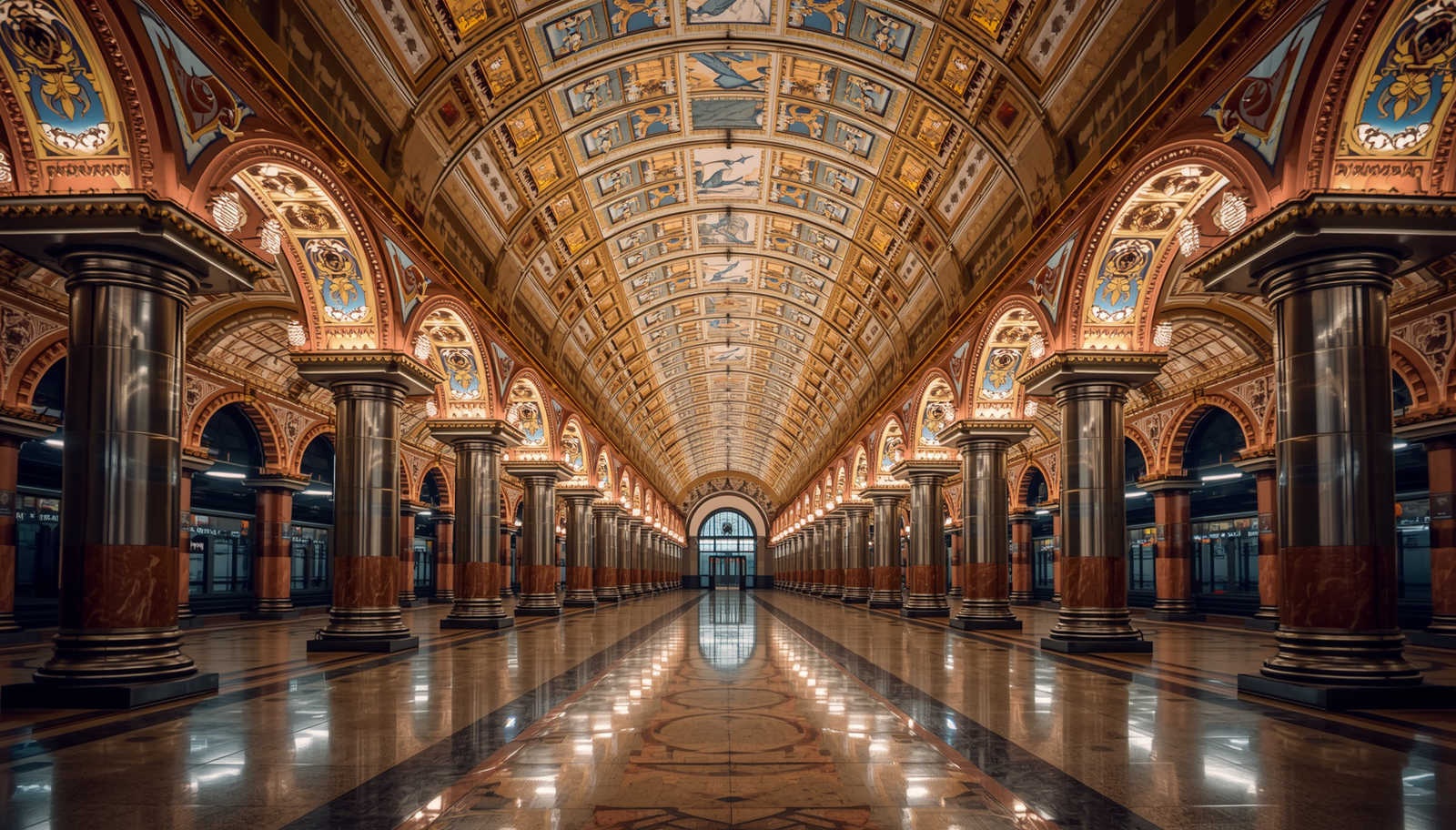
Mayakovskaya Station (1938)
Widely considered the single greatest station in the entire Moscow Metro, and indeed one of the finest works of architecture of the twentieth century, Mayakovskaya was designed by Alexey Dushkin and named after the futurist poet Vladimir Mayakovsky. It won the Grand Prize at the 1939 New York World’s Fair, a remarkable achievement for a Soviet public building, and a signal of the international prestige that the metro’s architects had now attained.
The station is an object lesson in the reconciliation of elegance and grandeur. Its platform hall is defined by a series of slender, arched steel columns clad in stainless steel and rhodonite (a pink-toned mineral), which soar upward to meet the barrel-vaulted ceiling in a series of oval niches. Each of these niches contains a mosaic panel by the artist Alexander Deineka, depicting the theme of “A Day in the Land of the Soviets”, images of Soviet aircraft, parachutists, athletes, workers, and the natural world, rendered in bold, jewel-like colours and viewed from below as if one were looking up at the sky through a series of skylights. The effect, particularly when the mosaics are lit from within, is breathtaking. Dushkin achieved something that few architects have managed: a space that is simultaneously austere and luxuriant, technically innovative and emotionally overwhelming.
Mayakovskaya holds a particular place in Soviet history beyond its architecture. During the terrible autumn of 1941, when German forces were advancing on Moscow and the city faced possible capture, Stalin descended to the station to deliver a famous speech on the occasion of the anniversary of the October Revolution. The station platform served as his makeshift auditorium, the mosaic sky of Deineka above his head, while the real sky above ground was threatened by Nazi bombers. The moment was widely photographed and filmed, and has passed into Soviet legend.
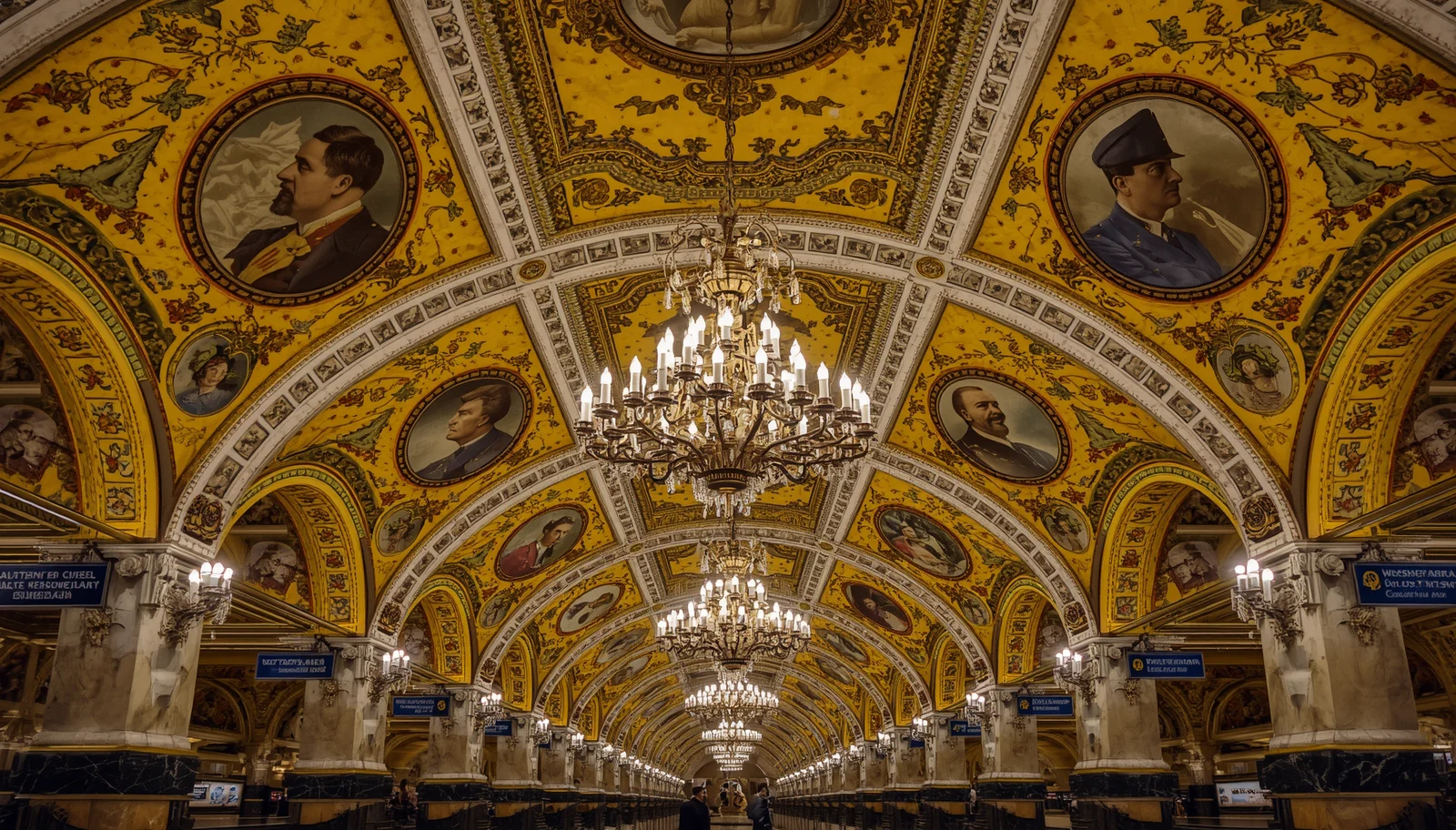
Komsomolskaya Station (1952) — Kazan Ring
The rebuilt and greatly enlarged Komsomolskaya station on the circular Koltsevaya Line, completed in 1952 and designed by Alexey Shchusev (who also designed Lenin’s Mausoleum on Red Square), is perhaps the most overtly palatial of all Moscow’s metro stations. Shchusev died before it was completed, and the project was finished under his successors, but his vision is unmistakable.
The station’s central hall is of cathedral-like proportions: a great barrel-vaulted ceiling of yellow and white, supported by pilasters of Ural marble, and illuminated by an extraordinary series of chandeliers. The ceiling is decorated with eight large mosaic panels by Pavel Korin, depicting scenes of Russian military triumph across the centuries, Alexander Nevsky defeating the Teutonic Knights, Dmitry Donskoy at the Battle of Kulikovo, Alexander Suvorov, Mikhail Kutuzov, and finally the Soviet victory in the Second World War. The iconographic programme is explicitly nationalist rather than purely communist: Stalin, in the years after the war, had increasingly fused Soviet ideology with Russian patriotic mythology, and Komsomolskaya station is perhaps the most complete architectural expression of this fusion.
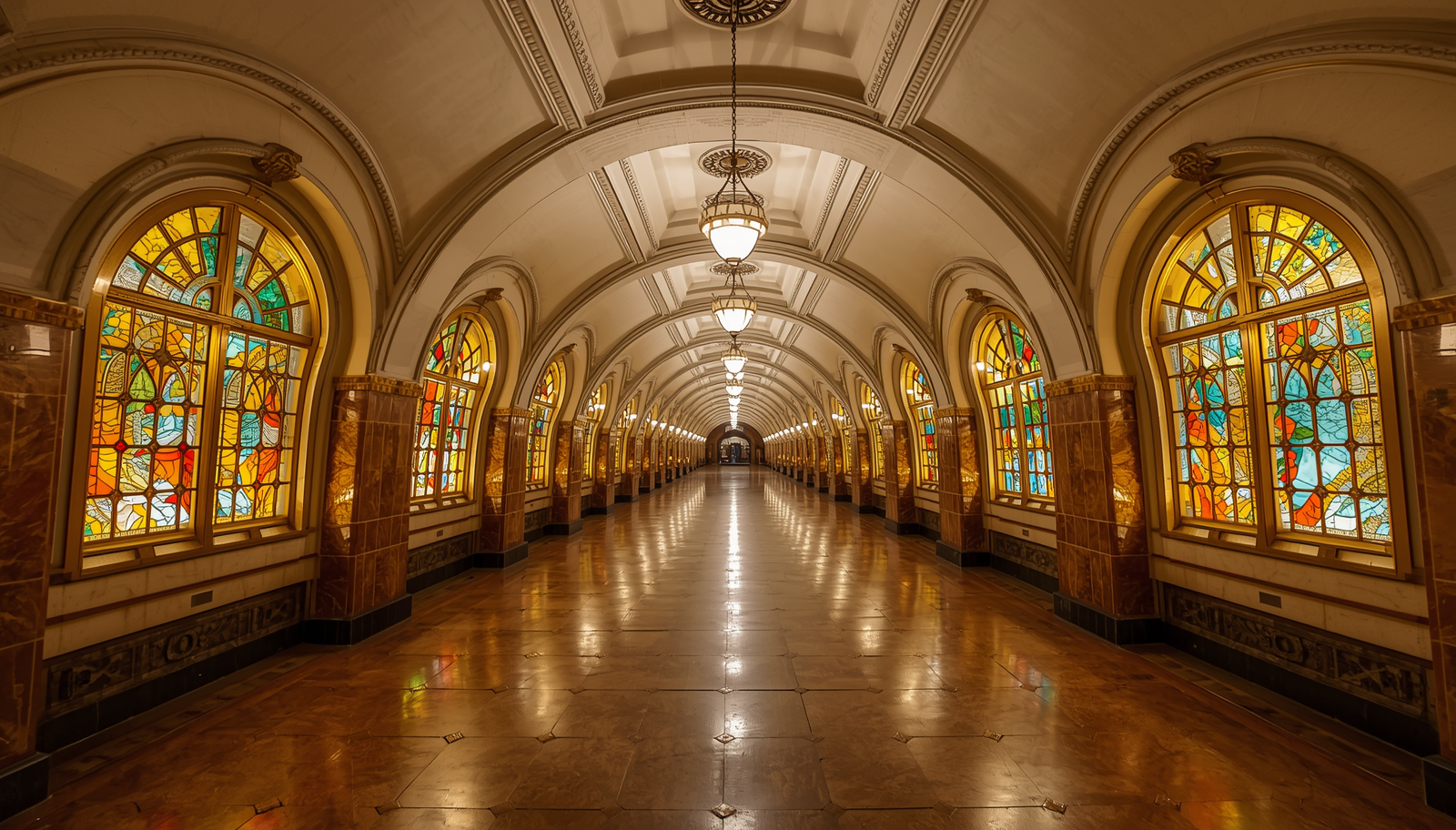
Novoslobodskaya Station (1952)
Also on the Koltsevaya Line, Novoslobodskaya was designed by Alexey Dushkin, the same architect responsible for Mayakovskaya, and represents a completely different but equally extraordinary approach. Here the primary decorative feature is a series of 32 stained-glass panels set into the station’s pillars, each one illuminated from behind and depicting a different theme: flowers, musicians, architects, engineers, athletes, mothers with children. The glass was made by the Riga stained-glass workshop in Latvia, which had a long tradition of ecclesiastical stained glass, and the ecclesiastical associations are hard to escape: the illuminated pillars of a Moscow metro station glowing with sacred-seeming coloured light.
At the end of the platform, above the archway leading to the escalators, hangs a large mosaic by Pavel Korin, the same artist who created the panels at Komsomolskaya, depicting a figure carrying a torch of knowledge. The combination of stained glass and mosaic gives Novoslobodskaya a quality unlike any other station in the system: warm, jewel-like, almost intimate despite its grand scale.
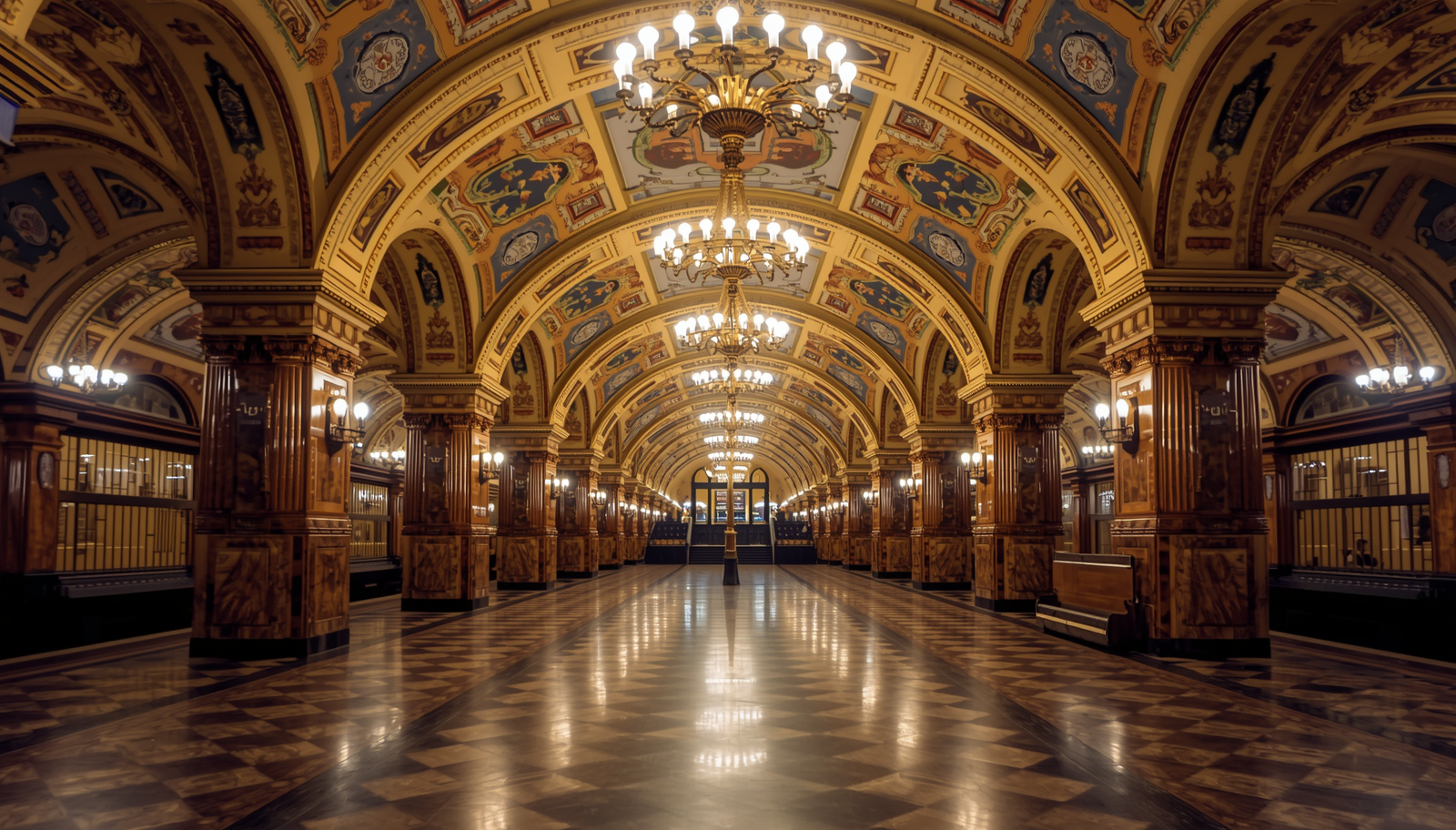
Kievskaya Station (1954)
Kievskaya station on the Koltsevaya Line, designed by Yevgeny Katsnelson, Viktor Skugarev and Georgy Golubev, was completed in 1954 to celebrate the three-hundredth anniversary of the “reunification” of Ukraine with Russia, a politically charged occasion, given the fraught history of Ukrainian-Russian relations. Its mosaic panels, executed in vivid colour by a team of Ukrainian artists, depict scenes from Ukrainian history and Soviet life: the friendship of the Ukrainian and Russian peoples, the revolutionary struggle, industrial and agricultural achievement, and cultural celebration. The panels are surrounded by ornate plasterwork of considerable exuberance, and the overall effect is of the richest kind of Baroque decoration transplanted underground.
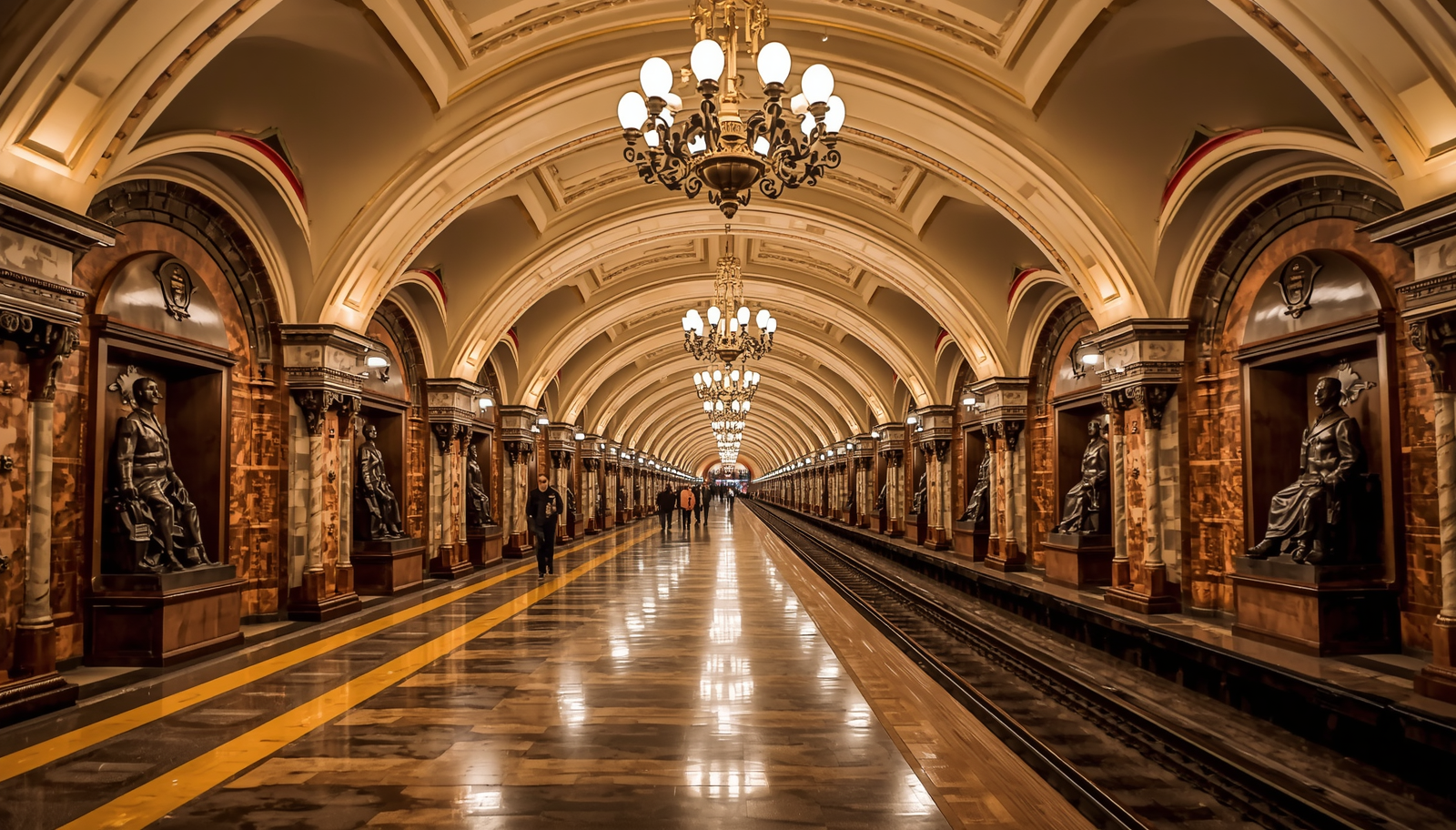
Ploshchad Revolyutsii (Revolution Square) Station (1938)
Designed by Alexey Dushkin, Ploshchad Revolyutsii is instantly recognisable for its extraordinary population of bronze sculptures. The station’s arched niches, 76 of them in total, each contain a cast bronze figure, and together they constitute a complete panorama of Soviet society in the 1930s: a border guard with his dog, a female athlete, a factory worker, a naval officer, a student, a young pioneer, a collective farm worker, a mother with an infant. The figures are shown in a crouching or kneeling posture because of the constraints of the arched niches in which they sit, which gives them an oddly compressed, powerful quality, as if they are about to spring upright.
The sculptures, by the artist Matvei Manizer, were cast from 20 distinct models, each model repeated multiple times across the station. They quickly acquired a folk mythology: the nose of the border guard’s dog is rubbed shiny by millions of commuters who believe touching it brings good luck before an examination or journey. Similarly, the shoe of the student figure and the hand of the sailor have become objects of superstitious veneration. In this unexpected way, Ploshchad Revolyutsii has become a station where the ideological programme has been entirely absorbed and transformed by the everyday lives of the people it was designed to impress.
The Architects: Masters of the Underground
The Moscow Metro produced a generation of architects who worked under conditions of extraordinary constraint, political, technical, and material, and yet created works of genuine artistic ambition. Several names stand out above the rest.
Alexey Dushkin (1904–1977)
The most celebrated of all Moscow Metro architects, Dushkin designed four stations, Kropotkinskaya (1935), Ploshchad Revolyutsii (1938), Mayakovskaya (1938), and Novoslobodskaya (1952), each of which is recognised as a masterpiece. His particular genius lay in his ability to create spaces that felt both technologically modern and emotionally rich, reconciling the structural demands of deep underground construction with an aesthetic vision of remarkable sophistication. Dushkin was trained as an engineer as well as an architect, which gave him an intuitive understanding of how materials and structure could be made to serve beauty. His Mayakovskaya station remains the pinnacle of Soviet metro architecture and one of the great interior spaces of the twentieth century.
Alexey Shchusev (1873–1949)
Already one of Russia’s most distinguished architects before the Revolution, he had designed the Martha and Mary Convent in Moscow and the Kazan Railway Station, Shchusev successfully navigated the transition to Soviet architectural practice and became one of its most prominent figures. His design for the Komsomolskaya Koltsevaya station, completed posthumously, drew on the entire vocabulary of Russian Baroque and Empire style, filtered through a Soviet ideological lens. Lenin’s Mausoleum, his most famous work above ground, and Komsomolskaya station underground, represent two poles of his Soviet-era work: the former austere and geometrically abstract, the latter overwhelmingly ornate.
Nikolai Ladovsky (1881–1941)
A leading figure of Soviet Constructivism in the 1920s and an influential theorist of architecture and urban planning, Ladovsky brought to his metro station designs (principally Krasnye Vorota) a rigorous spatial intelligence rooted in his theoretical work. He was deeply interested in the psychological effects of architectural space on the human body and perception, a concern that is palpable in the drama and tension of his station designs.
Dmitri Chechulin (1901–1981)
Chechulin was one of the most prolific and influential Soviet architects of the Stalinist era. His metro station designs, including Komsomolskaya (1935) and Kievskaya on the Arbatsko-Pokrovskaya Line, established him as a master of monumental interior space. He went on to design some of Moscow’s famous Stalinist skyscrapers and the Kotelnicheskaya Embankment building, one of the “Seven Sisters.” His work for the metro was characterised by bold sculptural decoration and a confident handling of grand scale.
Who Originally Used the Stations?
The Moscow Metro was conceived explicitly as a means of transport for the working classes, and this democratic aspiration was genuinely realised in practice. In the 1930s, when the first stations opened, Moscow was a city of extraordinary social diversity and turbulence: recent arrivals from the countryside, factory workers, party officials, engineers, artists, students, soldiers, and the bureaucratic elite of the Soviet state all used the metro. There were no class distinctions in carriage allocation as there had been on pre-revolutionary Russian railways.
For many Muscovites, particularly those newly arrived from rural areas, the metro stations represented their first encounter with marble, crystal chandeliers, and large-scale works of art. The propaganda value of this was not lost on Soviet authorities. A peasant from Tambov who had never visited a theatre or museum would descend into Komsomolskaya station and find himself surrounded by mosaic panels depicting Russian military glory, illuminated by chandeliers worthy of the Winter Palace. The implicit message was clear: this grandeur belongs to you, to the Soviet working people, not to the aristocracy or the bourgeoisie.
During the Second World War, several of the deepest stations served a dual function as air-raid shelters. When the German Luftwaffe bombed Moscow in 1941, the deep-level stations, Mayakovskaya, Kurskaya, and others, became refuges for thousands of civilians, who slept on the platforms and in the tunnels. Mayakovskaya in particular achieved a kind of legendary wartime status: Stalin’s speech there in November 1941 was broadcast on radio across the Soviet Union, and the image of the Soviet leader speaking beneath Deineka’s mosaics of peacetime Soviet sky while the real sky above was under attack became one of the defining images of the war.
There was, of course, a paradox at the heart of the metro’s democratic ambition. The stations were built in significant part by forced labour, prisoners of the Gulag system who were drafted into Metrostroy construction teams. The same regime that imprisoned millions in the camps was simultaneously creating these extraordinary palaces for the public. This paradox was, needless to say, invisible in Soviet public discourse, and remains a troubling footnote to the undeniable achievement of the architecture.
How the Stations Are Used Today
The Moscow Metro today is one of the busiest rapid transit systems in the world, with a network of over 260 stations serving more than seven million passengers daily. The historic Stalinist stations continue to operate as fully functioning commuter railway stations, carrying the same human traffic they were designed for, even as the city and the political system around them have changed beyond all recognition.
The stations are maintained to a high standard by Moscow Metro, the city-owned operator, and significant investment has been made in recent decades in restoration and preservation. Marble floors are polished, mosaics cleaned, chandeliers re-gilded. Several stations have undergone substantial restoration works to bring them back to their original appearance after decades of heavy use. The political iconography has been largely preserved, although certain explicitly Stalinist elements were removed or altered during the Khrushchev era (the late 1950s) when Stalin’s cult of personality was being dismantled. Images of Stalin himself were removed from several stations, most famously from Kurskaya, where his profile was removed from a mosaic, though his image has since been controversially restored.
Tourism to the metro has grown enormously in recent decades, and Moscow Metro itself actively promotes the historic stations as tourist attractions. Official guided tours are available, and independent travellers increasingly visit the network with the specific intention of exploring the architecture. The stations are free to photograph (a flash is not needed in most of the brightly lit halls), and the combination of extraordinary design and the everyday human bustle of commuter traffic makes them uniquely compelling photographic subjects.
Several of the historic stations have been recognised by UNESCO and by Russian cultural protection authorities as architectural monuments of national significance. This designation imposes legal constraints on what can be altered in the stations, providing an additional layer of protection for their fabric beyond the Metro’s own maintenance regime.
The ideological content of the stations now occupies an ambiguous position. The mosaics celebrating the Soviet victory in the Great Patriotic War (as the Second World War is known in Russia) remain entirely legible and emotionally resonant for modern Russian visitors, for whom the war remains the central event of national identity. The explicitly communist iconography, the hammers and sickles, the portraits of Lenin, the scenes of collectivised agricultural labour, is viewed more variously: as historical artefact, as kitsch, as patriotic symbol, or with varying degrees of irony, depending on the viewer. For foreign tourists, the ideological layer adds an additional dimension of fascination to what is already an overwhelmingly striking visual experience.
Later Stations and the Post-Stalin Era
In 1955, Nikita Khrushchev issued his famous decree condemning “excesses” in Soviet architecture. The palatial approach to metro station design was explicitly criticised as wasteful and self-indulgent. From that point onwards, new stations were built to a far more restrained standard: simpler forms, fewer decorative materials, standardised components. The contrast between stations like Mayakovskaya or Komsomolskaya and those built from the late 1950s onwards could hardly be more stark.
In more recent decades, from the 1990s onwards, there has been a partial return to decorative ambition in new station design, though never quite recapturing the extraordinary intensity of the Stalinist peak. Several post-Soviet stations have been designed with considerable architectural care, and some, such as the stations on the newly opened Big Circle Line, have attracted significant critical attention. But none has matched the sheer overwhelming effect of the great Stalinist palaces, which remain in a category entirely their own.
Conclusion: The Enduring Legacy
Moscow’s palatial metro stations occupy a singular position in the history of world architecture. They are, simultaneously, works of extraordinary artistic ambition, instruments of political propaganda, engineering achievements of the first order, and, most remarkably of all, fully functioning pieces of urban transport infrastructure used by millions of ordinary people every day. No other city on earth has anything quite like them.
The men and women who designed them, Dushkin, Shchusev, Ladovsky, Chechulin, and the many others who contributed, worked within a political system that constrained their creative freedom in some respects while providing it with resources and ambition in others. The result is a body of work that transcends its ideological origins. Whatever one thinks of the system that commissioned these stations, it is impossible to stand in the great hall of Komsomolskaya, or beneath the mosaics of Mayakovskaya, or between the stained-glass pillars of Novoslobodskaya, and not feel oneself in the presence of something genuinely great.
They were built as palaces for the people. Eighty years later, the people are still using them, hurrying through marble halls and past glittering chandeliers on their way to work, their phones in their hands and their minds elsewhere, largely indifferent to the extraordinary beauty around them. Which is, in its own way, the greatest tribute these stations could receive. They have become not monuments to be contemplated from a respectful distance, but the fabric of everyday life.